
Cross Google’s 5,000-email-a-day threshold once, even by accident, and you become a bulk sender. Permanently. Google’s own FAQ is direct about it: bulk sender status “doesn’t have an expiration date.” Cutting your sending volume back down afterward “will not affect” that classification. Most content covering Google & Yahoo bulk sender requirements skips this detail entirely, or buries it a few paragraphs past a generic authentication checklist. It changes something practical. The decision to treat these requirements seriously isn’t one you get to make later, once your list feels big enough to matter. You already made it, the moment you crossed the line, whether that send was deliberate or a one-off spike nobody planned for.
Yahoo complicates the picture in the opposite direction. Search for Yahoo’s own bulk sender threshold and you’ll find plenty of guides confidently repeating Google’s 5,000-a-day figure as though it applies equally to both. It doesn’t. Yahoo’s Sender Hub FAQ states its position plainly: “we will not specify a volume threshold.” Yahoo classifies a bulk sender by “significant volume,” a judgment call it reserves for itself. That’s not a number you can check against your own sending logs.
That gap between what most guides repeat and what Google and Yahoo actually publish is why this one exists. We pulled every requirement in it directly from both providers’ current documentation, not a secondhand summary of a summary. That includes the two specific places their rules genuinely diverge rather than mirror each other. That’s also where the real compliance risk tends to hide.
TL;DR on Google & Yahoo Bulk Sender Requirements
- Google and Yahoo’s bulk sender requirements, in effect since February 2024, apply stricter rules to any domain sending 5,000 or more emails a day, layered on top of baseline requirements every sender already has to meet.
- Google’s own guidelines were renamed from “Bulk sender guidelines” to “Email sender guidelines,” though most third-party coverage still uses the old name.
- Crossing Google’s 5,000-a-day threshold once makes a domain permanently a bulk sender, with no expiration and no way to opt back out by reducing volume later.
- Yahoo has explicitly declined to publish a numeric bulk-sender threshold, applying its requirements to “significant volume” instead of a fixed number.
- Both providers require SPF, DKIM, and a published DMARC record for bulk senders, and Google states that full DMARC alignment on both SPF and DKIM is likely to become mandatory in the future.
- One-click unsubscribe became enforced in June 2024 for both providers, but Google accepts only RFC 8058 List-Unsubscribe headers while Yahoo also accepts a mailto fallback.
- Both providers require the spam complaint rate to stay under 0.3%, targeting under 0.1% at Google specifically, calculated daily, with consequences that scale before that ceiling is actually reached.
- Enforcement escalated from temporary deferrals to permanent rejections in November 2025, and the underlying DMARC standard was formally promoted to Standards Track in May 2026 under RFC 9989.
- Not every compliance failure carries the same weight: authentication and formatting failures can mean outright rejection, while spam-rate and unsubscribe failures typically mean losing eligibility for Google’s own delivery support instead.
- A brand-new sending domain doesn’t get the same gradual ramp-up early adopters received in 2024; Google’s own FAQ states that enforcement on new domains moves on an accelerated timetable.
- MailCleanup’s own verification data shows list quality directly affecting the spam-complaint-rate requirement, the one factor a sender can improve before their very next send.
What Are Google and Yahoo’s Bulk Sender Requirements?
Google & Yahoo bulk sender requirements are a set of technical and behavioral standards. You need to meet them to reliably reach personal inboxes at either provider. Google and Yahoo announced them within roughly the same window in October 2023, and both began enforcement on the same date, February 1, 2024. That timing wasn’t a coincidence. Both providers were responding to the same problem: authentication was optional in practice for most senders, and spoofing and phishing exploited that gap at scale. Neither had a clean, enforceable line for what acceptable sending actually meant.
Worth knowing before anything else: Google doesn’t call these bulk sender requirements anymore, not officially. Its own FAQ names the current guidelines “Email sender guidelines,” adding, in its own words, that they were “previously called ‘Bulk sender guidelines.'” The name most searches and most competing guides still use is the retired one, probably the same name you used to find this guide. That’s not a trivial branding note. It’s the reason terms like Gmail bulk sender guidelines and Google bulk sender guidelines keep surfacing in search years after the rules themselves moved on. The language stuck even after Google’s own terminology changed underneath it.
Who Google and Yahoo’s Bulk Sender Requirements Actually Apply To
Google bulk sender requirements apply specifically to messages you send to personal Gmail and Googlemail addresses, not to Google Workspace inboxes. It doesn’t matter what platform actually sends the message. Send to a personal @gmail.com address from any domain, including one running on Google Workspace itself, and the requirements apply. Send to a Workspace-hosted business domain instead, and they don’t. Yahoo’s scope works the same way: its requirements cover Yahoo Mail, AOL, and Verizon Media consumer addresses, all on the same backend infrastructure. Together, they represent something like 10 to 15 percent of US consumer email volume.
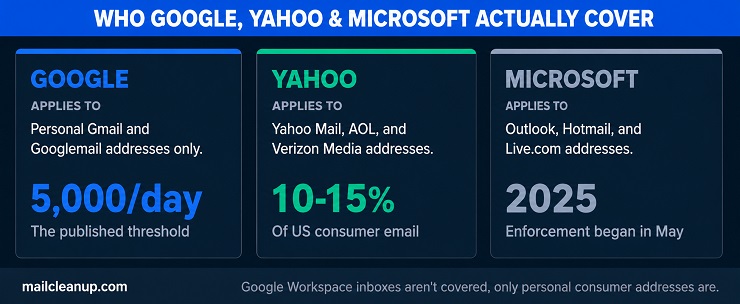
Microsoft later adopted a broadly similar framework for Outlook, Hotmail, and Live.com addresses, effective May 2025. That’s roughly sixteen months after Google and Yahoo’s own rules took effect. This guide stays focused on Google & Yahoo bulk sender requirements specifically. That’s where the two providers’ own published rules actually diverge in ways worth understanding in detail, covered next.
Google states its own reasoning for the rules directly: the goal is to “close loopholes exploited by attackers that threaten everyone who uses email.” Each requirement category earns its place for a different reason:
- Authentication: makes it dramatically harder to send a message that convincingly impersonates a domain you don’t control.
- Spam rate: pushes the cost of unwanted mail back onto whoever sends it, rather than leaving inbox quality entirely up to filters guessing after the fact.
- Unsubscribe: cuts down on how often a recipient’s only real option is clicking “report spam” on your mail, which does far more damage to your sender reputation than an honored opt-out ever would.
All three are pieces of the same six-factor picture behind email deliverability overall, the subject of its own dedicated guide.
The Google-Yahoo Bulk Sender Requirements Grid: Where the Two Providers Align, and Where They Don’t
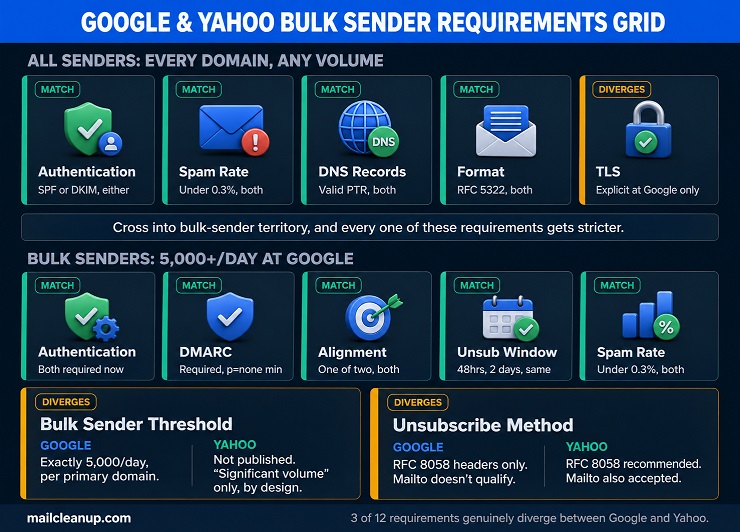
Both Google and Yahoo structure their own bulk sender requirements the same way. There’s a lighter baseline that applies to every sender, and a stricter tier that only kicks in once a domain crosses into bulk-sender territory. Almost no third-party guide preserves that structure, most flatten both tiers into one list. Keeping them separate is what actually makes Google & Yahoo bulk sender requirements usable. It’s the first thing to check against your own setup: which tier actually applies to you.
Requirements for all senders, regardless of your volume:
| Requirement | Yahoo | Aligned? | |
|---|---|---|---|
| Authentication | SPF or DKIM (either one) | SPF or DKIM (either one) | Match |
| Spam complaint rate | Under 0.3% | Under 0.3% | Match |
| DNS records | Valid forward and reverse (PTR) | Valid forward and reverse (PTR) | Match |
| Message format | RFC 5322 | RFC 5321 and RFC 5322 | Match |
| Transport encryption | TLS required | Not listed as its own requirement | Diverges |
Every baseline row lines up except one. Google names TLS explicitly as its own requirement at this tier. Yahoo’s published list doesn’t call out transport encryption as a separate line item at all. That doesn’t necessarily mean Yahoo ignores it in practice, since most mail servers negotiate TLS by default today. It does mean you can point to a published Google rule on TLS. There’s no equivalent published Yahoo rule to check against.
Requirements for bulk senders, once you cross Google’s 5,000-a-day threshold or Yahoo’s unpublished “significant volume” standard:
| Requirement | Yahoo | Aligned? | |
|---|---|---|---|
| Authentication | SPF and DKIM, both required | SPF and DKIM, both required | Match |
| DMARC | Required, minimum policy p=none | Required, minimum policy p=none | Match |
| DMARC alignment | From: header aligned with SPF or DKIM domain | From: header aligned with SPF or DKIM domain | Match |
| One-click unsubscribe method | RFC 8058 List-Unsubscribe headers only | RFC 8058 recommended; mailto also accepted | Diverges |
| Unsubscribe honored within | 48 hours | 2 days | Match |
| Spam complaint rate | Under 0.3%, targeting under 0.1% | Under 0.3% | Match |
| Bulk sender threshold | Exactly 5,000 messages a day, per primary domain | Not published | Diverges |
Two rows in that table deserve their own attention. They’re the two places a sender who’s only checked one provider’s published rules can genuinely still be out of step with the other’s.
Where Bulk Sender Requirements Set Genuinely Different Thresholds
Google bulk sender requirements set a specific, mechanical number: close to 5,000 messages or more to personal Gmail accounts within a 24-hour period. It’s counted against the sending domain as a whole, rather than any single subdomain. Send 2,500 messages from a root domain, then another 2,500 from a promotional subdomain of that root. Google counts both toward one 5,000-message limit, since both trace back to a single primary domain.
Most cold outreach never approaches this volume from a single domain. See our guide to cold email deliverability for where the real ceiling sits for cold senders specifically.
Yahoo won’t give you an equivalent number. Its FAQ addresses the question directly and declines to answer it: a bulk sender is “an email sender sending a significant volume of mail.” Full stop, no threshold attached. That’s a deliberate choice, not a documentation gap. It leaves Yahoo room to treat a smaller sender with a bad complaint pattern as a bulk sender in practice. That holds even if the sender never comes close to Google’s 5,000-message line.
Here’s the practical read for anyone tracking Google & Yahoo bulk sender requirements side by side. Don’t treat Google’s 5,000 figure as a safe proxy for your own Yahoo compliance. A domain sitting comfortably under Google’s threshold can still be evaluated under Yahoo’s stricter bulk-sender rules. That happens the moment its sending pattern looks like commercial volume to Yahoo’s own systems.
Where Bulk Sender Requirements Diverge on Unsubscribe Method
Google & Yahoo bulk sender requirements both mandate a working one-click unsubscribe mechanism for marketing and promotional mail once a sender crosses into bulk territory. Both also set the same effective deadline: honor a request within two days, 48 hours, the same window stated two different ways. Where they split is which technical implementation actually satisfies the requirement.
Google accepts only RFC 8058 List-Unsubscribe headers. Its FAQ rules out the alternative directly: “we’ll continue to support mailto links but they don’t meet our one-click unsubscribe requirement.” A visible body link to an unsubscribe page doesn’t qualify either, no matter how prominent, unless it’s paired with the correct header.
Yahoo is more permissive on this exact point. Its best-practices page calls the RFC 8058 method “highly recommended” while stating plainly that “the mail-to: method is acceptable” as an alternative. A sender who implements only a mailto-based one-click mechanism can be fully compliant with Yahoo’s bulk sender requirements while falling short of Google’s. Same technical setup, same domain, read two different ways by two different providers.
Authentication: One of Google and Yahoo’s Bulk Sender Requirements Most Teams Get Half-Right
The Grid above already shows the headline difference for your own authentication setup. Baseline senders like yours can get by with SPF or DKIM, either one. Bulk senders need both, plus a published DMARC record for your domain set to at least p=none. What the table doesn’t show is where your own setup can still fall short. Even once every listed box in Google & Yahoo bulk sender requirements is checked, gaps like these are easy to miss.
Start with something almost nobody double-checks: DKIM key length. Some coverage claims Yahoo enforces a stricter standard than Google here, rejecting shorter keys Google would still accept. Neither provider’s own documentation backs up that claim, so don’t take it at face value for your own domain.
| DKIM Key Length | Yahoo | |
|---|---|---|
| Minimum | 1024 bits | 1024 bits |
| Recommended | 2048 bits | 2048 bits (“if possible”) |
It’s the same floor either way. Google bulk sender requirements set it no differently than Yahoo’s. Check it directly against your own DKIM record, since a key generated years ago on default settings can easily fall under it.
DMARC alignment works the same way at both providers, for now. A message only needs to pass alignment on one of SPF or DKIM, not both, to satisfy the current requirement. SPF and DKIM are each covered in full in their own dedicated guides. Google’s own FAQ recommends you go further regardless: align DMARC fully to both SPF and DKIM, not just whichever one happens to pass. Our guide to DMARC covers alignment mechanics in depth; here, the relevant point is narrower.
What’s Coming Next for Google Bulk Sender Requirements
Google bulk sender guidelines already hint at where this is headed: this one-of-two alignment standard probably won’t stay the floor much longer. Its FAQ reads: “it’s likely that DMARC alignment with both SPF and DKIM will eventually be a sender requirement.” That’s not a hint buried in a changelog. It’s Google naming the direction of travel directly, in the same document that sets today’s rules for Google & Yahoo bulk sender requirements alike.
If you’ve only aligned one of the two, whichever was easier to set up, there’s no reason to treat that as finished. Getting both aligned now costs nothing extra once SPF and DKIM are already configured. It also closes the gap before Google turns today’s recommendation into tomorrow’s requirement.
There’s a real payoff for pushing your own DMARC enforcement past the bare minimum too, not just alignment. Yahoo will only display a sender’s BIMI logo once DMARC sits at quarantine or reject. The bare p=none that satisfies the bulk sender requirement on its own isn’t enough. A verified brand logo next to a sender’s name in the inbox is a visible payoff a compliance checkbox alone never delivers.
One-Click Unsubscribe and the Bulk Sender Requirements Behind It
The Grid already flagged one clear technical split in Google & Yahoo bulk sender requirements here. Google accepts only RFC 8058 List-Unsubscribe headers, while Yahoo also allows a mailto fallback. What’s still worth covering is what actually triggers the requirement in the first place, and when it started counting against your own compliance.
Where Bulk Sender Requirements Draw the Line on Marketing vs. Transactional Mail
Both providers scope one-click unsubscribe to marketing and promotional mail specifically, not everything a domain sends. Google names three concrete exceptions directly, all exempt from the requirement entirely:
- Password reset messages
- Reservation confirmations
- Form submission confirmations
Yahoo draws a similar line but declines to police it from its own side. In its own words: “We will not make the determination of what mail should and should not contain an unsubscribe link. You should rely on local regulations and your best judgment.”
That leaves a real gray zone for anyone trying to apply Google & Yahoo bulk sender requirements literally. A receipt with a promotional upsell embedded in it, or a shipping notification that also pushes a loyalty program, doesn’t cleanly sort into either category. Both providers effectively push that judgment call back onto you, the sender, rather than publishing a definitive list. When a message genuinely mixes both purposes, treating it as promotional is the safer default. Over-applying the requirement costs nothing. Under-applying it risks the exact spam reports the requirement exists to prevent.
Enforcement itself began the same month at both providers: June 2024. An ordinary body-text unsubscribe link stopped counting as compliant for bulk senders on its own after that. Our dedicated guide to one-click unsubscribe covers the full RFC 8058 header syntax and setup walkthrough for your own domain. The short version: two headers, List-Unsubscribe and List-Unsubscribe-Post, doing the actual technical work behind the button a recipient sees. Those same headers gate the button’s display too, Gmail bulk sender guidelines on one side, Yahoo on the other:
| What Shows the Native Unsubscribe Button | Yahoo | |
|---|---|---|
| Correct List-Unsubscribe header | Required | Required |
| Also requires | A sending history Google trusts | “Sufficient reputation and engagement” |
A technically perfect header on a brand-new, unproven domain of yours may not show the button at all, even though it satisfies the underlying requirement.
Spam Complaint Rate: The Google Bulk Sender Requirements Threshold That Moves Daily
Google & Yahoo bulk sender requirements cap spam complaint rate at the same ceiling: 0.3%. Google publishes a second, tighter number too, its actual target: keep it under 0.1%. Both figures get recalculated daily, not averaged over a week or a month, so a single bad send can move the number fast.
Most coverage treats 0.3% as a cliff: stay under it, you’re fine, cross it, you’re not. Google’s own FAQ describes something more gradual. User-reported spam rate’s impact on delivery is graduated, meaning the damage starts building well before 0.3%, not the instant you touch it. Sitting at 0.25% on your own numbers isn’t the same as being safe just because the ceiling hasn’t technically been crossed yet.
Where Bulk Sender Requirements Turn a Missed Threshold Into Lost Mitigation
Google & Yahoo bulk sender requirements tie a specific date and a specific recovery window to this threshold, both easy to miss in general coverage. Beginning June 2024, any bulk sender with a spam rate above 0.3% became ineligible for Google’s own delivery mitigation support. Those are the tools and interventions Google otherwise offers a sender working through a reputation problem. Losing that eligibility doesn’t mean every message you send gets rejected outright. It means losing help getting back on track while everything else gets harder.
Recovery has its own rule, and it’s stricter than it sounds: seven consecutive days back under 0.3% before mitigation eligibility returns. Not seven days total, seven in a row. One bad day resets your clock, even after six clean ones.
Where Your Own List Quality Sits Inside Bulk Sender Requirements Math
Spam complaint rate isn’t only about content or send cadence in Google & Yahoo bulk sender requirements. It’s substantially about who’s actually on your list before the first message ever goes out. MailCleanup’s own Email Quality & Statistics Report draws from 653,070 verified addresses across numerous separate lists. It gives a concrete sense of how much risk typically sits in a list nobody’s cleaned yet:
| List Composition | Share of 653,070 Addresses |
|---|---|
| Undeliverable | 13.73% |
| Accept-all | 7.48% |
| Unknown | 6.13% |
| Role-based | 1.37% |
| Spam traps | 5 addresses, about 8 per million |
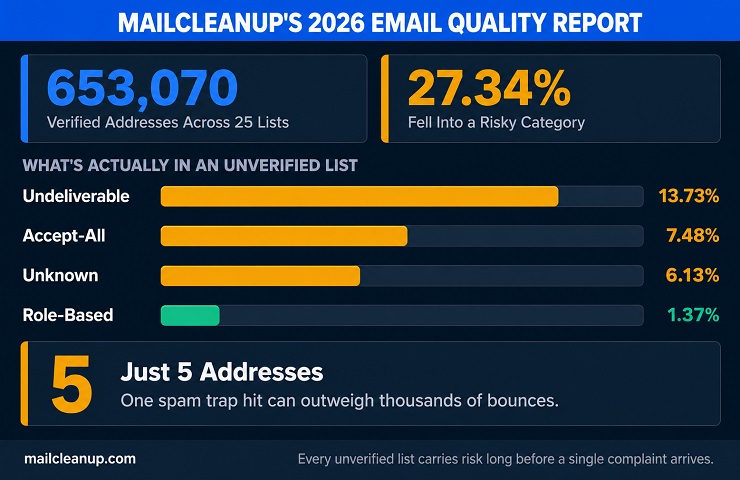
None of these categories is a spam complaint by itself. Undeliverable addresses bounce, they don’t complain, but repeated bounces erode the same sender reputation signals feeding into your own complaint-rate enforcement anyway. Role-based addresses are a more direct risk. Mail landing in a shared inbox nobody personally opted into is exactly the kind of message that gets marked as spam. Whoever happens to open it is the one deciding, not the sender. Spam traps carry the most outsized weight of all. Five addresses out of 653,070 sounds negligible, but a single spam trap hit can damage your reputation more than thousands of ordinary bounces.
Verifying a list before it goes anywhere near bulk-sending volume is the one piece of this requirement you control completely before your next send. That’s different from finding out after a complaint problem already shows up in your own numbers. Once mail is actually going out, seeing exactly which addresses are generating those complaints is a different problem. That’s the one feedback loops exist to solve, covered in a dedicated guide of their own.
DNS, TLS, and the Infrastructure Side of Yahoo Bulk Sender Requirements
The remaining Google & Yahoo bulk sender requirements are the least differentiated part of this whole comparison. Both providers already converge on nearly identical baseline expectations:
| Requirement | Yahoo | Aligned? | |
|---|---|---|---|
| DNS records | Valid forward and reverse (PTR) | Valid forward and reverse (PTR) | Match |
| Transport encryption | TLS, explicit requirement | Not listed as its own requirement | Diverges |
| Message format | RFC 5322 | RFC 5321 and RFC 5322 | Match |
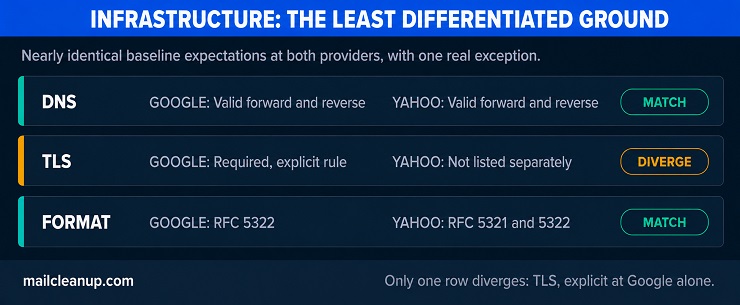
A PTR mismatch doesn’t just fail a bulk sender requirement. It fails the baseline tier too, the one you have to clear regardless of volume. The TLS row repeats a finding from earlier in this guide rather than introducing a new one. Nothing suggests Yahoo tolerates unencrypted transport in practice. It simply isn’t a rule Yahoo has put in writing the way Google has. Get the message format wrong at either provider and delivery fails regardless of how many other requirements are met.
How Bulk Sender Guidelines Enforcement Escalated From 2024 to Now
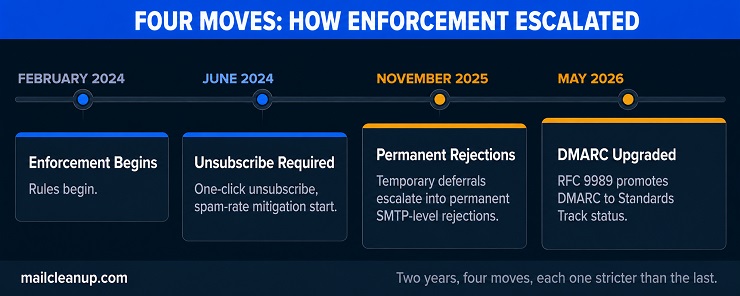
Google & Yahoo bulk sender requirements didn’t arrive as one fixed rulebook. They escalated in four distinct moves over roughly two years, each one tightening what you had to do to stay compliant:
| Date | What Changed |
|---|---|
| February 1, 2024 | Google and Yahoo begin enforcement: authentication, spam rate, and DNS requirements take effect for bulk senders |
| June 1, 2024 | One-click unsubscribe enforcement begins; spam rates above 0.3% start losing mitigation eligibility |
| November 2025 | Google escalates from temporary deferrals to permanent rejections for continued non-compliance |
| May 2026 | The underlying DMARC standard itself changes: RFC 9989 replaces the 2015-era RFC 7489 |
The first two dates already came up earlier in this guide, in the context of what they required of you rather than when. The last two haven’t, and they change the stakes of everything already covered.
November 2025 is where “non-compliant” stopped meaning “monitored” and started meaning “blocked.” Before that point, a sender failing Google & Yahoo bulk sender requirements mostly saw softer consequences: messages routed to spam, delayed, or flagged for review. After it, continued failure on the same requirements starts generating outright rejections at the SMTP level. The next section covers the actual codes you might see.
May 2026 changed something further upstream: the DMARC specification bulk sender requirements lean on so heavily. RFC 9989, together with two companion documents covering reporting, formally replaced RFC 7489, the original 2015 DMARC spec. Together they moved DMARC from Informational status to the IETF’s Standards Track for the first time in its history. That’s a different kind of change than a new enforcement deadline. It’s the protocol underneath the requirement becoming more rigorously defined, not the requirement itself getting stricter.
Our dedicated guide to DMARC covers what RFC 9989 actually changed in full. The relevant point here is simpler. The standard Google and Yahoo both point to for what counts as a valid DMARC policy got a formal upgrade. That happened the same year enforcement got its sharpest teeth yet. It’s worth knowing before you assume your own DMARC setup is already current.
What Happens When You Don’t Meet Google Bulk Sender Guidelines
Not every failure carries the same weight under Google & Yahoo bulk sender requirements, and Google’s own FAQ draws a line most coverage skips past. Some failures block delivery outright. Others just take away Google’s willingness to help you fix the underlying problem.
Authentication, DNS, TLS, and message-format failures fall in the first group. Fail one of these and a message can be temporarily deferred or permanently rejected, depending on how long the problem persists. Spam rate, missing DMARC, and unsubscribe failures fall in the second group. Cross those lines and you don’t necessarily lose every message outright. You lose eligibility for the delivery support Google otherwise offers, the same mitigation-eligibility mechanic covered earlier in this guide.
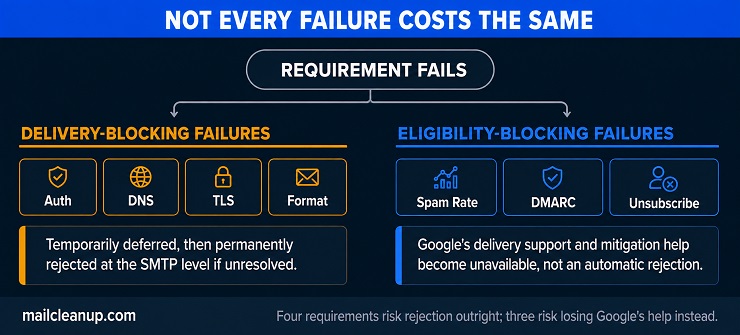
Google publishes exact codes for the first group, more specific than almost any competing coverage bothers to include:
| Code | Meaning | Severity |
|---|---|---|
| 4.7.23 | No or mismatched PTR record | Temporary |
| 4.7.27 | SPF authentication failed | Temporary |
| 4.7.29 | Not sent over TLS | Temporary |
| 4.7.30 | DKIM authentication failed | Temporary |
| 4.7.31 | No DMARC record found | Temporary |
| 4.7.32 | From: header not aligned with SPF or DKIM domain | Temporary |
| 5.7.25 | PTR record issue, unresolved | Permanent |
| 5.7.27 | SPF authentication failed, unresolved | Permanent |
| 5.7.29 | Not sent over TLS, unresolved | Permanent |
| 5.7.30 | DKIM authentication failed, unresolved | Permanent |
The pattern in that table is worth naming directly: every 4.7.x temporary code has a matching 5.7.x permanent version. A deferral is a warning with a deadline for you to fix things, not a separate problem from the rejection that follows it.
Yahoo documents its own failures differently, by named cause rather than granular numbered code. Its error-codes page groups failures under broad categories instead, authentication failures, excessive complaints, RFC compliance failures, among others. All of them sit under just two general code families you’ll actually encounter: 4xx for temporary problems, 5xx for permanent ones. Neither approach is more or less official. They’re just genuinely different documentation philosophies. One is more useful if you’re scripting automated alerts around specific codes. The other is more useful for a human reading through the cause of a specific bounce.
How to Check Your Gmail Bulk Sender Guidelines Compliance
Checking compliance with Google & Yahoo bulk sender requirements starts in different places for each provider. Google’s own answer is Postmaster Tools, specifically the Compliance status dashboard you’ll find there. It checks outgoing mail against the exact requirements covered in this guide, authentication, spam rate, DNS, and one-click unsubscribe among them. Each one gets reported back to you as compliant or needing work.
Multiple independent sources describe this as a binary pass-or-fail view, replacing the reputation gradient Postmaster Tools once showed. Exactly when that shift happened is reported inconsistently across secondary coverage, inconsistently enough that it’s not worth pinning to a specific date here. The substance holds up regardless: check compliance status directly rather than inferring it from delivery patterns alone.
Yahoo’s equivalent starting point is Sender Hub, its own portal for sender performance and reputation data. Where it splits from Google’s approach is in how complaint-level detail actually reaches you. Sender Hub gives the aggregate picture. Seeing which specific addresses are generating complaints requires enrolling in Yahoo’s Complaint Feedback Loop instead, a separate mechanism built specifically for that purpose. Its own dedicated guide is still to come on this site.
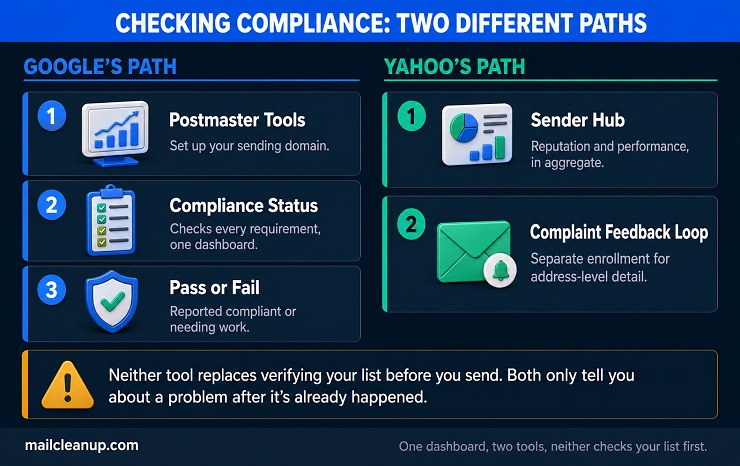
Neither tool replaces verifying a list before you send to it. Both tools tell you about a problem after mail has already gone out and something’s already gone wrong.
Common Mistakes That Break Bulk Sender Requirements Compliance
Most of the failures that show up against Google & Yahoo bulk sender requirements trace back to a handful of repeatable assumptions. They’re not genuinely obscure technical gaps. Four are worth naming directly.
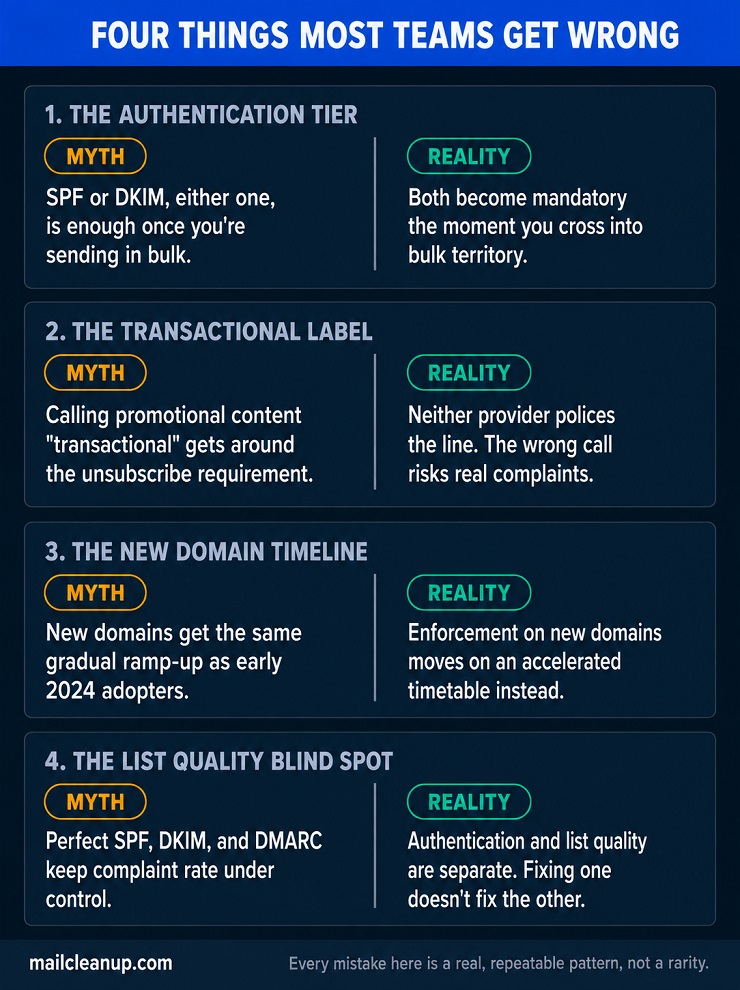
- Treating “SPF or DKIM” as good enough once you’re actually sending in bulk: that’s the baseline-tier rule, the one that applies below 5,000 a day. Cross into bulk territory and both become mandatory, not one or the other. A setup that was fully compliant last month can fail the moment volume crosses the line, with nothing about the authentication itself having changed.
- Relabeling obviously promotional content as “transactional” to sidestep the unsubscribe requirement: neither provider polices this distinction from their own side, and that’s an invitation for you to be honest, not an invitation to find the loophole. A newsletter with a receipt bolted on is still a newsletter. Treating it otherwise is how a compliant sender ends up generating the complaints this whole requirement was built to head off.
- Assuming a brand-new sending domain gets the same gradual ramp-up early adopters got in 2024: it doesn’t. Google’s own FAQ defines a new domain as one that hasn’t crossed 5,000 messages a day since January 1, 2024, and states plainly that enforcement on new domains moves on an accelerated timetable. If you just launched a sending domain last month, don’t expect years of soft warnings first.
- Trusting authentication and content alone while the list itself carries the real risk: perfect SPF, DKIM, and DMARC do nothing to stop a role-based address from generating a complaint, or a spam trap from damaging reputation the moment it’s mailed. The technical requirements and list quality are separate problems, and fixing one doesn’t fix the other.
Where to Go Next With Google and Yahoo’s Bulk Sender Requirements
Where Google & Yahoo bulk sender requirements point you next depends on where you actually stand, not on reading this guide in order.
If you’re not sure whether you’re a bulk sender yet, don’t wait to find out from a rejected send. Verifying your list before it goes anywhere near 5,000 recipients a day is the one piece you control completely before anything else happens. Our list hygiene guide is the place to start. If you know you’re already sending in bulk but haven’t confirmed SPF, DKIM, and a published DMARC record are all in place, start there. That’s the actual floor beneath everything else in this guide.
Our authentication overview walks through all three from the ground up. If authentication is solid but your spam complaint rate keeps creeping toward 0.3%, the fix usually isn’t content. It’s who’s on the list, covered in detail earlier in this guide alongside sender reputation more broadly.
Everyone else already compliant just needs to keep an eye on things as part of the broader email deliverability picture this entire post sits inside. Our email marketing guide covers what happens after a message actually lands in the inbox.
FAQs on Google and Yahoo Bulk Sender Requirements
Quick, standalone answers to the questions Google & Yahoo bulk sender requirements raise most often.
Can crossing Google’s 5,000-email threshold ever be undone?
No. Google’s own FAQ states that bulk sender status “doesn’t have an expiration date,” and that reducing your sending volume afterward does not affect the classification. Once a domain crosses roughly 5,000 messages a day to personal Gmail accounts, Google & Yahoo bulk sender requirements apply to that domain permanently. That holds true no matter how much you cut your sending volume afterward.
Does Yahoo use the same 5,000-email threshold as Google?
No. Google publishes an explicit number: close to 5,000 messages a day to personal Gmail accounts. Yahoo’s own FAQ states directly that it “will not specify a volume threshold,” classifying bulk senders by significant volume instead. A domain safely under Google’s number can still be evaluated as a bulk sender under Yahoo bulk sender requirements. Check your own volume against both, not just one.
Do Google and Yahoo’s bulk sender requirements apply to Microsoft or Outlook too?
No, not directly. Microsoft introduced its own, separate framework for Outlook, Hotmail, and Live.com addresses, effective May 2025, broadly similar in spirit but not identical in its specifics. Google & Yahoo bulk sender requirements and Microsoft’s own rules are documented and enforced independently, so check your own setup against each separately.
Is one-click unsubscribe required on transactional emails?
No. Both Google and Yahoo scope the one-click unsubscribe requirement inside their bulk sender requirements to marketing and promotional messages specifically. Google names password reset messages, reservation confirmations, and form submission confirmations as examples that stay exempt. Genuinely transactional mail you send never needs the List-Unsubscribe header this requirement is built around.
Does a mailto link satisfy Google’s one-click unsubscribe requirement?
No, not at Google. Its FAQ states plainly that mailto links “don’t meet our one-click unsubscribe requirement,” even though Google continues to support them for other purposes. Only a properly configured RFC 8058 List-Unsubscribe header qualifies. Yahoo is more permissive here and does accept a mailto fallback, one of the clearest points where the two providers’ bulk sender requirements genuinely diverge.
Is Yahoo’s DKIM key length requirement actually stricter than Google’s?
No, despite that claim circulating in some coverage. Yahoo’s own best-practices page requires a 1024-bit DKIM key minimum, recommending 2048 bits, language nearly identical to Google’s own stated minimum. Check your own key length against either provider’s minimum; neither publishes a stricter floor than the other under current bulk sender requirements.
How long do I need to stay under 0.3% before Google’s mitigation eligibility returns?
Seven consecutive days. Google’s own guidance ties mitigation eligibility, not outright message rejection, to spam complaint rate specifically under Google bulk sender requirements. Recovery requires seven consecutive days back under the 0.3% ceiling, not seven days total. A single bad day partway through resets that count back to zero, no matter how careful you were up to that point.
Do Google and Yahoo’s bulk sender requirements apply to messages sent to Google Workspace accounts?
No. Google’s FAQ states directly that the Email sender guidelines don’t apply to messages sent to Google Workspace accounts, only to personal Gmail and Googlemail addresses. A domain can send heavy volume to business Workspace inboxes without triggering Google bulk sender requirements, while the same volume to personal accounts would.