

Your sender reputation is under attack from addresses that never belonged to a real person, addresses that belonged to someone years ago and have since been repurposed, and addresses where a single keystroke error sent the email somewhere it was never meant to go.
These are spam traps. They sit in your list without announcing themselves. They never return a helpful error message. They never tell you directly that something is wrong. They accumulate quietly, and the evidence shows up later in your deliverability reports as throttling, blocklisting, and inbox placement that keeps falling without a clear reason.
Most coverage of spam traps explains three types and hands you a generic prevention checklist. This post goes further. Each type of spam trap that reaches your list does so because of a specific failure at a specific stage of your sending programme. Understanding what each type is telling you is how you fix the actual problem, not just respond to its most visible consequence.
By the time you finish reading, you will know which process failure each trap type points to, why verification tools cannot remove spam traps from your list, why your open rates will not warn you that you are hitting them, and how to build a programme that makes spam trap accumulation stop.
TL;DR on Spam Traps
- Spam traps are email addresses operated by mailbox providers, ISPs, and anti-spam organisations to identify senders with poor acquisition and list management practices.
- There are five distinct types of spam traps, and each type signals a different process failure in your sending programme.
- Pristine traps signal an acquisition problem. Recycled traps signal a hygiene or engagement management failure. Typo traps signal a missing validation step at capture. Dead domain traps signal that hard bounces are not being removed. Role address traps signal that the list contains scraped or purchased data.
- Email verification tools cannot detect or remove spam traps. Spam traps are kept secret by design, because a known trap is a useless trap. Any service claiming to remove actual trap addresses is making a claim it cannot support.
- Open rates will not warn you that you are hitting spam traps. Apple Mail Privacy Protection inflates open data, causing senders to believe dormant lists are engaged while recycled trap risk accumulates in the background.
- The correct response to a spam trap problem is not to search for the specific addresses. It is to fix the programme process that allowed them to accumulate.
- A sender running double opt-in, consistent hard bounce removal, and engagement-based suppression will keep spam trap exposure at levels low enough to avoid material damage to sender reputation.
- Email list verification does not identify spam traps specifically, but it removes invalid, expired, and undeliverable addresses that reduce your overall risk exposure.
What Are Spam Traps and Who Sets Them Up
Spam traps are email addresses that exist solely to monitor sending behaviour. They have valid MX records. They accept incoming mail. They report that mail back to the operator running the trap. No real person reads, opens, or acts on anything that arrives. The address functions purely as a detection instrument.
What are spam traps in practical terms?
They are an enforcement mechanism used by the organisations responsible for maintaining email deliverability standards. The main operators are mailbox providers such as Gmail, Outlook, and Yahoo; internet service providers; and dedicated anti-spam organisations including Spamhaus, Abusix, and Spamcop. Each operates spam traps for its own purposes, but the shared objective is to identify senders whose list acquisition or management practices suggest they are reaching recipients without genuine permission. If your email sender reputation has been dropping for reasons that are not obvious from your bounce and complaint data, spam trap hits are one of the likely contributors.
When a sender hits a spam trap, the operator monitoring that address registers the event. What happens next depends on the type of trap, the volume of hits, and the operator’s enforcement policies. Some move fast. A single pristine trap hit can trigger a blocklist listing within hours. Others observe patterns over time and act only after persistent signal behaviour. But the principle is consistent. Hitting a spam trap is not a technical delivery error. It is an evidence event, and the operator treats it accordingly.
One distinction is critical before going further: spam traps catch senders, not spammy content. Your subject line, email design, and copy are irrelevant. A properly authenticated, well-crafted campaign sent to an address that happens to be a spam trap still registers as a hit. This is a list quality problem, not a content problem. No authentication improvement or copy rewrite will prevent a spam trap hit if the address exists in your list and you are sending to it.
The Full Taxonomy of Spam Trap Types
Most posts describe three types of spam traps. The full picture is more complete than that. There are five distinct categories, each created for a different purpose, each operated by different actors, and each signalling something different about the sender who hits it. Understanding all five is the foundation for diagnosing which process in your programme needs to change.
Pristine Traps
Pristine spam traps are the most severe category. These are email addresses that have never belonged to a real person. They were created by an anti-spam organisation or mailbox provider specifically to catch senders who add addresses to lists without genuine consent. Because these addresses were never used for any real communication, they have no prior relationship with any legitimate sender. The only way a pristine spam trap enters a sending list is through acquisition practices that bypass real user intent: list purchases, web scraping, or data collection methods that did not confirm explicit permission.
What are spam traps of this type capable of triggering?
Because they have never been valid for personal use and have no conceivable path onto a permission-based list, the operator’s interpretation when one is hit is unambiguous: the sender acquired this address through a method that bypassed consent. There is no benign explanation, and the consequences reflect that. A pristine trap hit can result in an immediate listing on a major blocklist such as Spamhaus, which affects inbox placement across every ISP and provider that queries those blocklists. This is also the trap type most likely to flag your domain, not just your IP, depending on the operator’s response. You can read more about the blocklisting consequences and how to address them in the email blacklist check and removal guide.
These addresses are also called honeypots or seeded traps. Operators deliberately scatter them in locations where scrapers and list aggregators will encounter them, including within website source code, online directories, and forums. They look completely legitimate. No syntax checker, domain validator, or SMTP-level verification will flag a pristine trap, because from a technical standpoint it is a valid address that accepts mail. The trap reveals itself only when it receives your campaign. By then, the damage to email sender reputation is already in progress.
Recycled Traps
Recycled spam traps were once real email addresses belonging to real people. The original owner abandoned the address. The provider kept it dormant, during which time it returned hard bounce responses to anyone still sending to it. After a period typically lasting 12 months or more, the provider repurposed the address as an active trap rather than retiring it permanently.
The 12-month bounce window is a detail most coverage of what are spam traps omits, but it is operationally significant. During the dormancy period, any sender emailing that address receives a hard bounce. A sender who processes and removes hard bounces consistently will encounter the address during this window, suppress it, and never reach it again once it goes live as a trap. A sender who is not removing hard bounces is still mailing the dormant address when it quietly stops bouncing and starts reporting. The trap activates precisely because the sender failed to act on the bounce signal they were already receiving.
Recycled traps signal a hygiene or engagement management failure rather than an acquisition problem. In many cases, the sender originally collected the address legitimately. The problem is that the contact was never removed when they stopped engaging or when the address stopped accepting mail.
This makes recycled traps a persistent risk for senders with large inherited lists, long-running programmes, or no active sunset policy. A single recycled trap hit is unlikely to trigger an immediate blocklist listing. But sustained hitting of recycled traps signals to mailbox providers that the sender is not maintaining their list, and this erodes sender reputation progressively over time.
Typo Domain Traps
Typo spam traps are addresses at domains that resemble major providers but contain misspellings. Common examples include gmai.com, gmil.com, hotmil.com, yaho.com, and comcasr.net. Anti-spam organisations register these misspelled domains and monitor who sends to them.
These traps enter lists through a straightforward mechanism. A subscriber types their email address incorrectly at a signup form and submits. Without a double opt-in confirmation step or real-time syntax validation, that misspelled address enters the list as though it were valid. The subscriber who intended to sign up receives nothing. Your list picks up a spam trap email address instead.
What is a spam trap of this type telling you specifically?
It indicates a gap in your capture process: real-time address validation, a double opt-in confirmation step, or both are missing. Anti-spam operators generally treat typo trap hits with more leniency than pristine or recycled hits because the origin is a user error rather than a consent failure. That said, high volumes of typo trap hits signal a systematic validation gap that needs to be addressed at the form level, not just treated as one-off noise.
Dead Domain Traps
Dead domain traps are a category most posts skip entirely. These are email addresses at domains that were once legitimate, operated by real businesses or services, and whose domain registration later lapsed. When a domain expires, anti-spam organisations or trap operators can purchase it, configure it to accept incoming mail, and monitor who sends to those addresses.
Every address that ever existed at that domain, including contacts who legitimately opted into your list years ago, now routes to the trap operator. If those contacts remain in your list and you are still sending to them, you will hit the trap. The addresses looked valid when they were collected. The failure is not in how they were acquired but in the fact that they were never removed when the domain became undeliverable.
What are spam traps of the dead domain type signalling?
They indicate that hard bounces at the domain level are not being processed and removed. Like recycled traps, these hits reflect a hygiene failure. The addresses would have returned hard bounces during the period when the domain was down or unresolvable before being silently reactivated. A sender processing hard bounces consistently would have caught the signal and suppressed the entire domain segment before the trap went live.
Role and Registration Address Traps
Role addresses are email addresses tied to a function rather than a named individual. Common examples include postmaster@, abuse@, admin@, info@, sales@, support@, and contact@. Spamhaus specifically identifies these as a spam trap category, and the reason is straightforward: these addresses appear openly on company websites and are routinely harvested by scrapers and included in purchased contact lists, despite the fact that no individual behind these addresses ever opted into a marketing programme.
The risk with role and registration addresses goes beyond their low engagement potential. The person monitoring abuse@ or postmaster@ at a given domain is often a deliverability administrator or anti-spam professional with direct connections to blocklist organisations. Mailing them without permission is not a neutral deliverability event. It is sending unsolicited mail to someone who makes blocking decisions for a living.
What are spam traps of this type revealing about a sender’s programme?
They indicate that the list includes data acquired by scraping company websites, importing corporate directories, or purchasing contact files that contain functional addresses rather than personal opted-in contacts. A permission-based list built through a proper confirmation process will not contain role addresses, because a functional inbox at abuse@ or info@ does not complete individual opt-in confirmation flows. Finding these addresses in your list is a clear marker of a list quality problem that extends beyond a single bad address, and it warrants a full audit of your data acquisition sources. If any of these addresses appear alongside what is a disposable email address type patterns in your list, the likely explanation is a purchased or scraped data source affecting multiple segments simultaneously.
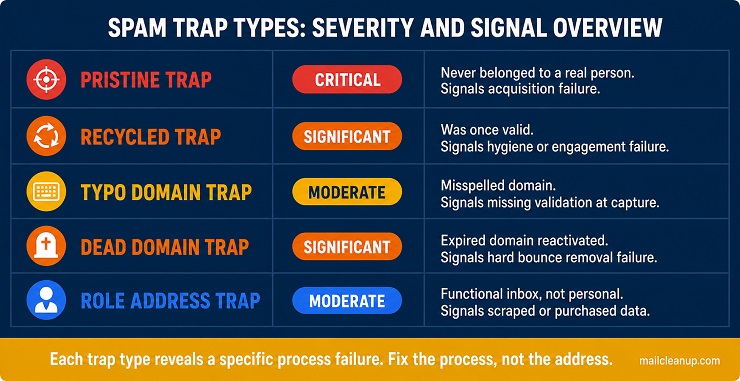
What Each Spam Trap Type Reveals About Your Programme
The most important conceptual shift in understanding what are spam traps is this: spam traps are not the problem. They are the evidence of the problem. Each type of trap reaches a sender’s list because of a specific failure at a specific point in the sending programme. Knowing which type you are hitting tells you exactly which process needs to change.
This is the Spam Trap Signal Matrix.
| Trap Type | Severity | What It Signals | The Process to Fix |
|---|---|---|---|
| Pristine | Critical | Acquisition failure: addresses added without consent | Audit all data sources immediately. Remove purchased and scraped data. Implement double opt-in. |
| Recycled | Significant | Hygiene or engagement failure: contacts never removed | Implement hard bounce removal. Build a sunset policy. Suppress unengaged contacts by engagement tier. |
| Typo domain | Moderate | Validation gap at point of capture | Add real-time syntax validation. Implement double opt-in confirmation. Add CAPTCHA to all forms. |
| Dead domain | Significant | Hard bounce removal failure: domain-level bounces not actioned | Process and suppress hard bounces within 30 to 90 days consistently across all send campaigns. |
| Role/registration | Moderate to Significant | Scraped or purchased data present in the list | Audit all data acquisition sources. Block role address formats at point of import or list cleaning. |
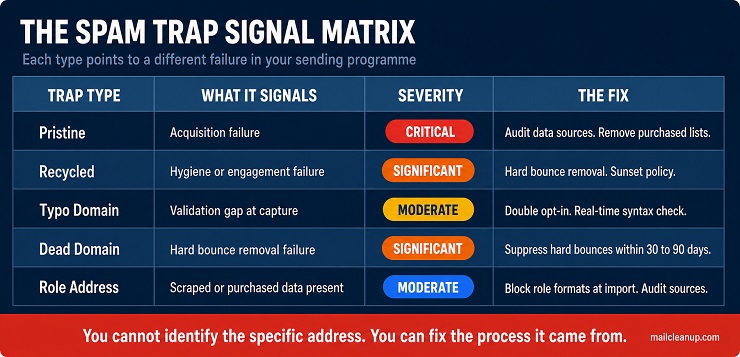
The practical value of this framework is that you do not need to identify which specific addresses in your list are spam traps. You cannot, and the next section will explain why in full. What you can do is diagnose which trap category your programme is most exposed to, based on your acquisition history and current hygiene practices, and fix the process failure that corresponds to it.
A sender who built their list primarily through purchased data and never implemented double opt-in should treat every pristine and recycled trap hit as evidence of an acquisition failure and address that at the source. A sender whose list is largely permission-based but has no engagement suppression in place should focus on the recycled and dead domain trap risk and build the hygiene cadence that removes stale contacts before they convert to signals against you. The spam trap is not telling you which address to delete. It is telling you which part of your programme is broken. Fix that, and the spam trap list problem resolves itself as a consequence.
For the broader email list hygiene programme that keeps these failure patterns from recurring, the hygiene discipline and the spam trap prevention work are the same thing. A list that is properly maintained does not accumulate traps, because the conditions that allow traps to persist are the same conditions that make a list unhealthy in every other measurable way.
Why Email Verification Cannot Remove Spam Traps from Your List
One of the most persistent misunderstandings in email deliverability is what spam trap removal actually means and whether it is something a verification or an email list cleaning tool can deliver. The claim appears frequently across the industry. Run your list through a verification service and spam traps will be identified and removed. It sounds like exactly the solution the problem calls for. The technical reality is different, and understanding it matters because acting on a false belief here will not protect your programme.
What are spam traps, structurally, that makes them undetectable to external tools?
They are kept secret by design. The organisations operating them, whether mailbox providers, ISPs, or blocklist operators such as Spamhaus, never disclose which addresses function as traps. This secrecy is not incidental. It is the mechanism by which the traps work. If a trap address were publicly known or technically identifiable through an external query, any sender could filter it out of their list without fixing the underlying problem that caused the trap to appear in the first place.
The trap would become useless as an enforcement instrument the moment it became discoverable. So the operators maintain strict confidentiality, and no third-party tool has access to the list of addresses they are monitoring.
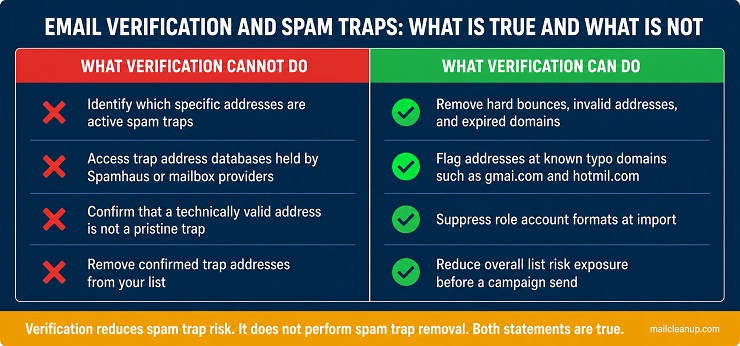
What this means in practice is that when an email verification service claims to detect and remove spam traps from your list, they are not accessing the actual trap address databases maintained by Spamhaus, Gmail, or any other operator. What these services can do, and this is genuinely valuable, is identify addresses that share characteristics with spam trap risk.
They can flag addresses at known typo domains, remove hard bounces and invalid addresses, suppress role accounts, and identify domains with no valid MX records. These actions reduce your overall exposure by removing the categories of address most likely to include trap risk. But they cannot confirm that a specific address is an active trap, because that information is not available to them.
The important distinction is this: email verification reduces spam trap risk. It does not perform spam trap removal in the literal sense of identifying and deleting confirmed trap addresses. The risk reduction is real and worth doing. The claim that specific traps are being identified is not accurate.
For a clear explanation of what the verification process actually checks and what it does not, the email verification vs email validation guide covers the full scope of both processes and where each one’s capability ends. Also there’s also a guide for email verification features explained in detail.
The practical implication for your programme is this – do not use verification as a substitute for fixing the underlying problem the trap type has identified. If you have hit pristine traps, verification alone will not solve it because pristine traps look identical to valid addresses in every technical check. If you have hit recycled traps, verification will catch some of the risk by removing hard bounces and long-dormant addresses, but the engagement management process that keeps dormant contacts from accumulating in the first place is the actual fix. Verification is one layer of the programme. It is not the whole programme, and treating it as the answer to a spam trap problem will leave the root cause unresolved.
Why Your Open Rate Will Not Warn You That You Are Hitting Spam Traps
This section addresses a different angle from the engagement signal problem covered in the email list scrubbing guide. That post focuses on why open rates are unreliable signals for deciding when to scrub unengaged subscribers. This section is specifically about spam traps: why senders whose open rate metrics look healthy can still be hitting traps, and why the metric they are trusting to signal list health is the wrong one for this purpose.
The mechanism here starts with Apple Mail Privacy Protection. When a subscriber opens an email using Apple Mail on iOS 15 or later, macOS Monterey or later, or the equivalent iPadOS version, Apple’s proxy server pre-fetches the email content, including the tracking pixel, before the recipient interacts with the message at all. The open is registered on your ESP’s dashboard. The subscriber may not have looked at the email. The open event is real as a data point. It reflects nothing about actual human engagement with your content.
For senders with audiences heavily weighted toward Apple Mail users, this creates a systematic problem. Contacts who have been entirely dormant for months or years will appear as active openers in your engagement data. Your open rate looks healthy. Your active subscriber count looks healthy. Your re-engagement thresholds are never triggered because the pixel keeps firing on autopilot. Meanwhile, those same contacts may have abandoned their addresses entirely, and some proportion of those abandoned addresses will over time be converted to recycled spam traps by the providers who own them.
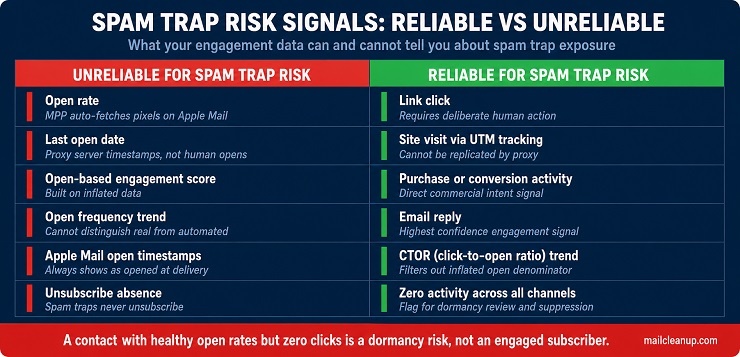
The key operational risk: what are spam traps doing to a sender in this situation? They are accumulating invisibly, in segments that look engaged by the primary metric the sender is using to monitor list health. The sender sees no warning signal in their open data, no obvious spike in bounces, and no immediate complaint rate change. The trap hits register silently with the operator. The first visible evidence is often a degradation in inbox placement or, in more serious cases, a blocklisting event that seems to arrive without warning.
The correct signal to use when monitoring for spam trap risk is not opens. It is clicks, site visits, purchase activity, and direct replies. These are signals that require a human to take a deliberate action and that proxy servers cannot replicate automatically. A contact who has not clicked a link, visited your site, or completed any conversion action in the past six to twelve months should be treated as dormant regardless of what your open rate data suggests. That is the population where recycled trap risk concentrates, and it is the population that engagement-based suppression and sunset policies are designed to address.
How Spam Traps Get onto Your List
Understanding what are spam traps as a category is useful. Understanding the specific routes by which they enter your list is what makes prevention practical. The entry points are not random. Each one corresponds directly to a decision made at some stage of your acquisition or management process.
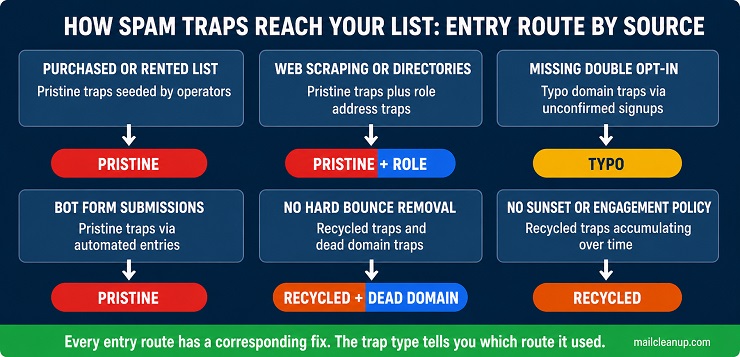
- Purchased and rented lists are the highest-risk source for pristine spam traps. Anti-spam organisations deliberately place pristine traps in locations where list brokers and data aggregators will collect them. A list purchased from a third party has been through hands that the trap operators anticipated. There is no verification layer that makes a purchased list safe from pristine trap exposure, because the traps were placed there specifically for senders who use this acquisition method.
- Web scraping and directory harvesting carry the same risk for pristine traps and add the role address trap risk on top. Scraped data from company websites and online directories will routinely contain postmaster@, abuse@, and info@ addresses that are monitored by deliverability professionals. If your B2B prospecting has ever involved importing contact files built from web scraping, those lists should be treated as high-risk regardless of how they were subsequently cleaned.
- Missing double opt-in opens the door to typo domain traps. When a subscriber completes a single-step signup form and the address they entered is never confirmed through a follow-up link click, misspelled addresses enter your list without validation. The subscriber who made the typo receives nothing. The trap at the misspelled domain receives your campaigns from that point forward.
- Bot and automated form submissions create pristine trap exposure for senders whose signup forms are not protected. Automated scripts submit addresses to forms at high volume, including addresses that happen to be pristine traps. Without CAPTCHA or other bot-blocking mechanisms in combination with double opt-in, those addresses enter the list as though they were legitimate signups.
- No hard bounce removal is the primary route for both recycled and dead domain traps. As described earlier, recycled traps return hard bounces during their dormancy window before going live as active traps. Dead domain addresses produce hard bounces when the domain becomes unresolvable. Both signals are visible to any sender monitoring their bounce data. The traps become active only after a period during which the sender was already receiving the warning. Failing to act on hard bounces within 30 to 90 days is the process failure that converts a manageable hygiene gap into active trap exposure.
- No engagement-based suppression is what keeps recycled traps alive in lists long-term. A contact who last engaged with your programme three years ago and has since abandoned their address may become a recycled trap while still appearing in your active send segment. Without a structured suppression policy tied to actual engagement signals (clicks, conversions, site visits) rather than opens, these contacts are never removed and the trap risk compounds over time. The how to clean email lists guide covers the execution steps for a single cleaning run that addresses this category of stale contact.
- Forcing email entry for gated content access is a less obvious but consistent source of pristine traps. When a signup form requires an email address to unlock a download, a webinar registration, or a discount code, the friction creates an incentive to enter a throwaway or fictitious address. Some of those fictitious addresses will be pristine traps. The fix is double opt-in: if the submitted address does not complete the confirmation step, the contact remains unconfirmed and does not enter the active send list.
- Importing corporate contact directories and CRM data without consent verification brings role addresses and potentially pristine traps into your list. A CRM file exported from a sales team and imported into a marketing platform has not been built through a permission process. Those contacts did not opt in to marketing email. The addresses will include role accounts, and the entire segment is a permission problem that spans beyond spam trap risk into broader deliverability and compliance concerns.
How to Build a Programme That Stops Accumulating Spam Traps
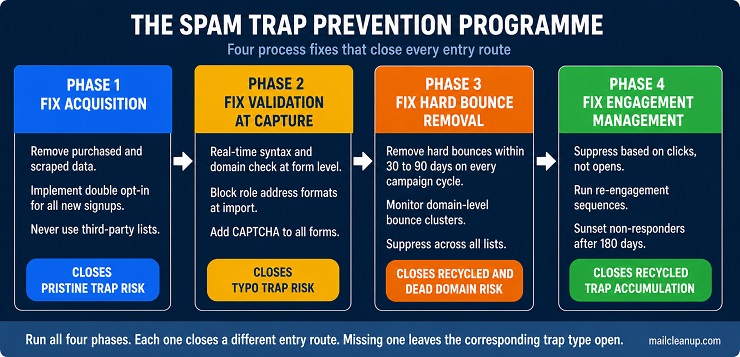
The Spam Trap Signal Matrix that we have discussed earlier, maps each trap type to a specific process failure. The prevention programme maps each of those failures to a specific fix. What are spam traps ultimately revealing? That four systems in your sending programme need to be in place and maintained consistently. Fix these four, and spam trap accumulation stops as a natural consequence.
Fix Acquisition First
Pristine trap exposure and role address exposure both originate at acquisition. The acquisition practices that allow these traps to reach your list are also the practices that produce the lowest-quality contacts in every other metric: high bounce rates, low engagement, high complaint rates. Cleaning up acquisition fixes multiple problems simultaneously.
Never use purchased, rented, or scraped lists. There is no version of this that becomes safe after a verification pass. The traps placed in these lists look identical to valid addresses in every technical check and only reveal themselves after a send. If your current list includes segments sourced from third parties, the correct treatment is to audit those segments against your engagement history. Contacts with no positive engagement signals across their entire history with your programme should be suppressed regardless of how they were acquired.
Implement double opt-in for all new acquisition. A subscriber who completes the confirmation step has proven that their email address is real, that they have access to it, and that they intended to sign up. None of those three things can be established without it. Double opt-in eliminates typo trap exposure, eliminates most pristine trap risk from form submissions, and creates a permission record that protects you in the event of a deliverability dispute.
Add CAPTCHA to all signup forms. Bot submissions are a growing route for both pristine traps and what is a disposable email address type fake signups. CAPTCHA reduces automated submissions without affecting the experience for real users, particularly when combined with the invisible versions that only trigger on suspicious behaviour patterns.
Fix Validation at Point of Capture
Real-time syntax and domain validation at the form level catches the most common typo trap vectors before they enter your list. This is different from full email verification: it checks that the format is valid and that the domain has a working MX record. It will not confirm that the address is active, but it will catch @gmai.com, @hotmil.com, and other common typo domains before they become part of your send list. This is a capture-stage fix that requires no ongoing intervention once implemented.
Block role address formats at import. If you are importing contact files into your sending platform, filter out addresses matching standard role account patterns before the import runs. Addresses starting with postmaster, abuse, admin, info, sales, support, contact, and similar functional prefixes should not be present in a marketing list built through individual consent. Their presence indicates a data quality problem in the import source that needs to be addressed at the source, not just filtered at the destination.
Fix Your Hard Bounce Removal Cadence
What are spam traps of the recycled and dead domain type doing during their dormancy window? They are returning hard bounces. This is the signal you have available before the trap activates. The window is typically 12 months or longer, meaning a sender who removes hard bounces within 30 to 90 days of the bounce event will in most cases eliminate these addresses before they become active traps.
Build hard bounce removal into every campaign cycle, not just periodic manual reviews. Your ESP already captures this data. The process is suppressing the bounced address permanently after confirmation of a hard bounce and ensuring that suppression carries across all lists and segments, not just the one the bounce was detected in. A contact suppressed from one list but still active in another is still a risk.
Extend this to domain-level monitoring. If a cluster of addresses at the same domain begin returning hard bounces simultaneously, that domain may have lapsed or been acquired by a trap operator. Suppressing the individual addresses is correct. Flagging the domain for review and suppressing all remaining active addresses at that domain is more complete protection.
Fix Engagement Management and Build a Sunset Policy
Recycled trap accumulation is the hygiene and engagement management failure that compounds over time and whose effect becomes visible gradually rather than all at once. The prevention mechanism is structured engagement-based suppression: defining thresholds based on positive engagement signals (clicks, site visits, purchases, replies) and removing contacts who fall below them before their addresses convert to trap risk.
Do not use opens as the threshold signal for these decisions. As covered in the section above, Apple Mail Privacy Protection makes open data unreliable for this purpose. A contact who has not clicked a link in 180 days should be treated as dormant regardless of whether their opens continue to register. Build your engagement thresholds around click behaviour and where relevant, broader conversion activity from your CRM or CDP.
A structured sunset policy works in phases. Start by reducing send frequency to dormant contacts to lower your exposure while you assess them. Run a focused re-engagement sequence with a clear call to action that requires a click. Contacts who click are reinstated to active segments. Contacts who do not respond after the sequence is complete are suppressed permanently. This is the same engagement layer process covered in depth in email list scrubbing, and the two processes work together: scrubbing removes unengaged contacts at the engagement layer, while the hygiene cadence addressed here removes the technically invalid and expired contacts at the list quality layer.
For the ongoing email list hygiene discipline that keeps this programme working over time, the key is that none of these fixes are one-time actions. Acquisition practices must be reviewed when new data sources are added. Hard bounce removal must happen on every campaign cycle. Engagement suppression thresholds must be enforced continuously rather than addressed only when deliverability problems become visible. Spam trap accumulation is a trailing indicator. By the time the trap is hitting, the process failure it points to has usually been present for months. The programme that prevents trap accumulation is the same programme that keeps every other deliverability metric healthy. The two are not separate.
Stop Chasing Spam Traps. Fix What Put Them There.
The instinct when spam trap exposure becomes visible is to look for the specific addresses causing the problem. That instinct leads to a dead end. What are spam traps designed to be? Secret. Undiscoverable by the sender. Their value as an enforcement mechanism depends entirely on the fact that you cannot identify them and simply remove them from your list. The resolution to a spam trap problem is never a hunt for specific addresses. It is the decision to fix the programme process that allowed them to accumulate.
Every spam trap type covered in this post maps to a failure that was already present in the sending programme before the trap hit registered. The pristine trap that arrived through a purchased data source was always going to arrive. The recycled trap that activated after 12 months of bouncing would have been removed by any sender processing hard bounce data consistently. The typo trap that entered through an unvalidated form would have been caught by a confirmation step that was never added. None of these are random events. They are predictable consequences of specific process gaps, and they are all correctable by addressing the process rather than the symptom.
The practical outcome of a well-maintained programme, one with permission-based acquisition, double opt-in confirmation, consistent hard bounce removal, and engagement-based suppression tied to click behaviour rather than opens, is not that it finds and removes spam traps. It is that the conditions for traps to accumulate are never present in the first place. A sender running this programme does not need spam trap removal. The traps simply have no route onto the list. That is the standard to build toward, and it is the same standard that makes every other deliverability metric, bounce rate, complaint rate, inbox placement, and email sender reputation, perform at the level a healthy sending programme requires.
FAQs on Spam Traps
What are spam traps and who operates them?
Spam traps are email addresses that exist to monitor sending behaviour and identify senders with poor list acquisition or management practices. They are operated by mailbox providers such as Gmail and Outlook, internet service providers, and anti-spam organisations including Spamhaus and Abusix. They accept mail, report it to the operator, and never interact with it as a real user would.
What is the difference between a pristine spam trap and a recycled spam trap?
A pristine spam trap has never belonged to a real person and was created solely to catch senders using purchased or scraped lists. A recycled spam trap was once a valid address that has been repurposed after abandonment. Pristine traps signal an acquisition failure. Recycled traps signal a hygiene or engagement management failure. Pristine trap hits carry the more severe immediate consequences.
Can email verification tools remove spam traps from my list?
No. Spam trap addresses are kept secret by their operators because a discoverable trap is a useless trap. No third-party tool has access to the trap address databases maintained by Spamhaus, Gmail, or any other operator. Verification reduces risk by removing invalid and high-risk addresses, but it cannot confirm which specific addresses are active traps.
How do I know if I am hitting spam traps?
There is no direct notification. The signals to watch for are unexplained inbox placement degradation, a domain or IP appearing on a blocklist without a clear complaint or bounce cause, and throttling from major providers that develops gradually. If deliverability is declining while surface metrics look stable, spam trap exposure combined with the MPP open rate inflation problem is a likely factor worth investigating.
Does double opt-in protect against all spam trap types?
Double opt-in eliminates typo trap risk and removes most pristine trap exposure from form submissions, because an address that cannot complete the confirmation click cannot enter your active list. It does not eliminate recycled trap risk from contacts who legitimately opted in years ago and whose addresses have since been repurposed. Engagement-based suppression handles the recycled trap risk that double opt-in cannot reach.
What happens to sender reputation when a spam trap is hit?
The consequences depend on the trap type and the operator’s enforcement policy. A pristine trap hit can result in an immediate listing on a major blocklist, causing widespread inbox placement failure across providers that query that blocklist. Recycled trap hits typically produce a gradual reputation decline rather than an immediate event. Both types damage email sender reputation and require process changes to recover from, not just delisting requests.
How do spam traps differ from spam complaints?
A spam complaint is generated when a real recipient presses the spam or junk button in their email client. It reflects direct negative feedback from a human subscriber. A spam trap is an automated enforcement address that reports to operators rather than generating a visible complaint event. Both damage sender reputation, but they signal different problems: complaints point to relevance and consent issues with active subscribers, while spam traps point to list acquisition and hygiene failures.
How long does it take to recover from a spam trap hit?
Recovery timelines vary by blocklist operator and the severity of the hit. A single typo or recycled trap hit detected early and addressed may produce minimal lasting impact. A sustained pattern of pristine trap hits leading to a Spamhaus listing can take weeks to months to fully resolve, even after the listing is removed, because inbox placement rebuilds on reputation signals that take time to accumulate. Fixing the process failure is required before the reputation recovery becomes sustainable.