
Every email marketer eventually hits the same wall. Open rates drift down. Bounce rates creep up. A campaign that used to perform well starts landing in spam folders. The instinct is to look at subject lines, send times, or content. The real problem is usually sitting in the list itself.
Email list hygiene is the discipline of managing what is on your list, how addresses got there, and what happens to them over time. It is not a one-time cleanup task you run when deliverability breaks. By the time the symptoms are visible, the damage is already recorded in your sender reputation.
The senders who maintain strong inbox placement do not treat hygiene as a response to problems. They treat it as the infrastructure condition that prevents them from starting. This post covers what email list hygiene actually is, why lists decay in ways that compound over time, how hygiene failures connect directly to deliverability outcomes, and what an ongoing hygiene practice looks like in real operational terms.
If you are looking for the step-by-step process of cleaning a list, that is covered separately at how to clean email lists. If you want to understand how to handle unengaged subscribers specifically, that is covered at email list scrubbing. This post is about the full discipline.
TL;DR
- Email list hygiene is the ongoing practice of managing address validity, acquisition quality, and engagement health across your list – not a one-time clean.
- MailCleanup’s own tracked data puts real annual list decay at 23.79%, accelerating late in the year, and that decay’s reputation damage compounds with every campaign, not just the next one.
- Google and Yahoo now enforce hard spam complaint thresholds. Poor list hygiene is the direct upstream cause of complaint rate breaches, with permanent rejection consequences above 0.3% for Gmail as of November 2025.
- Apple Mail Privacy Protection has broken open-rate-based hygiene decisions. For roughly half of most lists, no opens no longer means not engaged. Clicks, purchases, and on-site behaviour are now the reliable signals.
- Hygiene starts before an address reaches your list. Addresses that enter dirty generate bounce and complaint signals from the first send.
- A scheduled hygiene cadence should be determined by list type, not just list size. B2B lists need quarterly cleaning. B2C lists typically run on a six-month cycle.
- Email list hygiene cannot fix everything. It removes invalid addresses but does not repair a misaligned audience or recover a sender reputation already in serious decline.
What Is Email List Hygiene?
Email list hygiene is the practice of keeping your subscriber list in a state where it can do what you need it to do: deliver email reliably, generate accurate engagement data, and protect your sender reputation across sends.
Most definitions reduce this to removing bad email addresses. That framing is too narrow and it leads to the most common hygiene mistake, which is treating it as a periodic cleanup rather than an ongoing operational discipline. A complete email list hygiene practice covers three dimensions simultaneously.
| Dimension | What It Covers | What Breaks Without It |
|---|---|---|
| Address validity | Addresses exist, are formatted correctly, have active mail servers, and can receive mail | Hard bounces, soft bounce accumulation, bounce rate spikes |
| Acquisition quality | How addresses entered the list and whether they represent real, intended subscribers | Complaints, spam trap hits, disposable and role-based address problems |
| Engagement health | Whether subscribers are actually interacting and whether you can measure that interaction reliably | Reputation erosion, skewed engagement data, inaccurate suppression decisions |
Removing bounced addresses while ignoring acquisition quality and engagement health is not a hygiene practice. It is partial maintenance. The problems it leaves unaddressed – complaints from unrecognised senders, spam trap exposure from low-quality signups, engagement signals corrupted by measurement distortion are often more damaging than the bounces it fixes.
This post is specifically about email list hygiene as a strategic discipline. It is distinct from the operational process of cleaning a list and from the engagement segmentation work of scrubbing unengaged subscribers. Those are covered separately in this cluster. Here, the focus is on why the discipline matters, what drives the problems it solves, and how to build it into your sending programme as a permanent practice rather than a reactive event.
How Email Lists Decay and Why the Damage Compounds
Email list decay is a continuous process that runs in the background of every list regardless of how carefully it was built.
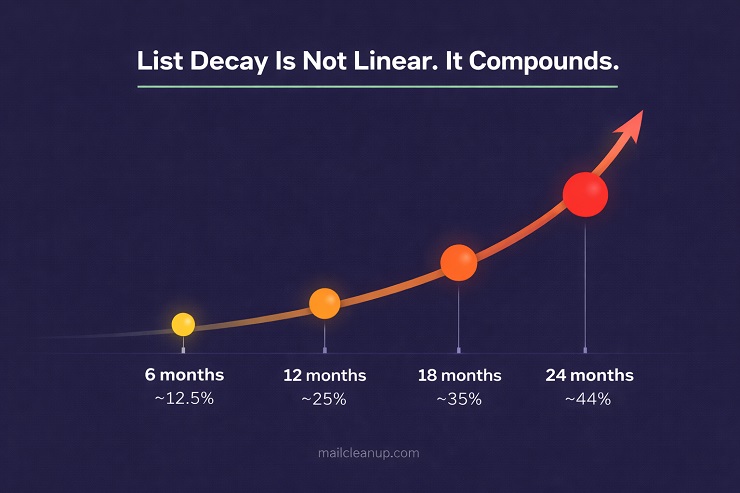
MailCleanup tracked one real client list monthly for a full year and measured 23.79% annual decay. That’s in line with the 20-30% range most industry sources cite, but with a real dataset behind it rather than an estimate. At that rate, a list of 50,000 addresses left uncleaned for a year has roughly 11,895 degraded addresses. What makes this more serious than the raw number suggests is that the damage does not accumulate in a straight line.
It compounds, and accelerates: the same tracked list decayed more than four times faster in its final quarter than its first. The full monthly and quarterly breakdown lives in MailCleanup’s Email List Decay Report.
Each send to a growing pool of invalid or unresponsive addresses deposits negative signals into your sender reputation: bounces, complaints from recycled addresses now functioning as spam traps, and reduced engagement ratios from a denominator that keeps growing while your active audience stays flat. Those negative signals do not reset between campaigns. They build across every send in the window inbox providers use to evaluate your behaviour.
The table below applies MailCleanup’s own tracked decay data, not a modeled assumption, to a list of 100,000 addresses left uncleaned. It uses the same four-tier Decay Index established in our full email list decay report, built from one real client’s list tracked monthly for a year.
| Months Since Last Clean | Tier (MailCleanup’s Decay Index) | Decay Range | Degraded Addresses (100,000-list) |
|---|---|---|---|
| 0-2 | Fresh | 0.00%-2.79% | 0-2,790 |
| 3-5 | Aging | 4.24%-7.51% | 4,240-7,510 |
| 6-8 | At Risk | 9.30%-13.49% | 9,300-13,490 |
| 9-11 | Critical | 16.67%-23.79% | 16,670-23,790 |
The four mechanisms driving this decay have different implications for how you detect and address them.
- Address abandonment. A person stops using an address without closing it. The address remains technically active, accepting mail at the server level, but nobody reads it. Engagement collapses. Eventually the provider closes the account and soft bounces become hard bounces. This is the most common decay type and the most visible in bounce data.
- Domain closure. When a company shuts down or is acquired, its email domain often goes inactive. All addresses at that domain start hard bouncing simultaneously. A single company closure can add dozens or hundreds of bouncing addresses to a B2B list overnight, which is why B2B lists decay faster than consumer lists.
- Role-based churn. Addresses like support@, info@, and contact@ are tied to a function rather than a person. When the person responsible for that inbox changes, engagement patterns shift unpredictably. The address remains technically valid but the audience behind it is effectively different from the one that originally subscribed.
- Spam trap conversion. Inbox providers and anti-spam organisations convert abandoned addresses into spam traps after a period of dormancy, typically 12 months or more. An address that was a real subscriber two years ago can be a spam trap today. Sending to it signals poor list management and can trigger blacklisting. What are spam traps and how they form is covered in detail in its own post in this cluster.
Understanding what causes email bounces at the technical level is covered separately. The point here is upstream: the bounces you diagnose after a send are the output of list decay that started months or years earlier.
How Email List Hygiene Affects Deliverability
Email list hygiene and deliverability are not separate concerns. Poor email list hygiene is the direct upstream cause of most deliverability failures. The mechanisms are specific enough to be worth understanding individually.
Bounce Rate and the Sender Reputation Threshold
Every invalid address on your list is a future bounce. Hard bounces, which are permanent email delivery failures from addresses that do not exist or have been closed, are the most immediately damaging signal you can send to inbox providers.
The thresholds that matter are:
- Below 0.5% hard bounce rate: healthy, within acceptable range for most providers
- Above 0.5%: sustained reputation damage begins accumulating
- Above 2%: spam folder placement and sending rate throttling become likely
- Above 5%: most reputable ESPs will suspend sending from the account
Soft bounces are slower-moving but equally important in aggregate. A soft bounce on the same address across multiple campaigns signals that the address is degrading. When this pattern plays out across a large pool of addresses simultaneously, the cumulative reputation signal is significant even though each individual event looks minor.
The full mechanism of how different bounce types damage email sender reputation, including the per-ISP differences in how Gmail, Outlook, and Yahoo weight these signals, is covered in depth in that post. The connection to make here is direct: bounces are not a deliverability problem you manage after they happen. They are a list hygiene failure that should have been caught before the send.
Spam Complaint Rates and the Enforcement Reality
This is where email list hygiene stopped being best practice and became a compliance requirement.
In February 2024, Google and Yahoo introduced mandatory spam complaint thresholds for bulk senders. Google has been enforcing hard rejections from November 2025. The thresholds are specific and non-negotiable.
| Provider | Recommended Threshold | Hard Limit | Consequence Above Hard Limit |
|---|---|---|---|
| Gmail | Below 0.1% | 0.3% | Permanent rejection, ineligible for mitigation |
| Yahoo | Below 0.1% | 0.3% | Spam folder placement, potential blocking |
| Outlook | Below 0.1% | 0.3% (from May 2025) | Filtering and rejection |
The connection to list hygiene is the piece most senders miss. Spam complaints do not come primarily from people who consciously decide your email is malicious. They come from people who do not recognise the sender, never clearly intended to subscribe, or have been inactive so long they no longer associate your brand with their inbox and see no easy way to stop the mail.
Every address that should not be on your list is a potential complaint. At scale, those complaints accumulate into rates that cross enforcement thresholds, and inbox providers do not distinguish between complaints from genuinely spammy senders and complaints from legitimate senders with poor list management. The outcome is the same.
The full detail of the 2024 and 2025 ISP mandates, authentication requirements, and enforcement mechanics is covered in the email authentication and email sender reputation posts. What belongs here is the upstream cause: if your complaint rate is approaching 0.1%, the first place to look is your list, not your content.
How Hygiene Failures Trigger the Reputation Death Spiral
Bounces and complaints do not damage sender reputation in isolation. They interact and accelerate each other.
Elevated bounce rates reduce your engagement ratio. A reduced engagement ratio means a higher proportion of spam complaints relative to positive signals. More complaints push your domain reputation down through the inbox provider bands. Lower domain reputation means more of your mail filters to spam, which means fewer opens and clicks even from genuinely engaged subscribers, which reduces your engagement signals further, which validates the provider’s filtering decision.
This is the reputation death spiral. It is covered in full in the email sender reputation post, including the five stages and recovery timelines by damage severity. The point here is that email list hygiene is the primary intervention that prevents the cycle from starting. Once you are inside it, cleaning the list is necessary but insufficient. You need the full recovery programme.
Keeping the list clean means you never enter the spiral in the first place.
The Open Rate Problem: Why Your Hygiene Signals May Be Wrong
Here is a problem most email list hygiene guides have not caught up with yet. The standard advice for years has been straightforward: if a subscriber has not opened your emails in 90 to 180 days, they are inactive. Suppress them, run a re-engagement campaign, remove them if they do not respond. It sounds logical. The problem is that the signal this entire process depends on, the open, is no longer reliable for a large portion of most lists.
In September 2021, Apple introduced Mail Privacy Protection. When enabled, it routes email content through Apple proxy servers and pre-loads tracking pixels before the recipient ever sees the message. This means the email registers as opened in your ESP dashboard whether the person read it or not. Apple Mail currently accounts for roughly 49 to 65% of all email opens depending on the list. In 2025, estimates suggest that up to 75% of reported opens in some segments are artificial, generated by Apple’s pre-fetching rather than by a human actually reading the email.
The practical consequence for email list hygiene is serious. If you are running suppression or removal decisions based on open rate inactivity, you are making those decisions with corrupted data for the majority of your list.
What This Means for Email List Hygiene Decisions
The standard 90-day or 180-day open-based suppression rule does not work as intended in a post-MPP environment. A subscriber who appears to have opened every email for the past six months may have never read a single one. A subscriber flagged as inactive because they show no opens may actually be clicking through from a preview pane or a non-Apple client that does not fire the tracking pixel at all.
This does not mean engagement-based hygiene decisions are impossible. It means the signal stack needs to change.
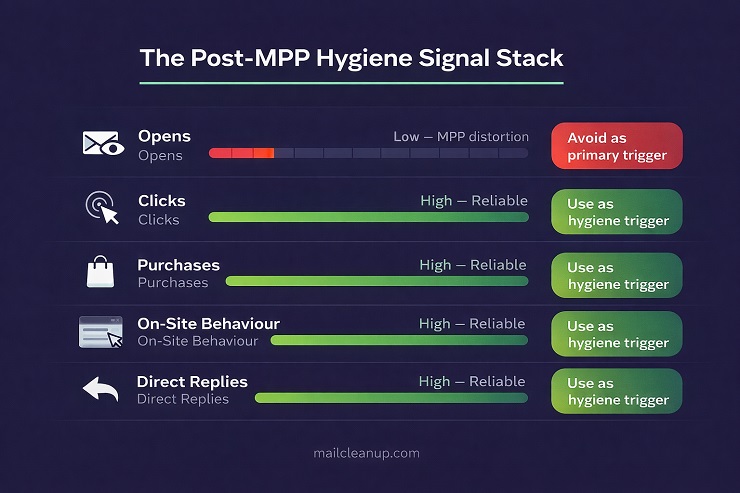
The reliable engagement signals for email list hygiene decisions today are:
- Clicks. A click requires a human to interact with a link. It cannot be faked by a proxy server pre-loading content. Click data is the most reliable engagement signal available and should be the primary metric for hygiene and suppression decisions.
- Purchases and conversions. If a subscriber has converted, purchased, or completed a meaningful on-site action within your lookback window, they are engaged regardless of what the open data shows.
- On-site behaviour. Sessions, page views, and cart activity originating from email traffic in your analytics platform confirm real engagement independent of ESP tracking.
- Direct replies. A reply to an email is an unambiguous engagement signal that no privacy proxy can obscure.
The Post-MPP Hygiene Signal Stack
Before making any suppression or removal decision on engagement grounds, run the address against all four signals, not just opens. The framework below replaces open-rate-based hygiene logic with a signal hierarchy that holds up in the current environment.
| Signal | Reliability Post-MPP | Use For |
|---|---|---|
| Email opens | Low (Apple Mail inflates ~50-65% of opens) | Not recommended as primary hygiene trigger |
| Link clicks | High | Primary suppression and removal trigger |
| Purchases / conversions | High | Overrides inactivity flags regardless of open data |
| On-site behaviour from email | High | Secondary confirmation of engagement |
| Direct replies | High | Strongest single signal of genuine engagement |
A subscriber with no clicks, no purchases, no on-site behaviour from email, and no replies within your lookback window is genuinely inactive regardless of what their open rate shows. That is the threshold for a re-engagement attempt, not open inactivity alone.
It is worth noting that this shift in hygiene signal logic also affects how you think about your existing lists. If you suppressed or removed subscribers in the past two to three years based purely on open inactivity, some of those decisions may have been incorrect. Not catastrophically so, because removing genuinely inactive addresses is still directionally right for list health. But the signal quality has improved now that clicks are the primary driver, and future decisions will be more accurate as a result.
Hygiene Starts at the Point of Acquisition
Most email list hygiene guidance treats the list as something you manage after the fact. Clean it periodically. Remove what has gone bad. The underlying assumption is that addresses enter the list in good condition and degrade over time.
That assumption is wrong for a significant proportion of most lists.
A meaningful share of list quality problems do not develop after acquisition. They arrive at the point of acquisition. Addresses that were never valid, never belonged to real individuals, or were never intended to engage with your email enter the list at signup and start generating negative signals from the very first send. Email list hygiene that ignores this upstream layer is always fighting the last battle.
Why Acquisition Source Determines Baseline List Quality
Not all signups are equal. The channel through which a subscriber joins your list has a direct bearing on the baseline quality of the address and the intent behind it.
Organic signups through a well-designed double opt-in form on your own site consistently produce the highest quality addresses. The subscriber chose to be there, confirmed their address, and has a recent memory of why they signed up. The baseline intent is strong.
Imported lists, purchased data, co-registration leads, and contest-driven signups produce significantly lower baseline quality. These addresses have not self-selected into a relationship with your brand in the same way. Many are real addresses attached to people who have no expectation of receiving your email. Some are not real addresses at all. All the sources and channels that affect the list quality while building an email list have been discussed deeply in our dedicated guide.
That being said, the practical implication for email list hygiene is that any new import or third-party acquisition needs verification before it touches your sending infrastructure. The damage from one bad import can take weeks to undo in terms of bounce rate and complaint signals.
The Address Types That Enter Dirty
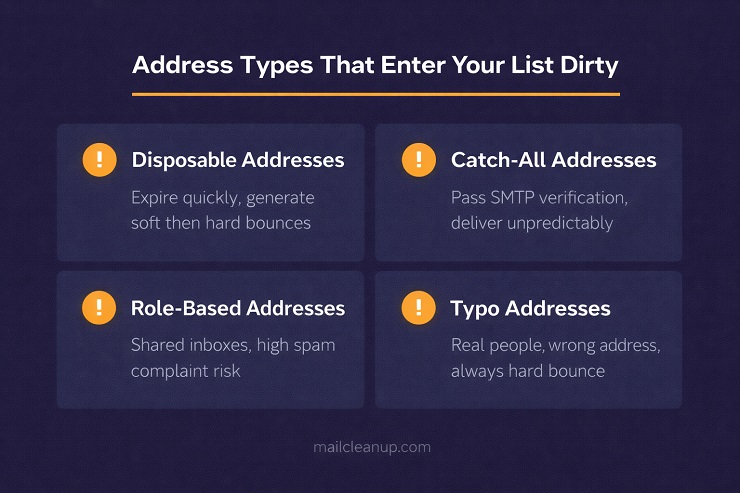
Several address categories generate list quality problems from the moment they arrive, regardless of whether they are technically valid at the point of signup.
- Disposable email addresses. Temporary addresses created specifically to access a lead magnet, free trial, or gated content without exposing a real inbox. They accept mail briefly and then expire or stop delivering. They are common in e-commerce and SaaS signup flows and they generate soft bounces that escalate to hard bounces quickly.
- Catch-all addresses. Domains configured to accept all incoming mail regardless of whether the specific mailbox exists. An SMTP verification check will return a valid result for these addresses because the domain accepts the connection. But delivery to the actual mailbox is unpredictable. Some catch-all domains deliver reliably. Many do not. Sending to unverified catch-all addresses inflates your unknown and soft bounce rates.
- Role-based addresses. Addresses tied to a function rather than an individual: info@, support@, contact@, admin@, hello@. These addresses are shared, monitored inconsistently, and have a high propensity for spam complaints because multiple people with different levels of context for your emails are checking the same inbox.
- Typo addresses. gnail.com instead of gmail.com. Hotmial.com instead of hotmail.com. These are real people who made a genuine mistake at signup. The address will hard bounce immediately and there is no way to reach the person behind it. Real-time syntax validation at the form level catches these before they enter the list.
Prevention: Stopping Bad Addresses Before They Reach the List
The most cost-effective email list hygiene intervention is the one that happens before an address is ever added to your list. There are three layers of prevention that work together.
Real-time verification at the point of signup checks each address as it is submitted against syntax rules, domain validity, MX record confirmation, and SMTP-level verification. Invalid, disposable, and high-risk addresses are flagged or blocked before they enter your database. This is particularly important for high-volume signup flows where manual review is not possible. MailCleanup handles bulk verification for existing lists and pre-campaign imports, ensuring that address quality is confirmed before any send goes out.
Double opt-in requires the subscriber to click a confirmation link in a welcome email before being added to the active list. It eliminates typo addresses, disposable addresses that expire before confirmation, and a large proportion of bot-generated signups. The tradeoff is a lower confirmation rate — typically 15 to 20% of initial signups do not complete the confirmation step. The benefit is a list where every address has been actively confirmed as reachable by a real person who intended to subscribe.
Form-level validation catches syntax errors, known disposable domain patterns, and role-based address formats at the point of entry. It is the first line of defence and the easiest to implement. Combined with double opt-in and pre-send verification, it creates a three-layer acquisition hygiene system that significantly reduces the volume of bad addresses that ever reach your active list.
The Email List Hygiene Cadence
Knowing that list hygiene matters is not the same as knowing when to act. Most guidance on this topic reduces to a single recommendation: clean your list every six months. That is a reasonable default but it is not a complete answer, because the right cadence depends on the nature of your list, not just its age.
Scheduled Hygiene by List Type
Different list types decay at different rates and carry different risk profiles. A single universal cleaning schedule applied to all of them leaves some lists over-cleaned and others dangerously under-maintained.
| List Type | Primary Decay Driver | Recommended Cadence | Why |
|---|---|---|---|
| B2B outreach list | Job turnover (~30% annually), domain closures | Quarterly | Business email addresses change with roles; decay is faster than consumer lists |
| B2C newsletter / ecommerce | Address abandonment, engagement fade | Every 6 months | Slower decay rate; engagement signals accumulate more gradually |
| Agency-managed client list | Mixed acquisition sources, variable quality | Before every major campaign | Quality varies significantly; client lists carry reputation risk back to the agency |
| Legacy or dormant list | Spam trap conversion, mass abandonment | Before the first send | Any list not contacted in 12+ months requires verification before reactivation |
| Third-party or purchased data | Unknown acquisition quality | Before any use | These lists should never be sent to without full verification |
The cadence column above is a minimum. If your metrics are signalling problems between scheduled cleans, waiting for the next scheduled date is the wrong call.
Signal-Triggered Hygiene: When to Clean Outside the Schedule
Scheduled email list hygiene cadences are built for normal operating conditions. Certain metric signals indicate that conditions have changed and an unscheduled clean is necessary regardless of when the last one ran.
The triggers below should initiate an immediate hygiene review.
- Hard bounce rate exceeds 0.5% on any campaign: Do not wait for the next scheduled clean. Investigate the source of the bounces and verify the affected segment before the next send.
- Spam complaint rate approaches 0.08 to 0.1%: You are within striking distance of Google’s enforcement threshold. The list segment generating the complaints needs to be identified and addressed before the rate crosses 0.1%.
- Google Postmaster Tools domain reputation drops one band: A drop from High to Medium, or Medium to Low, is a signal that accumulated negative signals have reached a threshold. Review bounce and complaint data immediately and run a verification pass on any recent imports.
- A large import or third-party acquisition has been added without verification: Even if metrics have not yet moved, the risk is already on your list. Verify before the next send.
- The list has not been contacted in more than four months: A cold list is not the same as a clean list. Decay continues whether you are sending or not. Reactivating a list that has been dormant requires a verification pass before any volume goes out.
The Hygiene Trigger Thresholds Framework
The table below consolidates the signal-to-action mapping into a single reference. These thresholds apply regardless of list type or sending volume.
| Metric | Healthy Range | Action Threshold | Immediate Action Required |
|---|---|---|---|
| Hard bounce rate | Below 0.5% | 0.5% to 1% | Above 2% |
| Spam complaint rate | Below 0.05% | 0.05% to 0.1% | At or above 0.1% |
| Soft bounce rate | Below 2% | 2% to 5% | Above 5% |
| Google Postmaster reputation | High | Medium | Low or Bad |
| Time since last verification | Under 6 months | 6 to 12 months | Over 12 months |
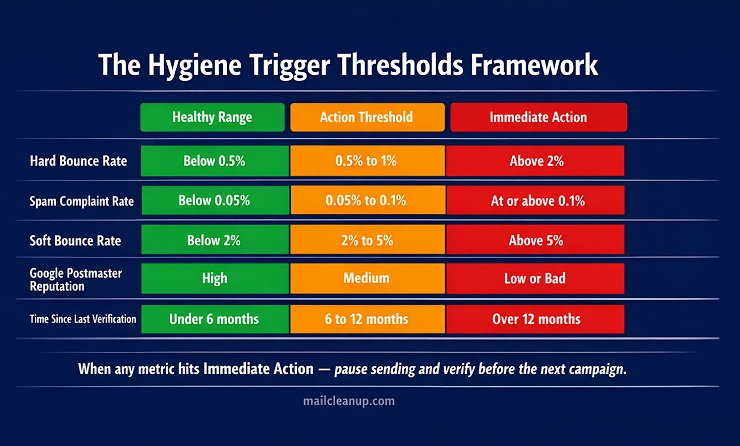
When any metric reaches the action threshold column, schedule a hygiene review within the next sending cycle. When any metric reaches the immediate action column, pause sending on the affected segment and run verification before the next send goes out.
For a deeper understanding of how to read and respond to bounce signals specifically, the post on how to fix email bounce rate covers the diagnostic and remediation process in detail. The monitoring tools for tracking Postmaster Tools reputation and complaint signals are covered in the email sender reputation post.
What Email List Hygiene Does Not Fix
Email list hygiene is one of the most important operational disciplines in email deliverability. It is also one of the most misunderstood in terms of what it actually solves. Before treating hygiene as the answer to every deliverability problem, it is worth being precise about its limits. Understanding where email list hygiene stops working is part of understanding how to use it correctly.
A Clean List Is Not the Same as the Right List
Verification removes addresses that are invalid, risky, or undeliverable. It cannot fix a list where the right addresses are attached to the wrong audience.
If your list was built through low-intent channels such as contest signups, co-registration, purchased data, or lead magnets with no relevance to your core offer; the addresses that survive verification may be technically deliverable and still generate high complaint rates. The people behind them never had a genuine reason to be on your list. They will mark your email as spam not because the address is broken but because the relationship was never real.
Email list hygiene in this situation reduces the surface area of the problem by removing the worst addresses. It does not resolve the underlying audience alignment issue. That requires a different intervention: re-evaluating acquisition channels, tightening opt-in intent, and segmenting by engagement quality rather than just address validity.
Catch-All Domains Pass Verification but Delivery Is Not Guaranteed
This is a technical limit of email list hygiene that every bulk sender operating in B2B should understand clearly.
A catch-all domain is configured to accept all incoming mail at the server level, regardless of whether the specific mailbox exists. When a verification tool runs an SMTP check against a catch-all address, the server returns a valid response because it accepts everything. The address passes verification. Whether it actually delivers to a real inbox behind that domain is a separate question that verification cannot answer.
The result is a category of addresses that sit in a grey zone: not invalid enough to remove with confidence, not reliable enough to treat as confirmed deliverable. Responsible email list hygiene treats catch-all addresses as a risk category to be sent to cautiously, monitored closely, and suppressed if they accumulate soft bounces without generating engagement signals.
Hygiene Does Not Repair a Reputation Already in Serious Decline
A clean list is the foundation of good sender reputation. It is not a recovery tool for a reputation that has already reached the Low or Bad band in Google Postmaster Tools, or that is sitting on active blacklistings.
If your domain reputation has deteriorated to the point where inbox placement is severely impacted, cleaning the list removes the ongoing source of damage. But the historical negative signals already recorded against your domain do not disappear the moment the list is clean. Inbox providers apply rolling evaluation windows. Recovery requires a sustained period of clean sending with strong positive signals, not just the removal of the problem addresses.
The full recovery programme for damaged sender reputation, including phase-by-phase timelines and what to expect at each stage, is covered in the email sender reputation post. Email list hygiene is a necessary component of that recovery. It is not sufficient on its own.
Hygiene Does Not Compensate for Authentication Failures
A clean list of valid, engaged subscribers will still have deliverability problems if your SPF, DKIM, and DMARC records are misconfigured. Authentication failures generate 5.7.x SMTP bounce codes and are treated by inbox providers as infrastructure-level problems, independent of list quality.
If your bounce data shows a pattern of authentication failure codes, list hygiene is not the intervention you need. The email authentication post covers the full setup, alignment requirements, and troubleshooting process for each protocol. Fix the authentication first, then assess what list hygiene work remains.
Email List Hygiene Best Practices: Building the Ongoing Programme
Understanding why email list hygiene matters and when it fails is the foundation. What it looks like as a functioning operational practice is where most senders need the most specific guidance. The best practices below are not a checklist of one-time tasks. They are the components of a programme that runs continuously alongside your sending activity.
1. Pre-Send Verification for Every New Import
Any list segment that has not been through a verification pass should not be sent to. This applies to new imports from third-party sources, reactivated legacy lists, migrated contacts from a previous ESP, and any acquisition that came through a channel with variable quality.
The standard for email list hygiene at the import stage is full multi-layer verification: syntax validation, domain and MX record checking, SMTP-level mailbox confirmation, disposable address detection, catch-all identification, and risk scoring. Running a new import through this process before it touches your sending infrastructure is the single highest-leverage hygiene intervention available, because it prevents bad addresses from generating their first negative signal rather than cleaning up after they already have.
MailCleanup is built specifically for this use case. Upload your list, run it through 12-plus verification layers, and receive a cleaned file with full documentation of every address removed and the reason for removal. No account setup required. The result is a verified list ready to send to with confidence. All these email verification features are explained in detail in our dedicated guide.
2. Hard Bounce Suppression Protocol
Hard bounces must be removed from your active list immediately and permanently. Every ESP manages this differently in terms of automation, but the principle is non-negotiable: an address that has hard bounced once should never be sent to again from that sending infrastructure.
The protocol for soft bounces requires more judgement. A single soft bounce on an address is not a removal trigger – it signals a temporary condition worth monitoring, not an immediate one. For the full retry-and-escalation logic behind when a recurring soft bounce should convert to suppression, see Soft Bounce Retry and Escalation Policy in our bounce management guide.
Keep a dedicated suppression list separate from your unsubscribe list. Hard bounces, confirmed spam trap hits, and addresses flagged as high-risk by verification should live here permanently. Suppression lists do not shrink over time. Every hygiene action you take should add to them.
3. Engagement Segmentation Using Reliable Signals
As covered in the Apple MPP section, open-rate-based engagement segmentation is no longer reliable as the primary driver of email list hygiene decisions. The practical replacement is a click and conversion-based segmentation model.
The segmentation tiers below provide a workable framework for ongoing engagement-based list management.
| Segment | Definition | Hygiene Action |
|---|---|---|
| Active | Clicked or converted within 90 days | Send normally, no action needed |
| Fading | No click or conversion in 90 to 180 days | Reduce frequency, monitor closely |
| At risk | No click or conversion in 180 to 365 days | Re-engagement sequence before suppression |
| Inactive | No click or conversion in 365 days or more | Suppress from main sends, consider removal |
Apply these tiers at the segment level, not the list level. A subscriber in the inactive tier on one list type may be active on another if you are running multiple streams. Suppression decisions should account for all engagement signals across your sending programme, not just the most recent campaign.
For the full engagement segmentation and scrubbing process, including how to structure re-engagement campaigns and when to make the final removal decision, the email list scrubbing post covers this in detail.
4. Weekly Monitoring as a Hygiene Early Warning System
Email list hygiene is not only about what you do to the list between sends. It is also about what you observe during and after sends. Monitoring gives you the early signals that allow you to act before problems become serious.
The minimum weekly monitoring practice for any sender operating at meaningful volume:
- Google Postmaster Tools: Check domain reputation band and spam rate. A reputation band drop or a complaint rate above 0.05% should trigger immediate investigation.
- Microsoft SNDS: Check IP reputation and complaint signals from Outlook’s infrastructure independently of Gmail data.
- ESP bounce report: Review hard bounce count and rate per campaign. Any single campaign above 0.5% hard bounce rate needs source investigation before the next send.
- Engagement trend: Track click rate trend across the last four to six campaigns. A sustained downward trend without a content explanation is a list quality signal, not just a creative performance signal.
The full monitoring tool evaluation, including how to read Postmaster Tools data, what SNDS signals mean, and how to interpret Sender Score in context, is covered in the email sender reputation post. What belongs here is the habit: monitoring is not a quarterly task. It runs every week, and the hygiene actions it triggers happen in response to what it shows.
The Ongoing Email List Hygiene Cadence in Practice
Bringing the full programme together, a sender running a healthy email list hygiene operation is doing the following things on a regular cycle:
- Verifying every new import before it enters the active list
- Removing hard bounces immediately and permanently after every send
- Running a scheduled full-list verification on the cadence appropriate to their list type (quarterly for B2B, every six months for B2C)
- Monitoring weekly metrics and triggering unscheduled hygiene actions when thresholds are breached
- Making engagement suppression decisions based on click and conversion data, not open rates
- Maintaining a permanent suppression list that grows with every hygiene action
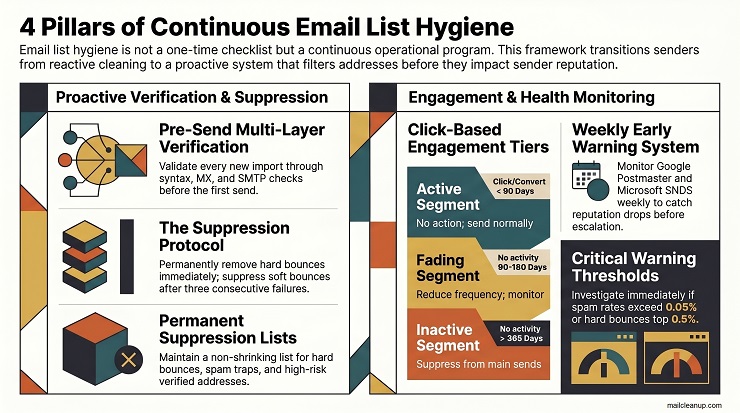
None of these steps are expensive or time-consuming in isolation. Combined, they constitute an email list hygiene practice that compounds positively over time, the same way a neglected list compounds negatively.
Your Email List Is Only as Good as the Discipline Behind It
A clean list does not happen by accident and it does not stay clean without attention. Every contact that enters your list through a low-quality channel, every invalid address left in place across multiple campaigns, and every suppression decision deferred because removing contacts feels counterintuitive is a deposit into a reputation debt that eventually comes due.
The senders with consistently strong inbox placement are not doing anything exotic. They are running the same programme described in this post, every sending cycle, without treating it as optional when things are going well. Email list hygiene is not a recovery activity. It is the condition that makes recovery unnecessary.
Before you explore the FAQ section, don’t forget to learn more about the difference between Email Verification & Email Validation.
Frequently Asked Questions on Email List Hygiene
What is email list hygiene?
Email list hygiene is the ongoing discipline of managing the quality of your subscriber list across three dimensions: address validity, acquisition quality, and engagement health. It involves regularly verifying that addresses are deliverable, ensuring that addresses were acquired through channels that produced genuine subscriber intent, and maintaining engagement signals that reflect real audience behaviour. Email list hygiene is not a one-time cleanup task. It is an operational practice embedded in the normal cycle of sending, monitoring, and managing a list over time.
What does email hygiene mean in practice?
Email hygiene means that at any given point, your list contains only addresses that are valid, deliverable, and attached to people who have a genuine reason to receive your email. In practical terms it means running verification passes before sends, removing hard bounces immediately, suppressing unengaged addresses based on click and conversion data, monitoring weekly metrics for early warning signals, and preventing bad addresses from entering the list at the point of acquisition. It is the sum of these practices running consistently, not any single action.
How often should you clean your email list?
The right cleaning frequency depends on list type, not just list size. B2B lists, where job turnover drives roughly 30% annual address churn, should be verified quarterly. B2C newsletter and ecommerce lists typically run on a six-month schedule. Legacy lists not contacted in 12 months or more should be verified before the first send back, regardless of when they were last cleaned. Any list should also be cleaned outside its scheduled cycle when metrics signal a problem: a hard bounce rate above 0.5%, a complaint rate approaching 0.1%, or a Postmaster Tools reputation band drop.
How does email list hygiene affect deliverability?
Poor email list hygiene is the direct upstream cause of most deliverability failures. Invalid addresses generate hard bounces that damage sender reputation. Unrecognised or unintended senders generate spam complaints that push complaint rates toward enforcement thresholds. Degraded engagement ratios from sending to inactive addresses reduce the positive signals inbox providers use to determine inbox placement. Together, these signals can trigger the reputation death spiral, where each metric problem accelerates the next. Maintaining email list hygiene interrupts this cycle before it starts.
What are email list hygiene best practices?
The core email list hygiene best practices are: verify every new import before it touches your sending infrastructure, remove hard bounces immediately and permanently after every send, run scheduled full-list verification on a cadence appropriate to your list type, make engagement suppression decisions based on click and conversion data rather than open rates, monitor Google Postmaster Tools and Microsoft SNDS weekly for early warning signals, and maintain a permanent suppression list that grows with every hygiene action. These practices run continuously, not as a periodic intervention.
Why are open rates no longer a reliable signal for email list hygiene decisions?
Apple Mail Privacy Protection, introduced in 2021 and now covering roughly 49 to 65% of most lists, pre-loads email tracking pixels through proxy servers before recipients actually read the message. This causes emails to register as opened in ESP dashboards regardless of real engagement. As a result, open-rate-based suppression rules, which have been the standard hygiene trigger for years, are now making decisions based on artificially inflated data for a large portion of most lists. The reliable replacement signals are clicks, purchases, on-site behaviour from email traffic, and direct replies. These cannot be faked by a pre-fetching proxy.
What types of addresses damage email list hygiene the most?
The address categories that generate the most list quality problems are: disposable addresses created for one-time access to gated content, which expire quickly and generate soft and then hard bounces; catch-all addresses on domains that accept all mail at the server level but deliver unpredictably to individual mailboxes; role-based addresses like info@ and support@ that are shared, monitored inconsistently, and have high complaint propensity; spam traps converted from abandoned addresses after 12 or more months of dormancy; and typo addresses from signups with incorrect domain entries. The most effective intervention for all of these is prevention at the point of acquisition through real-time verification and double opt-in.
What is the difference between email list hygiene, email list cleaning, and email list scrubbing?
These three terms are often used interchangeably but they describe different layers of the same problem. Email list hygiene is the overarching strategic discipline covering address validity, acquisition quality, and engagement health as an ongoing practice. Email list cleaning is the specific operational process of running a list through verification to identify and remove invalid, risky, and undeliverable addresses. It is a tactical execution of one dimension of hygiene. Email list scrubbing is the engagement layer: identifying and removing or suppressing subscribers who are technically reachable but no longer interacting with your email. A complete programme uses all three in combination, with hygiene as the framework, cleaning as the address-level intervention, and scrubbing as the engagement-level intervention.