MailCleanup

Spam Complaint Rate: Your ESP Says One Number, Google’s 0.1% Threshold Says Another

Spam Complaint Rate

Two senders can have the exact same 43 spam complaints this month and walk away with two different verdicts about their standing. One reads their spam complaint rate as 0.09%, comfortably under Google’s 0.1% target. The other reads the same 43 complaints as 0.10%, sitting right on the line. You could be either one and … Read more

Black Friday Email Marketing: The Complete Guide, and Why Volume Alone Isn’t What Flags You as Spam

Black Friday Email Marketing

Black Friday is the best week of the year for email revenue. It’s also the worst week of the year to get careless about who you’re sending to. Both are true at once, and most Black Friday email marketing advice only prepares you for the first one. The volume numbers alone explain why this week … Read more

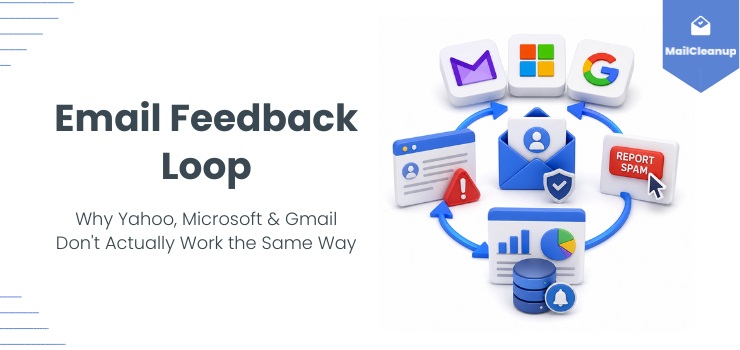
Email Feedback Loop: Why Yahoo, Microsoft & Gmail Don’t Actually Work the Same Way

Email Feedback Loop

Search “does Gmail have a feedback loop” and you will find dozens of guides confidently answering no. That is not quite right. Gmail runs a feedback loop, just not the kind Yahoo or Microsoft run. This is not a small detail. It is the reason so many setup guides send you looking for a Gmail … Read more

Cost Of Email Bounces: The Verified vs. Unverified List Cost Gap

Cost Of Email Bounces

Most articles about the cost of email bounces open with a hypothetical. Say you send 100,000 emails. Say your bounce rate runs at 4%. Say your average order value is $75. The math that follows might be sound, but every input is a guess wearing a data costume. We can do better than that, because … Read more

Google & Yahoo Bulk Sender Requirements: What’s Identical, What Isn’t & What’s Coming Next

Google & Yahoo Bulk Sender Requirements

Cross Google’s 5,000-email-a-day threshold once, even by accident, and you become a bulk sender. Permanently. Google’s own FAQ is direct about it: bulk sender status “doesn’t have an expiration date.” Cutting your sending volume back down afterward “will not affect” that classification. Most content covering Google & Yahoo bulk sender requirements skips this detail entirely, … Read more

What Is Email Deliverability? Why It Matters, Best Practices & Factors You Can/Can’t Control

What Is Email Deliverability

You send a campaign. It doesn’t bounce. Your dashboard says delivered. And still, fewer people are opening it, and you have no idea why. Every guide that talks about what is email deliverability hands you the same list: authentication, sender reputation, engagement, list quality, content, infrastructure. What almost none of them tell you is that … Read more

What Is BIMI? How It Works, Its Record Syntax & Why Your Logo Still Might Not Show

What Is BIMI

You did everything the setup checklist told you to do. SPF passes. DKIM passes. DMARC sits at p=reject. You published a BIMI record with a valid logo and a certificate from a real issuer. And the logo still isn’t showing up next to your emails. Maybe it shows in Gmail but never in Apple Mail. … Read more

What Is DKIM? How It Works, Its Full Record Syntax & What Actually Breaks the Signature

What Is DKIM

Search what is DKIM and most explainers will tell you it survives forwarding in a way SPF doesn’t. Then they stop there, as if that settles the question. It doesn’t. DKIM signs the body and a defined set of headers, and that signature holds up through simple relaying. Simple relaying means one mail server passing … Read more

What Is Sender Policy Framework? How SPF Works, Its Full Record Syntax & the 10-Lookup Limit That Actually Breaks It

What Is Sender Policy Framework

Most Sender Policy Framework records don’t fail because someone typed the syntax wrong. They fail because a team added a fourth or fifth sending tool well after the record was set up. Nobody recounted what that now costs in DNS lookups, so the record quietly crossed a limit that has nothing to do with spelling. … Read more

How To Read DMARC Reports: Aggregate, Forensic & What Neither One Tells You

How To Read DMARC Reports

Most guides to reading a DMARC report show a screenshot of a dashboard, or three or four lines pulled from an XML file. Either one gets called a walkthrough. Search enough of them and a pattern shows up. They cover the same aggregate report, from the same angle, and stop the moment forensic reports come … Read more