
AI in email marketing gets talked about as if it’s one capability. In practice, it splits into two fundamentally different technologies, and each one solves a different problem. Predictive AI looks at a subscriber’s existing history: purchases, opens, clicks, browsing behavior. It turns that history into a decision, like when to send, who to send to, or what a subscriber is likely to buy next. Generative AI does something different. It creates something new instead: a subject line, a paragraph of copy, drawn from a prompt, not that subscriber’s history.
If you’ve looked into AI-powered email marketing before, you’ve probably run into the same list everywhere. Most guides place predictive and generative side by side as interchangeable entries on a use-case checklist. That’s part of why the advice tends to read the same across every site. Six or ten numbered tips that could describe almost any marketing channel. They rarely explain how AI actually intersects with an email program and the list sitting behind it. The distinction matters in practice. It changes what each technology needs in order to work well, and later in this post, what goes wrong when it doesn’t have it.
This post covers both categories in full. You’ll get what email marketing with AI actually does across real use cases, plus the genuine benefits behind using it. You’ll also see the best practices that separate a program getting real value from one that’s just generating noise. It also covers the specific mistakes that can turn a promising AI rollout into a deliverability problem. That includes at least one mistake that has nothing to do with what most people assume.
TL;DR on AI Email Marketing
- AI in email marketing splits into two categories: predictive AI, which scores, times, and ranks decisions using existing subscriber data, and generative AI, which creates new content like subject lines and body copy.
- Five core use cases cover most real programs: content and subject line generation, personalization and segmentation, send-time optimization, predictive analytics, and accelerated A/B testing, each depending on data quality differently.
- The AI Data Dependency Ladder ranks those five use cases by how much address and engagement data actually affects their output, content generation least, predictive analytics most.
- Apple’s Mail Privacy Protection and corporate security scanners doing something similar can feed a send-time model a false open signal that has nothing to do with whether a subscriber actually engaged.
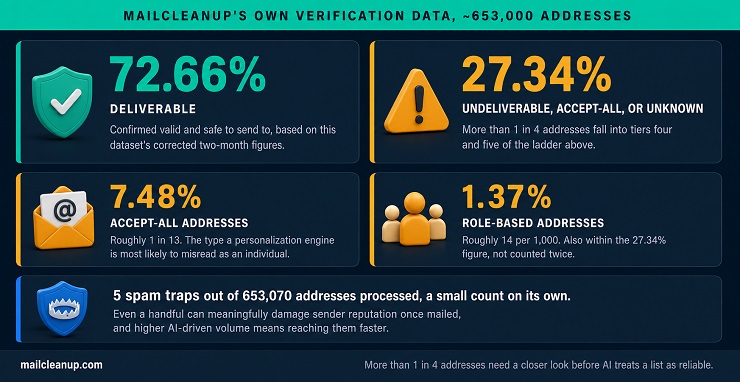
- MailCleanup’s own verification data puts a number on the exposure: across roughly 653,000 addresses processed over a recent two-month period, more than 1 in 4 came back undeliverable, accept-all, or unknown.
- Getting real value from AI in email marketing depends on five practices: human review, piloting before scaling, a real brand-voice foundation, a defined business goal, and transparency, none of which require special tooling.
- List verification matters most for the two most data-dependent use cases, personalization and predictive analytics, not as a blanket rule applied equally to every AI use case.
What Is AI in Email Marketing?
AI in email marketing means using machine learning, generative or predictive, to make a decision or produce content inside an email program. It’s work that would otherwise take a person to do by hand. That includes picking a send time based on when a specific subscriber tends to open email, or scoring which subscribers are close to churning. It also includes drafting a subject line, or deciding which product to feature in a personalized block. AI sits on top of the sending and automation infrastructure your program already has. It doesn’t replace that infrastructure.
That distinction is worth being precise about. Email automation and AI for email marketing get folded together constantly, and they aren’t the same layer. Our guide to email automation covers how trigger-based workflows fire on their own once a condition is met.
A cart sits abandoned for an hour, or a subscriber hits their one-year anniversary. AI is what can sit on top of or alongside that logic instead. It makes a decision inside the workflow smarter, rather than just making the workflow faster. If your program already runs automated flows, AI is what can make those flows smarter, not what replaces them. An automated flow can run with zero AI in it, and an AI-driven send-time model can exist without a single automated trigger behind it. The two get used together often, but neither one requires the other.
Predictive AI vs. Generative AI in Email Marketing
Both predictive and generative AI fall under the umbrella of AI in email marketing. They solve different problems, though, and depend on different inputs to work well. The two categories split cleanly along what they actually produce.
Predictive AI analyzes data a subscriber has already generated: opens, clicks, purchase history, time-of-day behavior. It turns that data into a decision: a send-time recommendation, a churn-risk score, a segment assignment. Or it produces a product recommendation ranked by likelihood to convert. It doesn’t create anything new. Instead, it makes an existing decision better by finding a pattern you wouldn’t have time to find manually across a large list.
Generative AI does the opposite. It creates new material instead: a subject line, a paragraph of body copy, an image variant, a product description. The starting point is a prompt, a brand-voice example set, or both. It isn’t querying an individual subscriber’s history the way predictive AI is. Instead, it’s producing content that then gets sent to that subscriber. That content is often personalized using data a predictive model or a simpler rules engine has already supplied.
| Predictive AI | Generative AI | |
|---|---|---|
| What it produces | A decision: timing, score, ranking, segment | New content: copy, subject lines, images |
| What it depends on most | Historical subscriber and engagement data | Prompt quality and brand-voice examples |
| Typical use cases | Send-time optimization, churn scoring, segmentation | Subject lines, body copy, product descriptions |
| Fails quietly when | The underlying data is stale, incomplete, or wrong | The prompt or examples are vague or off-brand |
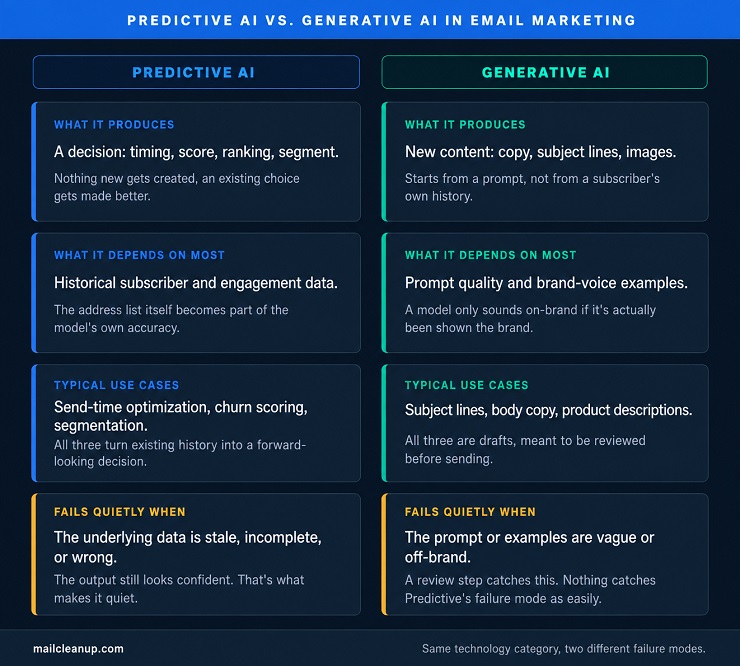
The row that matters most for the rest of this post is the third one. Predictive AI’s output is only as reliable as the data feeding it. That means the address list and engagement history behind your email program become part of the model’s own accuracy. They aren’t just a delivery mechanism sitting underneath it. Generative AI has a different failure mode entirely, one that has more to do with prompting and review than with list quality.
Picking the right AI for email marketing starts with knowing which category actually fits the problem you’re solving. Later sections in this guide, particularly the one on common mistakes, treat these two failure modes separately. A clean list fixes one and does nothing for the other.
How to Use AI in Email Marketing
Knowing how to use AI in email marketing starts with matching the right category to the actual problem in front of you. Predictive AI and generative AI solve different problems, and a program usually ends up needing both. A real program will need five things from AI in email marketing: content, personalization, timing, scoring, and faster testing. Each one leans on it differently, and each one has its own concrete payoff.
AI Email Marketing for Content and Subject Lines
Generative AI for email marketing most commonly means producing a first draft. That covers subject lines, preview text, body copy, and product descriptions. The starting point is a prompt or a set of brand-voice examples, not a blank page.
The clearest case for this is volume. A catalog with several thousand SKUs used to mean either generic, templated descriptions or an unrealistic writing workload for one person. Generative AI can draft a first pass for every product from structured data: size, material, use case. That takes roughly the time it takes a person to write a handful by hand. The same logic applies to subject lines. Instead of one writer guessing at three variants to test, a model can generate ten in the time it takes to type the prompt. A person then picks and edits the strongest ones.
That editing step matters. AI email marketing content works best as a draft, not a finished product. A model trained on general internet text doesn’t know your brand’s specific voice unless you give it real examples to work from. Even then, a subject line that reads as slightly off can cost opens. The reader never gets far enough to notice the rest of the email. The best practices section later in this guide covers exactly how much review AI in email marketing content actually needs.
Personalization and Segmentation in AI-Powered Email Marketing
This is one of AI in email marketing’s most identity-dependent use cases. Personalization has existed in email for years without AI. A first name in the subject line, or a segment built from one rule: everyone in California, everyone who bought one product. AI-powered email marketing does something more specific. It clusters subscribers by actual behavior, not by a single rule a person wrote in advance. It can also rebuild those clusters continuously as new behavior comes in.
A retailer’s AI model might notice that a subscriber consistently clicks on outerwear, regardless of what the campaign was actually about. It can then start weighting that subscriber’s future recommendations toward outerwear, without anyone manually building the segment. A B2B program might use the same underlying approach differently. It flags which leads are engaging like someone close to a buying decision, versus a lead that’s just browsing. The output in both cases is the same: content, or a product block, chosen per recipient rather than per broad list.
This AI-based email marketing use case depends more heavily on identity data than most others do. A personalization engine has to know who it’s actually talking to. An address that looks individual but isn’t, a shared team inbox, for instance, can quietly skew what the model believes about that subscriber. The common mistakes section later in this guide covers exactly how that happens.
Send-Time Optimization With AI-Driven Email Marketing
Send-time optimization is one of AI in email marketing’s most data-sensitive applications. Instead of sending an entire list at one fixed time, a model predicts the best moment to reach each subscriber individually. That prediction is based on when that person has actually engaged before. One subscriber’s ideal time might land on 7 p.m., another’s on 6 a.m. The campaign then goes out in staggered waves, rather than all at once.
The model’s raw material is historical engagement data, largely open and click timestamps. That’s where a mechanism most guides never mention comes in. Apple’s Mail Privacy Protection automatically retrieves a message’s content shortly after delivery, including the tracking pixel that records an open. It does this whether or not the subscriber ever actually looks at the email. Open rate reported for an Apple Mail user isn’t a reliable signal of when, or whether, a human actually read anything. That’s worth flagging every time open rate comes up as a metric in this guide. Apple Mail represents a meaningful share of most lists.
For an AI-driven email marketing model built on send timing, that’s not a minor data quality issue. Every one of those automated pre-fetch opens gets logged as a real engagement event. The timestamp reflects whenever Apple’s servers happened to process it, not when the person actually read the email. A model trained on that mixed population, without accounting for it, can learn a distorted version of when its audience engages. Predicted send times end up clustering around infrastructure behavior instead of human habit. This is a data problem address verification alone doesn’t catch, since every address involved might be completely valid. The common mistakes section covers how to actually account for it.
Predictive Analytics in AI-Based Email Marketing
Predictive analytics is the most cumulative use case in AI in email marketing. It doesn’t look at one signal, like a single open or click. It aggregates a subscriber’s full history into a longer-term forecast instead, like churn likelihood or lifetime value. It can also estimate how sales-ready a lead actually is.
If you run a subscription business, you might flag a customer as churn-risk. The signals could be declining opens, longer gaps between purchases, and fewer site visits. No single signal triggers the flag alone. A B2B program can score inbound leads the same way. It weighs email engagement alongside website behavior and firmographic data to rank who’s actually close to a purchase decision. Both examples turn scattered data points into one usable number a team can act on.
Predictive analytics draws on the longest history of any use case covered here. That’s also what makes it the most sensitive to how clean that history is. A single stale or invalid address sitting in the training data doesn’t just affect one prediction. It skews every pattern the model has learned from that address over time. The common mistakes section covers exactly how that compounds.
A/B Testing in Email Marketing With AI
Manual A/B testing usually means picking one variable, a subject line or a send time. Then it means testing two versions against a small slice of the list. AI changes what’s practical to test. Instead of one variable at a time, a model can test several simultaneously: subject line, send time, and call-to-action together. It then routes the strongest combination to the remaining list automatically.
You might manually test three subject line options over a week and call it done. Email marketing with AI can test ten variants across a smaller sample overnight. It can declare a winner before the manual version would have even finished its second round. The speed doesn’t just save time. It means more of a campaign’s total volume goes to whichever version actually performs, rather than to whichever version a person guessed first.
This use case carries a different kind of risk than the others in this guide. AI in email marketing testing infrastructure doesn’t get smarter by testing against a bad list. It just reaches more of that bad list faster. Accelerated testing is a multiplier on whatever a program already has, in both directions.
Benefits of AI in Email Marketing
AI in email marketing use cases translate into concrete benefits once they’re actually running well.
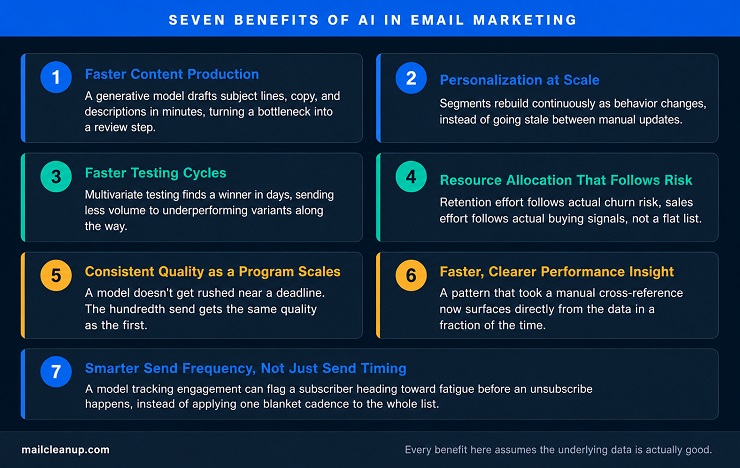
- Faster content production: A generative model can draft subject lines, body copy, and product descriptions in minutes. For large catalogs or high-frequency sending programs, that can turn your bottleneck into a review step instead.
- Personalization at a scale manual segmentation can’t reach: Building a hundred behavioral segments by hand isn’t realistic for most teams. AI for email marketing rebuilds those segments continuously, which means personalization stays current as behavior changes instead of going stale between manual updates.
- Testing cycles measured in days, not weeks: Multivariate AI testing finds a winning combination faster than sequential manual tests ever could. That means a campaign spends less send volume on underperforming variants, and more on the one that actually works.
- Resource allocation that follows real risk and value: Predictive scoring lets your team focus retention effort on subscribers actually likely to churn. It does the same for sales effort, prioritizing leads that are actually close to converting. Neither list nor pipeline has to get treated as one undifferentiated group.
- Consistent quality as a program scales: A human team’s output quality tends to dip as volume grows, more SKUs, more segments, more campaigns, without a proportional rise in headcount. A model doesn’t get tired or rushed near a deadline. The hundredth personalized send in a batch gets the same quality of input as the first.
- Faster, clearer insight into what actually drove performance: A team could manually cross-reference which subject line, segment, or send time correlated with a lift. AI-powered email marketing tools can surface that pattern directly from the data instead. The whole process takes a fraction of the manual time.
- Smarter send frequency, not just send timing: Send-time optimization decides when to reach someone in a day. A related but distinct benefit is deciding how often across a week or month. A model tracking individual engagement can flag a subscriber heading toward fatigue before an unsubscribe happens. That beats applying one blanket cadence to the whole list.
Every one of these AI-driven email marketing benefits assumes the underlying system is working from good data. The next two sections cover what that actually takes, and what tends to go wrong when it’s missing.
Best Practices for Using AI in Email Marketing
Getting real value from AI in email marketing depends on a handful of practices that have nothing to do with which tool you pick. They matter regardless of vendor, and they show up repeatedly in the use cases covered above.
Keep a Human in the Loop When Using AI for Email Marketing
Using AI for email marketing responsibly starts with review, before anything goes out. That’s a basic discipline for AI in email marketing generally, not just one use case. A model doesn’t know your legal or compliance constraints unless someone checks for them.
Consider a generated subject line using urgency language, “only 2 left,” when that isn’t actually true. The model produced fluent, persuasive copy. It just wasn’t accurate, and sending it creates real risk beyond a bad open rate. The fix isn’t avoiding generative AI. It’s building review into the workflow instead of treating a draft as finished.
Predictive decisions need the same scrutiny, just at a different scale. Reviewing every individual segment assignment isn’t practical on a list of any size. Spot-checking a sample regularly is. If a personalization engine keeps making the same category of mistake, a small sample catches that early, before it compounds across an entire send.
Test Before You Scale AI-Driven Email Marketing
This is different from the accelerated content testing covered earlier in this guide. That was about testing campaign variants. Testing before scaling matters most for AI-driven email marketing systems that make decisions on their own, not just campaigns a person reviews before sending.
A new send-time model, a new segmentation approach, a new scoring system. Each one changes how AI in email marketing actually behaves inside your program. Rolling any of them out to 100% of a list on day one means finding out what’s wrong at full scale. It’s not a small one to test against. Piloting on 5 to 10% of a list first limits how much damage an unexpected result can do. Testing it against a control group getting the existing approach makes the comparison real.
Two or three send cycles is usually enough to tell whether a new approach is actually working before scaling it further. That’s a small cost against the alternative. An untested model rolled out across an entire list means finding the problem after it’s already been sent.
Be Transparent When Using AI in Email Marketing
Subscribers don’t need a technical explanation of how AI in email marketing works behind a send. They do notice when something feels off. Generic copy that doesn’t match how a brand normally talks is one example. Urgency claims that turn out to be false are another.
Avoid false scarcity and urgency claims a generative model might produce on its own. Avoid presenting AI-drafted content as personally written by a named individual if that would be misleading to the reader. Regulation in this space is still developing, and requirements vary by region. Treat this as a baseline, not a substitute for checking what actually applies to your program.
Feed AI Email Marketing Tools a Real Brand-Voice Foundation
This is different from reviewing output after the fact. A model’s first draft is only as on-brand as the examples and guidance it was given. Get the input side right, and the review burden from the previous practice gets a lot lighter.
A real style guide produces something much closer to usable on the first pass. Actual examples of past sends that worked, specific words and phrases to avoid, tone notes for different campaign types, all help. AI in email marketing doesn’t know your brand until you’ve actually shown it.
Treat this as something to update periodically, not set once. Brand voice shifts over time, a new product line, a new audience segment, a rebrand. A style guide from two years ago trains a model on a brand that no longer exists.
Set the Actual Business Goal Before You Deploy AI for Email Marketing
A model optimizes for whatever metric it’s given, and that metric isn’t always the one that actually matters. A send-time model tuned purely for open rate can hit its own target and still miss the point. Open rate doesn’t always track with revenue. It’s also worth remembering that Apple Mail Privacy Protection inflates open rate for a meaningful share of most lists.
Define the real goal before turning AI in email marketing loose on a use case. Revenue per send, retention, qualified leads passed to sales, whatever actually matters for that specific program. Then check performance against that number periodically, not just against whichever metric the tool happens to report by default.
This matters most for the two most cumulative use cases covered earlier: predictive scoring and personalization. Both can look like they’re succeeding by a proxy metric while missing the actual business outcome entirely.
None of these five practices requires special tooling. They require someone to actually do them, consistently, as the program scales rather than only when it’s new.
Common Mistakes While Using AI in Email Marketing
Common mistakes with AI in email marketing tend to cluster around one root cause. The technology gets treated as more self-sufficient than the data behind it actually allows.
Scaling AI-Driven Email Marketing Sends Without Verifying the List First
Every AI-driven email marketing use case in this guide depends on data quality to some degree. They don’t depend on it the same amount, though, and treating them as equally risky misses where the real exposure actually sits.
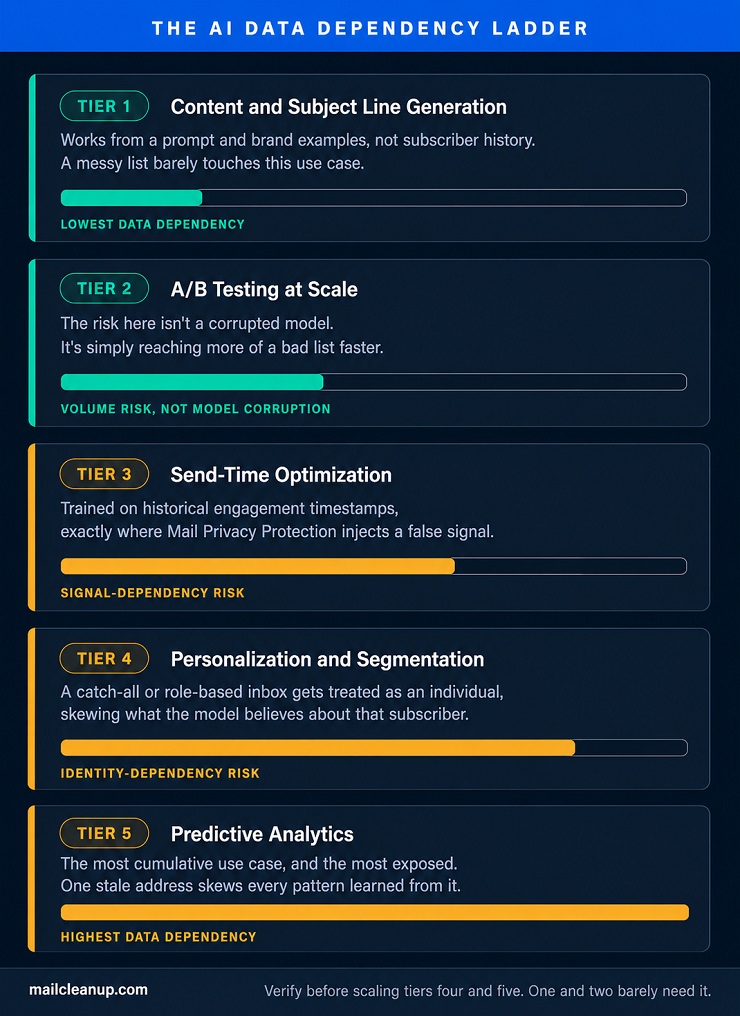
The AI Data Dependency Ladder ranks the five use cases by how much data quality actually affects their output. Least dependent to most:
- Content and subject line generation. Works from a prompt and brand examples, not subscriber history. A messy list barely touches this use case.
- A/B testing at scale. The risk here isn’t a corrupted model. It’s simply reaching more of a bad list faster, as covered earlier in this guide.
- Send-time optimization. Trained on historical engagement timestamps, exactly where Mail Privacy Protection injects a false signal, covered in detail above.
- Personalization and segmentation. Depends on knowing who’s actually behind an address. A catch-all or role-based inbox gets treated as an individual, skewing what the model believes about that subscriber.
- Predictive analytics. The most cumulative use case, and the most exposed. A single stale or invalid address in the training data skews every pattern the model has learned from it, compounding over time.
Our own verification data puts a real number on this. Across roughly 653,000 addresses MailCleanup processed over a recent two-month period, more than 1 in 4 came back undeliverable, accept-all, or unknown. Those are address types that fall squarely into tiers four and five of the ladder above. Accept-all addresses alone, the exact type a personalization engine is most likely to misread as an individual inbox, made up about 1 in 13.
Our guide to email verification covers what these result categories actually mean and how they get identified. The mistake this section is named for isn’t using AI in email marketing on tiers four and five. It’s doing so without checking which addresses belong to which result category first.
Trusting Corrupted Send-Time Data in AI-Powered Email Marketing
The mechanism covered earlier, Apple’s Mail Privacy Protection creating false opens, isn’t the only source of corrupted data feeding AI in email marketing models. Corporate security scanners do something similar. Many companies automatically open and scan incoming email before a human ever sees it. The scan includes any tracking pixel, done for security reasons that have nothing to do with genuine interest.
Both sources create the same downstream problem: an engagement timestamp that reflects automated infrastructure, not a person reading an email. A send-time model can’t tell the difference between the two without being told to look for it.
Left unaddressed, this compounds. A model that retrains on its own predictions treats a batch of automated-open timestamps as confirmed successes. It then optimizes future sends around that same distorted pattern. Each retraining cycle can reinforce the distortion rather than correct it.
Weighting click-through more heavily than raw opens helps. A click requires an actual action a scanner or pre-fetch typically doesn’t take. Treating an unusually clean, tightly clustered open-time pattern with some skepticism helps too, since real human behavior tends to be messier than that. It’s a small, mechanical fix, but it matters for any AI-powered email marketing program relying on send-time predictions.
Over-Personalizing With Thin Data in AI Email Marketing
Getting AI for email marketing personalization right means waiting for enough signal, not rushing it. A personalization engine needs enough real signal to work from. AI in email marketing can’t shortcut that requirement. Deployed too early against a new subscriber, the result usually goes wrong in one of two directions.
The first is generic output that doesn’t actually reflect the person, despite looking personalized on the surface. The second is overfitting to a single data point. That’s a genuine risk for any AI email marketing program still building up real history on a subscriber. A subscriber who bought one item as a gift can get permanently typed around that one purchase. The recommendations that follow can have nothing to do with what they’d actually buy for themselves.
Setting a minimum interaction threshold before enabling deep, individual-level personalization avoids both problems. Until a subscriber crosses it, broader segment-level personalization is the safer default, close enough to be useful without overreaching on a single data point.
Scaling AI-Based Email Marketing Volume Without Watching Deliverability
AI in email marketing increases how much a program can realistically send, more content variants, more tests, more personalized sends. None of that increased volume helps if deliverability signals aren’t being watched at the same time.
MailCleanup’s own dataset processed only 5 spam traps out of 653,000 addresses, a genuinely small count. The finding worth remembering isn’t the count. It’s that even a handful can meaningfully damage sender reputation once mailed. Higher AI-driven volume means reaching whatever traps are on a list faster than a smaller, slower program would.
Our guide to email deliverability covers bounce rates, spam complaints, and sender reputation in full. The short version for this guide: rising send volume is a reason to check those signals more often, not less. AI-based email marketing accelerating a program’s output is exactly the kind of change that warrants a closer look.
Choosing AI Email Marketing Tools for Your Use Case
Which AI email marketing tool actually fits depends on the use case above, more than on which platform has the longest feature list.
Ecommerce businesses tend to lean toward platforms built around predictive personalization and product recommendations. Klaviyo and Omnisend both fall into that category. Each builds AI-driven segmentation and send-time features around purchase history and browsing behavior, the kind of data an ecommerce program generates constantly.
Smaller lists and leaner budgets fit differently. MailerLite offers a lighter set of AI in email marketing features. Subject line generation and basic send-time optimization come without the complexity of a full predictive suite.
B2B programs tend to weigh lead-scoring and firmographic data more heavily than pure personalization. AI-powered email marketing platforms built for that audience, ActiveCampaign among them, structure their scoring features around that difference.
Content generation alone doesn’t require a platform switch. A general-purpose tool like ChatGPT works well paired with whatever ESP a program already uses. It covers subject lines and copy without switching platforms at all.
None of this is a full comparison. A dedicated breakdown of [the best AI email marketing tools and platforms] is coming soon. It’ll cover pricing, features, and which use case each one actually fits best.
Getting Started With AI in Email Marketing
Starting with AI in email marketing doesn’t mean adopting all five use cases at once. Pick the one already costing your team the most time. That might be content drafting for a busy send calendar, or manual segmentation for a growing list. Start there.
Pilot it on a small slice of your list before rolling it out fully. That’s true whether the use case is generative or predictive. It matters more the higher up the ladder covered earlier that use case sits.
One step matters regardless of which use case comes first: verify the list AI in email marketing will actually be working from. A model, predictive or generative, only performs as well as the data and addresses behind it, on day one as much as at scale.
Our email marketing guide covers the fundamentals this post builds on: campaign types, list building, and the basics of getting a program started. It’s useful if AI is being layered onto a program that’s still finding its footing more broadly.
FAQs on AI Email Marketing
What is AI in email marketing?
AI in email marketing refers to machine learning, generative or predictive, applied to decisions or content inside an email program. Generative AI drafts subject lines and copy from a prompt. Predictive AI turns a subscriber’s history into a decision, like a send-time recommendation or a churn score.
What should I include in an AI prompt for email marketing?
A useful prompt for AI for email marketing includes the audience, the offer, the goal, and the tone, not just a topic. Name who it’s for, what’s being promoted, and when the offer ends. Then add what action the reader should take next.
Does AI replace email marketers?
No. AI in email marketing can draft content, score subscribers, and suggest send times. It doesn’t set strategy, decide what to send, or know whether a message actually fits the audience. Every use case in this guide still depends on a person reviewing the output before it ships.
How do I keep AI-generated emails from sounding generic?
Feed AI email marketing tools a real style guide, not just a topic. Real examples of what’s worked before, specific words to avoid, and tone guidance for different campaign types all help. A model only sounds on-brand if it’s actually been shown what your brand sounds like.
Can AI help with email deliverability?
Yes, indirectly, by flagging spammy wording or sudden performance drops. Higher AI-driven email marketing volume also means reaching risky addresses faster. MailCleanup’s own data shows more than 1 in 4 verified addresses carry some real risk. AI helps with content, while a verified list still does the rest.
How do I start using AI in email marketing?
Start with one task that already takes the most time: drafting subject lines, building segments, or analyzing results. Pick one AI-powered email marketing use case and pilot it on a small slice of your list first. Expand once you’ve confirmed it’s actually working, before scaling to the full program.
What are the benefits of using AI in email marketing?
AI in email marketing offers faster content production and personalization at a scale manual work can’t match. It also means testing cycles measured in days instead of weeks, and resource allocation that follows real risk and value. All of it assumes the underlying data is actually good.
What AI email marketing tools are available?
It depends on the use case. Ecommerce brands often need strong predictive personalization and product recommendations. B2B teams weigh lead-scoring and firmographic data more heavily. Generative-only needs, like subject lines and copy, work with a much broader range of AI email marketing tools than personalization does.