
Most email copy fails for a boring reason. A subject line, a body, and a CTA are three different persuasion problems, each aimed at a reader in a different mental state. Most guides teach them as if they’re one continuous voice, and that mismatch is why technically “good” copy still gets deleted unread.
A subject line has about two seconds to convince a stranger their day is better for opening this message. The body then holds someone who already decided to give the email a chance. That’s an entirely different job: not convincing them to look, but delivering on what the subject line promised. The call-to-action solves a third problem again, neither attention nor trust, just a clean, specific instruction at the one moment a reader has both. Write all three as a single voice, and the result goes one of two ways. It either oversells the click and undersells the read. Or it plays it safe everywhere and earns nothing memorable anywhere.
This guide treats each part of email copywriting as its own problem. That means what each part is actually solving. It means the formulas that give it real structure when structure helps. And it means how the approach changes depending on who’s opening your email and why. Cold outreach, ecommerce, SaaS, nonprofit, and newsletter emails each need their own approach. One template doesn’t stretch across all of them.
TL;DR
- Email copywriting works best when the subject line, body copy, and CTA are treated as three separate persuasion problems, not one continuous voice.
- Plain-text and HTML emails call for different copywriting approaches, not just different designs.
- Six named formulas, AIDA, PAS, BAB, FAB, the 4 Ps, and storytelling, give email copy a different kind of structure for different situations.
- Cold outreach, ecommerce, SaaS, nonprofit, and newsletter emails each need copy written on their own terms. No generic template stretches across all of them.
- Well-formulated copy still underperforms when it reaches an unreachable or low-quality address, a factor no formula fixes. MailCleanup’s own research found this connection missing from every competing guide reviewed for this post.
What Is Email Copywriting?
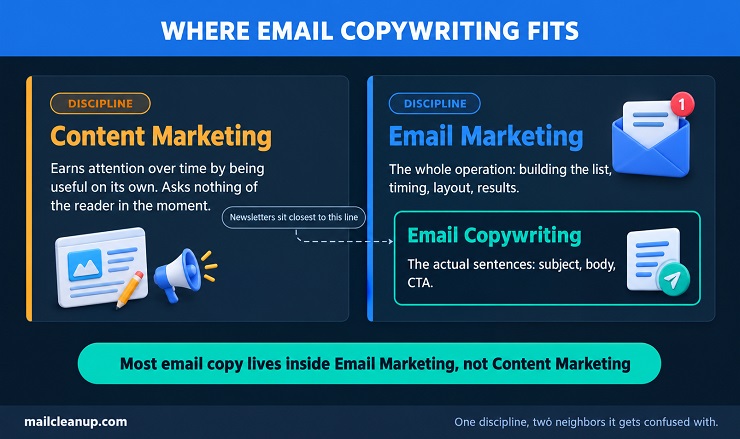
What is email copywriting, exactly? It’s the words inside an email: the subject line, the preview text, the body copy, and the call-to-action. Each one is written specifically to get a response after someone reads it. It sits inside two bigger disciplines this email copywriting guide keeps separate on purpose. Collapsing them together is where a lot of advice online goes vague.
Email marketing is the whole operation: building the list, deciding who gets which message and when, designing the layout, reading the results afterward. Email copywriting is one piece of that operation, the actual sentences, not the strategy around them. A perfectly targeted, perfectly timed campaign can still fail if the words inside it don’t hold up. A genuinely well-written email sent to the wrong list at the wrong time fails for reasons the copy never touched.
Content marketing is the other adjacent discipline, and the real distinction there is intent, not format. A blog post or a guide earns your attention over time by being useful or interesting on its own. It asks nothing of you in the moment. Email copywriting almost always wants something specific and immediate: open this, read this, click this.
A newsletter blurs the line more than most, since it often reads like content rather than a pitch. The words are still there to keep you subscribed and opening the next one. That’s a copywriting job wearing a content shape, not the other way around. Getting the distinction right matters for a specific reason: get it wrong, and the effort goes to waste in a predictable place.
- Treat copywriting like content marketing, and you get emails that inform but never actually ask for anything: opens with no clicks behind them.
- Treat copywriting like email marketing strategy alone, and you get emails that are perfectly targeted and badly written. Right person, right time, saying nothing worth reading.
- Treat email copywriting as its own discipline, distinct from both, and you close that gap on purpose instead of by accident.
Plain-Text and HTML Email Copywriting
Format is a decision this email copywriting guide treats as a copywriting choice, not just a design one. It changes what your words are allowed to do on their own, versus what they can lean on.
| Plain-Text | HTML | |
|---|---|---|
| Reads to the recipient as | A message from a person | A message from a campaign |
| Genuinely best for | Cold outreach, follow-ups meant to feel one-to-one | Visual products, anything where brand recognition itself persuades |
| What your copy alone has to do | Everything: no image or button shares the load | Guide the eye toward one action alongside the design |
| Real cost | Nothing to lean on but the sentences | Breaks the moment rendering fails or an image loads slowly |
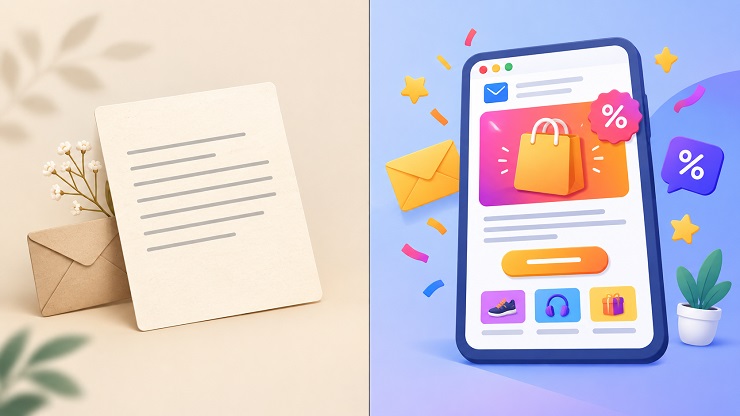
The pattern in that table is really about how much weight your sentences alone are carrying. Plain-text puts all of it on the words; HTML lets the words share the job with everything else on the page. Neither format is better in the abstract, only better for the specific message you’re sending.
A growing middle ground is worth naming directly: HTML emails built to look like plain-text. Minimal styling, a text-first layout, at most one small logo. They keep the personal read of plain-text while still tracking opens and clicks the way HTML allows. Welcome sequences and B2B nurture emails increasingly default here, splitting the difference rather than picking a side.
How to Write Email Copy
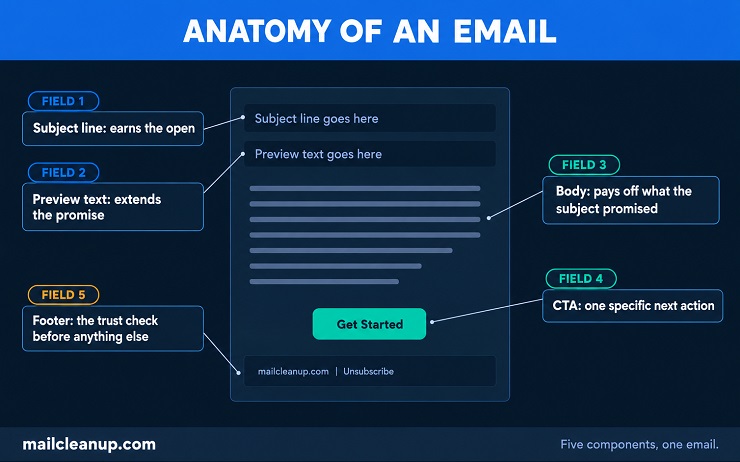
Every email breaks down into the same handful of pieces, and writing each one well is a different skill. This email copywriting guide treats each piece as its own problem, in the order a reader actually meets them.
How to Write Subject Lines
A subject line works when it passes one test. Is it specific enough that skipping it costs your reader something real, or vague enough that curiosity does the work? The failure sits in between, specific enough to reveal everything, vague enough to promise nothing. “Your order has shipped” passes the first way. “You’ll want to see this” passes the second way. “Some updates on your recent order” passes neither, which is exactly where most subject lines actually die.
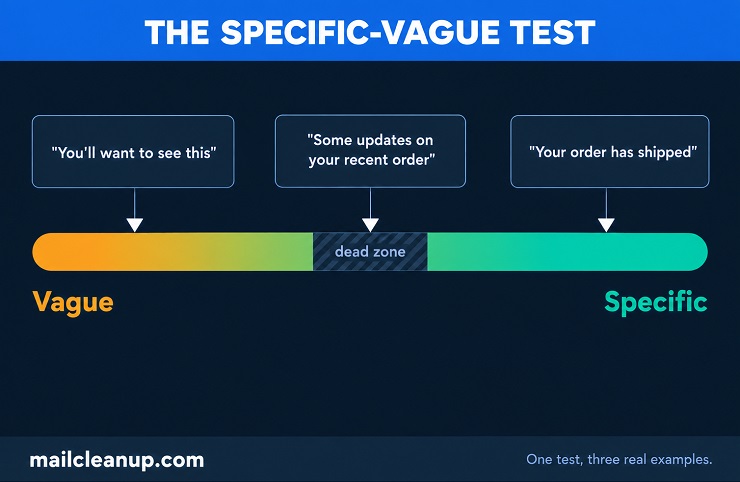
Curiosity is one emotional trigger. Urgency, FOMO, and mild loss-aversion work the same underlying way, giving a reader a reason to open that isn’t purely logical. “Your cart expires in an hour” works by making inaction feel like an active loss, not just a missed chance.
From there, a few concrete techniques make the real difference. This email copywriting guide keeps them practical, not theoretical:
- Personalize past the first name. Reference something specific to that reader: a recent order, a plan they’re on, a page they viewed. That goes further than swapping in their name for a generic greeting.
- Keep it short enough to survive a phone. Most inboxes truncate well before a desktop screen would, so the words doing the real work need to land early, not at the end.
- Skip the words that get you flagged before you’re even read. “Free,” “guarantee,” and “act now” trip spam filters regardless of how well the rest of the line is written.
- Use emojis carefully, if at all. The data on whether they lift open rates is genuinely inconsistent. Studies disagree on both direction and size, so treat any specific percentage you come across with real skepticism. What holds up across sources instead: match your audience and brand tone, and test on your own list rather than trusting someone else’s result. Check how it renders across different inboxes too, before you send.
- When you’re stuck, try a simple structure. A name, an action verb, the actual benefit, and a hint of urgency or curiosity, in that order. It won’t fit every subject line, but it’s a real starting point when a blank cursor is the actual problem.
Testing and structure make up the rest of what actually moves a subject line’s open rate. Our best practices for email subject lines covers both in the depth the data supports.
How to Write The Preview and Preheader Text
Preview text and preheader text get used interchangeably, but they’re not quite the same thing. Preview text is the snippet an inbox shows after the subject line. It’s pulled from whatever text comes first in the email, unless you write it deliberately. Preheader text is a short line of hidden copy placed specifically to control what that snippet says. It’s used when the visible first line of the email itself isn’t the right thing to show.
Skip writing either one, and most inboxes pull your unsubscribe link or a stray line of footer legal text into that space instead. That’s a wasted opportunity dressed up as a technical default.
Once you’re deciding what preview text to write, this email copywriting guide comes back to one real choice. Extend the subject line, or repeat it. A repeated preview text, essentially the subject line rephrased, tells a reader nothing they didn’t already decide on. An extended one adds a second, different piece of information, so the two lines together do more convincing than either alone.
- Subject “Your cart is waiting” + preview “still 20% off through midnight” extends the promise.
- The same subject + preview “come back and check out” just repeats it in fewer words.
How to Write The Email Body
The body is where a subject line’s promise gets paid off or exposed as a trick. It carries more separate jobs at once than most drafts account for.
- One sentence, one job: Every sentence in an email body is informing, persuading, or transitioning to the next thought. A sentence trying to do two of those at once usually does neither well.
- Benefits carry the sentence, features support it: A feature describes the product. A benefit describes what changes for your reader because of it. Copy that leads with benefits and backs them with features reads as reader-focused rather than product-focused.
- Second person does real work, not just politeness: Writing “you’ll save 20 minutes” instead of “users save 20 minutes” isn’t a style preference. It’s the difference between a reader picturing their own result and picturing someone else’s.
- Read it back out loud before it ships: A sentence that’s awkward to say is awkward to read, and this test catches problems that scanning silently misses almost every time.
None of these fixes the body on their own. Stacked together in the same email, they’re what separates copy written for one specific reader from copy written for a list. That’s the standard this email copywriting guide keeps coming back to.
How to Write The Call-to-Action
A CTA has one job: get your reader to do the next specific thing, not several possible things.
There are two genuinely different kinds worth separating. A hard CTA asks for the actual conversion right now: buy, sign up, book a call. A soft CTA asks for a smaller, lower-commitment step instead: learn more, read the guide, see how it works. Which one belongs in a given email depends on where your reader actually is, not on which one converts better in the abstract. A hard CTA aimed at someone who’s never heard from you before usually gets ignored. A soft CTA aimed at someone already deep into a purchase decision wastes momentum that was already there.
Specificity is what separates a working CTA from a decorative one. “Click Here” and “Learn More” tell a reader nothing about what happens next. “Get My 20% Code” or “See the Full Case Study” tell them exactly what they’re about to get. The button itself carries some of this weight too, sized and colored to be found without hunting. That’s why this email copywriting guide treats CTA design as part of the writing job, not a separate handoff.
How to Write The Email Footer
Most writers treat the footer as legal boilerplate and move on, which undersells what it’s actually doing. A footer is the last thing a skeptical reader checks before deciding whether an email is legitimate at all. A real physical address, a working unsubscribe link, and contact details that go somewhere real are all trust signals. A scam email usually can’t be bothered to fake them convincingly.
The unsubscribe link specifically isn’t optional copy. It’s a legal requirement in most places email marketing happens. Burying it doesn’t just annoy your reader, it’s the kind of thing that puts an entire sending domain at risk, not just one email.
Beyond the required elements, a footer is a quiet place to reinforce identity. A tagline, a one-line mission statement, social links for a reader who wants more contact than one email provides. None of it needs to convert anything. It just needs to hold up under a skeptical glance. That’s the same standard this email copywriting guide applies to every component, the footer included.
Choosing an Email Copywriting Formula
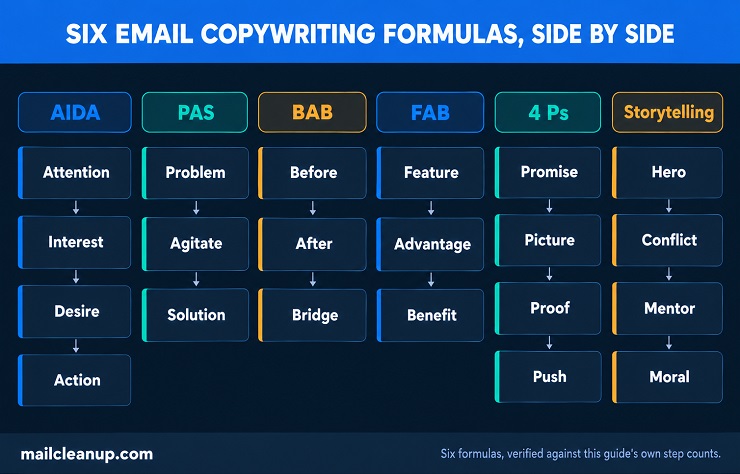
A formula isn’t a script to copy word for word. It’s a proven sequence of persuasion steps, tested across thousands of emails, that gives you a starting structure instead of a blank page. This email copywriting guide covers six worth knowing, what each one does differently, and which kind of email it actually fits. Each one comes with a short email copywriting example, and doubles as one of the email copywriting templates you can reuse directly.
Email Copywriting Using AIDA
AIDA breaks a sale into four stages: Attention, Interest, Desire, Action. It’s the oldest formula covered in this email copywriting guide, dating back over a century in advertising. It still works because it maps to how a reader’s mind actually moves from noticing something to acting on it.
- Attention interrupts the scroll: a subject line or opening line that breaks autopilot scanning through specificity or an unexpected claim, not volume.
- Interest makes that attention personal: not “here’s a feature” but “here’s why this matters to you specifically.”
- Desire connects that interest to an outcome the reader actually wants, not just wants to know about.
- Action is the smallest, most specific step you can ask for at that exact moment, not a vague invitation to “learn more.”
Template:
- Attention: [pattern-interrupt opener]
- Interest: [why this matters to them, specifically]
- Desire: [the outcome they actually want]
- Action: [one specific next step]
Example, cart abandonment:
- Attention: “You left something behind”
- Interest: “Still in stock, but almost gone”
- Desire: “Picture it already on its way to you”
- Action: “Finish Checkout”
AIDA works best for cold or unfamiliar audiences, where nothing can be assumed and the whole case has to be built in one email.
Email Copywriting Using PAS
PAS stands for Problem, Agitate, Solution. It’s built around a psychological reality this email copywriting guide keeps coming back to. A reader who feels a problem clearly is far more receptive to a solution than one who’s simply told about it.
Problem states the issue plainly, in the reader’s own terms, not the sender’s. Solution arrives only once the reader actually feels the weight of that problem, not before. Agitate is the step in between, and it’s the one most people either skip or overdo.
The line between real agitation and manipulation comes down to specificity versus escalation:
- “Your list is decaying” states the problem.
- “Every month you wait, more of it goes stale” agitates with a real, specific mechanism.
- “Your business is failing because of this” isn’t agitation, it’s manufactured panic dressed up as one.
Template:
- Problem: [the issue, in the reader’s own terms]
- Agitate: [the real, specific cost of leaving it]
- Solution: [the one clear way to solve it]
Example, re-engagement:
- Problem: “You haven’t opened an email from us in 90 days”
- Agitate: “That usually means our emails are getting buried, not that you don’t want them”
- Solution: “Tell us what you’d rather see, or we’ll stop sending”
PAS fits best when the reader already has the problem but hasn’t named it themselves. It falls flat against an audience that doesn’t have the problem at all, since agitating something that isn’t there just reads as pushy.
Email Copywriting Using BAB
BAB stands for Before, After, Bridge, and unlike PAS, it starts with the reward instead of the pain. Before describes the reader’s current, unsatisfying state. After paints the specific state once the problem is solved. Bridge is the one sentence connecting the two: your product or service, positioned as the thing that makes After actually happen.
The psychology behind it is straightforward. It’s why this email copywriting guide treats BAB as PAS’s mirror image. Showing someone a better version of their own situation creates its own pull, independent of anything negative about where they are now.
Template:
- Before: [the reader’s current, unsatisfying state]
- After: [the specific state once solved]
- Bridge: [your product, positioned as the reason After happens]
Example, welcome email:
- Before: “Right now, verifying an email list by hand takes hours”
- After: “With a CSV upload, the same list comes back clean in minutes”
- Bridge: “That’s what this tool does, start to finish”
BAB fits best for products with a genuinely clear, fast before-and-after story. It struggles for anything where the after state takes a long time or a lot of the reader’s own effort to reach. The contrast collapses under scrutiny at that point.
Email Copywriting Using FAB
FAB stands for Features, Advantages, Benefits. The formula’s whole value in this email copywriting guide sits in a distinction most copy collapses by accident. A feature and a benefit are not the same claim, and neither is an advantage.
A feature is a fact about the product. An advantage is what that fact does in general, true for anyone who uses it. A benefit is what that fact means for this specific reader, in their own situation. Most copy stops at advantage and calls it a benefit. That’s why so much of it feels correct but flat: true, without ever landing on what it means for the reader specifically.
Template:
- Feature: [a fact about the product]
- Advantage: [what that fact does, in general]
- Benefit: [what it means for this specific reader]
Example, verification tool:
- Feature: “Real-time syntax checking”
- Advantage: “Catches typos before you send”
- Benefit: “You stop losing subscribers to a single mistyped domain in your welcome sequence”
FAB works well anywhere a product has a real, defensible technical edge that competitors can’t easily claim. The format is built to walk a reader from fact to personal stake in three clean steps.
Email Copywriting Using the 4 Ps
The 4 Ps stand for Promise, Picture, Proof, Push. You’ll also see it written as Promise, Paint, Proof, Push depending on the source, same four steps under a slightly different second word.
- Promise states the specific outcome up front.
- Picture (or Paint) makes that outcome concrete enough for the reader to actually see it happening, not just hear about it in the abstract.
- Proof backs the promise with something verifiable: a number, a named result, a real example, not just a claim.
- Push closes with the specific action that gets the reader from proof to outcome.
Template:
- Promise: [the specific outcome, stated up front]
- Picture: [what that outcome actually looks like]
- Proof: [a real, verifiable number or result, never invented for the sake of the email]
- Push: [the specific action]
Example, product launch:
- Promise: “Verify a list in under five minutes”
- Picture: “Upload, wait, download, done”
- Proof: (a real, checkable number or named result goes here, not one made up for the example)
- Push: “Try It Free”
The 4 Ps fits products with a genuinely provable claim behind them. Without real proof to plug into step three, this email copywriting guide would call it an unsupported promise. That reads as marketing rather than information.
Email Copywriting Using Storytelling
Storytelling formulas trade a formula’s usual step-by-step logic for a narrative shape instead. They’re built around one structural choice: the reader is the hero, not the brand.
The clearest version borrows from classic story structure:
- A hero, the reader, has a goal.
- A conflict blocks that goal.
- A mentor, your brand or product, offers a way through.
- A moral or outcome follows because of it.
The brand’s job here is never to be the hero. It’s to be the guide who already knows the way. That’s a harder discipline than it sounds, since most product copy defaults to making the product the star.
Template:
- Hero (the reader): [their goal]
- Conflict: [what’s blocking it]
- Mentor (your brand): [how it offers a way through]
- Moral: [the outcome]
Example, welcome email:
- Hero’s goal: a clean list before the next campaign
- Conflict: the hours manual checking actually takes
- Mentor: the brand, offering a faster way through
- Moral: the campaign that finally lands the way it was supposed to
This email copywriting guide would point storytelling formulas at longer nurture sequences and brand-building emails, where there’s room for a real arc. They’re a poor fit for a single transactional email that needs one fast action, not a narrative.
Email Copywriting for Different Audiences
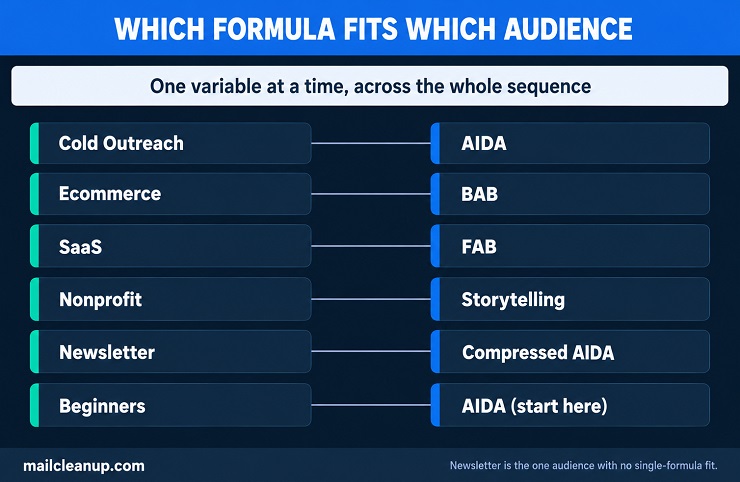
The techniques covered so far apply everywhere, but who’s actually opening the email changes which formula fits and how to apply it. This email copywriting guide shows each audience below as a worked application of the formulas already covered, not a separate checklist of tips.
Cold Email Copywriting
Cold email starts from zero trust, and that constraint points directly at a formula rather than a list of tips. AIDA is built for exactly this. It’s the formula this email copywriting guide leans on hardest here. A whole case, made in one email, for someone who can’t be assumed to know or want anything yet.
What changes for cold outreach specifically starts with Attention. It has to work on someone with zero context. Naming something true and specific about them or their company earns more than a clever opener would. Interest and Desire both stay grounded in relevance rather than excitement, since there’s no existing goodwill to borrow from. Action is almost always a soft ask, since a hard ask this early is why most cold pitches get ignored before they’re finished.
Cold email using AIDA:
- Attention: “Noticed your team is still verifying lists by hand”
- Interest: “That’s usually a few hours a week most teams don’t track”
- Desire: “A clean list back in minutes instead”
- Action: “Worth 15 minutes to see if this would help?”
One more piece belongs in the writing job itself, not as an afterthought: the follow-up. Most replies come from the second or third message, not the first. A short, different-angle follow-up two or three days later is as much a part of writing cold email well as the original AIDA structure.
Cold email also carries more deliverability risk than an opted-in list. A message with no prior engagement signal gets more scrutiny from spam filters. Our breakdown of verification across different sending scenarios, cold outreach included covers this risk in more depth.
Ecommerce Email Copywriting
Ecommerce email starts from the opposite position. The recipient already showed real interest: browsing, adding to a cart, or buying before. That’s exactly the situation BAB is built for. It contrasts where a reader already stands against where they’d rather be. That’s different from building desire from zero, the way AIDA does for cold outreach.
What changes for ecommerce specifically: After is worth showing visually, not just describing, given ecommerce is where HTML format earns its complexity. Bridge is also where real urgency belongs, and it only works when it’s true. “3 left in stock” or “free shipping ends tonight” describes an actual fact. A countdown timer for a sale that never really ends teaches a reader to ignore every future one. That’s the same specificity-versus-manipulation line PAS draws for agitation.
Ecommerce email using BAB:
- Before: “Still deciding?”
- After: “Picture it arriving this week, free shipping included”
- Bridge: “Complete your order, no code needed”
Cart abandonment is BAB’s most common ecommerce use, but it isn’t the only fit this email copywriting guide would point to. A PAS structure works just as well when there’s a real, nameable reason someone hasn’t bought yet. That’s a specific objection to address, rather than a general reminder to nudge past.
Deliverability matters here too: ecommerce lists decay fastest around big sale periods, when list growth spikes with addresses that were never fully engaged. This section covers email copywriting for ecommerce specifically. For the broader question of what to send and when, our ecommerce email marketing guide covers that ground instead.
SaaS Email Copywriting
SaaS email copywriting is where FAB earns its keep most directly. The product is often feature-rich and technical, sold to an audience that reads specs closely. FAB’s whole structure exists to walk that audience from a technical fact to a personal reason to care.
What changes for SaaS specifically starts with Feature. The audience tolerates technical precision more than almost anywhere else in this email copywriting guide. It can stay genuinely technical rather than getting simplified away. Benefit still has to land on something personal though: an account, a workflow, a specific next campaign, not a generic productivity claim. That’s the step most SaaS copy skips by stopping at Advantage and calling it done.
SaaS email using FAB:
- Feature: “Automatic re-verification on a rolling 90-day schedule”
- Advantage: “Your list stays current without anyone remembering to re-check it”
- Benefit: “Your next campaign doesn’t quietly lose reach to addresses that went stale since you last uploaded”
Onboarding emails are the exception worth naming. The reader already signed up, so the job isn’t persuading anymore, it’s activating. A good onboarding email skips FAB’s full structure and goes straight to one specific instruction: “upload a CSV to see it work.” The broader case is already made by the signup itself.
Trial-ending urgency, when it shows up later in the lifecycle, has to be tied to an actual date. A trial genuinely ends, and treating that deadline honestly is also just accurate, the same real-urgency standard ecommerce holds itself to.
Nonprofit Email Copywriting
Nonprofit email inverts who plays which role in a story. That’s why this email copywriting guide treats it as storytelling’s most interesting case, not just another use of the same structure from earlier. The beneficiary is usually the story’s protagonist. The donor, the actual reader, becomes the mentor who made the outcome possible, not a spectator watching someone else’s story.
What changes for nonprofit specifically: the moral of the story has to land on the donor’s own role in it. Not just the beneficiary’s outcome. “We helped 200 families this year” describes an outcome with the donor written out of it. “You kept the lights on for one family through the coldest week of the year.” That writes the donor back in as the reason it happened.
Nonprofit email using storytelling:
- Hero (the beneficiary): a family behind on a winter heating bill
- Conflict: a shutoff notice with nowhere else to turn
- Mentor (the donor, reading this): funded the program that covered the balance
- Moral: the lights stayed on through the coldest week of the year
Segmentation matters more here than for most of the other audiences in this email copywriting guide too. A first-time donor, a lapsed one, and a recurring monthly donor are three different relationships. The same appeal rarely fits all three without feeling either presumptuous or forgettable.
Newsletter Email Copywriting
Newsletter email is the one audience in this email copywriting guide that resists a single whole-email formula. That’s worth stating honestly rather than forcing a fit. A newsletter usually bundles several separate items, a content roundup, an update, a small offer. Each item needs its own tiny hook more than the whole email needs one grand structure.
What actually works instead: give each item inside the newsletter a compressed version of AIDA. Just enough attention and interest to earn a click, not a full persuasion arc. A three-item roundup might run a one-line hook, a one-line reason to care, and one link. Repeat that shape for each item rather than building one sustained argument across the whole email.
One newsletter item, compressed:
- Hook: “We just published the deliverability numbers for Q3”
- Reason to care: “Bounce rates crept up industry-wide, here’s what changed”
- Link: “Read the breakdown”
The tone also runs closer to content than to a pitch. That’s where this email copywriting guide’s own definitional split from its opening section actually earns its keep. A newsletter reads more like something a reader chose to receive than something trying to sell them in the moment. Copy that forgets this and pushes too hard on every single item trains readers to skim past all of them.
Email Copywriting for Beginners
You don’t need a seventh formula to get started. You need the safest place to begin among the six already covered, and this email copywriting guide’s own answer is AIDA. It’s the most linear of the six, and each stage has an obvious job. It’s also harder to get wrong than PAS’s agitation step or FAB’s feature-to-benefit translation, both of which take real judgment to calibrate.
Three mistakes are worth watching for at this stage, more than which formula you pick:
- Writing to “everyone” instead of one specific reader in mind, which is what makes Interest and Desire feel generic instead of personal.
- Burying the one action that matters under two or three competing links, which undoes Action’s whole job.
- Polishing sentence-level word choice before the structure itself is sound, which is solving the wrong problem first.
Once AIDA feels automatic to you, the other five are worth learning. Different email types genuinely call for them, not because AIDA stops working.
Common Email Copywriting Mistakes
Seven mistakes show up more than any others in email copywriting, each costing more than the one email they’re in.
- Subject and body mismatch: A subject line that promises one thing while the body delivers another costs more than a single email. A reader who feels misled once reads every future subject line from you with more suspicion. That’s a self-inflicted version of the trust problem cold email already starts with.
- Sending without testing: A/B testing your subject lines and CTAs turns opinion into evidence. Skip it, and every future email keeps repeating whatever the last one happened to get right or wrong by chance.
- Overusing real urgency: This is a subtler trap than manufacturing fake urgency. Even a genuinely limited sale, run in every single email you send, teaches a reader that “limited” doesn’t mean anything specific anymore. The one time it’s actually critical, it gets ignored along with the rest.
- Images that fail to render: A blank block where your whole visual argument was supposed to be, with no alt text explaining what was there, is an HTML-specific risk. Plain-text doesn’t have anything to fail to load.
- Clustering spam-trigger words: No single word like “free” or “guaranteed” reliably flags an email on its own; filters weigh density and pattern, not a blacklist. The real risk is stacking several from one category, urgency, financial, or promotional, in the same email. “Act now, limited time, guaranteed savings” in one paragraph reads as a pattern, even though each phrase alone is common, legitimate marketing language.
- Inconsistent formatting from copy-paste: Pasting text from a doc or an old email without clearing its formatting leaves mismatched fonts, sizes, and colors sitting inside one message. It reads as sloppy at best, and inconsistent formatting is itself a pattern spam filters notice too.
- Language that could describe any brand: “Innovative solutions,” “seamless experience,” and “game-changing” say nothing a competitor couldn’t claim in the exact same words. The specificity this email copywriting guide argues for everywhere else, in subject lines, in FAB’s benefit step, applies here too. A claim only your reader could verify against your specific brand is the one that actually persuades.
This email copywriting guide treats all seven the same way: each one is fixable with one specific habit, not a full rewrite.
What Email Copywriting Can’t Fix
Every technique in this email copywriting guide assumes your email actually reaches an inbox a real person opens. That assumption is where the guide’s own limits sit, worth stating plainly rather than leaving it implicit.
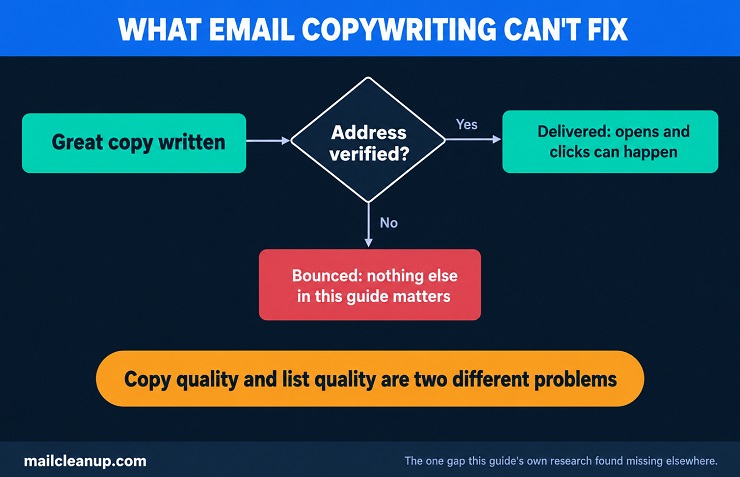
AIDA’s four stages, PAS’s careful agitation, BAB’s before-and-after contrast: none of it registers if the address fails. That happens when it bounces, lands in a spam trap, or reaches an accept-all address where nobody’s actually reading. The best cold email you write using this guide’s own advice still fails completely in one case. If the address behind it was never real to begin with, nothing else matters. Copy quality and list quality solve two different problems, and no formula bridges the gap between them.
This is also the one honest gap this whole research process found. Not one competitor guide fetched for this post connects list or address quality to copywriting effectiveness at any real depth. Not even the one verification company whose own formulas post mentioned it, in a single closing line. Our explainer on what email verification actually checks covers what “reachable” actually means beyond a valid-looking address. MailCleanup runs that check directly: upload your list, get back which addresses are safe to send to.
Putting This Email Copywriting Guide to Work
Start with whichever section actually applies to your next email due out, not the whole guide end to end. A cold outreach campaign due tomorrow needs the Cold Email Copywriting section and AIDA, not a full read of all six formulas first.
For copy you’ve already written and have sitting in a draft folder, two fast tests catch the most. Run the specific-versus-vague check from the subject line section, then read the body out loud once before you send. Both catch more than a spelling check would.
One step belongs before any of it though, given everything the previous section just covered. Check whether the list you’re sending to is actually worth writing for in the first place. This email copywriting guide is one part of a broader look at email marketing as a whole. It’s worth reading next if you’re starting from scratch, rather than fixing one specific email.
FAQs on Email Copywriting
What is email copywriting?
Email copywriting is the words inside your email itself: the subject line, preview text, body copy, and call-to-action, written to get a specific response. It’s distinct from email marketing, the whole campaign operation, and from content marketing, which asks nothing of the reader in the moment.
What makes email copy effective?
Effective email copy gives each part its own distinct job. The subject line, the body, the CTA: none of them get written in one uniform voice. A named formula like AIDA or PAS supplies real structure. Personalization goes beyond a first name, and no formula fixes copy sent to an unreachable address.
How long should a marketing email be?
Length depends on the email type more than one universal number. Promotional emails run roughly 50-150 words to drive one click. Newsletters run 200-500 words since they cover several items; transactional emails stay closest to 50-125 words. Cold outreach specifically tends to perform best under 100 words.
What’s the best email copywriting formula to start with?
AIDA is the safest starting point if you’re new to this. Its four steps run in a straight, predictable line. That’s easier to execute correctly than the subtler calls other formulas ask for. How hard to push in PAS, or how specific to get in FAB, both take more judgment. Learn AIDA first, then branch out.
How do I write email copy for ecommerce specifically?
Ecommerce copy starts from a warmer position than cold outreach. Your recipient has typically engaged with the brand already, through a visit, a saved item, or a past order. The job is removing friction from a decision already underway, not building a case from zero. Real urgency, actual stock levels or real deadlines, works better than a manufactured countdown timer.
How can I improve my email copywriting skills?
Picture one actual reader before writing anything, not a general audience. Vague copy is usually a symptom of that, not a wording problem on its own. Read your finished copy aloud before sending, since awkward-to-say sentences are usually awkward to read too. A/B test your subject lines and CTAs rather than guessing.
Does personalization actually improve email copywriting results?
Personalization helps most when it goes beyond a first name. Referencing a specific order, plan, or page a reader visited works harder than a mail-merge greeting. Cold outreach depends on it especially. A personalized opening is often the only signal a stranger gets that your email wasn’t sent to a thousand other people too.
Should I use AI tools for email copywriting?
AI tools can help you draft variations quickly or brainstorm subject lines. They don’t know your specific audience’s real objections or your brand’s actual voice without real input. They’re most useful for a first pass or getting past a blank page, not a finished, sent-as-is email. Judgment calls like calibrating PAS’s agitation step still need a person.