
Most articles about the cost of email bounces open with a hypothetical. Say you send 100,000 emails. Say your bounce rate runs at 4%. Say your average order value is $75. The math that follows might be sound, but every input is a guess wearing a data costume.
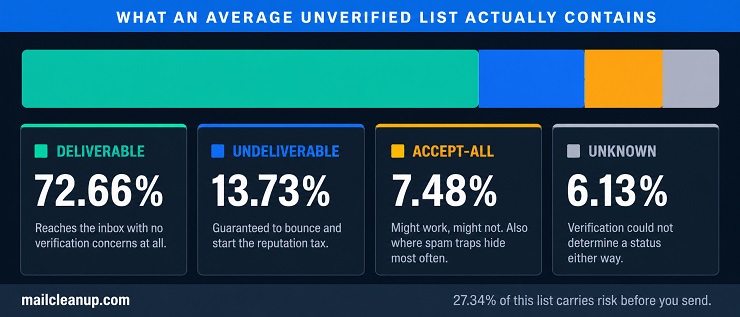
We can do better than that, because guessing isn’t something we have to do. Across 653,070 addresses we verified over a recent two-month stretch, 13.73% came back Undeliverable. Those are addresses our checks confirmed don’t exist, can’t receive mail, or point at a domain that’s gone. That’s not a hypothetical bounce rate plugged into a spreadsheet. That’s what an average unverified list actually contains before anyone clicks send.
Here’s the part most of that hypothetical math misses. Not every risky address in a list carries the same kind of risk. Treating them as one undifferentiated “bounce rate” number hides more than it reveals. An Undeliverable address is a confirmed, compounding cost. You already paid to send to it, and it keeps taxing your reputation on every campaign after that, until you remove it. An Accept-All or Unknown address is a different animal, uncertain rather than confirmed. It deserves different math, not the same average multiplied across your whole list.
TL;DR on Cost of Email Bounces
- MailCleanup’s own verification data across 653,070 addresses shows 13.73% of an average unverified list comes back confirmed Undeliverable. Another 13.61% sits in uncertain territory, Accept-All and Unknown combined.
- An Undeliverable address carries a confirmed, two-part cost. The wasted send is the smaller piece. The larger one is a reputation tax that lowers inbox placement on every campaign sent afterward, until the address is removed.
- Accept-All addresses carry a specific added risk beyond the ordinary uncertain cost: they’re where spam traps hide most effectively. This guide’s own dataset confirmed 5 across 653,070 addresses.
- The cost of email bounces compounds rather than staying flat. Bounce rate functions as an ongoing sender-reputation signal, so a high rate on one send lowers inbox placement on the sends that follow. Lists also decay on their own, even after a clean.
- The confirmed and uncertain shares can be calculated for any list. Multiply list size by 13.73% and 13.61% respectively for a real, list-specific number instead of an industry average.
- Verification addresses both halves at once. It removes the confirmed cost outright and converts the uncertain cost from a guess into an active decision.
What Actually Counts as the Cost of Email Bounces
Ask five people about the cost of bounced emails and you’ll get five different answers. That’s because “bounce” gets used as a catch-all for several different things. A hard bounce and a soft bounce are mechanically different failures with different causes. This article won’t re-cover that distinction; soft bounces versus hard bounces already covers it in full. What matters here is narrower: not what causes a bounce, but what it actually costs you once it happens. That cost isn’t identical for every risky address on your list either.
When you run a list through verification, every address lands in one of several result categories. Our breakdown of what each verification check actually finds covers all of them individually. For the cost of email bounces specifically, two categories matter most to you, and they matter for different reasons. Here’s how they actually compare, before either one gets its own dedicated math further down.
| Result Category | What Verification Confirmed | Certainty | What Happens If You Send Anyway |
|---|---|---|---|
| Undeliverable | The mailbox doesn’t exist, the domain is dead, or mail can’t land there at all | Confirmed | It bounces, every time, no exceptions |
| Accept-All & Unknown | The server accepts everything regardless of validity, or a status genuinely couldn’t be determined | Uncertain | It might land fine. It might also become a spam trap, or sit in a dead mailbox quietly hurting your engagement instead |
That right-hand column is really the whole argument in miniature. One side of this table gets a definite answer before you ever click send. The other side doesn’t. That gap is exactly why lumping both into a single bounce-rate number costs you the accuracy this guide is built to give back.
This is exactly where most estimates of the cost of a high bounce rate go wrong. They take one overall bounce rate and multiply it by an assumed dollar value per email. That collapses a confirmed cost and an uncertain cost into a single blended number. The rest of this guide keeps them separate and works real numbers for each. That builds on the operational groundwork our email bounce management guide already covers.
The Confirmed Cost of Email Bounces: What Your Undeliverable Addresses Are Costing You
Start with the certain part. An Undeliverable address isn’t a maybe. Verification already confirmed it can’t receive mail, so if it’s still sitting in your list when you hit send, it bounces. Every time. The confirmed cost of email bounces breaks into two pieces, and only one of them is obvious.
The Direct Cost of Email Bounces: What You Already Paid For
You paid your ESP to deliver a message that never had a chance of arriving. That’s the most direct piece of the cost of email bounces, and also the easiest to calculate. Depending on your platform, it might mean a wasted credit or a wasted slot in your monthly send allowance. It can also mean wasted time building a campaign a chunk of your list was never going to see.
On its own, this piece is usually small. If your ESP charges by volume, a 13.73% Undeliverable rate on your list is real revenue lost to email bounces on every single send. That figure roughly matches what we see across our own verified data. It’s rarely the number that should worry you most, though, and the next section explains why.
The Reputation Tax: The Hidden Cost of Email Bounces
Gmail, Yahoo, Outlook, and every other major mailbox provider track how often mail sent from your domain bounces. They use that rate as a trust signal. A high bounce rate on one campaign doesn’t just cost you that campaign. It tells the receiving server your list quality is questionable. That server then starts routing more of your future mail to spam, even mail sent to addresses that were never a problem. This is the cost a per-send calculation misses entirely. One bad address doesn’t cost you once. It costs you a little on every campaign you send until you find it and remove it.
That compounding effect is also why the true cost of email bounces is always higher than the sticker price of the send. A list with a 13.73% Undeliverable rate isn’t just wasting 13.73% of a campaign’s budget. It’s actively degrading inbox placement for the other 86.27% too, on that send and the ones that follow. That damage lasts for as long as those addresses stay on the list. Exactly how far it compounds, and what it takes to reverse once it’s already happening, gets its own section later in this guide.
Removing the Undeliverable share before you send doesn’t just stop the waste on that one campaign. It stops the reputation tax from accruing at all. That’s the part of the confirmed cost most bounce-rate math never puts a number on.
The Uncertain Cost of Email Bounces: What Accept-All and Unknown Addresses Are Costing You
Not every risky address in your list announces itself the way an Undeliverable one does. Accept-All and Unknown addresses make up 13.61% of an average unverified list, 7.48% and 6.13% respectively, and neither comes with a guarantee either way. That uncertainty is exactly what makes them worth their own math, separate from the confirmed cost of email bounces you just read about.
The Hidden Cost of Email Bounces: Why Accept-All Addresses Carry Spam Trap Risk
An Accept-All domain says yes to everything, valid mailbox or not. Verification genuinely can’t tell you whether a specific address on your list is real. Most of the time, that just means an ordinary uncertain outcome: the address might work, might not. Occasionally, it means something worse. The full mechanics are covered separately, in what spam traps actually are. Spam traps are built to look exactly like a normal address, which is what makes them so easy to miss. An Accept-All domain is one of the places they hide most effectively in your list. The domain’s own permissive behavior masks whatever the trap itself would otherwise reveal.
Across the same 653,070 addresses behind the Undeliverable rate in this guide, our own data found 5 confirmed spam traps. That’s a tiny fraction of the list, and probably a tiny fraction of yours too. It’s also the kind of number that does far more damage per hit than its size suggests. A single spam trap can flag your entire sending domain. That flag takes real time to undo, no matter how clean the rest of your list was.
Unknown addresses are a different kind of uncertain for you to deal with. Verification didn’t find a clean yes or no on these, often because the receiving server deferred the check rather than answering it. Greylisting is the most common cause. It’s a temporary rejection built specifically to filter out spam senders who don’t bother retrying. Real mail systems handle it automatically and get through on the next attempt, so it rarely means anything is actually wrong on your end. A verification snapshot taken in that window can still show Unknown, though.
Send to one of these and the outcome depends entirely on what was actually behind that non-answer. Sometimes it’s a real, working mailbox. Sometimes it’s an address already circling the drain. There’s no way for you to know from an Unknown result alone. That’s exactly why it belongs in the uncertain cost of email bounces, not the confirmed one.
Add the two together, Accept-All and Unknown, and you get 13.61% of an average list. That’s territory a simple bounce-rate calculation just averages away. It’s a real cost of bounced emails all the same. Most of the time it shows up as quiet reputation drag. Occasionally, it’s the kind of spam trap hit that turns the cost of a high bounce rate from an estimate into an emergency.
What an Unclean List Actually Burns: The Cost of Email Bounces in a Real Example
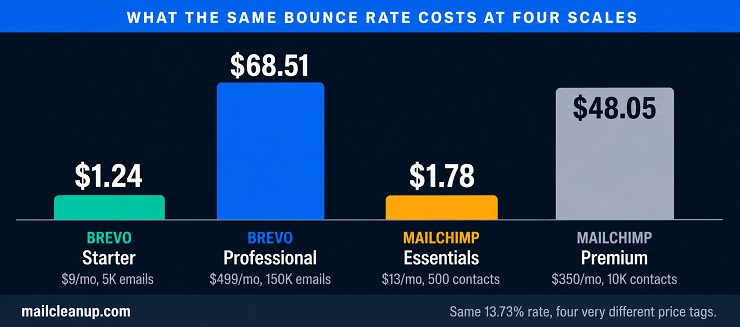
Every number so far in this guide has used our own verification data as the source of the percentages. This section does something different. It applies those same percentages against real pricing from two email marketing platforms, Brevo and Mailchimp. The goal is to show what an unverified list actually burns in subscription spend alone, before revenue ever enters the picture. Both platforms price differently: Brevo by email send volume, Mailchimp by stored contact count, so the waste shows up differently on each. Here’s what the same confirmed cost of email bounces looks like in each platform’s own terms.
| Platform | Plan | Price | Included Volume | Confirmed-Bounce Waste (13.73%) |
|---|---|---|---|---|
| Brevo | Starter | $9/month | 5,000 emails/month | ~686 wasted sends, about $1.24/month |
| Brevo | Professional | $499/month | 150,000 emails/month | ~20,595 wasted sends, about $68.51/month |
| Mailchimp | Essentials | $13/month | 500 contacts | ~69 dead contacts, about $1.78/month |
| Mailchimp | Premium | $350/month | 10,000 contacts | ~1,373 dead contacts, about $48.05/month |
That right-hand column is only the confirmed share, the 13.73% verification has already flagged as certain to fail. It doesn’t include the uncertain 13.61%, Accept-All and Unknown, covered earlier in this guide. On Mailchimp specifically, the number understates the real risk in a way Brevo’s doesn’t. Those dead contacts count toward the contact total that determines your pricing tier. A bounce-heavy list can push a business into a more expensive tier it wouldn’t need on a clean one.
Subscription waste is the smaller number. Here’s what the same confirmed-bounce share does to revenue directly. Two illustrative assumptions go into the math: a $50 average order value and a 2% conversion rate on delivered email. Both are replaceable with your own numbers, not MailCleanup’s own data. The chain runs the same way at any scale, only the inputs change.
| Step | Mailchimp Essentials (500 contacts) | Brevo Professional (150,000 emails) |
|---|---|---|
| Send volume | 500 | 150,000 |
| Confirmed-bounce share (13.73%) | ~69 | ~20,595 |
| Lost sales at 2% conversion | ~1.4 | ~412 |
| Lost revenue at $50 average order value | ~$69 | ~$20,595 |
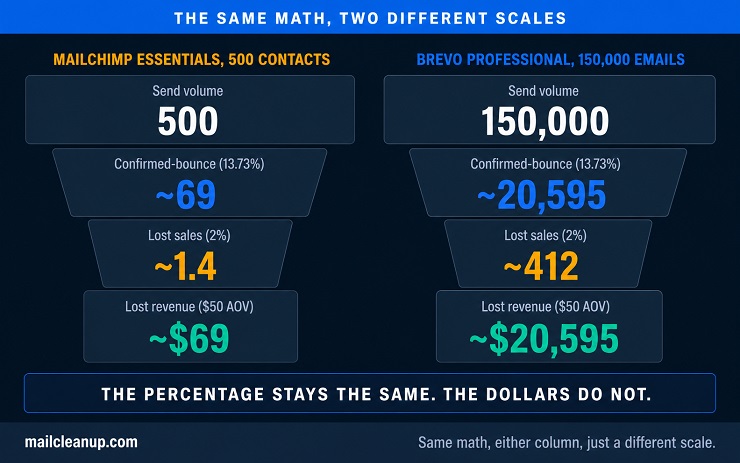
Read down either column and the multiplication is identical: the same 13.73%, the same 2%, the same $50, just against a different starting number. That’s the actual lesson here. The percentage doesn’t change with scale. The dollar stakes do, from roughly $69 on a small list to over $20,000 on a single send at a larger one. Multiply either column by twelve sends a year, or by however many campaigns actually go out. The true cost of email bounces stops being an abstraction and starts being a line item.
Putting a Real Number on the Cost of Email Bounces for Your Own List
Everything so far has used our own verified baseline, 13.73% confirmed, 13.61% uncertain, but your list isn’t our list. Here’s how to turn those same rates into a number that’s actually yours.
- Start with your list size. Whatever you’re about to send to, that’s your base number.
- Multiply by 13.73% for your confirmed-risk count. That’s roughly how many addresses are carrying the confirmed cost of email bounces this guide just walked through. That assumes your list looks like an average unverified one.
- Multiply by 13.61% for your uncertain-risk count. That’s the Accept-All and Unknown share, the addresses carrying the uncertain cost covered above.
- Add the two together. That’s your total at-risk count before you’ve sent a single email.
- Apply your own numbers to it. Multiply the confirmed count by your ESP’s per-send cost for the direct piece. Multiply it again by your average order value and conversion rate for the revenue lost to email bounces specifically. Neither of those needs to be a guess. They’re sitting in your own ESP dashboard and your own sales data right now.
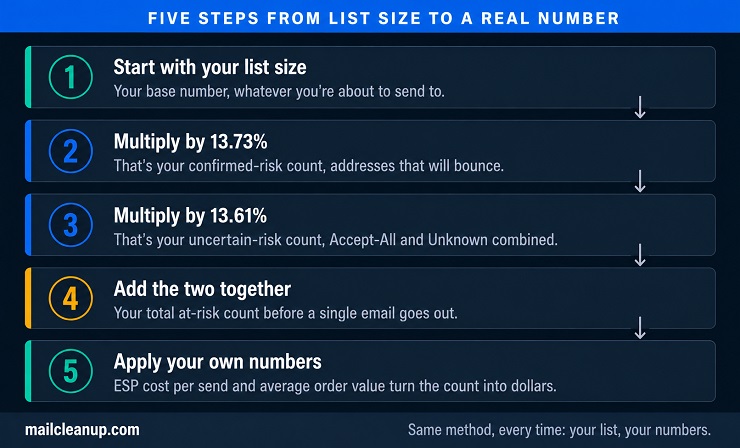
Here’s what that looks like on a 10,000-address list: about 1,373 addresses land in confirmed territory, and about 1,361 more sit in uncertain territory. That’s 2,734 addresses, over a quarter of the list, carrying some form of cost before a single send goes out. Your own list will land somewhere close to that if it’s never been verified. The exact figure depends on how the list was built and how long it’s been sitting untouched.
The financial impact of email bounces isn’t really about the 13.73% or the 13.61% on their own. It’s what happens when you multiply either one by your actual send volume and actual revenue per email. That repeats month after month, for as long as the list stays unverified. That ongoing multiplication, not the percentage on its own, is the true cost of email bounces.
If that number looks high, our benchmarks for an acceptable bounce rate by industry and campaign type are the next place to check.
How the Cost of Email Bounces Compounds If You Ignore It
Nothing about the cost covered so far stays flat if you leave it alone. It compounds, and it compounds specifically because the same addresses that triggered it are usually still sitting in your list. They keep generating the same signal on every send that follows.
Here’s why that matters more than it sounds like it should. A bounce doesn’t just cost you the one campaign it happened on. Gmail, Yahoo, and Outlook all track bounce rate as an ongoing trust signal, not a per-campaign one. A high rate on one of your sends lowers inbox placement on the ones that come after it too. Lower placement means fewer opens and clicks, not because interest dropped, but because fewer people ever saw the email. Mailbox providers read that drop in engagement as its own separate trust signal, on top of the bounce rate itself, and reputation drops again.
Email sender reputation maps that exact mechanism in full, under what it calls the Reputation Death Spiral. What matters for the cost of email bounces specifically is what that spiral means for the math already worked out above. The confirmed cost and the uncertain cost from earlier sections aren’t a bill you pay once. They’re a bill that gets bigger the longer the addresses causing it stay on your list. That compounding tax is the hidden cost of email bounces most estimates never capture. It never shows up as a single bounce. It shows up as a slow erosion in results across every campaign that follows.
There’s a second reason ignoring this doesn’t stay static: lists decay on their own, even ones that started clean. People change jobs, abandon inboxes, and let domains lapse, all the time, whether you send to them or not. Email list hygiene is the ongoing discipline that keeps that decay in check, covered there in full. The short version is that a list you verified and cleaned six months ago isn’t the same list today. The confirmed and uncertain shares this guide just walked through creep back up on their own if nothing maintains them.
Common Mistakes When Estimating the Cost of Email Bounces
Everything covered so far exists because the usual way people estimate the cost of email bounces gets it wrong in a few repeatable ways.
- Treating all bounces as one number: A single blended bounce rate hides the difference between a confirmed cost and an uncertain one. That’s the entire reason this guide splits them apart from the start.
- Counting only the direct send cost: The wasted credit or send slot is real, but it’s usually the smaller piece. The reputation tax that follows is what actually does the damage, and it doesn’t show up if you stop at the obvious number. Stopping there understates the real financial impact of email bounces by a wide margin.
- Using an industry-average benchmark instead of your own list: A generic bounce-rate average tells you nothing about what’s actually sitting in your list right now. The walkthrough above exists specifically so you don’t have to guess.
- Treating Accept-All and Unknown addresses as either safe or as good as bounced: Neither is accurate. They’re uncertain, and that uncertainty carries its own real risk, spam traps in particular, covered above.
- Assuming a one-time list clean solves the problem for good: Lists decay whether you send to them or not. The confirmed and uncertain shares this guide just worked through creep back up on their own without ongoing maintenance.
Every mistake on this list adds up to the same result. You end up underestimating the real cost of bounced emails until it shows up where you didn’t expect it.
How to Actually Lower the Cost of Email Bounces
Everything in this guide points at the same underlying fix. Here’s what that looks like as a concrete, ordered set of moves, not just a general principle.
- Verify your list before every send, not after a bounce happens. This is the single highest-leverage move, and it addresses both halves of the cost of email bounces at once.
- Remove Undeliverable addresses from your list outright. There’s no judgment call to make here. Verification already confirmed these addresses can’t receive mail. Removing them stops both the wasted send and the reputation tax before either one starts.
- Make an active decision on Accept-All and Unknown addresses, rather than defaulting either way. MailCleanup’s own verification sorts these into a real choice: send with the small remaining risk, or hold them back. That’s what turns the uncertain cost from a guess into something you’re actually managing.
- Re-verify on a schedule, not once. Lists decay whether you send to them or not, covered above. A one-time clean only holds for as long as the list stays untouched.
- Watch your bounce rate by category, not as one blended number. A shift in your confirmed share and a shift in your uncertain share mean different things. A single overall percentage hides which one actually moved.
For the full tactical picture beyond this list, reducing your email bounce rate walks through list-building practices and sending cadence. It also covers the emergency protocol for a rate that’s already spiked. If you’re deciding whether verification itself is worth adding to your workflow, what email verification actually is covers how the process works. Between the two, the true cost of email bounces really comes down to timing: catching it before the send, not after.
The Cost of Email Bounces Starts With What’s Already in Your List
Everything in this guide comes back to one number: the cost of email bounces for your list right now, today, not a hypothetical one. It’s also not the industry-average placeholder most articles on this topic run their math on instead. Across the 653,070 addresses behind every figure in this guide, 13.73% were confirmed Undeliverable. Another 13.61% sat in uncertain territory, Accept-All and Unknown combined (a detailed case study of email verification statistics is also available for detailed breakdown). That’s not a coincidence specific to our own data. It’s what an average unverified list actually looks like, and there’s no reason to assume yours is meaningfully different until you’ve actually checked.
The confirmed share and the uncertain share this guide walked through aren’t abstract, and neither is what happens if you leave them alone. Together, they’re the true cost of email bounces, the number a blended bounce-rate estimate always underprices, and it doesn’t sit still. It compounds with every send the addresses causing it stay on your list. It also creeps back up on its own even after a clean, since lists decay whether you send to them or not. The only way to know your actual number, hidden cost of email bounces included, is to run your own list through verification. That beats assuming it matches the averages in this guide.
That’s the concrete next step, not a general recommendation to “take email hygiene seriously” and move on. Pull your list, run it, and sort the results the same way this guide did: what’s confirmed, what’s uncertain. Then see what that split actually costs at your own send volume and your own numbers. It takes far less time than the campaigns it’s currently costing you. Does the math justify making that a regular part of how you send, rather than something you find out the hard way?
FAQs on Cost of Email Bounces
How much does a bounced email actually cost?
There’s no single number, because the cost of email bounces splits into two parts. A confirmed bounce, one verification already flagged as Undeliverable, wastes the send and starts a reputation tax that compounds on every campaign after it. An uncertain address in your list, Accept-All or Unknown, carries a smaller but real risk instead of a guaranteed cost.
Is a bounced email the same as a lost sale?
Not exactly, though the two are related. A bounce means the send itself failed, no message ever arrived, so any potential sale from that specific email is lost outright. But the bigger financial impact of email bounces comes afterward. A damaged reputation lowers inbox placement on your future campaigns, which costs sales that were never individually bounced at all.
Do Accept-All or Unknown results count as bounces?
Not directly. Accept-All servers say yes to every address, valid or not, so sending to one might succeed with no bounce at all. Unknown means verification couldn’t determine a status either way. Both carry real, uncertain risk for your list: spam trap exposure and reputation damage. That’s exactly why the cost of email bounces has to treat them differently from a confirmed Undeliverable address.
How often should an email list be re-verified?
There’s no universal schedule, but lists decay continuously, not just once. People change jobs, abandon inboxes, and let domains lapse on an ongoing basis, whether a list is actively used or not. Re-verifying your list before every major send helps. So does a fixed schedule for lists used less often. Both keep the confirmed cost of email bounces from creeping back up.
Does one bad campaign really affect future email performance?
Yes, and that’s the part flat-rate cost estimates usually miss. Mailbox providers track bounce rate as an ongoing trust signal, not a per-campaign one. A spike on one of your sends lowers inbox placement on the ones that follow. That’s what makes the cost of email bounces compound instead of resetting to zero after each campaign.
Is list verification worth it for a small email list?
Yes, arguably more so. A small list has less room to absorb the confirmed and uncertain cost of email bounces before it noticeably affects your results. A single spam trap hit does the same reputation damage regardless of list size. The math scales down with list size, but the underlying risk doesn’t disappear.
Do all bounces cost the same amount?
No. The cost of email bounces splits into two categories precisely because they don’t. An Undeliverable address is a confirmed, certain cost, the send is wasted and the reputation tax starts immediately. An Accept-All or Unknown address carries an uncertain cost instead, real risk, but conditional on what actually happens when you send to it.
Can I calculate the exact cost of bounces for my own list?
Close to it. Multiply your list size by 13.73% for a confirmed-risk count and by 13.61% for an uncertain-risk count, MailCleanup’s own verified baseline rates. Multiply each by your ESP’s per-send cost and average order value. That translates the cost of bounced emails into your own numbers, not an industry average.