

Email List Verify built its reputation on being fast, cheap, and simple: upload a CSV, pay for what you use, get a cleaned list back. For a small business sending occasional newsletters, that combination still works well. The distinction between email verification and validation matters here too, since Email List Verify’s checks go only as deep as syntax and server-level validation, not always deep enough to confirm a mailbox actually exists.
The trouble starts once your list stops looking like a newsletter list. Corporate domains, catch-all mail servers, and B2B contact data behave differently than consumer inboxes, and Email List Verify’s core checks were not built with that difference in mind. When a meaningful share of your list comes back as Unknown instead of a clear answer, you are not looking at a verified list anymore, you are looking at a guess you still have to make yourself, one that can quietly damage email deliverability if you guess wrong at scale.
That is the actual reason most people search for Email List Verify alternatives: not because the tool is bad at what it does, but because what it does stops being enough once volume, list type, or accuracy requirements change. This guide compares eight Email List Verify alternatives against the specific places Email List Verify itself tends to break down, using verified, checkpoint-level pricing and independently reported accuracy data rather than marketing claims.
Not every Email List Verify alternative solves the same problem, so the comparison below is organized around which specific gap each one closes.
TL;DR on Email List Verify Alternatives
- Email List Verify markets 97 to 99% accuracy, but independently tested results on catch-all-heavy business lists run closer to 91%, and one independent benchmark found it correctly identified real contacts on fewer than half the addresses it checked on enterprise domains, even after its paid Deep Scan upgrade.
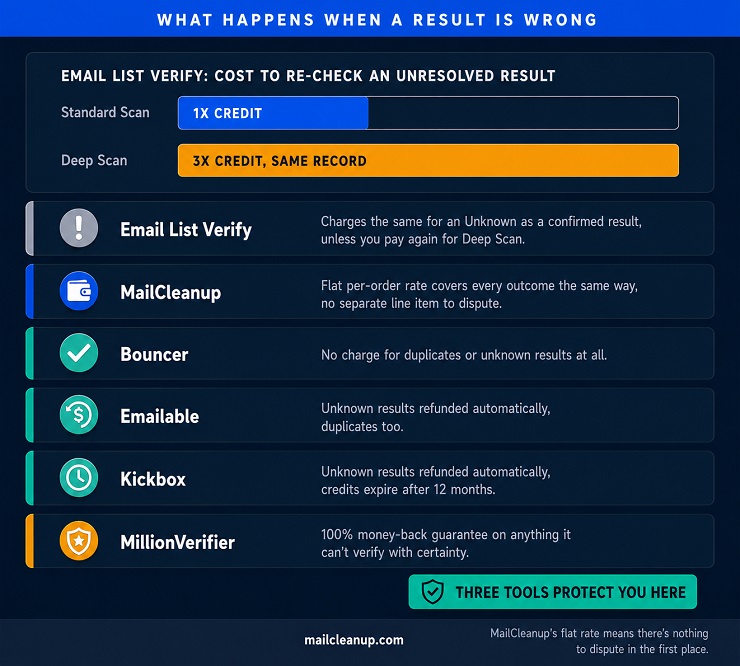
- Deep Scan, Email List Verify’s own fix for unresolved catch-all results, charges triple credits for every record it re-checks, so a more accurate answer costs more, not the same amount.
- Email List Verify is genuinely one of the cheapest options here at small volume, but DeBounce, a genuine alternative to Email List Verify at every checkpoint from 5,000 to 100,000 credits, is cheaper throughout, and MillionVerifier overtakes it once volume passes roughly 50,000.
- On G2, Email List Verify’s composite satisfaction score sits at 55.41 against ZeroBounce’s 81.55, and its Quality of Support rating trails at 8.7 versus 9.6, even though its raw star rating of 4.5 out of 5 is still respectable.
- Kickbox refunds credits automatically on unknown results, and MillionVerifier backs every result with a 100% money-back guarantee, two safety nets Email List Verify’s own pricing doesn’t build in.
- Email List Verify’s credits never expire, but real user reports describe accuracy disputes that ended without a refund, its policy was not built around contested results.
- MailCleanup, one of the Email List Verify alternatives in this list, charges one flat rate per order with no account, dashboard, or subscription to manage.
- For small, low-risk B2C lists, Email List Verify remains a reasonable, budget-friendly choice. The accuracy gap shows up specifically on corporate, catch-all-heavy B2B domains, not casual newsletter sends.
Why Teams Look for Email List Verify Alternatives
Email List Verify has real strengths worth naming honestly before getting into where it falls short. Its pay-as-you-go pricing starts as low as $17 for 5,000 credits, credits never expire, and the upload-to-download workflow is genuinely simple. G2 reviewers rate it 4.5 out of 5 stars, and its review base skews heavily toward small businesses, over 75% of reviewers, who praise exactly what it is built for: quick, affordable bulk list cleaning for straightforward lists. Trustpilot shows customers who have stuck with it for three and four years without complaint.
The weaknesses show up in a specific place, and the framework below walks through each one with real numbers. In short: accuracy drops meaningfully on corporate, catch-all-heavy domains, the tool’s own paid upgrade for fixing that doesn’t fully solve it, and a result marked “clean” isn’t a guarantee against bounces the way it should be. Several other friction points show up consistently across reviews too, unrelated to catch-all domains entirely.
Other friction points, found across G2, Capterra, and Trustpilot reviews:
- A documented Capterra dispute describes a customer contesting inaccurate results and being refused a refund.
- One reviewer flagged inconsistent handling between CSV and XLS upload formats, with CSV processing described as unreliable.
- Live chat support is not available; a Capterra review names its absence directly.
None of this makes Email List Verify a bad tool for what it was built for. It makes it a tool with specific, documented limits, and the eight Email List Verify alternatives compared below each handle at least one of those limits differently, some on accuracy, some on cost, some on what happens when a result turns out to be wrong.
The Email List Verify Breaking Point: A Framework for Evaluating Email List Verify Alternatives
Four checkpoints separate a genuinely better fit from a lateral move among these Email List Verify alternatives. Work through them against your own list before picking a tool from the comparison below.
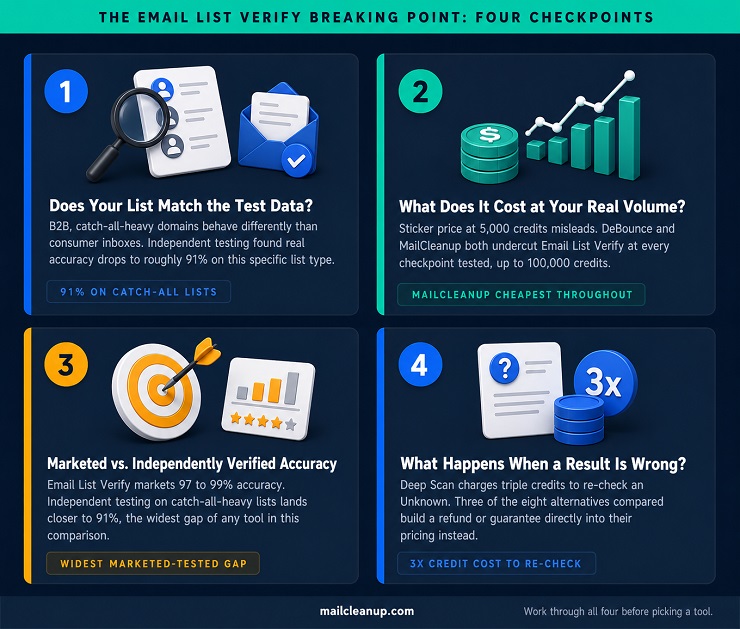
Checkpoint 1: Does Your List Match the Data Email List Verify Alternatives Are Actually Tested On?
Email List Verify built its reputation on B2C and newsletter-style lists: personal Gmail and Outlook addresses, straightforward syntax, no catch-all ambiguity. Corporate B2B lists behave differently. A catch-all domain accepts mail for any address without confirming whether a specific mailbox exists, and roughly 30% of B2B domains are configured this way. Syntax and SMTP-level checks, the same broad category of checks used to catch disposable email addresses and basic typos, tend to collapse into an inconclusive “Unknown” result against that kind of server, since there is no clear valid or invalid signal to read.
One independent test made the gap measurable rather than anecdotal. It built a controlled dataset of 1,222 records across enterprise catch-all domains: roughly ten realistic email permutations (firstname.lastname@, flastname@, and similar patterns) for each of 23 verified real professionals, plus 989 deliberately fictional addresses on the same domains to check for false positives.
Against that dataset, Email List Verify’s standard scan correctly identified only 9 of the 23 real contacts (39%) and returned Unknown or Catch-All for 804 of the 1,222 records (66%). Its Deep Scan upgrade, priced at triple credits for every unresolved record from the standard scan, improved the real-contact count to 11 of 23 (48%) and cut the Unknown rate to 681 of 1,222 (56%), meaning the majority of the dataset was still unresolved even after paying more for a second pass.
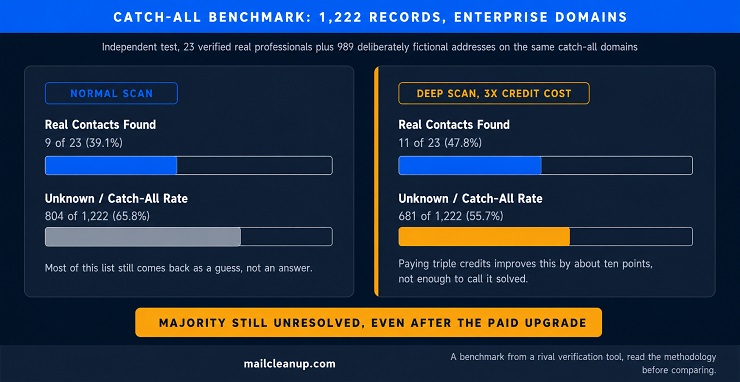
This lines up with what is already independently documented elsewhere: Email List Verify’s tested accuracy on catch-all-heavy lists runs closer to 91%, well under its own marketed 97 to 99% figure, specifically on domains built the way real B2B contact data actually looks. Getting this wrong doesn’t just waste credits, it puts genuine strain on sender reputation once bad guesses turn into sends. If your list is mostly consumer inboxes, this checkpoint matters less.
If a meaningful share of it is corporate domains, for sales, recruiting, or B2B marketing, this is the single biggest reason to look at alternatives to Email List Verify with deeper catch-all handling, and it’s also where spam traps tend to concentrate, since abandoned corporate mailboxes on catch-all domains are a common trap source.
Checkpoint 2: True Cost at Volume Across Email List Verify Alternatives
Sticker price is not the same as cost at your actual volume, and once all four tools are lined up side by side, MailCleanup comes out cheapest at every single checkpoint:
- 5,000 credits: MailCleanup $10, DeBounce $15, Email List Verify $17, MillionVerifier $39
- 10,000 credits: MailCleanup $15, DeBounce $25, Email List Verify $27, MillionVerifier $39
- 50,000 credits: MailCleanup $50, DeBounce $75, Email List Verify $98, MillionVerifier $89
- 100,000 credits: MailCleanup $90, DeBounce $135, Email List Verify $186, MillionVerifier $149
MailCleanup runs on a flat pay-per-order model with no subscription or credit balance to track, a genuinely different structure from the credit-based pay-as-you-go plans the other three use. DeBounce is the closest competitor on price and stays cheaper than Email List Verify at every checkpoint tested. MillionVerifier tells a more interesting story than a flat “cheaper” or “more expensive” claim against Email List Verify specifically: at 5,000 and 10,000 credits it is actually pricier, $39 against $17 and $27, but past 50,000 credits that flips, dropping to $89 and $149 against Email List Verify’s $98 and $186, still above MailCleanup throughout.
That crossover point lands almost exactly where independent reviewers have already flagged a real problem: one Capterra reviewer specifically noted that Email List Verify’s own pricing curve stops making sense against bulk-oriented alternatives once volume passes roughly 25,000 emails, a claim the numbers above confirm rather than just repeat.
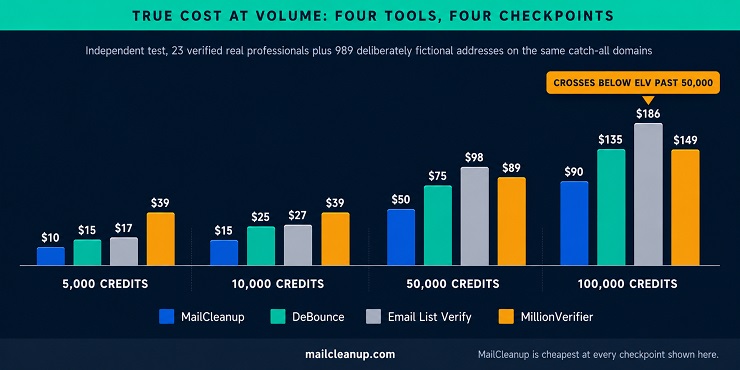
For anyone verifying under 5,000 emails occasionally, Email List Verify’s entry price is reasonable, though still not the cheapest option here. For anyone verifying tens of thousands of contacts regularly, particularly as ongoing list scrubbing rather than a one-time clean, the true cost at volume table below is worth reading closely, since it’s exactly where Email List Verify alternatives start to separate on real cost, not sticker price.
Checkpoint 3: Marketed vs. Independently Verified Accuracy Across Email List Verify Alternatives
Email List Verify markets 97 to 99% accuracy. Checkpoint 1 already showed where that breaks down on catch-all-heavy B2B domains specifically, independently tested accuracy on that kind of list runs closer to 91%. The gap shows up in a second, unrelated place too: real-world satisfaction data.
On G2, Email List Verify carries a 4.5 out of 5 star rating from 59 reviews, genuinely decent, but G2’s own composite satisfaction score for the product sits at 55.41, against ZeroBounce’s 81.55 on the same scale. Its Quality of Support rating trails too, 8.7 against ZeroBounce’s 9.6. Part of that gap is simply sample size, 59 reviews against ZeroBounce’s 1,367, but the direction is consistent with the accuracy pattern already established: a tool that performs well for the audience it was built for and less well once requirements get more demanding.
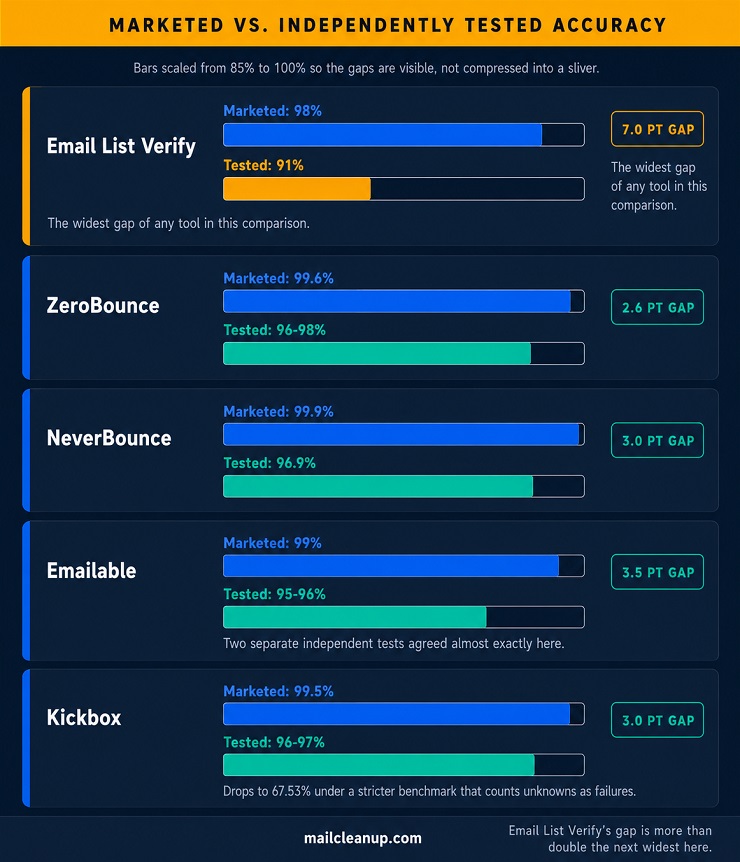
None of the eight Email List Verify alternatives compared below claim perfect accuracy either, and this guide isn’t going to pretend they do. What differs is whether marketed and tested numbers are close together or far apart, and whether a tool discloses email verification features like catch-all resolution depth clearly enough that you can judge the gap yourself before paying for results.
Checkpoint 4: What Happens When a Result Is Wrong, and Which Email List Verify Alternatives Cover You
Every verification tool gets some results wrong. What separates them is what happens next, and here Email List Verify’s policy leaves a real gap. Credits never expire, which is genuinely generous, but its refund policy was not built around contested or disputed results. A documented Capterra complaint describes exactly this: a customer whose supposedly clean list still produced hard bounces at a rate the company disputed rather than refunded, with both sides unable to agree on which list had actually been checked.
Two of the eight Email List Verify alternatives compared below build a direct answer to this problem into their pricing, in different ways. Kickbox refunds credits automatically on unknown results rather than charging for an inconclusive answer. MillionVerifier backs every result with a 100% money-back guarantee on anything it cannot verify with certainty.
MailCleanup takes a different approach again: a single flat per-order rate means every result costs the same regardless of outcome, so there’s no separate “unknown” or “invalid” line item to dispute in the first place, and no account or credit balance sitting around to complicate a refund conversation later. It’s a simpler, more predictable bill by design, the trade-off being that MailCleanup doesn’t market a money-back guarantee the way MillionVerifier does.
Deep Scan sits in the middle of this same question. It’s marketed as a fix for unresolved catch-all results, and Checkpoint 1 already showed it does meaningfully improve on the standard scan, but it charges triple credits to do it. That’s a legitimate design choice, more thorough checking costs more to run, but it means the accuracy improvement isn’t free the way it might be with a tool that includes deeper catch-all resolution in its base price. It’s a genuine trade-off worth weighing before you judge Email List Verify competitors on accuracy alone.
Email List Verify Alternatives at a Glance: Quick Comparison Table
Before going deep on any single checkpoint, here’s how all eight Email List Verify alternatives stack up side by side on the basics: starting price, marketed accuracy, and how each one actually handles catch-all addresses, which Checkpoint 1 already showed is where Email List Verify itself struggles most.
| Tool | Starting Price (5,000 credits) | Marketed Accuracy | Catch-All Handling | Best For |
|---|---|---|---|---|
| MailCleanup | $10 | 99% | Flagged, not individually resolved | Simple, flat-rate cleaning with no account needed |
| Email List Verify | $17 | 97-99% | Flagged; Deep Scan add-on at extra cost | Budget-friendly B2C and newsletter lists |
| ZeroBounce | $69 | 99.6% | AI-driven scoring, 0-10 scale | High-volume senders who want a confidence score, not just a flag |
| NeverBounce | $40 | Up to 99.9% | Resolved in roughly 8% of cases | Fastest turnaround, human-QA backed verification |
| Bouncer | $35 | 99.5% | Deep resolution via Toxicity Check, 0.3-3% unknown rate | Teams that need catch-all actually resolved, not just flagged |
| Emailable | $38 | 99% guarantee | Flags as accept-all, not resolved | Fast bulk processing with automatic refunds on unknowns |
| Kickbox | $40 | 99.5% | Returns Unknown, refunded automatically | Teams already standardized on HubSpot |
| DeBounce | $15 | 97.5%+ | Identified, not individually resolved | Lowest cost at every checkpoint after MailCleanup |
| MillionVerifier | $39 | 99%+ | Included at no extra cost | A money-back guarantee on uncertain results |
MailCleanup and DeBounce are the two cheapest entry points here, and only Bouncer genuinely resolves catch-all addresses rather than flagging or scoring them, making it the clearest alternative to Email List Verify specifically for catch-all-heavy lists. The next three tables dig into each of those claims individually, starting with the gap between what’s marketed and what’s actually been independently verified.
Marketed vs. Independently Tested Accuracy Across Email List Verify Alternatives
Marketed accuracy numbers cluster tightly together, 97% to 99.9% across all nine tools here. Independently tested numbers tell a more scattered story, and three of the eight Email List Verify alternatives in this comparison haven’t been independently tested to a single confirmed figure at all.
| Tool | Marketed Accuracy | Independently Tested Accuracy |
|---|---|---|
| MailCleanup | 99% | Approximately 98-99% |
| Email List Verify | 97-99% | Approximately 91% on catch-all-heavy lists |
| ZeroBounce | 99.6% | 96-98% (third-party benchmarks) |
| NeverBounce | Up to 99.9% | Approximately 96.9% |
| Bouncer | 99.5% | Not independently tested to a single percentage |
| Emailable | 99% guarantee | 95-96% (independently corroborated by two separate tests) |
| Kickbox | 99.5% (ecosystem claim) | 96-97% if unknowns are excluded, 67.53% if unknowns count as failures |
| DeBounce | 97.5%+ | Not independently benchmarked (third-party estimates range from 97% to 99.7%) |
| MillionVerifier | 99%+ | Not independently tested |
Email List Verify’s gap, marketed at 97 to 99%, tested closer to 91% on the exact list type Checkpoint 1 covered, is the widest of any tool with a confirmed independent figure here. Kickbox’s spread is the most methodology-dependent: whether an Unknown counts as a pass or a failure changes its tested number by nearly 30 points, worth knowing if you’re comparing Email List Verify competitors on this figure alone rather than reading the methodology behind it.
True Cost at Volume: What Email List Verify Alternatives Really Cost at Scale
Checkpoint 2 already walked through why sticker price misleads at scale. Here’s the full picture across all eight Email List Verify alternatives plus Email List Verify itself, at four volume checkpoints, sorted from cheapest to most expensive at the 5,000-credit tier.
| Tool | 5,000 credits | 10,000 credits | 50,000 credits | 100,000 credits |
|---|---|---|---|---|
| MailCleanup | $10 | $15 | $50 | $90 |
| DeBounce | $15 | $25 | $75 | $135 |
| Email List Verify | $17 | $27 | $98 | $186 |
| Bouncer | $35 | $60 | $250 | $400 |
| MillionVerifier | $39 | $39 | $89 | $149 |
| Emailable | $38 | $60 | $245 | $420 |
| NeverBounce | $40 | $50 | $250 | $400 |
| Kickbox | $40 | $70 | $275 | $500 |
| ZeroBounce | $69 | $129 | $499 | $649 |
MailCleanup is cheapest at every single checkpoint in this table, and Kickbox is the most expensive at every checkpoint except 5,000 credits, where it ties NeverBounce. ZeroBounce costs more than four times what MailCleanup charges at 100,000 credits, a gap that’s easy to miss when comparing headline features instead of the actual bill.
Credit Expiry and Billing Fairness Across Email List Verify Alternatives
Price is only half the billing picture. What happens to unused credits, and what happens when a result turns out to be wrong, varies more across these Email List Verify alternatives than the pricing table alone suggests.
| Tool | Credit Expiry | Charges for Unknown Results | Notable Billing Detail |
|---|---|---|---|
| MailCleanup | Not applicable, no persistent balance | Yes | Flat per-order rate covers every outcome, no separate dispute categories |
| Email List Verify | Never | Not stated | Deep Scan re-checks Unknowns at triple credit cost |
| ZeroBounce | Never | No | Charges for invalid results only |
| NeverBounce | 12 months, applied retroactively in 2024 | Not stated | Some customers lost existing balances when the policy changed |
| Bouncer | Never | No charge for duplicates or unknowns | – |
| Emailable | Never | No, refunded automatically | Duplicates also refunded |
| Kickbox | 12 months | No, refunded automatically | Same 12-month policy as NeverBounce |
| DeBounce | Never | Not stated distinctly | – |
| MillionVerifier | Never | Not stated | 100% money-back guarantee on anything it can’t verify with certainty |
Four of the eight alternatives to Email List Verify here, Bouncer, Emailable, Kickbox, and MillionVerifier, build some form of protection against paying for an inconclusive result directly into their policy. Email List Verify does not: credits never expire, but an uncertain result costs the same as a confirmed one unless you pay again for Deep Scan, and Checkpoint 4 already covered what that’s meant for at least one documented customer dispute.
8 Email List Verify Alternatives, Reviewed in Detail
The tables above cover the numbers. The eight profiles below cover what makes each Email List Verify alternative genuinely different, not just cheaper or pricier, and which specific gap in Email List Verify it’s built to close.
1. MailCleanup: A Flat-Rate Alternative to Email List Verify With No Account Required
We built MailCleanup as a genuinely different kind of alternative to Email List Verify: no credit balance to manage, no account, no subscription, just a flat price for a cleaned list. If you’re cleaning a list once, or semi-regularly, and don’t want a dashboard or unused credits sitting around between projects, we skip all of that. You upload a list, we tell you what it costs upfront, and you get a cleaned list back.
That flat-rate model is also, as the tables above show, genuinely the cheapest option in this comparison at every volume checkpoint, from $10 at 5,000 credits up to $90 at 100,000, without needing to compare subscription tiers or credit-rollover policies to know what you’re actually paying. Every result costs the same flat rate, so there’s no separate charge structure to learn or dispute, what you see at checkout is what you pay.
We keep the process simple on purpose: fast turnaround, a flat price you know before you commit, and no account to set up or forget about afterward. For anyone who just needs a list cleaned without becoming a long-term subscriber to another SaaS tool, that’s what we’re built for.

MailCleanup Software Overview
| Attribute | Detail |
|---|---|
| Pricing model | Pay-per-order, one-time, no account or credit balance |
| Price at 5,000 / 10,000 / 50,000 / 100,000 | $10 / $15 / $50 / $90 |
| Marketed accuracy | Up to 99% |
| Catch-all handling | Flagged, not individually resolved |
| API / integrations | None; CSV in, cleaned list out |
| Free credits | Available on request |
2. ZeroBounce: The Email List Verify Alternative With AI-Driven Catch-All Scoring
Where Email List Verify returns a flat Unknown for catch-all addresses, ZeroBounce assigns a 0-10 AI-driven quality score instead, giving you a confidence level to work with rather than a dead end. For B2B lists specifically, where Checkpoint 1 showed Email List Verify’s standard scan misses more real contacts than it catches, having a gradient score to filter on rather than a binary flag is a genuinely useful, practical difference.
Beyond catch-all scoring, ZeroBounce backs its results with over 400,000 customers by its own count and more than 30 billion emails validated, and its data handling is unusually well documented: uploaded files and results are automatically deleted within 30 days unless removed sooner, confirmed directly from its own privacy policy and GDPR documentation. Independently tested accuracy lands at 96 to 98%, closer to its marketed 99.6% than Email List Verify’s own gap between marketed and tested numbers.
The trade-off is cost. ZeroBounce is the most expensive tool in this entire comparison, $69 at 5,000 credits climbing to $649 at 100,000, nearly three and a half times what Email List Verify charges at the same volume. It doesn’t charge for unknown results specifically, only invalid ones, which softens that gap somewhat, but this is not the tool to reach for if price is the deciding factor among Email List Verify competitors. If ZeroBounce’s own limits are the reason you’re reading this, our ZeroBounce Alternatives guide covers that comparison in full.
ZeroBounce Software Overview
| Attribute | Detail |
|---|---|
| Pricing model | Pay-as-you-go, or ZeroBounce ONE subscription |
| Price at 5,000 / 10,000 / 50,000 / 100,000 (PAYG) | $69 / $129 / $499 / $649 |
| Marketed accuracy | 99.6% |
| Independently tested accuracy | 96-98% |
| Catch-all handling | AI-driven scoring, 0-10 scale |
| API / integrations | Real-time API, 60+ native integrations |
| Credit expiry | Never (PAYG) |
3. NeverBounce: Built for Teams That Outgrow Basic Email List Verify Alternatives
NeverBounce combines an automated 20-plus step verification process with a human quality-assurance layer, and the practical result shows up in speed: a documented turnaround of 2 to 10 minutes for a 10,000-email batch, the fastest confirmed figure of any tool in this comparison. Independent reviews have specifically flagged Email List Verify’s dated interface and slower performance on very large uploads, so for teams processing big lists regularly, that speed difference is a genuine, practical reason to switch, not just a spec-sheet number.
Beyond speed, NeverBounce’s real-time API and 80-plus native integrations, including HubSpot, Salesforce, and Marketo, make it straightforward to wire into an existing sales or marketing stack rather than running verification as a separate manual step. Independently tested accuracy comes in around 96.9%, against a marketed figure of up to 99.9%, a narrower gap than Email List Verify’s own marketed-versus-tested spread.
The genuine trade-off is credit expiry: NeverBounce credits expire 12 months after purchase, and that policy was applied retroactively in 2024 to balances some customers had already bought under no-expiration terms, a real, documented complaint worth knowing about before buying in bulk. A $49-per-month Growth plan sidesteps the issue if ongoing list hygiene as part of a regular monthly workflow fits your team better than pay-as-you-go. For anyone weighing Email List Verify alternatives specifically on speed, this is the one built around it. For a closer look at NeverBounce on its own, our NeverBounce Alternatives guide covers that comparison directly.
NeverBounce Software Overview
| Attribute | Detail |
|---|---|
| Pricing model | Pay-as-you-go, or Growth subscription ($49/mo) |
| Price at 5,000 / 10,000 / 50,000 / 100,000 | $40 / $50 / $250 / $400 |
| Marketed accuracy | Up to 99.9% |
| Independently tested accuracy | Approximately 96.9% |
| Catch-all handling | Resolved in roughly 8% of cases |
| Credit expiry | 12 months, applied retroactively in 2024 |
| API / integrations | Real-time API, 80+ native integrations |
4. Bouncer: Deepest Alternatives to Email List Verify for Catch-All Resolution
Checkpoint 1 already showed the core problem: Email List Verify’s standard scan resolves catch-all addresses poorly, and even its paid Deep Scan upgrade still leaves the majority of a catch-all-heavy list unresolved. Bouncer is one of the few Email List Verify alternatives built specifically around solving exactly that, with a Toxicity Check feature, a dedicated deep-verification layer that screens for spam traps, serial complainers, litigators, and breached-credential lists as a separate step beyond standard syntax and SMTP checks, bringing its unknown-result rate down to as low as 0.3 to 3%, the lowest of any tool in this comparison.
That depth shows up in real outcomes too: one Capterra reviewer described a bounce rate falling from 14% to under 1% after switching to Bouncer, and its own reported figures put verified volume north of 4 billion emails with more than 500 million bounces prevented. Data retention is confirmed directly from Bouncer’s own Data Processing Amendment: personal data is stored up to 60 days for verification purposes, then anonymized and permanently deleted.
The trade-off is support responsiveness: Bouncer offers email-only support with a documented response time of roughly 24 hours, no live chat or phone option, worth knowing if fast human help matters as much to you as verification depth does. Pricing runs $35 at 5,000 credits up to $400 at 100,000, more than Email List Verify at every checkpoint, the cost of the deeper Toxicity Check layer. For the full comparison, our Bouncer Alternatives guide covers Bouncer from the other direction.
Bouncer Software Overview
| Attribute | Detail |
|---|---|
| Pricing model | Pay-as-you-go |
| Price at 5,000 / 10,000 / 50,000 / 100,000 | $35 / $60 / $250 / $400 |
| Marketed accuracy | 99.5% |
| Catch-all handling | Deep resolution via Toxicity Check, 0.3-3% unknown rate |
| Support | Email-only, ~24-hour response |
| Credit expiry | Never |
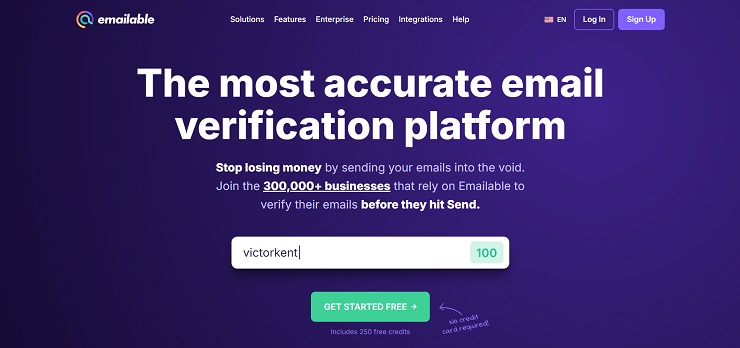
5. Emailable: A Faster Email List Verify Alternative for Bulk Processing
Email List Verify’s own reviews describe slower performance on very large uploads and a comparatively dated interface. Emailable answers directly on speed: roughly 2 to 3 minutes for a 10,000-email batch and about 10 minutes for a quarter-million addresses, confirmed directly from its own pricing page rather than a marketing claim.
Emailable also handles the “what happens when a result is wrong” question differently than Email List Verify does: unknown results aren’t charged at all, they’re refunded automatically, and so are duplicates. Its integration library is one of the largest in this comparison, more than 50 native connections including HubSpot, Salesforce, Klaviyo, and Mailchimp, and it holds SOC 2 Type II certification alongside GDPR compliance. An independent Sparkle.io test of 1,510 real emails landed at roughly 95 to 96% effective, closely matching Emailable’s own independently tested figure, a rare case of two separate outside tests agreeing almost exactly.
The trade-off is price: Emailable runs from $38 at 5,000 credits to $420 at 100,000, more than double Email List Verify at the low end and over twice as much at the high end. Its catch-all handling is also a flat “accept-all” flag rather than a deeper resolution attempt, the same basic limitation Email List Verify has on that specific point, so this is a genuine alternative to Email List Verify on speed and refund fairness, not on catch-all depth. If Emailable itself is the one you’re looking to replace, our Emailable Alternatives guide covers that from the other side.
Emailable Software Overview
| Attribute | Detail |
|---|---|
| Pricing model | Pay-as-you-go, 5,000-credit minimum |
| Price at 5,000 / 10,000 / 50,000 / 100,000 | $38 / $60 / $245 / $420 |
| Marketed accuracy | 99% guarantee |
| Independently tested accuracy | Approximately 95-96% |
| Catch-all handling | Flags as accept-all, not resolved |
| Speed | Approximately 2-3 minutes for 10,000 emails |
| Credit expiry | Never |
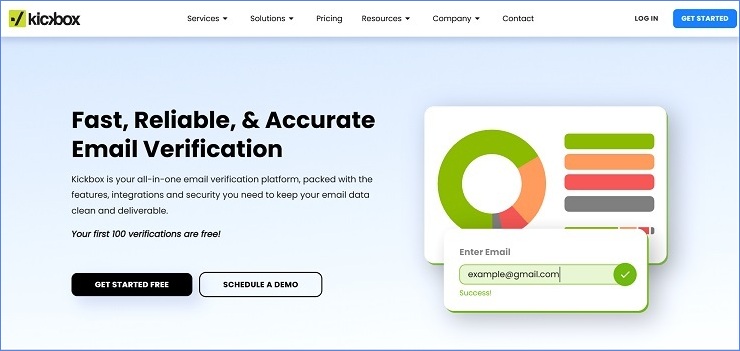
6. Kickbox: The Alternative to Email List Verify That Refunds Unknowns Automatically
Checkpoint 4 already covered the core issue: Email List Verify charges the same regardless of outcome, and its Deep Scan upgrade costs triple credits to even attempt resolving an Unknown. Kickbox handles this differently: when it returns Unknown rather than a confident result, that credit is refunded automatically, not charged and not held against you.
Kickbox also replaces a binary valid/invalid flag with a Sendex quality score on a 0 to 1 gradient, giving more context than a flat pass/fail. Its G2 reputation centers specifically on integration ease, reviewers consistently point to its HubSpot connection as one of the smoothest in the category, alongside straightforward accuracy reporting. Independently tested accuracy runs 96 to 97% when unknowns are excluded from the count, though a stricter benchmark that treats every Unknown as a failure puts the figure at 67.53%, a reminder that “accuracy” means different things depending on how unknowns get counted.
The genuine trade-off is price and credit expiry. Kickbox is one of the pricier tools in this comparison, behind only ZeroBounce at every checkpoint, running from $40 at 5,000 credits to $500 at 100,000, and its credits expire 12 months after purchase, the same policy NeverBounce uses. For teams that value not paying for uncertain results over minimizing sticker price, that’s a deliberate trade, not an oversight, and one of the more direct alternatives to Email List Verify on exactly that point.
Kickbox Software Overview
| Attribute | Detail |
|---|---|
| Pricing model | Pay-as-you-go |
| Price at 5,000 / 10,000 / 50,000 / 100,000 | $40 / $70 / $275 / $500 |
| Marketed accuracy | 99.5% (ecosystem claim) |
| Independently tested accuracy | 96-97% (unknowns excluded) or 67.53% (unknowns as failures) |
| Catch-all handling | Returns Unknown, refunded automatically |
| Credit expiry | 12 months |
| API / integrations | Real-time API, 25+ native integrations |
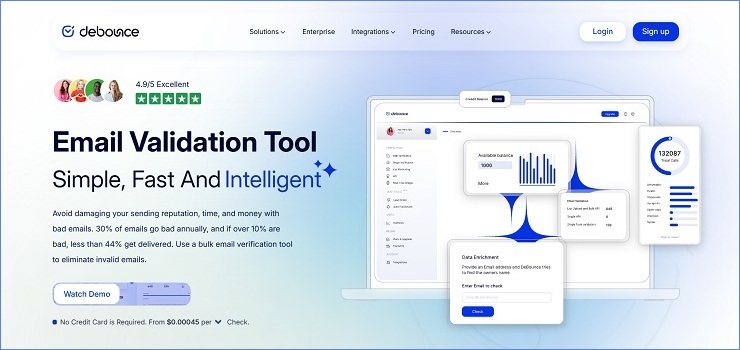
7. DeBounce: A Lower-Cost Alternative to Email List Verify
Checkpoint 2 already showed the headline number: DeBounce is cheaper than Email List Verify at every single volume checkpoint tested, from $15 versus $17 at 5,000 credits up to $135 versus $186 at 100,000. That gap holds even though DeBounce’s own marketed figure, a 97.5%-plus deliverability guarantee, is phrased differently from a flat accuracy percentage, and third-party reviews of its actual performance range inconsistently from roughly 97% to 99.7% depending on the reviewer.
DeBounce runs verification through a multi-stage pipeline: syntax, domain and MX lookup, SMTP handshake, disposable-address detection, catch-all identification, and role-based filtering, though like Email List Verify it identifies catch-all addresses rather than individually resolving them the way Bouncer’s deeper process does. Real enterprise customers are confirmed through independent review sources, including Western Digital, Samsung, Cornell University, and Siemens, and it holds a 4.9-out-of-5 rating across more than 1,300 Trustpilot reviews, a notably large and positive review base for a budget-positioned tool.
For teams where cost at volume is the deciding factor among Email List Verify alternatives and catch-all depth isn’t the priority, DeBounce is the more direct, dollar-for-dollar answer, real-time API access and 20-plus native ESP and CRM integrations included at every tier, with credits that never expire.
DeBounce Software Overview
| Attribute | Detail |
|---|---|
| Pricing model | Pay-as-you-go |
| Price at 5,000 / 10,000 / 50,000 / 100,000 | $15 / $25 / $75 / $135 |
| Marketed accuracy | 97.5%+ deliverability guarantee |
| Independently tested accuracy | Not independently benchmarked (third-party range 97-99.7%) |
| Catch-all handling | Identified, not individually resolved |
| Credit expiry | Never |
| API / integrations | Real-time API, 20+ native integrations |
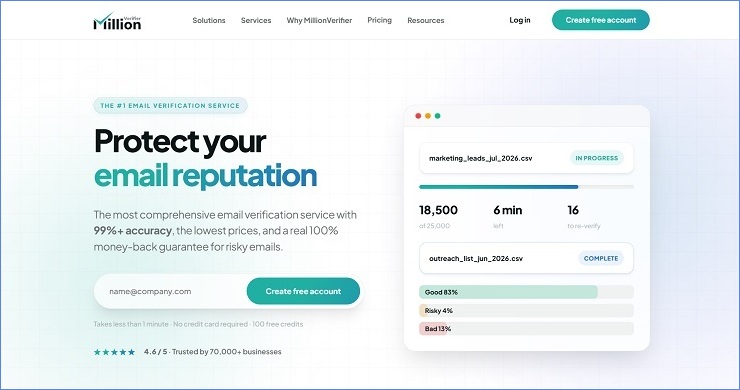
8. MillionVerifier: The Email List Verify Alternative With a 100% Money-Back Guarantee
Checkpoint 4 already introduced MillionVerifier’s core differentiator: a 100% money-back guarantee on any result it cannot verify with certainty, a direct, formal answer to the exact billing-fairness gap Email List Verify’s own policy leaves open. Catch-all handling is included at no extra cost, no separate Deep-Scan-style upgrade required, though an independent review notes it’s less granular than ZeroBounce’s scoring approach.
Pricing is where MillionVerifier gets genuinely interesting rather than simply cheaper or pricier. At 5,000 and 10,000 credits it actually costs more than Email List Verify, $39 against $17 and $27. Past 50,000 credits that flips: $89 against Email List Verify’s $98, and $149 against $186 at 100,000, the exact crossover Checkpoint 2 already walked through in detail. Bulk discounts also stack the higher you go, with an extra million credits included free for every 5 million purchased.
Marketed accuracy sits at 99%-plus, though this is one of three tools in this comparison without an independently tested figure to check that claim against. For teams verifying tens of thousands of contacts regularly, where the money-back guarantee and the pricing crossover both matter more than an independently confirmed accuracy number, MillionVerifier is a genuine alternative to Email List Verify worth the trade.
MillionVerifier Software Overview
| Attribute | Detail |
|---|---|
| Pricing model | Pay-as-you-go |
| Price at 5,000 / 10,000 / 50,000 / 100,000 | $39 / $39 / $89 / $149 |
| Marketed accuracy | 99%+ |
| Independently tested accuracy | Not independently tested |
| Catch-all handling | Included at no extra cost |
| Credit expiry | Never |
| Notable | 100% money-back guarantee on uncertain results |
So, Is It Time to Choose One of These Email List Verify Alternatives?
The four checkpoints at the top of this guide aren’t abstract. They’re the actual questions worth answering before picking any of these eight tools over Email List Verify.
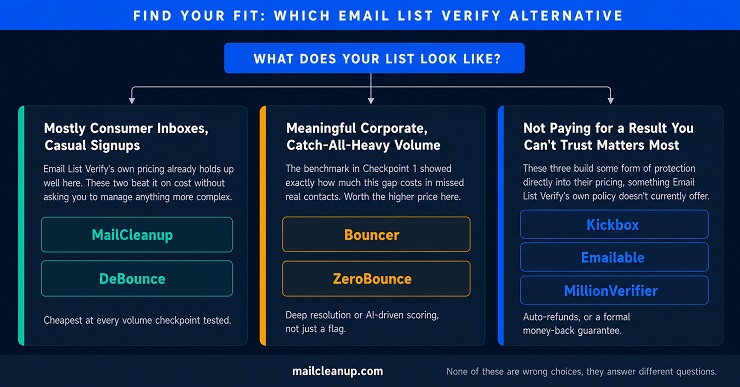
If your list is mostly consumer inboxes and casual signups, Email List Verify’s own pricing still holds up, and MailCleanup or DeBounce beat it on cost without asking you to manage anything more complex. If a meaningful share of your list is corporate, catch-all-heavy B2B domains, Bouncer’s deep resolution or ZeroBounce’s AI-driven scoring are worth the higher price, since Checkpoint 1’s benchmark showed exactly how much that specific gap costs in missed real contacts. If what matters most is not paying for a result you can’t trust, Kickbox, Emailable, and MillionVerifier all build some form of that protection directly into their pricing, something Email List Verify’s own policy doesn’t currently offer.
None of that makes Email List Verify a bad tool. It makes it a tool with a specific shape, and the right alternative to Email List Verify depends entirely on where your own list stops fitting that shape.
FAQs on Email List Verify Alternatives
Why do Email List Verify alternatives handle unknown results better on B2B lists?
Email List Verify’s core checks rely on syntax and SMTP-level validation, which struggle against catch-all corporate mail servers that accept mail for any address without confirming a specific mailbox. Independent testing on B2B lists puts its accuracy closer to 91%, well under its marketed 97 to 99%. Tools like Bouncer and ZeroBounce add deeper resolution or AI-driven scoring specifically to close that gap.
What Is the difference between Email List Verify alternatives like ZeroBounce and Kickbox?
ZeroBounce assigns catch-all addresses a 0-10 AI-driven confidence score rather than a binary flag, and costs more, $69 versus Kickbox’s $40 at 5,000 credits. Kickbox instead refunds credits automatically on any Unknown result and centers its reputation on integration ease, especially with HubSpot. Neither charges for results it can’t confirm, unlike Email List Verify’s own policy.
Do Email List Verify alternatives charge extra for catch-all or unknown results?
It varies. Email List Verify’s own Deep Scan add-on charges triple credits to re-check unresolved catch-all results. Bouncer, Emailable, and Kickbox don’t charge for unknown results at all, and MillionVerifier backs uncertain results with a 100% money-back guarantee instead. ZeroBounce charges for invalid results but not unknowns, while MailCleanup’s flat per-order rate covers every outcome the same way.
Which Email List Verify alternatives offer refunds for inaccurate results?
None of the tools compared here offer a blanket refund for results that turn out to be inaccurate after the fact, that includes Email List Verify itself, where a documented Capterra dispute describes a refund being refused over contested bounce data. What several alternatives do instead is avoid charging for uncertain results upfront: Kickbox, Emailable, and MillionVerifier’s money-back guarantee all work this way.
Are Email List Verify alternatives worth it for small email lists?
Not necessarily. Email List Verify’s own review base skews heavily toward small businesses, over 75% of its G2 reviewers, and its pay-as-you-go pricing starting at $17 for 5,000 credits already works well for casual, low-volume lists. MailCleanup and DeBounce both undercut that price further. The accuracy gap that justifies switching shows up specifically on larger, catch-all-heavy B2B lists, not small consumer ones.
Which Email List Verify alternative is cheapest at high volume?
MailCleanup is cheapest across every volume checkpoint tested, $90 at 100,000 credits against Email List Verify’s $186. DeBounce is the next cheapest at $135. MillionVerifier is worth watching specifically at high volume: it starts pricier than Email List Verify at 5,000 and 10,000 credits but overtakes it in value past roughly 50,000, landing at $149 versus $186 at 100,000.
Do Email List Verify alternatives offer live chat support?
It’s mixed, and Email List Verify itself does not, a Capterra review specifically names the absence of live chat as an area for improvement. Bouncer also offers email-only support with a roughly 24-hour response time, no live chat either. Among the tools compared here, checking each vendor’s current support page directly is worth doing before volume or accuracy alone decides the choice.
What Is the best alternative to Email List Verify for B2B teams?
Bouncer is the strongest fit for B2B-heavy, catch-all-dense lists specifically, its Toxicity Check feature resolves catch-all addresses down to a 0.3-3% unknown rate, the lowest of any tool compared here. ZeroBounce is the next best option if an AI-driven confidence score matters more than deep resolution. Both cost more than Email List Verify, the trade-off for meaningfully better B2B accuracy.