
If you’re reading this, there’s a good chance ZeroBounce already has your email list, or is about to. It’s one of the more recognizable names in email verification, and for plenty of teams it works fine. But recognizable isn’t the same as best fit, and if you’ve landed here, something about the price, the speed, or the way it handles a stubborn catch-all domain probably didn’t sit right.
This guide walks through 10 real ZeroBounce alternatives, tested against the same four criteria: how well each one actually resolves a catch-all address instead of just flagging it, what it really costs at 5,000, 10,000, 50,000, and 100,000 verifications, how fast it processes a large batch, and whether the day-to-day workflow is something your team will actually want to use. No tool here is flawless, including ours, so every section below covers what each one gets right and where it genuinely falls short.
By the end, you should have enough detail on how each tool actually verifies an address, not just what it costs, to make a real decision.
TL;DR on ZeroBounce Alternatives
- MailCleanup is the cheapest of the 10 alternatives tested at every volume checkpoint, from $10 at 5,000 verifications to $90 at 100,000.
- Bouncer’s Toxicity Check screens separately for spam traps, serial complainers, and breached credentials, part of why its catch-all unknown-result rate runs as low as 0.3 to 3 percent.
- NeverBounce combines a 20-plus step automated process with human quality assurance, processing 10,000 emails in as little as 2 to 10 minutes against ZeroBounce’s roughly 45 minutes for 100,000.
- DeBounce runs syntax, domain, MX, and SMTP-handshake checks in one pipeline at $15 for 5,000 verifications up to $135 for 100,000, cheaper than ZeroBounce at every tier but not the cheapest tool in this guide.
- ZeroBounce’s own pay-as-you-go pricing runs from $69 at 5,000 verifications to $649 at 100,000, a leading reason users start comparing alternatives.
- ZeroBounce markets 99.6 percent accuracy, though independent testing has found real-world results closer to 96 to 98 percent.
- Every alternative in this guide is scored on catch-all resolution depth, true cost at scale, verification speed, and day-to-day workflow simplicity.
What Is ZeroBounce & Why Do Teams Search for Alternatives to ZeroBounce?
ZeroBounce is an email verification platform that checks a list for syntax errors, domain validity, and spam traps, then scores each address on how safe it is to send to. It markets 99.6 percent accuracy, though independent benchmarks have generally landed closer to 96 to 98 percent, a gap worth knowing about before you budget around the higher number. For a service (learn how email verification differs from validation) that positions itself at the premium end of the category, that gap is one of the more common reasons teams start comparing ZeroBounce alternatives.
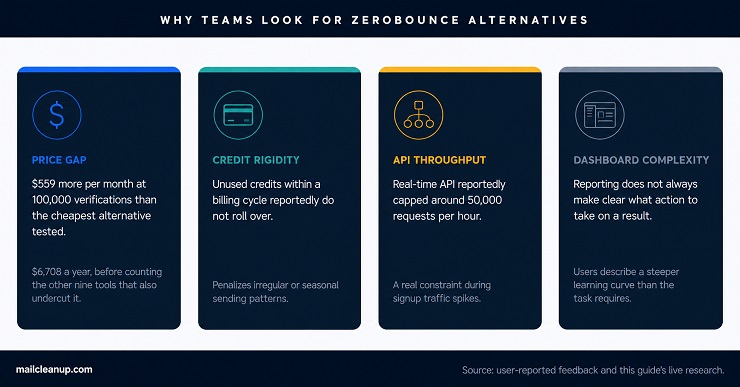
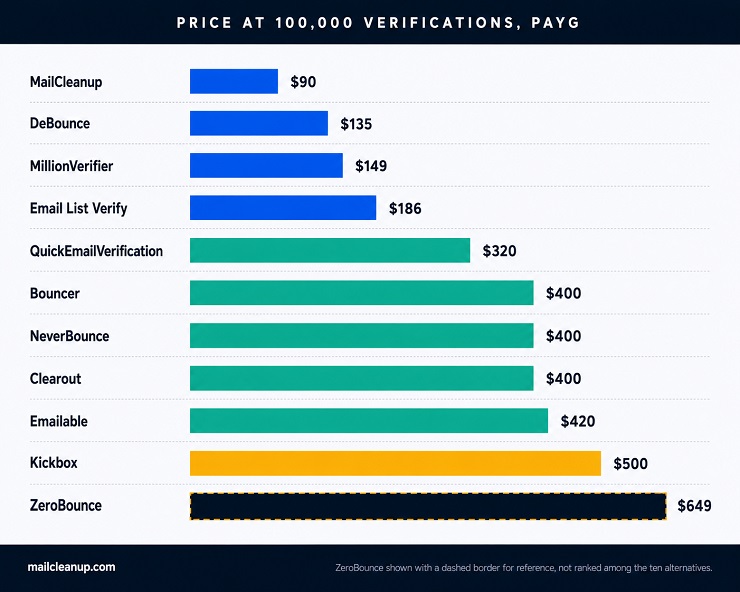
Pricing is the clearest, most quantifiable complaint. ZeroBounce’s own pay-as-you-go rates run from $69 at 5,000 verifications up to $649 at 100,000. Run that against MailCleanup’s $90 at the same 100,000-verification checkpoint and the gap is $559 a month for a team cleaning that volume regularly, $6,708 a year, and that’s comparing ZeroBounce to just one of the nine other tools in this guide that undercut it. Reports also suggest unused ZeroBounce credits within a billing cycle don’t roll over, a use-it-or-lose-it structure that penalizes exactly the kind of irregular, seasonal sending pattern a lot of businesses actually have, without giving up the deliverability gains a clean list is actually supposed to buy you.
Two other frictions come up often in user feedback:
- API throughput: ZeroBounce’s real-time API is reportedly capped around 50,000 requests per hour, a real constraint if your workflow needs to verify addresses at the point of signup during a traffic spike rather than in a scheduled batch.
- Dashboard complexity: Some users describe the interface as more complex than it needs to be for a straightforward list-cleaning task, with reporting that doesn’t always make clear what action to take on a given result.
Worth knowing regardless of which tool you choose: ZeroBounce automatically deletes uploaded files and validation results within 30 days if you don’t delete them manually first, relevant if data retention is part of your own compliance checklist.
None of that makes ZeroBounce a bad tool. It means the right alternative to ZeroBounce depends on which of these frictions, price, credit rigidity, API throughput, or workflow complexity, actually matters for your list and your team, which is exactly what the next section is built to help you sort out.
How We Evaluated These ZeroBounce Competitors: The ZeroBounce Exit Stack
Every tool in this guide is scored against the same four layers, in this order:
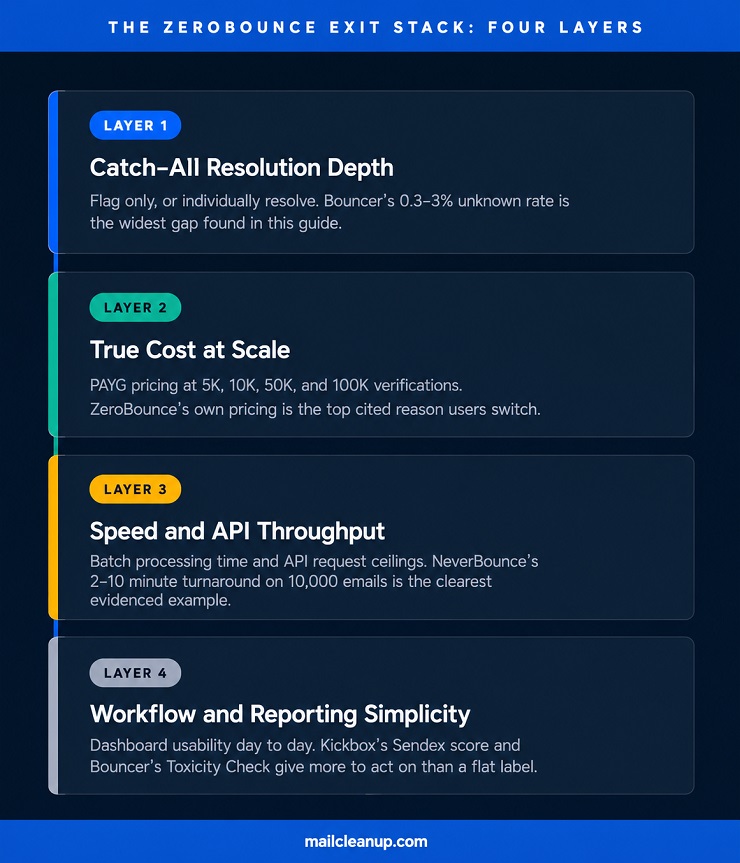
- Catch-All Resolution Depth: Whether a tool simply flags a catch-all domain the way ZeroBounce does, or goes further to individually score or fully resolve the address to a confident valid or invalid call. This is the single biggest accuracy differentiator in the category, and it’s where the widest gap in this guide shows up: Bouncer resolves catch-all addresses down to a 0.3 to 3 percent unknown rate, while several tools, including ZeroBounce itself, still just apply a flag and leave the decision to you.
- True Cost at Scale: Real pay-as-you-go pricing at 5,000, 10,000, 50,000, and 100,000 verifications for every tool, since ZeroBounce’s own pricing structure, and its use-it-or-lose-it credit policy, is the most commonly cited reason its users go looking elsewhere. At the 100,000-verification checkpoint alone, the gap between ZeroBounce and the cheapest tool in this guide runs into hundreds of dollars a month.
- Speed and API Throughput: How long a bulk batch actually takes to process, and whether a tool’s real-time API carries the kind of request-volume ceilings ZeroBounce users report running into, reportedly capped around 50,000 requests per hour. NeverBounce’s documented turnaround on a 10,000-email batch, as little as 2 to 10 minutes, is the clearest evidenced example in this guide of what a faster alternative actually looks like.
- Workflow and Reporting Simplicity: Whether the dashboard and the resulting reports are genuinely usable day to day, since interface complexity and thin reporting depth are recurring friction points ZeroBounce users mention, and this is also where spam trap detection depth tends to show up in the reporting. Kickbox’s graded Sendex score and Bouncer’s Toxicity Check are the two clearest examples in this guide of a tool giving you more to act on than a flat status label.
Quick Comparison of ZeroBounce Alternatives
| Tool | Price at 5,000 | Price at 10,000 | Price at 50,000 | Price at 100,000 |
|---|---|---|---|---|
| MailCleanup | $10 | $15 | $50 | $90 |
| Bouncer | $35 | $60 | $250 | $400 |
| NeverBounce | $40 | $50 | $250 | $400 |
| DeBounce | $15 | $25 | $75 | $135 |
| Emailable | $38 | $60 | $245 | $420 |
| Kickbox | $40 | $70 | $275 | $500 |
| Clearout | $40 | $65 | $325 | $400 |
| Email List Verify | $17 | $27 | $98 | $186 |
| MillionVerifier | $39 | $39 | $89 | $149 |
| QuickEmailVerification | $35 | $60 | $200 | $320 |
Marketed vs. Independently Tested Accuracy Across These ZeroBounce Alternatives
Marketed accuracy figures in this category are aspirational by design, and the gap between what’s advertised and what independent testing actually finds varies enormously by tool and by methodology. The widest gaps below come from benchmarks that count an unresolved “unknown” result as a failure, a stricter standard than benchmarks that set unknowns aside before scoring. That single methodological choice is why Clearout and Kickbox, both marketed at 98 percent or higher, score below 70 percent on the strictest tests while performing respectably, in the mid-90s, on benchmarks that handle unknowns separately.
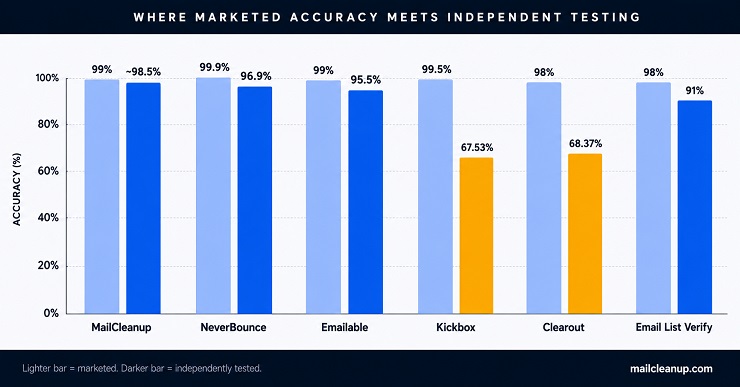
| Tool | Marketed Accuracy | Independently Tested Accuracy |
|---|---|---|
| MailCleanup | Up to 99% | ~98-99% |
| Bouncer | 99.5% | Not independently tested this session |
| NeverBounce | Up to 99.9% | ~96.9% |
| DeBounce | 97.5%+ deliverability guarantee | Not independently benchmarked to a single figure this session |
| Emailable | 99% guarantee | ~95-96% |
| Kickbox | 99.5% deliverability prediction (ecosystem claim) | ~96-97% with unknowns handled separately, 67.53% when unknowns count as failures |
| Clearout | 98%+ (some materials cite 99.73%) | 68.37% (Hunter benchmark, unknowns count as failures) |
| Email List Verify | 97-99% | ~91% on catch-all-heavy lists |
| MillionVerifier | 99%+ | Not independently tested this session |
| QuickEmailVerification | 99% | Not independently tested this session |
The practical takeaway: a marketed accuracy figure alone doesn’t tell you how a tool will perform on your specific list. A list with very few catch-all domains will likely perform close to the marketed number on any of these tools. A list with a lot of accept-all business domains will expose the gap between marketed and tested accuracy fast, which is exactly why catch-all resolution depth, not the accuracy percentage on a landing page, is the first layer of the Exit Stack framework above.
Credit Expiry and Billing Fairness Across These ZeroBounce Competitors
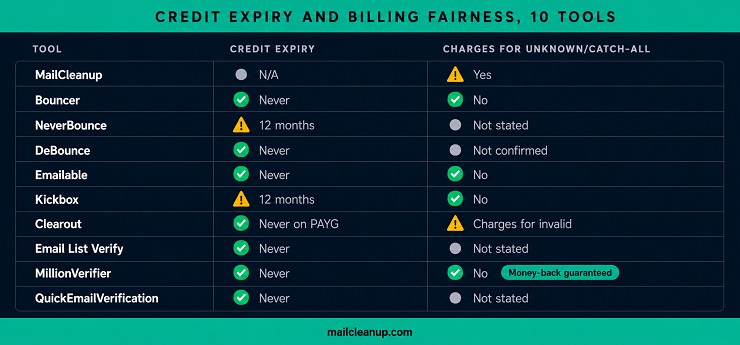
Billing fairness in this category comes down to one simple question: does the tool charge you for a result it can’t actually resolve? MillionVerifier’s money-back guarantee and the automatic refund policies at Bouncer, Kickbox, and Emailable mean an ambiguous result doesn’t cost you anything beyond the attempt. MailCleanup and Clearout take the opposite approach for different reasons: MailCleanup’s flat rate is a simplicity trade-off with a genuinely low absolute cost, covered earlier in this guide, while Clearout’s strict billing on invalid results is worth factoring into your total spend if your list runs old or purchased contacts.
| Tool | Credit Expiry | Charges for Unknown or Catch-All Results |
|---|---|---|
| MailCleanup | Not applicable, no persistent balance | Yes, flat rate covers every result type |
| Bouncer | Never | No |
| NeverBounce | 12 months after purchase | Not stated |
| DeBounce | Never | Not confirmed this session |
| Emailable | Never | No, refunded automatically |
| Kickbox | 12 months after purchase | No, refunded automatically |
| Clearout | Never on PAYG, rolls over on subscriptions | Charges for invalid results, stricter than most tools here |
| Email List Verify | Never | Not stated |
| MillionVerifier | Never; bulk discounts stack | No, backed by a 100% money-back guarantee |
| QuickEmailVerification | Never | Not stated |
Credit expiry matters more than it looks like on the surface. NeverBounce and Kickbox both expire unused credits after 12 months, which penalizes exactly the kind of irregular or seasonal verification pattern a lot of teams actually have, the same use-it-or-lose-it structure that pushes people away from ZeroBounce in the first place. Every other tool in this guide leaves credits usable indefinitely, worth weighing against the raw price if your verification volume varies a lot month to month.
The Best ZeroBounce Alternatives, Tool by Tool
1. MailCleanup: The Simplest, Cheapest ZeroBounce Alternative for List Cleaning
MailCleanup is our own email verification service, so we’ll say this plainly rather than let you find it out later: we’re not a neutral party here. What we can offer instead is the same honesty about our own limitations we’d expect from any tool in this guide. MailCleanup runs each address through standard syntax, domain, and mailbox-existence checks and sends a cleaned list back to your inbox, no dashboard login or account setup required. Every result type, valid, invalid, catch-all, or unknown, is billed at the same flat per-credit rate, which is what makes MailCleanup the cheapest ZeroBounce alternative in this entire guide against ZeroBounce’s $69 to $649 range across the same four checkpoints.
The one real trade-off: MailCleanup bills catch-all and unknown results at the same flat rate as a clear valid or invalid, rather than refunding or discounting them the way a couple of competitors do. In practice this costs very little. MailCleanup’s per-credit rate is already the lowest of any tool in this guide, so even a handful of ambiguous results at that rate adds up to pennies, not a meaningful expense. There’s also no live API or native integrations.
MailCleanup is built as a single, order-based service: send a list, get a clean one back, with nothing to configure. That suits small teams and marketers without a developer on hand to wire up an API integration, since the entire workflow is a file upload and a download link.

MailCleanup Overview
| Metric | Detail |
|---|---|
| Marketed accuracy | Up to 99% |
| Independently tested accuracy | ~98-99% |
| Catch-all handling | Flagged, not individually resolved |
| Free credits | Available on request, no automatic signup offer |
| Credit expiry | Not applicable, no persistent balance |
| API / integrations | None. CSV in, cleaned list out |
| Price at 5,000 | $10 |
| Price at 10,000 | $15 |
| Price at 50,000 | $50 |
| Price at 100,000 | $90 |
Solves ZeroBounce’s pricing problem: at every one of the four volume checkpoints tested in this guide, MailCleanup costs less than ZeroBounce and less than every other alternative on this list, without a subscription commitment.
2. Bouncer: Most Accurate Alternatives to ZeroBounce for Catch-All Domains
Bouncer’s verification pipeline goes beyond a standard syntax-and-SMTP check. Its Toxicity Check feature separately screens for addresses tied to known spam traps, serial complainers, litigators, and breached-credential lists, categories ZeroBounce’s own scoring doesn’t break out individually. That extra layer is a real part of why Bouncer’s unknown-result rate on catch-all domains runs as low as 0.3 to 3 percent, the strongest catch-all number found anywhere in this session’s research, since it’s actually resolving addresses that a flag-only tool would leave as a shrug. Bouncer is GDPR-first, based in Poland with EU data centers, and SOC 2 certified, and protects sender reputation further through a separately priced deliverability suite and a signup-form protection tool called Shield.
Uploaded data is retained for up to 60 days before being anonymized and permanently deleted, actually longer than ZeroBounce’s own 30-day window, worth factoring in if a shorter retention period matters more to your compliance requirements than a longer one. Its per-credit rate also improves meaningfully at very high volume, dropping to around $2 per 1,000 credits at the 1 million tier, worth knowing if your list is going to keep growing well past the checkpoints covered in this guide.
The honest trade-off: that deeper resolution and the Toxicity Check layer come at a real cost premium over the cheapest tools in this guide, and Shield plus the deliverability suite are priced outside the core verification numbers below, so the sticker price isn’t the full cost if you want those add-ons too.
Bouncer Overview
| Metric | Detail |
|---|---|
| Marketed accuracy | 99.5% |
| Independently tested accuracy | Not independently tested as of this session’s research |
| Catch-all handling | Toxicity Check plus deep verification, unknown-result rate as low as 0.3 to 3% |
| Free credits | 100, no credit card required |
| Credit expiry | Never |
| API / integrations | Real-time API, plus separately priced Shield and deliverability suite |
| Price at 5,000 | $35 |
| Price at 10,000 | $60 |
| Price at 50,000 | $250 |
| Price at 100,000 | $400 |
Solves ZeroBounce’s catch-all guesswork: where ZeroBounce flags an accept-all domain and leaves you to decide, Bouncer’s Toxicity Check and deep resolution process actually work through the majority of those same addresses to a confident answer.
3. NeverBounce: Fastest ZeroBounce Alternatives for Bulk Verification
NeverBounce combines a 20-plus step automated verification process with a layer of human quality assurance rather than relying on automation alone, and that combination is part of why it processes a 10,000-email batch in as little as 2 to 10 minutes, against ZeroBounce’s roughly 45 minutes for a 100,000-email batch. It backs that up with 80-plus native integrations, including Sync CRM automation for teams verifying continuously rather than in one-off batches, which matters if your list grows daily rather than getting cleaned once a quarter. NeverBounce is now owned by ZoomInfo, which gives it access to a much larger B2B data ecosystem than a standalone verifier typically has.
The honest trade-off: only 10 free credits on signup, the thinnest free tier of any tool covered so far, and a 12-month credit expiry window means unused credits don’t sit indefinitely the way they do with several other alternatives here. Its catch-all handling also lags behind Bouncer, resolving only around 8 percent of catch-all cases, with most returning unresolved. Some users also report that product updates have slowed and support quality has dipped somewhat since the ZoomInfo acquisition, worth weighing against the ecosystem benefits above.
NeverBounce Overview
| Metric | Detail |
|---|---|
| Marketed accuracy | Up to 99.9% |
| Independently tested accuracy | ~96.9% |
| Catch-all handling | Resolved in roughly 8% of cases, most return unresolved |
| Free credits | Only 10 on signup |
| Credit expiry | 12 months after purchase |
| API / integrations | Real-time API, 80+ native integrations, Sync CRM automation |
| Price at 5,000 | $40 |
| Price at 10,000 | $50 |
| Price at 50,000 | $250 |
| Price at 100,000 | $400 |
Solves ZeroBounce’s speed problem: NeverBounce’s documented turnaround on bulk batches is the clearest, best-evidenced speed advantage of any tool in this comparison, directly targeting the bounce risk of sitting on an unverified list too long before a send.
4. DeBounce: Affordable ZeroBounce Competitors
DeBounce runs every address through a defined pipeline: syntax check, domain and MX record lookup, SMTP handshake testing, disposable-email detection, catch-all identification, and role-based filtering, at $15 for 5,000 verifications up to $135 for 100,000. That’s meaningfully cheaper than ZeroBounce at every checkpoint tested, and it’s backed by real enterprise usage (Western Digital, Samsung, Cornell University, and Siemens are among its customers), 20-plus native ESP and CRM integrations, and a real-time API without the request-volume friction some ZeroBounce users report. It carries a 4.9 out of 5 rating on Trustpilot across more than 1,300 reviews, a large enough sample to take seriously.
The honest trade-off: DeBounce identifies catch-all domains within its pipeline but doesn’t score or individually resolve them the way Bouncer’s Toxicity Check does, and independent reviews flag gaps in its spam-trap coverage specifically. It also retains verified results for only 7 days, so lists need to be downloaded promptly after each run. And while it beats ZeroBounce on price, it isn’t the cheapest tool in this guide, MailCleanup costs less at every one of the same four checkpoints.
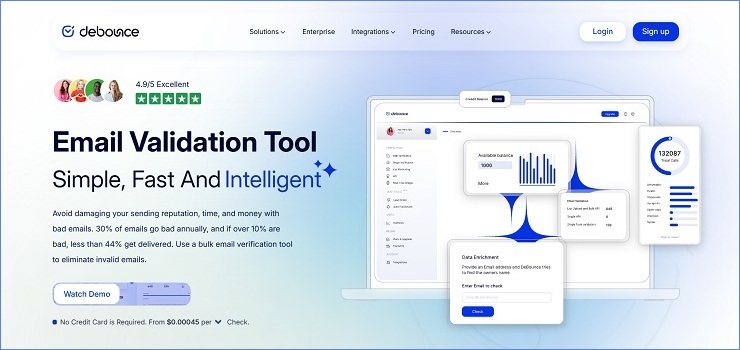
DeBounce Overview
| Metric | Detail |
|---|---|
| Marketed accuracy | 97.5%+ deliverability guarantee (DeBounce’s own figure) |
| Independently tested accuracy | Not independently benchmarked to a single figure this session |
| Catch-all handling | Identified within the verification pipeline, not individually resolved |
| Free credits | 100 on signup |
| Credit expiry | Never |
| API / integrations | Real-time API, 20+ native ESP/CRM integrations |
| Price at 5,000 | $15 |
| Price at 10,000 | $25 |
| Price at 50,000 | $75 |
| Price at 100,000 | $135 |
Solves ZeroBounce’s integration friction: DeBounce’s 20-plus native connectors and unrestricted real-time API give it more out-of-the-box workflow flexibility than ZeroBounce, at a lower price across the board, though not the lowest in this guide.
5. Emailable: A Well-Rounded Alternative to ZeroBounce for Integrations
Emailable verifies a 10,000-email batch in about 2 to 3 minutes, and a 250,000-email list in roughly 10, a speed figure sourced directly from its own pricing page rather than a third-party estimate. It integrates with more than 50 platforms, HubSpot, Salesforce, Klaviyo, Mailchimp, ActiveCampaign, and Brevo among them, one of the largest connector libraries of any tool in this guide, and it doesn’t charge for duplicate or unknown results, both refunded automatically to your credit balance. A monthly subscription shaves 15 percent off the pay-as-you-go rates below, worth considering if your volume is predictable rather than occasional.
It also has its own dedicated Emailable alternatives guide on this site if you want to see how it stacks up against other options directly. It’s SOC 2 Type II certified and GDPR compliant, worth knowing if your team has a compliance checklist to clear before adopting a new vendor.
The honest trade-off: Emailable markets a 99 percent deliverability guarantee, but independent testing puts real-world accuracy closer to 95 to 96 percent, a meaningful enough gap to budget around. Its pricing is also uneven across volume: genuinely competitive at 50,000 verifications compared to Bouncer, NeverBounce, Kickbox, and Clearout, but by 100,000 verifications only Kickbox costs more. Catch-all handling still just flags an accept-all domain rather than resolving it the way Bouncer does.
Emailable Overview
| Metric | Detail |
|---|---|
| Marketed accuracy | 99% guarantee |
| Independently tested accuracy | ~95-96% |
| Catch-all handling | Flagged as accept-all, not individually resolved |
| Free credits | 250, one-time |
| Credit expiry | Never |
| API / integrations | Real-time API, 50+ integrations, one of the largest libraries in the category |
| Price at 5,000 | $38 |
| Price at 10,000 | $60 |
| Price at 50,000 | $245 |
| Price at 100,000 | $420 |
Solves ZeroBounce’s integration ceiling: Emailable’s 50-plus native connectors match or exceed ZeroBounce’s own integration library, without the API request friction some ZeroBounce users report.
6. Kickbox: Transparent ZeroBounce Alternatives on Accuracy Reporting
Kickbox scores every address with its Sendex quality rating, a 0 to 1 gradient rather than a flat valid or invalid call, so you can set your own list-scrubbing threshold instead of treating every “valid” result as equally safe (a deeper look at what a verification feature set should actually cover is worth a read if you want the full picture). Results it can’t confidently resolve come back as Unknown and are refunded automatically, so you’re not billed for an answer you can’t act on, a real point of difference from MailCleanup’s flat-rate approach covered earlier in this guide. Kickbox is GDPR and CCPA compliant, with SOC 2 certification in progress at the time of this research.
The honest trade-off: Kickbox’s marketed 99.5 percent deliverability prediction is explicitly framed as an ecosystem-wide claim rather than a guarantee specific to your list, and the real number depends heavily on how you measure it. A Sparkle test that handled unknowns separately found 96 to 97 percent accuracy, while a stricter Hunter benchmark that counted unknown results as failures scored Kickbox at just 67.53 percent, a reminder that accuracy numbers in this category can mean very different things depending on methodology.
Kickbox is also the most expensive tool in this guide at every volume checkpoint tested, which tends to make sense for teams who value the Sendex gradient and automatic refund policy enough to pay a premium for them, less so for teams optimizing purely on cost.
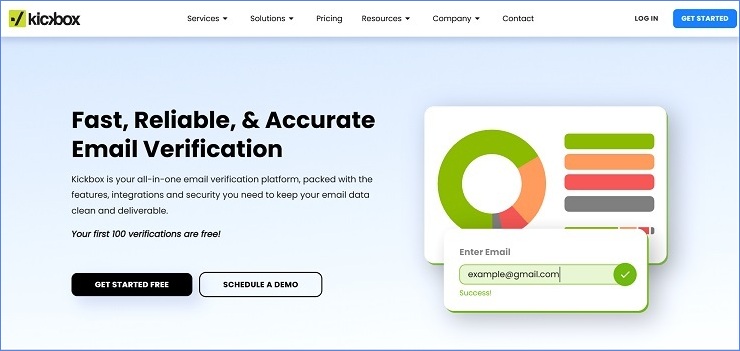
Kickbox Overview
| Metric | Detail |
|---|---|
| Marketed accuracy | 99.5% deliverability prediction (ecosystem claim, not a guarantee) |
| Independently tested accuracy | ~96-97% when unknowns handled separately; 67.53% on a stricter benchmark counting unknowns as failures |
| Catch-all handling | Returns “Unknown” rather than a confident call, refunded automatically |
| Free credits | 100 on signup |
| Credit expiry | 12 months after purchase |
| API / integrations | Real-time API, 25+ native integrations, Sendex quality score (0-1 gradient) |
| Price at 5,000 | $40 |
| Price at 10,000 | $70 |
| Price at 50,000 | $275 |
| Price at 100,000 | $500 |
Solves ZeroBounce’s confidence-scoring gap: Sendex gives a graded 0 to 1 confidence score instead of ZeroBounce’s simpler status categories, useful if your team wants to set its own risk threshold rather than accept a binary call.
7. Clearout: A Real-Time ZeroBounce Alternative for Signup Forms
Clearout’s Form Guard product plugs directly into a signup form to block risky addresses at the exact moment someone submits it, before a bad address ever reaches your list or your ESP, catching disposable email addresses right at the point of entry, alongside its core bulk and real-time API verification. It connects natively to HubSpot, Salesforce, Google Sheets, WordPress, and a LinkedIn Chrome extension for prospecting workflows, and it’s ISO 27001 and SOC 2 Type II certified, credentials that matter if your legal or security team vets vendors before signoff. Worth flagging directly: Clearout also includes email-finding features alongside verification, so unlike most tools in this guide, it can double as a lead-discovery tool, not just a list cleaner.
The honest trade-off, and it’s a significant one: Clearout markets 98 percent or higher accuracy, with some materials citing as high as 99.73 percent, but an independent Hunter benchmark using a strict methodology that counts unknown results as failures scored it at just 68.37 percent, the widest gap between marketed and independently tested accuracy found anywhere in this guide. Clearout is also unusually strict about billing: it charges for invalid results in a way most competitors here don’t, so a list with a lot of dead addresses costs more to process than the sticker price implies.

Clearout Overview
| Metric | Detail |
|---|---|
| Marketed accuracy | 98%+ (some materials cite 99.73%) |
| Independently tested accuracy | 68.37% (Hunter benchmark, strict methodology counting unknowns as failures) |
| Catch-all handling | Advanced resolver |
| Free credits | 100, one-time lifetime allotment |
| Credit expiry | Never on PAYG, rolls over on subscriptions |
| API / integrations | Real-time API, Form Guard, HubSpot, Salesforce, Google Sheets, WordPress, LinkedIn Chrome extension |
| Price at 5,000 | $40 |
| Price at 10,000 | $65 |
| Price at 50,000 | $325 |
| Price at 100,000 | $400 |
Solves ZeroBounce’s signup-form gap: Form Guard verifies an address at the point of entry, something ZeroBounce doesn’t offer as a dedicated product, though the accuracy gap above means that convenience should be weighed against real testing, not the marketed number alone.
8. Email List Verify: Cheaper ZeroBounce Competitors at Every Volume
Email List Verify categorizes every result into one of 18 status codes rather than a simple valid, invalid, or unknown, giving a more granular read on exactly why an address failed, useful context for anyone treating email list hygiene as an ongoing discipline rather than a one-off cleanup. Its optional Deep Scan add-on goes further on catch-all domains for an extra cost, for teams willing to pay a bit more on the addresses that matter most. It integrates natively with Mailchimp, AWeber, MailerLite, HubSpot, and Campaign Monitor, and offers a real-time API for point-of-entry verification, similar in spirit to a full execution guide for cleaning a list from scratch.
The honest trade-off: independent testing found accuracy dropping to around 91 percent specifically on catch-all-heavy lists, noticeably below its marketed 97 to 99 percent range, so the gap widens exactly where accuracy matters most. A monthly subscription runs about 10 percent cheaper than the pay-as-you-go rates below if your verification needs are steady rather than occasional. Across the 10 tools in this guide, Email List Verify is the third cheapest at every volume checkpoint, behind only MailCleanup and DeBounce.
Email List Verify Overview
| Metric | Detail |
|---|---|
| Marketed accuracy | 97-99% |
| Independently tested accuracy | ~91% on catch-all-heavy lists |
| Catch-all handling | Flagged as one of 18 status codes; Deep Scan add-on for deeper resolution at extra cost |
| Free credits | 100 on signup |
| Credit expiry | Never (PAYG) |
| API / integrations | Real-time API, Mailchimp, AWeber, MailerLite, HubSpot, Campaign Monitor |
| Price at 5,000 | $17 |
| Price at 10,000 | $27 |
| Price at 50,000 | $98 |
| Price at 100,000 | $186 |
Solves ZeroBounce’s pricing problem too: at less than half of ZeroBounce’s price at every checkpoint, Email List Verify is a straightforward budget upgrade, provided catch-all-heavy lists get the optional Deep Scan treatment.
9. MillionVerifier: ZeroBounce Alternative at Small List Sizes
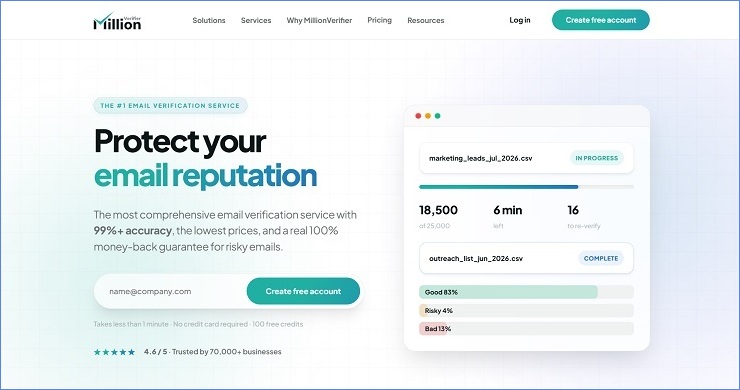
MillionVerifier’s pricing has an unusual quirk worth knowing before you buy: 5,000 and 10,000 credits cost the same $39, so if you’re anywhere under 10,000 verifications, there’s no reason to buy the smaller pack. Its bulk discounts also stack in an unusual way: purchase 5 million credits and you get an extra 1 million free, a structure that rewards committing to volume upfront rather than topping up in small increments.
Catch-all detection is included at no extra cost rather than gated behind a pricier tier, and every result comes with a 100 percent money-back guarantee if MillionVerifier can’t verify an address with certainty, a stronger commitment than simply not billing for unknowns. For teams that need to keep a list clean on an ongoing basis rather than doing a one-off scrub, EverClean is available separately as an automated daily re-verification subscription.
The honest trade-off: an independent review found MillionVerifier’s catch-all handling less granular than ZeroBounce’s own scoring, so while it’s included free, it isn’t necessarily doing more with a catch-all address than the tool it’s replacing. Independent accuracy testing wasn’t available for MillionVerifier as of this session’s research, so the marketed 99%-plus figure hasn’t been checked against a third-party benchmark the way several other tools in this guide have been.
MillionVerifier Overview
| Metric | Detail |
|---|---|
| Marketed accuracy | 99%+ |
| Independently tested accuracy | Not independently tested as of this session’s research |
| Catch-all handling | Included at no extra cost; less granular than ZeroBounce’s own scoring per an independent review |
| Free credits | 100, one-time, no credit card required |
| Credit expiry | Never; bulk discounts stack, extra 1M credits free per 5M purchased |
| API / integrations | Real-time API, one-click Mailchimp, HubSpot, ActiveCampaign, SendGrid |
| Price at 5,000 | $39 |
| Price at 10,000 | $39 |
| Price at 50,000 | $89 |
| Price at 100,000 | $149 |
Solves ZeroBounce’s uncertainty-billing problem: MillionVerifier’s money-back guarantee on results it can’t verify with certainty goes further than simply refunding a credit, backing its own accuracy claim with an actual guarantee.
10. QuickEmailVerification: A Long-Established Alternative to ZeroBounce
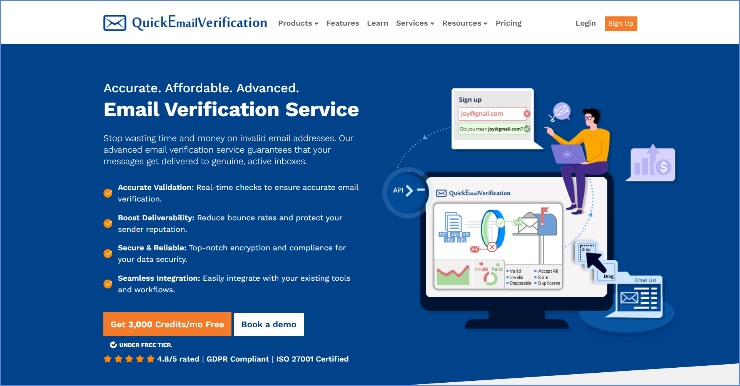
QuickEmailVerification has been in the category long enough to serve a large, established user base, independent reviews cite figures upward of 190,000 businesses, and processes around 100,000 emails in about an hour according to user-reported testing. It also markets itself as trusted by Fortune 50 companies and email service providers, a claim from its own site rather than something independently verified this session.
Its REST API and existing integrations, including a straightforward Google Sheets connection, are frequently singled out in independent reviews as one of its strongest areas, useful if a developer on your team needs verification working inside an existing workflow without a steep setup process. The free tier includes 100 verifications daily with no credit card required, and pay-as-you-go credits never expire.
The honest trade-off, and it’s worth being direct about this one: QuickEmailVerification’s catch-all handling doesn’t actually improve on ZeroBounce’s own approach. Independent reviews describe the same limitation both tools share, a catch-all address gets labeled and the decision to send still falls to you. Independent accuracy testing wasn’t available for QuickEmailVerification as of this session’s research, so its marketed 99 percent figure hasn’t been checked against a third-party benchmark the way several other tools in this guide have been.
QuickEmailVerification Overview
| Metric | Detail |
|---|---|
| Marketed accuracy | 99% |
| Independently tested accuracy | Not independently tested as of this session’s research |
| Catch-all handling | Flagged as catch-all, not individually resolved, the same limitation ZeroBounce has |
| Free credits | 100 daily, no credit card required |
| Credit expiry | Never (pay-as-you-go) |
| API / integrations | Real-time API, 25+ integrations, Google Sheets |
| Price at 5,000 | $35 |
| Price at 10,000 | $60 |
| Price at 50,000 | $200 |
| Price at 100,000 | $320 |
Solves ZeroBounce’s onboarding friction, not its catch-all problem: QuickEmailVerification’s REST API and Google Sheets integration are genuinely easy to get running quickly, though if catch-all resolution is your main frustration with ZeroBounce, this isn’t the tool that fixes it. Bouncer or Kickbox address that gap more directly.
Which ZeroBounce Alternative Should You Actually Choose?
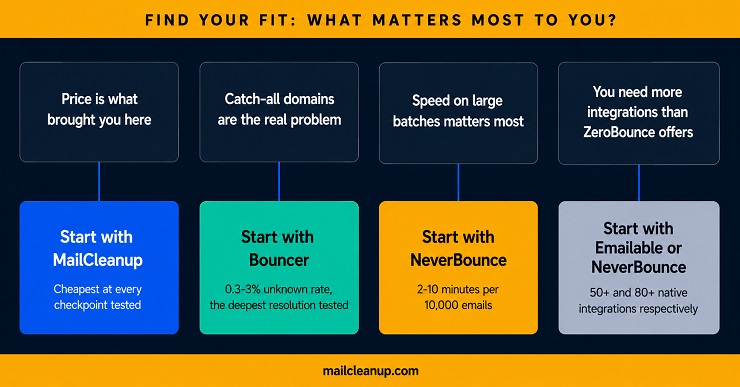
For most teams switching away from ZeroBounce, MailCleanup is the place to start: it’s the cheapest tool in this guide at every volume checkpoint, with accuracy in the same range as tools costing four to seven times as much. Run the math at 100,000 verifications a month and the gap against ZeroBounce alone is $559, $6,708 a year, before counting anything else. It’s the right starting point if a simple, order-based workflow with no account to manage suits how your team actually works.
If your list leans heavily catch-all and that’s the specific problem ZeroBounce hasn’t solved for you, Bouncer’s Toxicity Check and deep resolution process are the strongest evidenced option here, resolving addresses down to a 0.3 to 3 percent unknown rate rather than leaving them as a flag. If verification speed on very large batches is the bottleneck, NeverBounce’s documented 2-to-10-minute turnaround on 10,000 emails is hard to beat, though its 12-month credit expiry and thin free tier are real costs of that speed.
If you need more integrations than ZeroBounce itself offers, Emailable and NeverBounce both go further, at 50-plus and 80-plus native connections respectively. And if billing fairness on ambiguous results matters most, MillionVerifier’s money-back guarantee and the automatic refund policies at Bouncer, Kickbox, and Emailable are the tools that won’t charge you for an answer you can’t act on.
Test the same list across two or three alternatives to ZeroBounce before committing to a full switch. The trade-offs covered throughout this guide, catch-all depth, credit rigidity, and marketed-versus-tested accuracy gaps alike, are worth confirming against your own data, not just ours.
FAQs About ZeroBounce Alternatives
What is the best alternative to ZeroBounce for email verification?
The best alternative to ZeroBounce depends on what’s actually driving the switch. MailCleanup is the cheapest option tested at every volume checkpoint. Bouncer resolves catch-all domains most accurately. NeverBounce processes large batches fastest. There’s no single universal answer, the right fit depends on which of these matters most for your list.
Which ZeroBounce alternative is the most affordable?
MailCleanup is the most affordable ZeroBounce alternative tested in this guide, priced from $10 at 5,000 verifications up to $90 at 100,000, cheaper than every other tool covered here at all four checkpoints. DeBounce and Email List Verify are the next cheapest options if MailCleanup’s lack of a live API is a dealbreaker.
Are ZeroBounce alternatives as accurate as ZeroBounce?
It depends on the tool and how accuracy is measured. Bouncer and MailCleanup test close to or above ZeroBounce’s own 96 to 98 percent independently verified range. Clearout and Kickbox market accuracy well above 95 percent but scored far lower, 68.37 percent and 67.53 percent respectively, on stricter benchmarks counting unknown results as failures.
Can ZeroBounce alternatives integrate with my existing email marketing platform?
Most can. Emailable and NeverBounce offer the largest integration libraries in this guide, at 50-plus and 80-plus native connections respectively, covering platforms like HubSpot, Salesforce, and Mailchimp. MailCleanup is the exception: it’s an order-based service with no live API or native integrations by design, so it won’t plug directly into your existing stack.
How do ZeroBounce alternatives handle catch-all email addresses?
Handling varies widely. Bouncer’s Toxicity Check and deep resolution process actually resolve most catch-all addresses to a confident answer, with an unknown rate as low as 0.3 to 3 percent. Most other tools, including ZeroBounce itself, MailCleanup, DeBounce, and QuickEmailVerification, simply flag an address as catch-all and leave the decision to you.
What does it cost to use an alternative to ZeroBounce at scale?
At 100,000 verifications, ZeroBounce’s own pay-as-you-go rate runs $649. Every tool in this guide costs less at that volume, from MailCleanup’s $90 up to Kickbox’s $500, the only tool priced higher than several of ZeroBounce’s own tiers. Where you land in that range depends mostly on how much catch-all resolution and integration depth you need.
Do ZeroBounce alternatives offer free trials or free credits?
Yes, every one of these alternatives to ZeroBounce includes some free allotment. Emailable offers the most generous one-time amount at 250 credits, more than double ZeroBounce’s own limited trial. NeverBounce offers the thinnest at just 10 credits on signup. QuickEmailVerification and Bouncer both offer credits that renew, 100 daily and 100 with no card required.
Which ZeroBounce competitors don’t charge for unknown or catch-all results?
Several do. Bouncer, Kickbox, Clearout, Emailable, and MillionVerifier all refund or don’t bill for results they can’t confidently resolve. MillionVerifier goes furthest, backing its accuracy with a 100 percent money-back guarantee. MailCleanup and DeBounce are two of the few that bill catch-all and unknown results at the same flat rate as any other result.