

NeverBounce has real strengths. Its API is fast. Independent testing puts its turnaround at 2 to 10 minutes for a 10,000-email batch, quicker than any other tool in this guide. It backs that speed with a hybrid verification process, human quality assurance layered on top of automated checks, something most lower-cost competitors skip entirely. It also has scale: over 125,000 users have run lists through it.
But NeverBounce also carries a documented list of problems. Credits expire after 12 months. Trustpilot rates it 2 out of 5, “Poor,” largely because of that policy. Catch-all domains, the kind most B2B senders deal with constantly, get resolved inconsistently.
That combination is exactly why so many teams search for NeverBounce alternatives every year. This guide covers eight of them, tested against the specific problems NeverBounce’s own users report, not just a generic features checklist. If you’re looking at alternatives to NeverBounce because of one of these issues, you’re in the right place.
TL;DR on NeverBounce Alternatives
- NeverBounce’s PAYG pricing runs $40 for 5,000 credits, $50 for 10,000, $250 for 50,000, and $400 for 100,000 verifications.
- NeverBounce credits expire after 12 months, a policy that shows up repeatedly in its 2-out-of-5 “Poor” Trustpilot rating.
- NeverBounce resolves catch-all email addresses in only about 8% of cases; the rest come back unresolved.
- MailCleanup prices per order starting at $10 for 5,000 verifications, with no account, subscription, or credit expiry to manage.
- Bouncer’s Toxicity Check pushes its unknown-result rate as low as 0.3% to 3%, screening for spam traps and breached-credential lists along the way.
- Kickbox is the one tool in this guide that shares NeverBounce’s 12-month credit expiry policy.
- ZeroBounce replaces a flat valid or invalid call with an AI-driven 0-10 quality score.
- If you clean lists occasionally rather than continuously, a per-order tool avoids the credit-expiry risk that drives most NeverBounce complaints.
NeverBounce Alternatives at a Glance: Quick Comparison Table
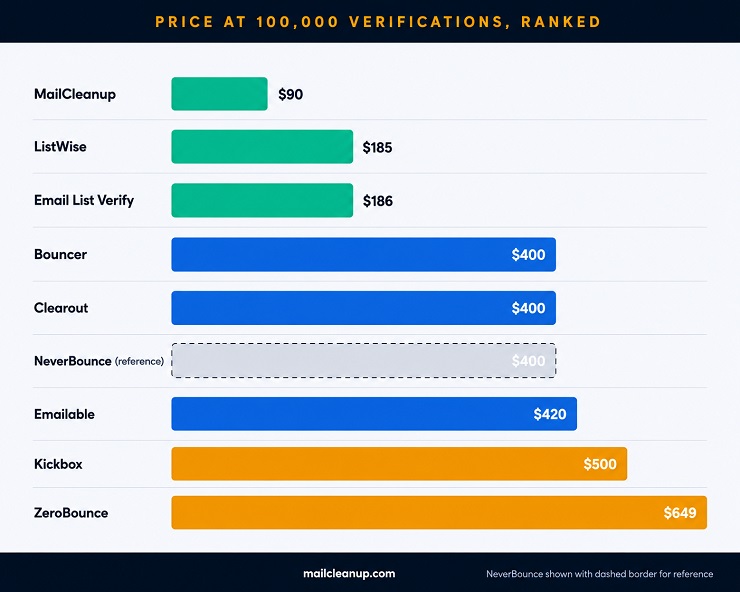
Before the deep dive, here’s how pricing compares across the NeverBounce alternatives covered in this guide, checkpoint by checkpoint.
| Tool | Price at 5,000 | Price at 10,000 | Price at 50,000 | Price at 100,000 |
|---|---|---|---|---|
| MailCleanup | $10 | $15 | $50 | $90 |
| Email List Verify | $17 | $27 | $98 | $186 |
| Bouncer | $35 | $60 | $250 | $400 |
| Emailable | $38 | $60 | $245 | $420 |
| Kickbox | $40 | $70 | $275 | $500 |
| Clearout | $40 | $65 | $325 | $400 |
| ZeroBounce | $69 | $129 | $499 | $649 |
| ListWise | N/A (10K minimum) | $45 | $105 | $185 |
| NeverBounce (for reference) | $40 | $50 | $250 | $400 |
Why Teams Look for NeverBounce Alternatives (and What It Still Does Well)
NeverBounce isn’t a bad product. It has real technical strengths that are easy to overlook once you start reading complaint threads, and understanding the difference between email verification and email validation helps explain why this category exists at all.
Its API is fast, its user base is large, and its hybrid human-plus-automation process catches things a purely automated tool can miss. None of that is in dispute.
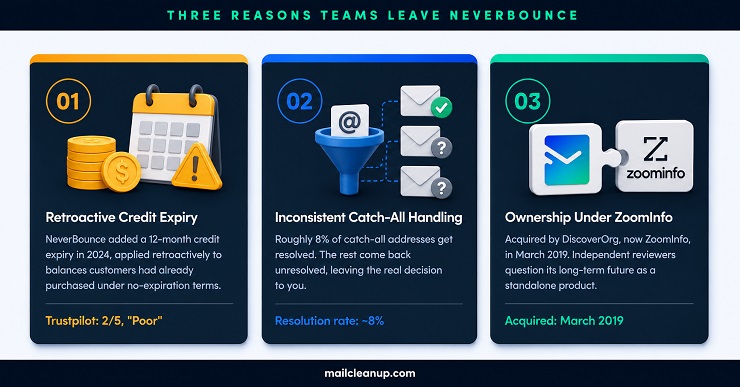
So why do so many of those same users go looking for NeverBounce alternatives? Three specific, documented reasons keep coming up:
- Credits expire after 12 months, a policy NeverBounce introduced retroactively in 2024 on balances some customers had already purchased under no-expiration terms. This shows up constantly in NeverBounce’s Trustpilot reviews, rated 2 out of 5, “Poor,” overall, with reviewers describing losing hundreds to thousands of dollars in unused credits.
- Catch-all domains get resolved inconsistently. NeverBounce clears roughly 8% of catch-all addresses; the rest come back unresolved, and unresolved catch-all addresses are exactly the kind that later drive email bounces, leaving the real decision to you.
- ZoomInfo’s ownership of NeverBounce has raised real questions about its future as a standalone product. This isn’t speculation on our part, independent reviewers have flagged the same concern directly.
None of that makes NeverBounce broken. It makes it a mismatch for a specific set of buying patterns: infrequent verification, catch-all-heavy B2B lists that quietly erode sender reputation over time, and long-term planning around a single vendor. The rest of this guide is built around exactly those three mismatches.
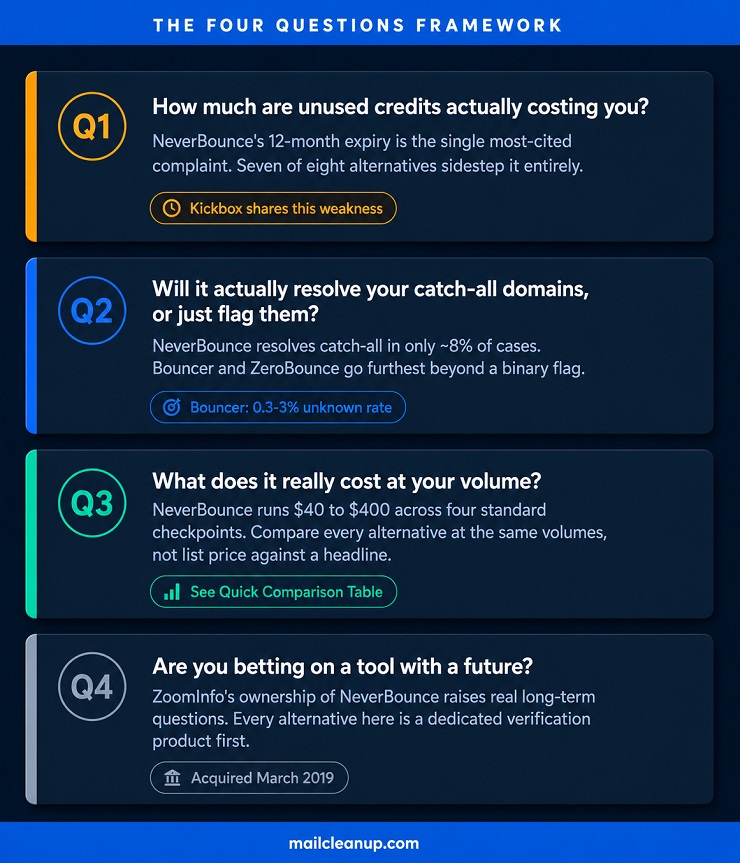
The Four Questions to Ask Before Choosing a NeverBounce Alternative
Every one of the eight NeverBounce alternatives in this guide answers a real, verifiable weakness with NeverBounce. For a broader primer on what a verification tool should actually check, see our features guide. Before the tool-by-tool breakdown, here’s what actually matters, in the order it should matter to you.
- How much are unused credits actually costing you? NeverBounce’s 12-month expiry is the single most-cited complaint in its own reviews. Seven of the eight tools ahead sidestep it entirely, MailCleanup skips the credit model altogether with a flat per-order price. Kickbox is the one exception in this guide; it carries the same 12-month window NeverBounce does.
- Will it actually resolve your catch-all domains, or just flag them? NeverBounce resolves catch-all addresses in only about 8% of cases. Bouncer’s Toxicity Check pushes its own unknown-result rate as low as 0.3% to 3%, and ZeroBounce replaces the flat valid or invalid call with an AI-driven 0-10 score. Both go further than a binary flag; most of the other tools here handle catch-all closer to the way NeverBounce does.
- What does it really cost at your volume? NeverBounce runs $40, $50, $250, and $400 at 5,000, 10,000, 50,000, and 100,000 verifications on its PAYG plan. The Quick Comparison Table above breaks out where every alternative in this guide lands at those same four checkpoints, so you’re comparing like for like, not list price against a marketing headline.
- Are you betting on a tool with a future? ZoomInfo’s ownership of NeverBounce is worth weighing before you commit long-term. It’s exactly why this guide includes a dedicated section on that question later on, not just a passing mention.
8 NeverBounce Alternatives, Compared Head-to-Head
Here’s how each of the eight NeverBounce alternatives in this guide actually holds up, not just on price, but on what each one checks and how well it checks it.
1. MailCleanup: One of the Cheapest NeverBounce Competitors for One-Time Cleanup
MailCleanup works differently from every other tool in this guide. There’s no account to create and no subscription to manage. You upload your list, place an order, and MailCleanup runs it through its own verification process, returning a cleaned list with a full breakdown of valid, invalid, and risky addresses.
That structure makes MailCleanup one of the more unusual NeverBounce alternatives here. Most of the other seven price by credit and expect you to keep coming back. MailCleanup prices by order, once, and the credit-expiry question that drives so many NeverBounce complaints simply doesn’t apply.
The trade-off is real, and worth stating plainly. MailCleanup flags catch-all and unknown results rather than individually resolving them, the same limitation NeverBounce itself has, and it has no live API or native integrations, so it isn’t built for real-time verification at the point of signup. That’s a deliberate simplicity trade-off, not an oversight, and it’s reflected in the price: MailCleanup starts at $10 for 5,000 verifications, among the lowest of any tool covered here.

Better fit if: you need a list cleaned occasionally and don’t want a subscription, expiring credits, or an account to manage.
Skip it if: you need real-time API verification at signup, or you need catch-all addresses individually resolved rather than flagged.
| MailCleanup Overview | |
| Marketed accuracy | Up to 99% |
| Independently tested accuracy | ~98-99% |
| Catch-all handling | Flagged, not individually resolved |
| Free credits | Available on request, contact required |
| Credit expiry | Not applicable, no persistent balance |
| Price at 5,000 / 10,000 / 50,000 / 100,000 | $10 / $15 / $50 / $90 |
2. Email List Verify: A Budget-Friendly Alternative to NeverBounce With a Real-Time API
Email List Verify runs every address through a pipeline that sorts results into 18 distinct status codes. Syntax failures, domain issues, disposable addresses, and catch-all addresses each get their own classification rather than a single pass or fail. Catch-all results can be pushed through a paid Deep Scan add-on for deeper resolution, a genuinely different approach from tools that just flag catch-all and stop.
As a straightforward, lower-cost alternative to NeverBounce, Email List Verify pairs that granularity with a real-time API and native integrations across Mailchimp, AWeber, MailerLite, HubSpot, and Campaign Monitor. It’s one of the more affordably priced NeverBounce alternatives in this guide, fitting both bulk cleanup and point-of-signup verification.
The honest catch: independent testing found its accuracy drops to around 91% specifically on catch-all-heavy lists, well below its own marketed 97 to 99% range. If your list skews heavily B2B, that gap is worth knowing about before you commit.
Better fit if: you want real-time API verification without NeverBounce’s per-credit pricing or 12-month expiry.
Skip it if: your list is heavily catch-all or B2B and you need accuracy closer to marketed claims out of the box.
| Email List Verify Overview | |
| Marketed accuracy | 97-99% |
| Independently tested accuracy | ~91% on catch-all-heavy lists |
| Catch-all handling | Flagged as 1 of 18 status codes; Deep Scan add-on available for deeper resolution |
| Free credits | 100 on signup |
| Credit expiry | Never (PAYG) |
| Price at 5,000 / 10,000 / 50,000 / 100,000 | $17 / $27 / $98 / $186 |
3. Bouncer: Among the Deepest NeverBounce Alternatives for Catch-All Detection
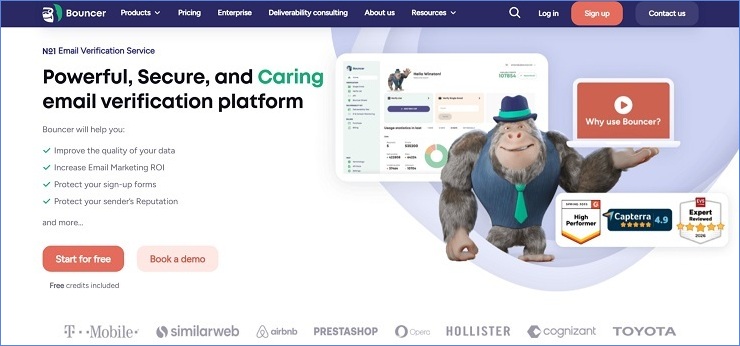
Bouncer goes further than standard syntax, domain, and SMTP checks with its Toxicity Check, a separate layer that screens for spam traps, serial complainers, litigators, and addresses tied to known credential breaches. That’s part of why its unknown-result rate runs as low as 0.3% to 3%, well below NeverBounce’s roughly 8% catch-all resolution rate.
It’s one of the more thoroughly built NeverBounce alternatives in this guide for exactly that reason: catch-all handling isn’t an afterthought; it’s a dedicated feature. Bouncer backs this with a real-time API, a separately priced Shield product for signup-form protection, and a full deliverability suite.
It’s also GDPR-first by design, Poland-based, SOC 2 certified, and runs on EU data centers, worth noting if data residency matters for your decision. Data itself is retained up to 60 days before being anonymized and deleted, longer than NeverBounce’s own window, not shorter, so weigh that against your own compliance needs rather than assuming newer automatically means stricter.
Better fit if: catch-all accuracy is your top priority, or you want built-in spam-trap and breached-credential screening.
Skip it if: you need the absolute lowest price at high volume, Bouncer isn’t the cheapest option here.
| Bouncer Overview | |
| Marketed accuracy | 99.5% |
| Independently tested accuracy | Not independently tested (as of this session’s research) |
| Catch-all handling | Toxicity Check; unknown-result rate as low as 0.3-3% |
| Free credits | 100, no credit card required |
| Credit expiry | Never; no charge for duplicates or unknowns |
| Price at 5,000 / 10,000 / 50,000 / 100,000 | $35 / $60 / $250 / $400 |
4. Kickbox: A Granular NeverBounce Alternative With Automatic Refunds on Unknowns
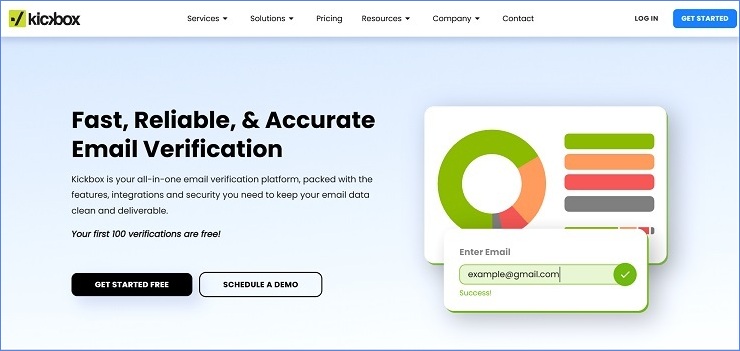
Kickbox scores every address on its Sendex gradient, a 0-to-1 scale rather than a flat valid or invalid call, giving you more to act on when deciding which contacts are worth keeping. Addresses it can’t confidently resolve come back marked Unknown and are refunded automatically, so you’re not paying for a result you can’t use.
As a NeverBounce alternative, though, Kickbox is worth a specific caution: it shares NeverBounce’s exact weak point on billing. Kickbox credits also expire 12 months after purchase, the same policy driving so many NeverBounce complaints. Independent benchmarks are mixed too. One test that handles unknowns separately puts Kickbox around 96 to 97% accurate, while a stricter benchmark counting unknowns as failures scored it at 67.53%, a wide enough gap that it’s worth knowing which methodology you’re comparing against.
Kickbox is also consistently the most expensive tool in this guide at every volume checkpoint, a real cost to weigh against its scoring granularity. It remains one of the more precise NeverBounce alternatives here on pure scoring depth, even with those caveats in mind.
Better fit if: you want a granular quality score instead of a binary result, plus automatic refunds on unresolved addresses.
Skip it if: credit expiry is your main reason for leaving NeverBounce, Kickbox won’t fix that specific problem.
| Kickbox Overview | |
| Marketed accuracy | 99.5% deliverability prediction (ecosystem claim, not a guarantee) |
| Independently tested accuracy | ~96-97% treating unknowns separately; 67.53% on a stricter benchmark counting unknowns as failures |
| Catch-all handling | Returns “Unknown,” refunded automatically |
| Free credits | 100 on signup |
| Credit expiry | 12 months after purchase |
| Price at 5,000 / 10,000 / 50,000 / 100,000 | $40 / $70 / $275 / $500 |
5. Emailable: A Well-Rounded NeverBounce Alternative With 50+ Integrations
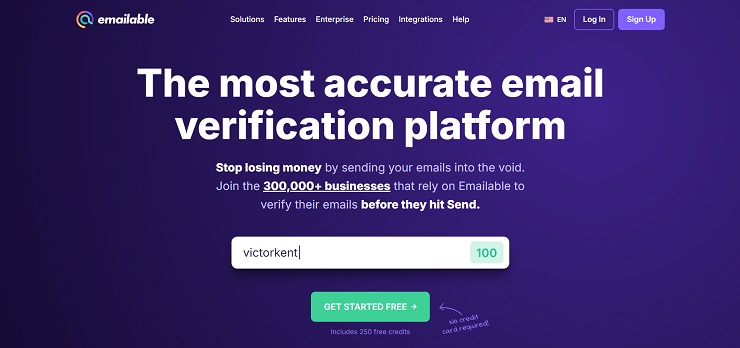
Emailable flags accept-all domains as a distinct category rather than resolving them individually, similar to NeverBounce’s own approach, but backs that up with one of the largest integration libraries in this guide: 50-plus native connections including HubSpot, Salesforce, Klaviyo, Mailchimp, ActiveCampaign, and Brevo.
Speed is a genuine strength too. Emailable’s own documentation puts a 10,000-email batch at 2 to 3 minutes, and a 250,000-email list at around 10 minutes, competitive with NeverBounce’s own fast turnaround. It also refunds automatically for both unknown and duplicate results, so accept-all uncertainty doesn’t cost you twice.
Among the NeverBounce alternatives here, Emailable is one of the more balanced picks: SOC 2 Type II certified, GDPR compliant, 250 free credits on signup, and pricing that sits in the middle of the pack rather than at either extreme. If Emailable itself is the tool you’re weighing directly, our dedicated Emailable Alternatives guide goes deeper.
Better fit if: integration breadth and speed matter as much as price, and you’re fine with accept-all being flagged rather than resolved.
Skip it if: you specifically need catch-all addresses resolved beyond a flag, Emailable won’t do more here than NeverBounce already does.
| Emailable Overview | |
| Marketed accuracy | 99% guarantee |
| Independently tested accuracy | ~95-96% |
| Catch-all handling | Flags as “accept-all,” does not resolve individual addresses |
| Free credits | 250, one-time |
| Credit expiry | Never |
| Price at 5,000 / 10,000 / 50,000 / 100,000 | $38 / $60 / $245 / $420 |
6. Clearout: One of the More Feature-Dense NeverBounce Alternatives
Clearout runs email addresses through syntax checks, domain and MX record lookups, and SMTP authentication, then layers on an advanced catch-all resolver rather than a flat flag. It also ships Form Guard, a feature that blocks risky addresses at the moment a signup form is submitted, before a bad address ever reaches your list.
Worth flagging directly: Clearout is genuinely a hybrid finder-and-verifier product, not a pure verification tool. It’s included here because it’s a real, capable verifier in its own right, not despite that overlap.
One independent benchmark found real tension between Clearout’s marketing and its tested results: a Hunter benchmark that counts unknown results as failures scored it at 68.37% accuracy, the widest gap between marketed and tested accuracy of any tool in this guide. Clearout markets itself at 98%-plus, with some materials citing 99.73%. That combination of real features and a wide benchmark gap makes it one of the more feature-dense NeverBounce alternatives in this guide, just one where the marketed number deserves real scrutiny.

Better fit if: you want Form Guard’s real-time signup protection or need email-finding capability alongside verification.
Skip it if: you want a pure verifier without finder functionality, or the marketed-vs-tested accuracy gap concerns you.
| Clearout Overview | |
| Marketed accuracy | 98%+ (some materials cite 99.73%) |
| Independently tested accuracy | 68.37% |
| Catch-all handling | Advanced resolver |
| Free credits | 100, one-time lifetime allotment |
| Credit expiry | Never on PAYG; rolls over on subscriptions |
| Price at 5,000 / 10,000 / 50,000 / 100,000 | $40 / $65 / $325 / $400 |
7. ZeroBounce: Priciest of the NeverBounce Competitors, Backed by AI Scoring
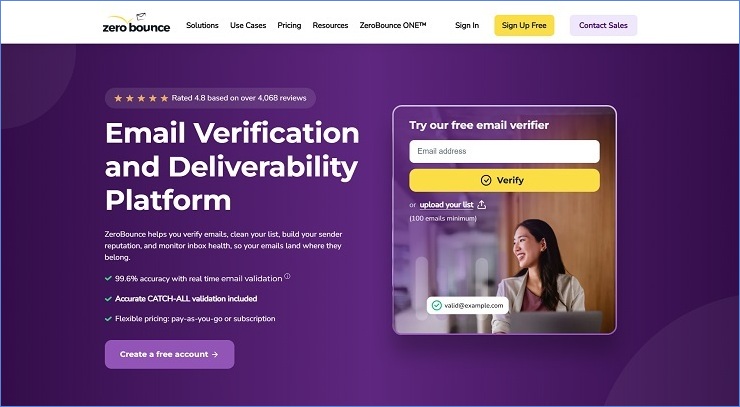
ZeroBounce replaces a binary valid-or-invalid result with an AI-driven quality score from 0 to 10, giving you a gradient to prioritize contacts rather than a flat cutoff. It backs this with a real-time API, 60-plus native integrations, and a confirmed 30-day auto-deletion policy for uploaded files, verified directly across six of ZeroBounce’s own documentation pages.
It’s also the most expensive tool among the NeverBounce competitors covered here at every volume checkpoint, running $69 to $649 across the four standard checkpoints on its PAYG plan. Independent benchmarks (LaGrowthMachine, Woodpecker) put its tested accuracy at 96 to 98%, against a marketed 99.6%, a smaller gap than several cheaper tools in this guide manage.
Its API is reported to cap out around 50,000 requests per hour, and unused credits within a single billing cycle reportedly don’t roll over, both details sourced from user reports rather than ZeroBounce’s own stated terms, worth a direct confirmation if either becomes decision-critical for you. Even at that price, it remains one of the most feature-rich NeverBounce alternatives in this lineup. If ZeroBounce itself is the tool you’re evaluating directly, our dedicated ZeroBounce Alternatives guide goes deeper.
Better fit if: you want a graded quality score instead of a flag, and price is a secondary concern next to feature depth.
Skip it if: budget is the deciding factor, ZeroBounce is the most expensive option in this guide at every checkpoint.
| ZeroBounce Overview | |
| Marketed accuracy | 99.6% |
| Independently tested accuracy | 96-98% |
| Catch-all handling | AI-driven Email Scoring, 0-10 quality score |
| Free credits | 100 monthly, requires business/premium email domain |
| Credit expiry | Never (PAYG); reports suggest no rollover within a single billing cycle |
| Price at 5,000 / 10,000 / 50,000 / 100,000 | $69 / $129 / $499 / $649 |
8. ListWise: One of the Slower Alternatives to NeverBounce Worth a Careful Look
ListWise checks syntax, domain and MX records, catch-all domains, and runs a real SMTP handshake with each provider, the same baseline checks most tools in this guide run. Where it differs is speed and depth: one independent audit clocked it at roughly 120 minutes to verify 10,000 emails, and found its tested accuracy ranging from 78% to 95% depending on the test point, against ListWise’s own marketed 99%-plus. It’s still a legitimate pick among the NeverBounce alternatives in this guide, just one with real trade-offs to weigh.
Pricing is also structured differently. ListWise’s standard prepaid tier starts at 10,000 credits for $45, it doesn’t sell a 5,000-credit tier at all, so there’s no direct price to compare at that checkpoint. Credits never expire, and new users get 1,000 free verifications on signup, confirmed directly from listwisehq.com.
One more thing worth knowing: ListWise’s real-time API isn’t included in its standard pricing. It’s part of a separate Premium plan starting at $408 a month for 100,000 addresses, a real cost difference from tools that bundle real-time API access into their base PAYG pricing. As one of the more dated alternatives to NeverBounce in this space, ListWise is worth considering mainly if its specific feature set, like automatic typo-fixing, matters more to you than speed or integrations.

Better fit if: automatic typo-fixing or a straightforward one-off bulk clean is what you need, and speed isn’t critical.
Skip it if: you need a 5,000-credit entry tier, real-time API access at standard pricing, or accuracy closer to its marketed claim.
| ListWise Overview | |
| Marketed accuracy | 99%+ |
| Independently tested accuracy | One audit found 78-95%, varying by test point, no single confirmed figure |
| Catch-all handling | Listed as a detection feature; site doesn’t specify individual resolution beyond detection |
| Free credits | 1,000 on signup |
| Credit expiry | Never |
| Price at 5,000 / 10,000 / 50,000 / 100,000 | N/A (no 5,000-credit tier; 10,000-credit minimum) / $45 / $105 / $185 |
Marketed vs. Independently Tested Accuracy for NeverBounce Alternatives
Every one of the NeverBounce alternatives in this guide markets accuracy north of 97%. Independent testing tells a messier story, and the gap matters more than the headline number.
The widest gaps belong to Clearout and Kickbox, but only under one specific benchmark methodology: a Hunter benchmark that counts unresolved “unknown” results as outright failures, rather than a separate category. That’s why Clearout (68.37%) and Kickbox (67.53%) look dramatically worse there than their marketed 98%+ and 99.5% claims, while a different benchmark that treats unknowns separately puts Kickbox closer to 96-97%. The methodology, not just the tool, decides the number.
MailCleanup and Bouncer sit in a different kind of gap: neither has a named third-party adversarial benchmark behind its tested figure. That’s a real information gap worth naming plainly, not a hidden strength.
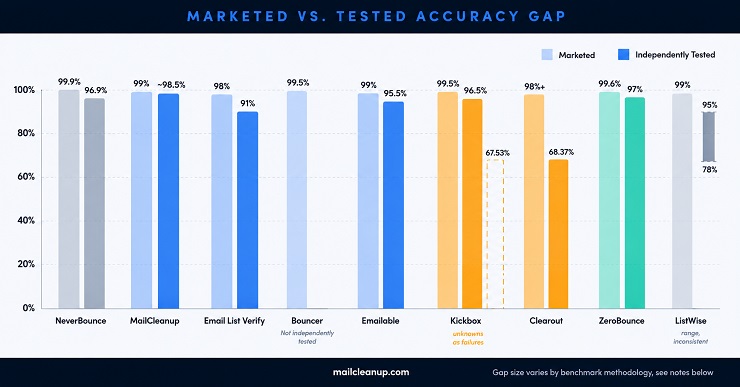
| Tool | Marketed Accuracy | Independently Tested Accuracy |
|---|---|---|
| MailCleanup | Up to 99% | ~98-99% (client-confirmed, no named benchmark) |
| NeverBounce | Up to 99.9% | ~96.9% |
| Email List Verify | 97-99% | ~91% on catch-all-heavy lists |
| Bouncer | 99.5% | Not independently tested |
| Kickbox | 99.5% (ecosystem claim) | ~96-97% (unknowns separate) / 67.53% (unknowns as failures) |
| Emailable | 99% guarantee | ~95-96% |
| Clearout | 98%+ (99.73% some materials) | 68.37% (unknowns as failures) |
| ZeroBounce | 99.6% | 96-98% |
| ListWise | 99%+ | 78-95%, inconsistent across one audit’s own test points |
Credit Expiry and Billing Fairness Across NeverBounce Alternatives
Credit expiry is the single most-cited complaint against NeverBounce, so it’s worth seeing exactly how the NeverBounce alternatives in this guide actually compare, not just that they’re “better.”
Kickbox is the one tool in this entire guide that shares NeverBounce’s exact 12-month expiry policy, worth knowing if that’s your specific reason for leaving. Every other tool here either never expires credits, or in MailCleanup’s case, has no credit balance at all to expire.
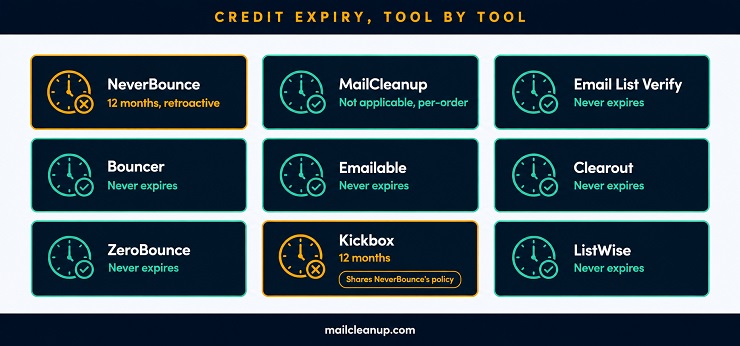
| Tool | Credit Expiry |
|---|---|
| MailCleanup | Not applicable, no persistent balance |
| NeverBounce | 12 months after purchase |
| Kickbox | 12 months after purchase |
| Email List Verify | Never (PAYG) |
| Bouncer | Never; no charge for duplicates or unknowns |
| Emailable | Never; refunds automatically for unknown and duplicate results |
| Clearout | Never on PAYG; rolls over on subscriptions |
| ZeroBounce | Never (PAYG); reports suggest no rollover within a single billing cycle |
| ListWise | Never |
ZoomInfo Ownership and Why It Matters When Picking a NeverBounce Alternative
NeverBounce was acquired by DiscoverOrg, which rebranded as ZoomInfo shortly afterward, in March 2019. ZoomInfo has been transparent that NeverBounce’s verification technology now runs inside its broader sales-intelligence platform, not just as a standalone product.
That’s the real source of the ownership concern some independent reviewers raise. NeverBounce still operates as its own branded product today, but its technology and roadmap now serve ZoomInfo’s platform first. If ZoomInfo eventually prioritizes folding verification fully into its main product rather than maintaining NeverBounce standalone, that’s a real business risk for anyone building a long-term workflow around it, not a hypothetical one.
None of the other tools in this guide carry that specific risk. Weigh that against the NeverBounce alternatives covered in this guide: all of them are built as dedicated verification products, not a bolt-on to a larger platform. That’s not a guarantee of longevity either, but their incentive to keep improving verification specifically is more directly aligned with their core business.
One-Time List Cleanup vs. Ongoing Verification: Which NeverBounce Alternative Do You Actually Need?
Every comparison in this guide assumes you’re choosing between subscription or credit-based tools, because that’s what NeverBounce and seven of the eight alternatives here actually are. But that framing skips a real question: do you need an ongoing verification tool at all?
If you verify continuously, at the point of signup, through an API-connected form, or as part of a recurring outreach workflow, a credit or subscription-based tool with a real-time API is genuinely the right category. Bouncer, Kickbox, Emailable, Clearout, and ZeroBounce all fit that use case, and NeverBounce’s own real-time API is a legitimate strength there too.
If you clean a list occasionally, a quarterly newsletter list scrub, a list you inherited, a one-off push before a single campaign, the credit-expiry problem that drives so many people to look for NeverBounce alternatives doesn’t need a different credit policy. That’s a matter of periodic email list hygiene rather than an ongoing subscription commitment. It needs a model that doesn’t use credits at all. That’s the specific gap MailCleanup’s per-order pricing fills: no account, no subscription, no 12-month clock running on an unused balance.
What Changes When You Move to a NeverBounce Alternative
Switching verification tools is usually simpler than switching an email service provider or CRM, but it’s not zero-effort. Here’s what actually changes, depending on how you use NeverBounce today.
- If you only use NeverBounce for occasional bulk uploads, moving to any other tool in this guide, including MailCleanup, is close to a copy-paste change, similar to any standard approach to cleaning an email list: export, upload to the new tool, done.
- If you use NeverBounce’s real-time API at signup forms or inside an automated workflow, you’ll need to swap API keys and re-point that integration. Most tools here (Bouncer, Kickbox, Emailable, Clearout, ZeroBounce) offer a comparable real-time API.
- If you have an unused NeverBounce credit balance, use it down before the 12-month window closes rather than losing it outright, and factor that into your switching timeline.
- If you’re moving to a per-order model like MailCleanup, there’s no credit balance to migrate at all, which removes this step entirely.
A short overlap while you confirm the new tool’s results match your expectations is reasonable. A permanent dual subscription just adds cost without solving the original problem. These four steps cover the realistic migration path across every one of the NeverBounce alternatives in this guide.
Which NeverBounce Alternative Should You Actually Pick?
There’s no single best answer, only the tool that fits how you actually use NeverBounce today.
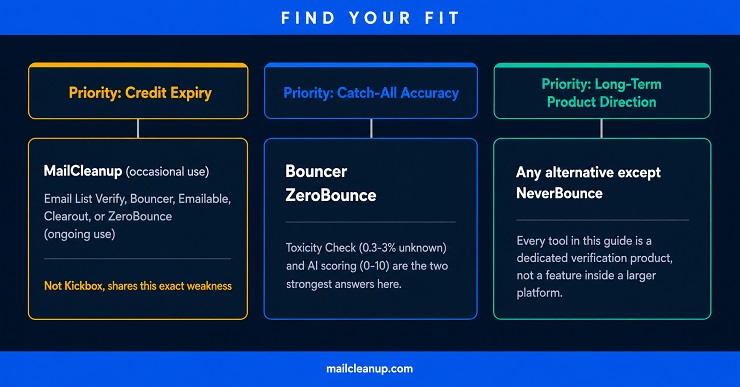
- If credit expiry is what pushed you here: look at MailCleanup for occasional cleanup, or Email List Verify, Bouncer, Emailable, Clearout, and ZeroBounce for an ongoing subscription without that 12-month clock. Kickbox is the one alternative here that won’t fix this specific problem.
- If catch-all accuracy is the priority: Bouncer’s Toxicity Check and ZeroBounce’s AI scoring are the two strongest answers in this guide.
- If you want the wider picture beyond this comparison: our full breakdown of the best email list cleaning services and guide to improving email deliverability cover related ground.
Every one of the NeverBounce alternatives in this guide is worth testing against your own list before you commit to a long-term switch.
FAQs About NeverBounce Alternatives
What’s the biggest reason people search for NeverBounce alternatives?
The most-cited reason is NeverBounce’s 12-month credit expiry, introduced retroactively in 2024 on credit balances some customers had already purchased under no-expiration terms. Trustpilot rates NeverBounce 2 out of 5, “Poor,” largely because of this. Catch-all handling (resolved in only about 8% of cases) and questions about ZoomInfo’s ownership are the other two recurring drivers.
Which NeverBounce alternative is cheapest at high volume?
MailCleanup is the cheapest option in this guide at every volume checkpoint compared, starting at $10 for 5,000 verifications, $15 for 10,000, $50 for 50,000, and $90 for 100,000. It’s priced per order rather than by credit, with no subscription or expiring balance to manage.
Do any NeverBounce alternatives handle catch-all addresses better than NeverBounce itself?
Yes. NeverBounce only resolves catch-all addresses in about 8% of cases. Bouncer’s Toxicity Check pushes its unknown-result rate as low as 0.3% to 3%, and ZeroBounce replaces a flat catch-all flag with an AI-driven 0-10 quality score. Both go meaningfully further than a binary valid-or-invalid call.
Is there a free NeverBounce alternative?
Not entirely free at scale, but several tools in this guide offer meaningful free credits to test first: ListWise offers 1,000 on signup, Emailable offers 250, and Bouncer and Kickbox each offer around 100. None are free for ongoing bulk verification, including NeverBounce itself.
Should I run two verification tools alongside NeverBounce alternatives instead of switching outright?
A short overlap during migration is reasonable, run your list through both the old and new tool briefly to confirm the results match. A permanent dual setup just adds cost without solving the problem that sent you looking for alternatives in the first place. Pick one and commit once you trust the results.
Does ZoomInfo’s ownership of NeverBounce affect which NeverBounce alternative I should choose?
It’s one legitimate factor, not a dealbreaker. ZoomInfo acquired NeverBounce in March 2019 and has since integrated its verification technology into its own platform. One G2 reviewer directly caught a mismatch between NeverBounce’s marketed “7,000+ reviews, 4.5 stars” and the 138 reviews and 4.2 stars actually showing on G2, worth checking yourself before a long-term commitment.
Are the NeverBounce alternatives in this guide priced the same way NeverBounce is?
No. NeverBounce prices by credit, with a 12-month expiry. Most alternatives here also use credits, but without an expiry date, Kickbox is the one exception, sharing NeverBounce’s 12-month window. MailCleanup breaks from the credit model entirely, pricing per order instead, so expiry isn’t a factor at all.
Which NeverBounce alternative has the best independently tested accuracy?
By the benchmarks found this session, MailCleanup’s 98-99% and ZeroBounce’s 96 to 98% tested range sits closest to their marketed claims. Kickbox and Clearout show the widest marketed-versus-tested gaps, but only under a stricter methodology that counts unresolved results as failures.