
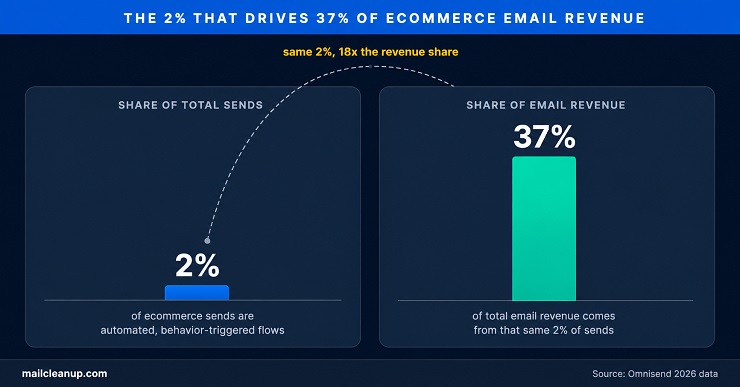
Automated flows make up about 2% of the emails an ecommerce store sends. Omnisend’s own 2026 data puts their share of total email revenue at 37%. That gap is the entire story of ecommerce email marketing, and most guides on the topic never explain it. They hand you a list of eight or nine flow types and call it a strategy.
We spend our days looking at what happens on the other side of a send. That means asking whether the list behind a campaign was ever going to reach a real inbox in the first place. That vantage point shows something the flow-type lists miss. An ecommerce program’s revenue and its list quality are the same problem, viewed from two different angles, not two separate topics. A store with a beautifully built win-back flow can still lose money on every send. That happens when the list it’s aimed at was never actually reachable to begin with.
This guide covers every campaign type ecommerce brands use. It walks through building a program from your first signup form to your compliance checklist. It also names two things almost nothing else in this space covers. The first is why your capture method quietly determines your list’s long-term health. The second is why your win-back flow carries more deliverability risk than any other send you’ll make. Ecommerce email marketing works when you treat it as one connected system, not eleven separate tips.
TL;DR on Ecommerce Email Marketing
- Ecommerce email marketing uses a customer’s own behavior, not a calendar date, to trigger and target emails for an online store.
- Automated flows make up roughly 2% of ecommerce sends but generate around a third of total email revenue, far outperforming one-off campaigns.
- Ecommerce email marketing offers a typical return of $36 to $45 for every $1 spent.
- How an email address gets captured, not just how fast the list grows, determines how healthy that list stays months later.
- Win-back campaigns target the segment where address decay concentrates, making them the highest deliverability risk in ecommerce email marketing.
- Revenue per email, not open rate, is the metric that actually reflects whether an ecommerce email marketing program is working.
- The guide covers nine campaign types in depth, plus list building, segmentation, personalization, compliance, and testing.
- Segmented ecommerce email marketing campaigns generate roughly 760% more revenue than list-wide blasts sent to everyone the same way.
What Is Ecommerce Email Marketing?
Ecommerce email marketing is the use of email to engage, convert, and retain the customers of an online store. It relies on signals like browsing behavior, cart activity, and purchase history to decide what you send and when. It differs from email marketing in general in one specific way. Almost everything an ecommerce brand sends is tied to a stage in the customer’s actual buying journey. That’s the key difference from being driven mainly by a calendar date or a general interest signal.
A B2B newsletter might go out every Tuesday regardless of what any individual subscriber has done that week. An ecommerce welcome email, by contrast, fires the moment someone signs up. An abandoned cart email fires the moment someone leaves a full cart behind. The trigger is the customer’s own behavior, and that’s what makes the email feel relevant to your reader rather than random.
This also changes what counts as success. A B2B marketer might track engagement or pipeline influence. An ecommerce marketer tracks revenue per email instead. That’s because almost every message can be traced back to a sale, a recovered cart, or a repeat purchase. That direct line from send to revenue is what separates ecommerce email marketing from the broader email marketing discipline it sits inside.
The Benefits of Ecommerce Email Marketing
The return on ecommerce email marketing is hard to match anywhere else in your marketing budget. Litmus puts the typical return at $36 to $45 for every $1 spent, and some individual programs run well above that. No paid channel comes close. Unlike paid channels, the list you build is an asset you own outright. It isn’t access rented from a platform that can change its algorithm or its prices at any time.
The bigger benefit sits inside that number, not next to it. Automated, behavior-triggered flows make up a small share of total sends, commonly cited around 2%. Omnisend’s 2026 data attributes 37% of email revenue to that same small share. A welcome series, a cart abandonment sequence, and a win-back flow, built once, keep generating revenue with no ongoing manual effort. A one-off promotional campaign only earns what that single send produces. That gap is why a mature ecommerce email marketing program gets judged on its flow architecture first. The campaign calendar comes second, not the other way around.
Ecommerce email marketing also compounds in ways paid acquisition doesn’t. Every dollar you spend on a paid ad buys one transaction’s worth of attention. Every email address you capture, correctly and with the recipient’s genuine consent, can be reached again and again at close to zero marginal cost. That’s the case for building your list well from the first signup form onward. This guide comes back to that point directly in the strategy section ahead. A few more advantages worth naming plainly:
- Higher average order value: personalized product recommendations tend to drive larger baskets than generic browsing.
- Direct, measurable attribution: every send traces to a specific sale or recovered cart, unlike brand-awareness channels where the link to revenue is indirect.
- Cost that doesn’t scale with list size: sending to 50,000 people costs nowhere near 50,000 times what sending to one costs.
- Compounding customer relationships: each well-timed email adds to a relationship that pays off in repeat purchase rate, not just a single conversion.
- A first-party data advantage: the same behavioral data that improves your emails also sharpens ad targeting and product decisions elsewhere.
- Immune to algorithm changes: unlike organic social reach, an email list’s reach doesn’t erode because a platform changed its rules.
- Fast time-to-value once built: a flow built once keeps earning without the ongoing spend a paid campaign needs to sustain the same results.
- Reaches your list at every depth at once: one automated flow speaks to a brand-new subscriber and a five-year customer, each getting what’s relevant.
Types of Ecommerce Email Marketing Campaigns
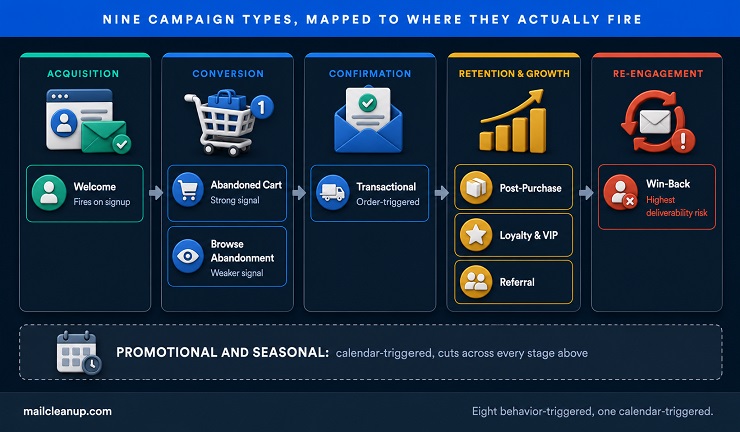
Ecommerce brands send two fundamentally different kinds of email. Behavior-triggered flows fire because a specific customer did something: signed up, browsed a product, left a full cart, or completed a purchase. Calendar-triggered campaigns fire because you decided to send them, tied to a date rather than an individual action.
Most of what follows here is the first kind, since behavior-triggered flows are where ecommerce email marketing earns most of its return. Calendar-triggered campaigns get their own full treatment later in Promotional and Seasonal email marketing for ecommerce.
Reading through all nine individually is useful, but seeing them side by side makes the pattern clearer:
| Campaign Type | Trigger | Lifecycle Stage |
|---|---|---|
| Welcome | Signup | Acquisition |
| Abandoned Cart | Cart left, no checkout | Conversion |
| Browse Abandonment | Product viewed, no cart add | Conversion |
| Transactional | Order placed | Confirmation |
| Post-Purchase | Order placed | Retention & Growth |
| Loyalty & VIP | Ongoing status | Retention & Growth |
| Referral | Existing relationship | Retention & Growth |
| Win-Back | Extended inactivity | Re-engagement |
| Promotional & Seasonal | Calendar date | Cuts across every stage |
Eight of the nine fire because a customer did something. Only promotional and seasonal runs on your calendar instead of their behavior, which is exactly why it gets its own separate treatment later in this guide.
1. Welcome Emails: Ecommerce Email Marketing’s First Impression
A welcome email fires the moment someone joins your list, and it earns the highest engagement of any email you’ll send. Open rates in the 80 to 90% range are common for the first message in a welcome series. That’s well above what any later campaign in ecommerce email marketing will see. That attention window is short. It closes fast once the novelty of signing up wears off.
Treat the welcome message as a series, not a single email. A single “thanks for subscribing” note wastes most of that attention window. A stronger structure runs across several emails. An immediate welcome sets expectations. A follow-up a day or two later tells your brand’s actual story. A product showcase comes after that. A time-limited incentive belongs toward the end of the sequence, not the start. Leading with a discount code trains new subscribers to expect one before they’ve had any reason to trust the brand yet.
A welcome series that opens with a coupon trains new subscribers to wait for a discount before every future purchase. One that opens with what actually makes the brand worth following builds a more durable relationship. The incentive still lands, just further into the sequence, once some of that trust already exists.
2. Abandoned Cart Emails and Ecommerce Email Marketing Automation
Cart abandonment is the most familiar automation in ecommerce email marketing, and for good reason. Roughly 70% of online shopping carts get abandoned before checkout completes, and a well-timed reminder recovers a meaningful share of that lost revenue.
Timing, sequencing across multiple emails, and where to place a discount versus holding it back all matter more than any single email’s copy. We cover that full playbook in our dedicated guide to abandoned cart emails.
3. Browse Abandonment Ecommerce Email Marketing Campaigns
Browse abandonment targets a different moment than cart abandonment in ecommerce email marketing. It’s aimed at someone who viewed a product, sometimes more than once, but never added it to a cart at all. The signal is weaker than an abandoned cart, so the tone should be lighter too. A gentle nudge and a relevant recommendation fit better here than the urgency or discount pressure a cart-abandonment sequence can justify.
We walk through how to calibrate that lighter touch in [our dedicated guide to browse abandonment emails]. That guide also covers when it’s worth automating at all for a smaller list.
4. Post-Purchase Emails: A Core Ecommerce Email Marketing Strategy
Few moments matter more for retention in ecommerce email marketing than what happens right after checkout. Post-purchase emails start once an order is placed and continue until a single sale turns into a second one. A typical sequence includes:
- Order-adjacent follow-up and care instructions
- A review request once enough time has passed to actually use the product
- Cross-sell or upsell recommendations based on what was bought
Getting the timing and sequencing right across all of that earns its own guide. We cover the details in [our dedicated guide to post-purchase email flows].
5. Transactional Emails in Ecommerce Email Marketing
Transactional emails, order confirmations, shipping notifications, delivery updates, earn open rates well above 60%. That’s higher than almost any other email type in ecommerce email marketing. Customers actively look for this information. That makes a transactional email one of the few messages in your program that’s genuinely anticipated rather than tolerated.
That anticipation comes with a legal condition worth knowing. Under CAN-SPAM, a transactional email’s primary purpose has to stay transactional: order details, shipping status, account information. Otherwise it gets treated as a marketing email, not a transactional one. A light cross-sell suggestion below the order summary is standard practice and doesn’t change that classification. Leading the email with a sale, or building the whole message around a promotion, does change that classification. That shift brings full marketing-email rules along with it, opt-out requirements included.
Within that limit, transactional emails still deserve real design attention. Confirming the order details clearly comes first. A brief, genuinely relevant product suggestion fits naturally below that. So does a shipping timeline the customer can actually check, without crossing into promotional territory.
6. Win-Back Emails in Ecommerce Email Marketing
A win-back sequence targets customers who haven’t purchased, or haven’t opened or clicked, within a defined window. That window commonly runs somewhere between 60 and 180 days, depending on how often your typical customer buys. The goal is reactivation before that customer is gone for good.
Treat the sequence as a ladder, not one email repeated until it works. A recently lapsed customer, someone at the shorter end of that window, responds well to a simple message with no discount attached. Someone approaching the long end of the window usually needs a stronger incentive to move. The final email in the sequence should read like exactly what it is, a last chance before you stop emailing them regularly. Customers who don’t respond even to that message are candidates for suppression, not another attempt next month.
Why Win-Back Emails Are Ecommerce Email Marketing’s Highest Deliverability Risk
Every flow in this guide targets a specific moment in the customer relationship. Win-back is the only one that targets time itself, specifically, the longest stretch of inactivity anywhere on your list. That’s exactly the population where a real deliverability problem concentrates.
Mailbox providers reclaim addresses that go quiet. After a period of inactivity commonly cited at 6 to 12 months, providers like Gmail and Yahoo start treating a dormant address differently. Some get converted into what the industry calls recycled spam traps. These are addresses that once belonged to a real person and went unused long enough to be deactivated. The provider later repurposes the address specifically to catch senders who haven’t kept their lists current. Hitting even a handful of these on a single send can damage your sender reputation for weeks.
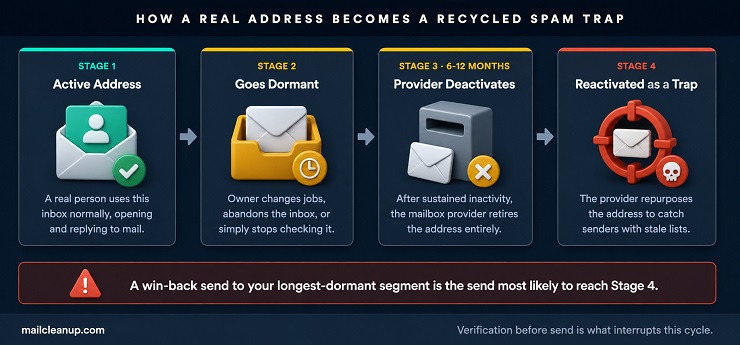
Your win-back list sits closer to that danger zone than any other segment you’ll email. The tail end of a win-back sequence, the “last chance” tier aimed at your longest-dormant subscribers, sits closest to that risk. Those are the addresses that have had the most time to go through exactly that process. Verifying that segment specifically before you send matters more than a general cleanup once a quarter. That’s the difference between a win-back campaign that recovers real revenue and one that quietly trains mailbox providers to distrust your domain.
7. Loyalty and VIP Emails in Ecommerce Email Marketing
Loyalty emails work differently than the rest of your ecommerce email marketing program. Nothing has to happen for them to matter. They run on an ongoing relationship instead of a single trigger, rewarding customers for sticking around rather than reacting to one specific action.
Recognition does more work here than the reward itself. A points balance update, an early-access window, or a visible status tier all signal the same thing. A customer’s loyalty is being seen, not just tracked. Milestone emails, a purchase anniversary, a birthday, a points threshold crossed, give you a natural reason to reach out. That reason has nothing to do with pushing a sale.
Keep the tiers genuinely meaningful. A top tier nobody can realistically reach, or rewards too small to notice, reads as a gimmick rather than a relationship. Customers notice that difference quickly.
8. Referral Emails in Ecommerce Email Marketing
Referral emails turn existing customers into the least expensive acquisition channel in ecommerce email marketing. A friend’s recommendation carries more trust than any ad. Referred customers also tend to stick around longer than customers acquired through paid channels.
Structure the incentive as a two-sided reward. Give the referrer something and give the person they referred something too, rather than rewarding only one side. That structure gives your existing customer a genuine reason to share. It also gives the new customer the same first-purchase incentive a welcome email would offer anyway.
Time the ask carefully. A referral request sent immediately after signup, before someone has even tried the product, asks for an endorsement they aren’t ready to give. Two to three weeks after a purchase, once they’ve had a real experience to vouch for, is a more natural moment to ask.
9. Promotional and Seasonal Email Marketing for Ecommerce
Promotional and seasonal sends are the calendar-triggered half of ecommerce email marketing, built around a date rather than a customer’s own behavior. Black Friday, major holidays, and brand-specific moments like an anniversary sale all belong here.
Urgency works when it’s real and backfires when it isn’t. A genuine limited-time offer or a low-stock alert gives a hesitant shopper a reason to act now instead of later. The same urgency language reused on every single send, whether or not anything is actually running out, teaches engaged subscribers to stop believing it. We cover how to write real urgency into a subject line without the pattern that trains subscribers to stop opening. See our guide to email subject line best practices for the details.
Reward loyalty inside a promotional calendar too, not just through a separate program. Giving your most engaged subscribers early access to a big sale, ahead of the general list, does double duty. It rewards the relationship, and it spreads order volume across a longer window instead of concentrating everything into one opening-minute rush.
How to Build an Ecommerce Email Marketing Strategy
Knowing the campaign types is only half the job. Turning them into an actual ecommerce email marketing strategy means making deliberate choices. That starts with how you capture addresses, how you divide your list, and how personal each message actually gets.
Build Your Ecommerce Email Marketing List the Right Way
Building an ecommerce email list starts with where and how you ask. Signup forms belong where customers are already paying attention: the footer, an exit-intent popup, a landing page, and the checkout flow itself. A lead magnet, a first-order discount, or free shipping on the next order gives someone a real reason to hand over an address. Not every capture point carries the same weight, and that difference matters more than most guides let on.
How Your Capture Method Shapes Ecommerce Email Marketing List Health
Every capture method makes the same trade. The less friction you put between a visitor and your signup form, the faster your list grows. It also gets less certain that any given address is real, reachable, or actually meant for your list.
Guest checkout is the clearest example. A customer types an address quickly to finish buying something, not to join a mailing list. Typos slip through at a higher rate than on a form where subscribing is the actual goal. An exit-intent popup chasing a discount has a similar problem. Someone in a hurry to grab 10% off has less incentive to get the address exactly right.
Double opt-in fixes part of this by design. Requiring a confirmed click from the actual inbox filters out addresses that can’t complete that step. That covers addresses that were mistyped, fake, or never real to begin with. It isn’t a universal fix.
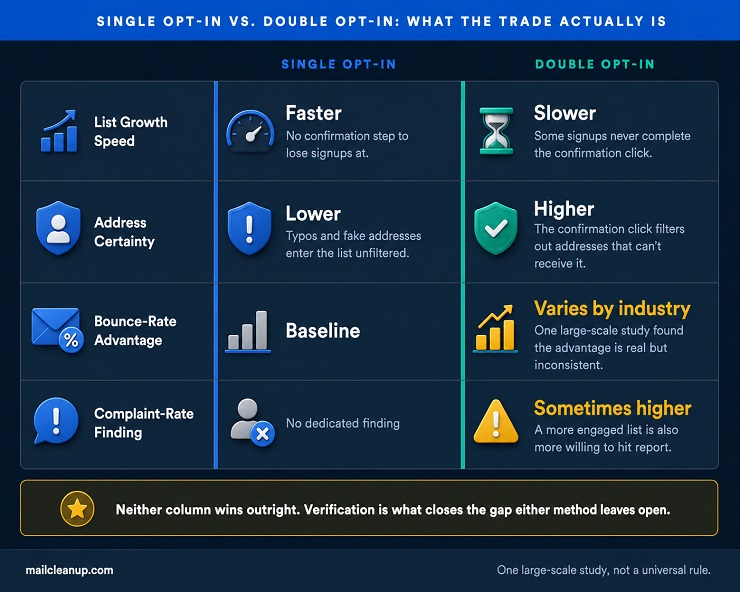
The tradeoffs between the two methods aren’t as one-sided as they’re often presented:
| Factor | Single Opt-In | Double Opt-In |
|---|---|---|
| List growth speed | Faster, no confirmation step to lose signups at | Slower, some signups never complete the click |
| Address certainty | Lower, typos and fake addresses enter unfiltered | Higher, the confirmation click filters unreachable ones |
| Bounce-rate advantage | Baseline | Varies by industry, real but inconsistent per one large-scale study |
| Complaint-rate finding | No dedicated finding | Sometimes higher, a more engaged list is also more willing to report |
Neither column wins outright, which is the actual point. Verification closes the gap either method leaves open, so the real decision comes down to your volume and risk tolerance, not a search for the objectively correct choice.
The research isn’t as clean as the conventional wisdom suggests –
One large-scale study across billions of sends found double opt-in’s bounce-rate advantage varies by industry. It even found complaint rates running higher for double opt-in in some categories. A more engaged list is also a list more willing to hit report instead of just ignoring an email.
The honest takeaway isn’t that one method is always right. It’s that a low-friction capture point trades certainty for speed. That trade shows up later, at your welcome email, your first campaign, and eventually your win-back list, not at the moment someone signs up.
Verification closes that gap regardless of which method you choose. A single opt-in list needs it because nothing filtered the address on the way in. A double opt-in list still needs it eventually. A confirmed, valid address at signup can still decay into an unreachable one over the months that follow. That’s the same decay this guide already covered in the win-back section above.
Segmenting for Ecommerce Email Marketing
Ecommerce email marketing segmentation works best when it’s built from what a customer actually does, not just who they are. Purchase history, product category, order value, and recency all say more about what someone wants next than age or location ever will.
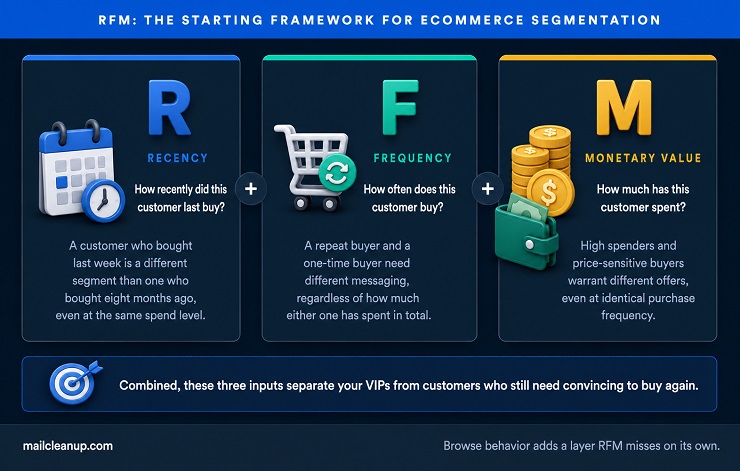
Recency, frequency, and monetary value, RFM for short, is the starting framework most ecommerce brands reach for. A customer who bought recently, buys often, and spends a lot gets treated differently than someone who bought once, months ago, at a discount. That distinction alone can separate who moves toward VIP-track messaging from who still needs convincing to buy a second time.
The three inputs break down cleanly:
| Input | Question It Answers | Why It Matters |
|---|---|---|
| Recency | How recently did they buy? | A week-old customer and an eight-month-old one need different messages |
| Frequency | How often do they buy? | A repeat buyer and a one-time buyer aren’t the same segment |
| Monetary Value | How much have they spent? | High spenders and price-sensitive buyers warrant different offers |
Combined, these three separate your VIPs from customers who still need convincing, which is the whole point of segmenting in the first place.
Browse behavior adds a layer RFM misses on its own. Someone who’s viewed the same product three times without buying is a different segment than someone who’s never looked at all. That’s true even if their purchase history looks identical. We cover the full mechanics of building segments like these, RFM scoring, engagement tiers, and more, in our dedicated guide to email segmentation.
Personalizing Ecommerce Email Marketing Beyond a First Name
A first name in the subject line was personalization a decade ago. It barely registers now, and it isn’t what separates a message that converts in ecommerce email marketing from one that gets deleted.
Real personalization uses what a customer has actually done. Product recommendations built from browsing history or past purchases outperform generic bestseller lists because they reflect real intent instead of a guess. A shopper who keeps returning to the same product page is telling you something a first-name merge tag never could.
None of this works without the data behind it. A recommendation engine fed by a small, unverified, or inactive list has less real behavior to learn from, and ends up guessing more. A personalization tactic built on a guess reads as more impersonal than no personalization at all. We go deeper on how personalization scales from simple to advanced, and what breaks it, in our full guide to email personalization.
Ecommerce Email Marketing Compliance: CAN-SPAM, GDPR, and Consent
Compliance isn’t optional, and it protects your program as much as it protects your customers. Two frameworks matter most if you sell to US or EU customers, and they don’t ask for the same thing.
CAN-SPAM governs commercial email in the US, and it requires a few specific things from every send:
- A working unsubscribe link, honored within 10 business days
- Accurate sender information that identifies who’s actually emailing
- A subject line that doesn’t misrepresent what’s inside the email
The two frameworks that matter most don’t ask for the same thing, and conflating them is a common, avoidable mistake:
| Requirement | CAN-SPAM (US) | GDPR (EU) |
|---|---|---|
| Consent model | Opt-out, no permission needed before the first send | Opt-in, affirmative consent required before any send |
| Unsubscribe | Working link, honored within 10 business days | Same expectation, tied to a broader consent-withdrawal right |
| Sender identification | Accurate sender information required | Required, plus a clear legal basis for holding the data |
| Consent shortcuts | Not applicable | Pre-checked boxes and bundled terms of service don’t count |
If your list includes EU customers, default to the stricter standard everywhere, since building genuine opt-in consent from the start costs far less than retrofitting it after the fact.
You don’t need explicit permission to email someone under CAN-SPAM. That’s why so many US ecommerce brands default to single opt-in and lean on unsubscribes to manage their list instead.
GDPR asks for more if you have EU customers. You need affirmative, explicit consent before you send marketing email at all, not just a working way to opt out afterward. A pre-checked consent box at checkout doesn’t count. Neither does bundling email consent into your terms of service. If your ecommerce email marketing reaches EU customers, treat consent as something you earn at signup, not something you assume by default.
Build your unsubscribe and preference center to do more than remove someone entirely. Letting a customer choose fewer emails, or promotions only, keeps them on your list. That beats losing them completely the first time your frequency feels like too much.
We have a detailed guide on email compliance for detailed understanding and breakdown of most important compliance laws.
Mobile-First Ecommerce Email Marketing Design
Most of your ecommerce email marketing gets opened on a phone, not a desktop screen. Design for that reality first, and treat desktop as the format that has to adapt, not the other way around.
Keep your layout to a single column that scales cleanly at any width. Make your buttons large enough to tap accurately with a thumb, not a mouse cursor. Write subject lines short enough to survive the tightest mobile inbox. Some mobile email apps cut off a subject line well before 40 characters. Compress your images so they load fast on a spotty connection, since a slow-loading email gets abandoned before your offer even renders.
Test what you build on an actual phone before you send it, not just in your email platform’s desktop preview. A layout that looks perfect in a browser preview can break entirely once it’s rendered by a real mobile mail client.
Setting Up Ecommerce Email Marketing Automation
Ecommerce email marketing automation only works once your platform can actually see what’s happening in your store. Connect your ecommerce platform to your email service provider first, before you build a single flow. That way purchases, cart activity, and browsing behavior all sync in real time.
That connection is what lets a workflow builder trigger the right message off the right event. You set the trigger once, a cart left for an hour, an order placed, a product viewed twice; the platform handles the rest without you sending anything manually. Most modern email marketing for ecommerce runs on exactly this kind of real-time sync. That’s also why a stale integration quietly breaks more flows than a bad subject line ever does.
Start with your highest-value flows first. Welcome, abandoned cart, and post-purchase alone typically cover most of what automation earns you. You can layer in win-back, browse abandonment, and the rest once those three are actually working.
A/B Testing Your Ecommerce Email Marketing Campaigns
Testing tells you what actually works for your ecommerce email marketing list, not what worked for someone else’s. Subject lines, send times, and discount depth are the three variables worth testing first. They move the needle more than almost anything else you could tweak.
Change one variable at a time, or you won’t know which change caused the result. We cover the complete methodology, sample sizes, and test duration in our full guide to email A/B testing.
Where AI Fits Into Ecommerce Email Marketing
AI email marketing for ecommerce is changing faster than almost any other part of the stack. Two applications actually earn their place in ecommerce email marketing right now.
Dynamic product recommendations are the clearest win. Instead of showing every subscriber the same bestseller block, your platform can build the recommendation from what a specific customer actually browsed or bought. It refreshes automatically as their behavior changes. You set the logic once, and it keeps working without you touching a single email again.
Send-time optimization is the second, and it builds directly on the ecommerce email marketing automation you just set up. Rather than picking one send time for your whole list, these tools learn when each subscriber individually tends to open. They then time that subscriber’s copy of the same campaign to land in that window.
Neither replaces judgment. A recommendation engine trained on a small or unverified list has less real behavior to learn from. That’s the same limitation we covered in the personalization section above. An AI-generated subject line or email draft still needs your review before it goes out. The tool can generate options. It can’t tell you whether your list is the kind of list those options will actually work on.
Ecommerce Email Marketing Best Practices
These ecommerce email marketing best practices apply across every flow and campaign this ecommerce email marketing guide has covered. Treat them as a final check before you send anything, not a one-time setup task.
- Verify your list before high-stakes sends: win-back campaigns and major promotional blasts carry the most deliverability risk.
- Lead welcome and win-back sequences with value, not a discount: save the incentive for later, once you’ve earned some trust.
- Segment by behavior, not just demographics: purchase history, cart value, and browse activity predict what a customer wants next.
- Design mobile-first: most of your list opens on a phone, so build for that screen first.
- Treat AI recommendations as a draft: review AI-generated copy from your AI email marketing for ecommerce tools before it goes out.
- Test one variable at a time: a subject line, a send time, or a discount depth, never all three at once.
- Authenticate your sending domain: SPF, DKIM, and DMARC configured properly is what lets mailbox providers trust a send genuinely came from you.
- Warm up a new sending domain or IP gradually: jumping straight to full volume reads as spam behavior, even with a genuinely clean list.
- Keep your sender name and address consistent: a recognizable, unchanging “from” identity builds trust before the subject line even matters.
- Give subscribers a granular preference option, not just unsubscribe: losing someone to fewer emails beats losing them entirely.
Most mistakes in ecommerce email marketing come from skipping one of these, not from a flawed ecommerce email marketing strategy to begin with.
Ecommerce Email Marketing Statistics and the Metrics That Matter
The ecommerce email marketing statistics that get repeated most, average open rate and average click rate, don’t tell the whole story. Open rate specifically gets inflated by Apple Mail Privacy Protection for any list with a meaningful share of Apple Mail subscribers. Revenue per email tells you what actually matters.
The numbers worth remembering from this guide, gathered in one place:
| Metric | Figure | Source |
|---|---|---|
| Typical ROI | $36-$45 per $1 spent | Litmus |
| Revenue from automated flows | 37% of total email revenue, from 2% of sends | Omnisend, 2026 |
| Cart abandonment rate | ~70% | Consistent across most ecommerce categories |
| Revenue lift from segmentation | ~760% vs. non-segmented blasts | DMA |
Every number here points the same direction: relevance, not volume, is what actually drives ecommerce email revenue.
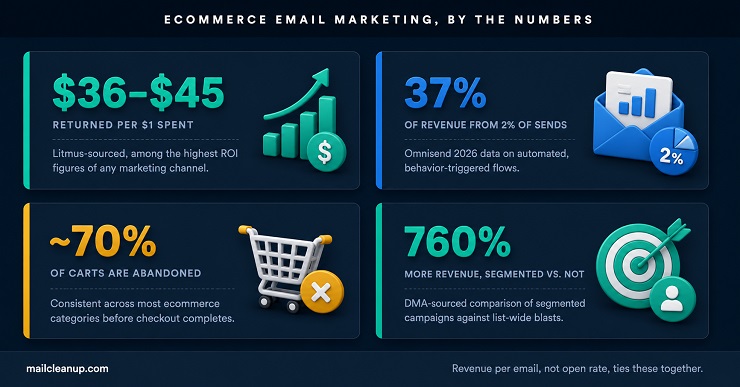
Segmentation alone can lift revenue significantly. DMA-sourced data puts segmented campaigns at roughly 760% more revenue than non-segmented blasts sent to an entire list. That single number explains why the segmentation section earlier in this guide matters more than almost anything else you could optimize.
Cart abandonment sits near 70% across most ecommerce categories. Even a modest recovery sequence typically wins back a meaningful share of that lost revenue. Automated, behavior-triggered flows consistently outperform one-off campaigns on revenue per send. Sometimes the margin is wide enough that flow architecture alone separates a mature program from a beginner one.
The benefits of ecommerce email marketing show up fastest when strategy and hygiene move together. A strong ecommerce email marketing strategy built on a dirty list still underperforms one with a smaller but verified list. That’s because the revenue-per-email numbers above assume the email actually reaches an inbox.
We cover the full set of KPIs, and what counts as healthy for your list size, in our dedicated guide to email marketing KPIs. The short version for ecommerce specifically: track revenue per email and repeat purchase rate before you worry about anything else.
Common Ecommerce Email Marketing Mistakes
Most mistakes in ecommerce email marketing repeat across brands because they come from the same handful of root causes, not from bad luck.
- Sending win-back campaigns to an unverified list: the longest-dormant segment carries the highest concentration of dead and recycled addresses.
- Capturing addresses with no verification: guest checkout and popup discounts grow your list fast and seed it with typos just as fast.
- Leading every campaign with a discount: it works once and trains your list to wait for the next one before it works again.
- Treating every customer the same: a first-time buyer and a five-time repeat customer need different messages, not the same newsletter.
- Ignoring mobile rendering: a broken layout on the device most of your list actually uses costs more revenue than almost any copy mistake.
- Running a single abandoned cart email instead of a sequence: one email recovers some revenue, a well-timed sequence recovers meaningfully more.
- Ignoring compliance until it becomes a problem: treating CAN-SPAM and GDPR as boilerplate costs more in complaints than the setup ever would.
- Stacking campaigns and flows on the same day: a promotional blast layered onto an active welcome sequence overwhelms a subscriber and inflates unsubscribes.
- Never revisiting an old automation: a welcome series built years ago and never touched again drifts out of step with current products.
None of these require a rebuild. Fixing even one, especially the two tied to list quality, does more than chasing every item on an ecommerce email marketing best practices checklist.
Building Your Ecommerce Email Marketing Program From Here
Ecommerce email marketing succeeds or fails as a system, not as a collection of individual tactics. The brands that get real revenue from it treat capture, campaigns, segmentation, and compliance as one connected program. It’s not a checklist to work through once and forget.
Start wherever your program is weakest right now. If you don’t have a verified welcome series and cart abandonment flow running, build those first, since they earn the fastest return. If those are already solid, look at your list quality specifically. When did you last verify it, and does your win-back segment carry more risk than you’ve accounted for?
Every flow and campaign in this guide earns attention the same way, through relevance built from real customer behavior. What separates a program that actually performs from one that just looks complete is simple. It’s whether the list behind it can receive that relevance in the first place. That’s the piece most guides leave out, and it’s worth checking first. The benefits of ecommerce email marketing compound the longer you run a genuinely connected program, not the moment you send one well-optimized email.
And, once you are ready, you can start browsing the best ecommerce email marketing tools for your business.
FAQs About Ecommerce Email Marketing
What is ecommerce email marketing?
Ecommerce email marketing uses a customer’s own behavior, browsing, cart activity, and purchase history, to trigger and target emails for an online store. That’s different from relying on a calendar date or a generic interest signal. It covers everything from welcome emails to win-back campaigns, measured by revenue per email rather than open rate alone.
How often should ecommerce brands send marketing emails?
There’s no universal number, and testing your own list matters more than copying someone else’s cadence. Most ecommerce email marketing programs send 2 to 4 promotional emails a week, on top of automated flows, without seeing meaningful unsubscribe increases. The bigger risk isn’t frequency itself, it’s repeating the same offer or urgency language until engaged subscribers stop believing it.
What email marketing KPIs should ecommerce brands actually track?
Ecommerce email marketing success depends on revenue per email, not open rate. Apple Mail Privacy Protection inflates open rate for any list with a meaningful share of Apple Mail subscribers. Track revenue per email, click-through rate, and repeat purchase rate as your core three. Bounce rate and unsubscribe rate matter too, but mainly as early warning signs that your list needs attention.
What are the most common ecommerce email marketing mistakes?
The most damaging mistakes in ecommerce email marketing trace back to list quality, not creative choices. Sending win-back campaigns to a long-dormant, unverified segment risks hitting recycled spam traps and damaging sender reputation. Leading every campaign with a discount trains subscribers to wait for one. Treating every customer identically regardless of purchase history is a close third.
How can ecommerce brands improve email deliverability?
Ecommerce email marketing deliverability starts with list quality, not send-time tricks. Verify addresses before high-stakes sends, especially win-back campaigns targeting your longest-dormant subscribers, since that segment carries the highest concentration of dead or recycled addresses. Use double opt-in where your volume allows it, and authenticate your sending domain with SPF, DKIM, and DMARC. Remove hard bounces immediately rather than letting them accumulate.
Should ecommerce brands use single or double opt-in?
There’s no universal right answer for ecommerce email marketing, and the research is more mixed than most guides suggest. Single opt-in grows your list faster but with less certainty about each address. Double opt-in filters out unreachable and mistyped addresses, though one large-scale study found its bounce-rate advantage varies by industry. Whichever you choose, verification closes the gap the opt-in method leaves open.
How does AI fit into ecommerce email marketing?
AI email marketing for ecommerce earns its place in two specific spots: dynamic product recommendations and send-time optimization. Both rely on real behavior, browsing and purchases for one, individual open patterns for the other. Both are only as good as the data feeding them, so an unverified list gives either one less to work with. Every AI-generated draft still needs review before it sends.
What’s the difference between an abandoned cart email and a browse abandonment email?
An abandoned cart email and a browse abandonment email serve different moments in ecommerce email marketing. The cart email targets someone who added an item and left before checkout, justifying real urgency. The browse email targets someone who viewed a product but never added it, calling for a gentler nudge instead.