
Black Friday is the best week of the year for email revenue. It’s also the worst week of the year to get careless about who you’re sending to. Both are true at once, and most Black Friday email marketing advice only prepares you for the first one.
The volume numbers alone explain why this week gets treated as a special case. Every serious sender is scaling up at the same time, and every inbox provider knows it.
What almost nobody explains is why that scaling gets some senders flagged as spam while others sail through untouched. The usual advice is to ramp up slowly and clean your list first, and that advice is correct. It’s also incomplete. A volume spike by itself is not what trips a spam filter. Who ends up inside that spike matters just as much.
Black Friday campaigns have a specific, predictable habit of reaching straight into the part of a list most likely to cause the damage. This guide covers the full Black Friday email marketing strategy you need, timeline through offers through the mistakes that quietly wreck a strong send. It also gives real numbers for the one mechanism most Black Friday content only gestures at without actually explaining.
TL;DR on Black Friday Email Marketing
- Black Friday email marketing volume runs 60 to 65% above normal, and inbox providers scrutinize it harder than any other week of the year.
- No inbox provider publishes a fixed volume percentage that triggers spam filtering. The real signal is a sharp break from a sender’s own established pattern, not a number on its own.
- The Black Friday Volume-Risk Grid sorts a list into four engagement tiers: Active, Fading, At Risk, and Inactive. Each tier has a different safe way to factor into a volume increase.
- MailCleanup’s data shows Black Friday sends most often newly reach the exact segment where list decay and spam trap risk run highest.
- A realistic Black Friday email marketing timeline starts 10 to 12 weeks out, built around two milestones: segmentation review and volume ramp.
- Discount depth is not the only lever. Several Black Friday email marketing ideas outperform a straight percentage-off offer without adding deliverability risk.
- Subject lines, creative, and send cadence during Black Friday week carry their own risk if rushed, separate from the volume question.
- The most damaging Black Friday email marketing mistakes are rarely about the offer. They’re about testing, timing, and treating a stale segment the same as an engaged one.
- A customer acquired during Black Friday who doesn’t engage again becomes the highest-risk win-back profile, where spam trap risk concentrates.
- Sorting the list into the Grid’s tiers belongs before offers, creative, or cadence, since verification takes time and can’t be rushed.
Why Black Friday Email Marketing Carries More Risk Than Any Other Send You’ll Make
Every other week of the year, a spike in your sending volume is something you plan for gradually, over weeks. Inbox providers watch how your list responds the whole time. Black Friday email marketing doesn’t work that way. You’re trying to reach nearly everyone who has ever shown interest in your brand. You’re doing it inside the same 72-hour window as every other retailer doing exactly the same thing. And you’re doing it in the one week your subscribers’ inboxes are already the most crowded they’ll be all year.
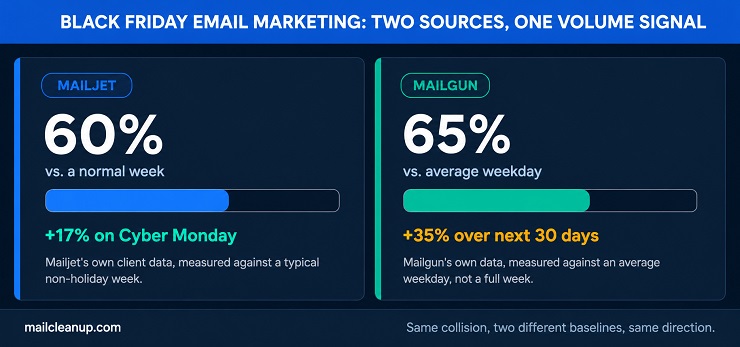
That collision, everyone scaling at once into the most crowded inboxes of the year, is what makes your Black Friday email marketing riskier than usual. Two independent sending platforms have measured just how sharp that collision actually is:
| Source | What They Measured |
|---|---|
| Mailjet | Email volume climbs close to 60% on Black Friday and 17% on Cyber Monday, against a normal week |
| Mailgun | Black Friday volume runs about 65% above an average weekday, and the 30 days that follow stay roughly 35% above a quieter comparison month |
Neither figure describes an unusual sender pushing its luck. That’s simply what a normal, healthy Black Friday email marketing programme looks like from the inbox provider’s side of the connection. The same collision is happening to your list at the same time, whether you’ve planned for it or not.
The stakes justify the risk. According to Adobe Analytics, US shoppers spent $10.8 billion online on Black Friday 2024, up more than 10% year over year. Cyber Monday added another $13.3 billion on top of that. For most ecommerce brands, a Black Friday email marketing strategy isn’t one campaign among many. It’s the single highest-leverage week on your calendar. That’s exactly why getting the deliverability side wrong here costs more than getting it wrong in March.
None of this means you should send less. Coming out of Black Friday with your reputation intact means understanding what triggers a spam filter during a volume spike. Knowing one exists isn’t the same thing. We’ll get to the specific mechanism, and real numbers for how much volume growth is genuinely safe, in the next section. For the full six-factor picture of what drives deliverability the rest of the year, our guide to email deliverability is the place to start. This guide stays focused on what changes specifically during Black Friday week.
Planning Your Black Friday Email Marketing Strategy Timeline
Subscribers and inbox providers both notice when a Black Friday email campaign was thrown together at the last minute, just for different reasons. Subscribers can tell the difference between a campaign built over two months and one assembled the week of Thanksgiving. Inbox providers can tell the difference too. A sender who’s stayed active looks nothing like one that’s gone quiet for months, then blasts its whole list in one week.
How Far Out to Start Your Black Friday Email Marketing
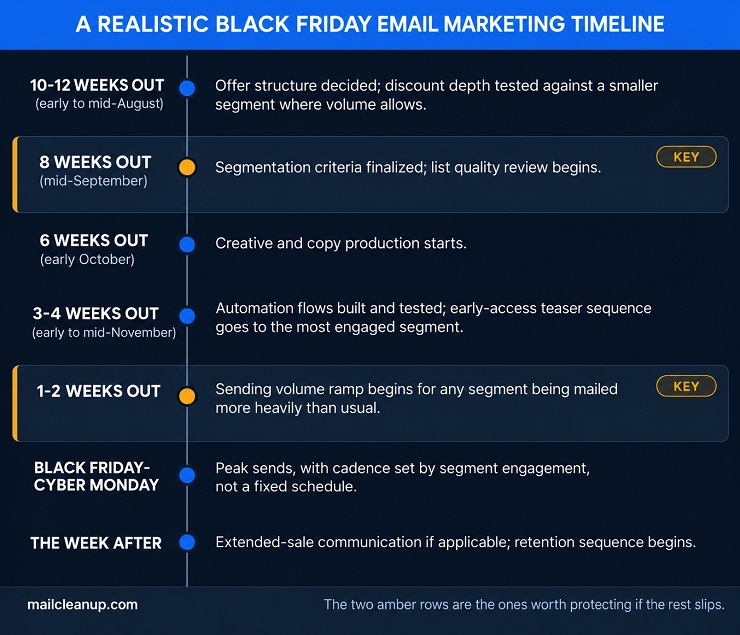
The exact calendar shifts with list size and how much new creative your Black Friday email marketing strategy depends on. The underlying shape holds across most ecommerce sends regardless. Here’s a realistic timeline working backward from Black Friday itself.
| Timeframe | What Happens |
|---|---|
| 10-12 weeks out (early to mid-August) | Offer structure decided; discount depth tested against a smaller segment where volume allows |
| 8 weeks out (mid-September) | Segmentation criteria finalized; list quality review begins |
| 6 weeks out (early October) | Creative and copy production starts |
| 3-4 weeks out (early to mid-November) | Automation flows built and tested; early-access teaser sequence goes to the most engaged segment |
| 1-2 weeks out | Sending volume ramp begins for any segment being mailed more heavily than usual |
| Black Friday through Cyber Monday | Peak sends, with cadence set by segment engagement rather than a fixed schedule |
| The week after | Extended-sale communication if applicable; retention sequence begins |
Two milestones matter when everything else slips: the segmentation review at 8 weeks out, and the volume ramp at 1-2 weeks out. Both directly determine whether your Black Friday email marketing reaches the inbox or the spam folder, which the next section covers in full.
What Last Year’s Black Friday Email Marketing Data Actually Tells You
Before locking this year’s Black Friday email marketing plan, pull these four numbers from last year’s send:
- Revenue per recipient, not total revenue: List size changes year to year. Only revenue per recipient tells you whether your Black Friday email marketing is actually getting more effective, not just bigger.
- Conversion rate and placed-order rate by segment: This shows which audience groups genuinely earned another invitation this year, rather than which ones happened to be on the list.
- Click-through rate on your best-performing subject lines and offers: In a crowded inbox, clicks are the cleanest signal of what actually earned attention. Opens are unreliable once Apple Mail Privacy Protection is in the mix.
- Bounce rate and complaint rate from last year’s Black Friday sends specifically, checked apart from your normal monthly average: This is the number that tells you whether last year’s volume spike already left a dent in your reputation you’re still recovering from.
If you don’t have last year’s data because this is a new domain or a new list, the timeline above still holds. You just treat every milestone with more caution, since you have no established pattern for inbox providers to compare this year’s spike against. That’s exactly the mechanism the next section explains, and it should shape your Black Friday email strategy either way.
The Real Reason High-Volume Sends Trigger Black Friday Email Spam Filters
Every inbox provider filtering your Black Friday email marketing send is trying to answer one question. Does this look like the same sender they’ve seen before, just sending more, or does it look like someone new. Get that question right and a big spike moves through cleanly. Get it wrong and the exact same spike gets treated as an attack.
It’s Not a Fixed Number: How Black Friday Email Spam Filters Actually Work
Search for a specific percentage that triggers Black Friday email spam filters and you’ll find dozens of confident-sounding numbers. None of them come from Google, Yahoo, or Microsoft directly, because no inbox provider publishes one. Volume alone isn’t the trigger. A sender who’s built up to a large, engaged list can send millions of emails a day without incident. A sender who jumps from a few thousand emails a week to ten times that overnight looks suspicious at a fraction of the volume. That’s true even when every address on the list is real.
What actually gets evaluated is the size of the jump against your own history, not the size of the send in isolation. A sharp, unexplained break from a domain’s sending pattern reads as the same signal a compromised account or a spam botnet would produce. From the inbox provider’s side of the connection, those three things can look identical for the first few hours. Your genuine Black Friday email marketing campaign and someone else’s hijacked mailing list both show up as the same anomaly at first glance. Both look like a domain that suddenly sends far more than it used to.
The practical number worth working from isn’t a spam-filter threshold. It’s a safe scaling ratio. The common guidance across email deliverability practitioners is to avoid more than doubling your average sending volume in a single jump. That’s not a hard rule any provider enforces. It’s the pace that keeps your own pattern recognizable as it grows, and recognizable is the actual thing being evaluated.
The Black Friday Email Marketing Volume-Risk Grid
Knowing the safe scaling ratio only answers half the question. The other half is who ends up inside that larger send, and that’s where most Black Friday email marketing advice stops short.
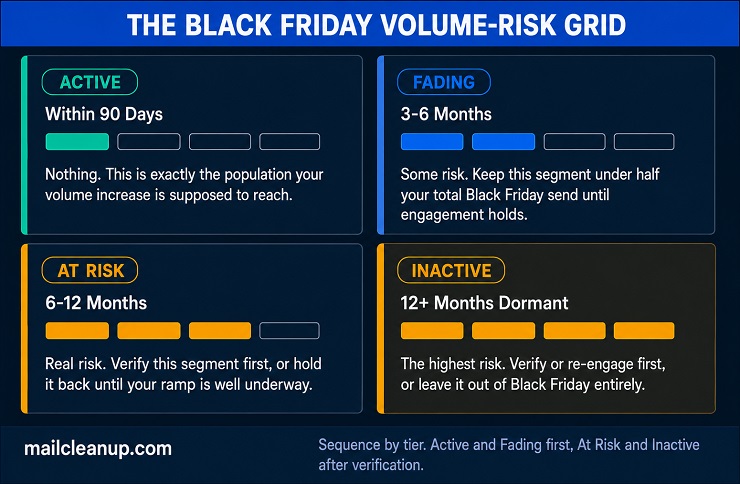
We use the same four engagement tiers from our email list hygiene guide to answer it. How long it’s been since a segment last engaged determines how safely it factors into your volume increase. List size on paper doesn’t.
| Segment (Time Since Last Engagement) | What Happens If You Include It at Full Volume |
|---|---|
| Active: within 90 days | Nothing. This is exactly the population your volume increase is supposed to reach. |
| Fading: 3-6 months | Some risk. Keep this segment under half your total Black Friday send until engagement holds. |
| At Risk: 6-12 months | Real risk. Verify this segment before including it, or hold it back until your ramp is well underway. |
| Inactive: 12+ months dormant | The highest risk, and the reason the next section exists. Verify or re-engage first, or leave it out of Black Friday entirely. |
The Grid isn’t a reason to shrink your Black Friday email marketing reach. It’s a reason to sequence it. Active and Fading segments can absorb your steepest volume increase safely. At Risk and Inactive segments need a different kind of preparation first, which is exactly what the next section explains.
Why Who You’re Reaching Matters as Much as Your Black Friday Email Marketing Volume
Black Friday email marketing has a specific habit most volume-spike advice never mentions. It doesn’t just increase how much you’re sending. It specifically reaches back into the part of your list you’ve been mailing least. The instinct is understandable. You have addresses sitting unused, the year’s biggest sale is coming, and it feels wasteful to leave anyone out.
That instinct runs directly into a mechanism our spam traps guide covers in full. Recycled spam traps are addresses that once belonged to real subscribers, went dormant, and were converted by the mailbox provider into monitoring addresses. That conversion typically happens after 12 months or longer of inactivity. An address you haven’t mailed in over a year isn’t just less likely to convert. It’s a candidate for being exactly this kind of trap, and you have no way to tell which dormant addresses have already crossed that line.
MailCleanup’s own decay data sharpens this further. Our 12-month decay report found that decay doesn’t accumulate at a steady pace. It accelerates the longer a list goes since its last cleaning. Our own tracked list decayed more than four times faster near the end of that window than at the start. The segment you’re most tempted to add for Black Friday volume is the one that hasn’t heard from you in the longest time. It’s mechanically the same segment where that acceleration is running hardest.
The actual finding underneath this whole section: your volume spike and your list quality aren’t two separate risks that happen to occur the same week. They’re the same risk, showing up twice, in the same dormant segment. It’s the moment your sending pattern gets its closest look all year.
Segmenting Your List for Black Friday Email Marketing Without Wrecking Your Reputation
The Grid above tells you which segments need caution. This section covers what to actually do about it before Black Friday email marketing sends start going out. It’s the part of your Black Friday email strategy that determines whether the rest of this guide’s advice actually holds up.
Start by pulling your list into the same four tiers, Active, Fading, At Risk, Inactive, using whatever engagement window your ESP already tracks. Our full email segmentation guide covers the complete methodology, including the data types and segmentation models worth building beyond this one seasonal use case. For Black Friday specifically, three practical steps matter most.
- Verify before you reach, not after you bounce: Any At Risk or Inactive segment you plan to include should go through a verification pass first. This is precisely the gap MailCleanup is built to close, separating addresses still worth re-engaging from the ones that have decayed into risk.
- Sequence your sends by tier, not by calendar date alone: Active and Fading segments can receive your earliest and heaviest volume. At Risk and Inactive segments go out later, at lower volume, and only after the earlier sends have confirmed your pattern is holding.
- Treat a failed re-engagement attempt as your answer, not an obstacle: A segment that doesn’t respond to a pre-Black Friday re-engagement email is telling you something. Sending it your full Black Friday volume anyway doesn’t change what it already told you.
None of this requires shrinking your list ambitions for Black Friday. It requires sequencing them against exactly the risk the Grid maps out. That way, your biggest send of the year reaches the people actually going to open it.
Black Friday Email Marketing Ideas Beyond the Standard Discount
Straight percentage-off Black Friday email marketing ideas dominate every inbox during Black Friday week for a reason. They work, and they’re easy to execute under deadline. They’re also the least differentiated thing you can send, competing for attention against dozens of other 20-to-40%-off subject lines landing in the same hour.
A few black friday email marketing examples worth testing alongside, or instead of, a straight discount:
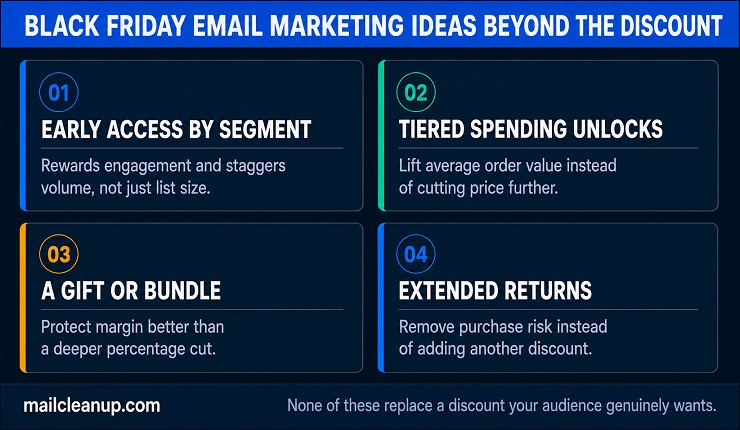
- Early access by segment, not by discount depth: Give your Active tier, the same segment the Grid marks safest to reach first, a 24 to 48-hour head start before the general list. It rewards engagement rather than just list membership, and it naturally staggers your volume the way the next section recommends.
- Tiered unlocks instead of a flat percentage: Spend $75, get 15% off. Spend $150, get 25% off and free shipping. This lifts average order value in a way a flat discount code doesn’t. It also gives you a second subject line moment when a customer crosses a tier.
- A gift or bundle instead of a lower price: A free add-on at a fixed spend threshold protects margin better than a deeper percentage cut. It also photographs better in a product-focused email than another discount banner.
- Extended returns or a price-match guarantee as the offer: For higher-consideration purchases, removing purchase risk can outperform a discount, especially for subscribers who’ve already shown interest but haven’t converted.
None of these replace a good discount when a discount is genuinely what your audience wants. They give you Black Friday email marketing ideas that don’t all collapse into the same subject line everyone else is sending that week. Building offer variety like this into your Black Friday email marketing strategy pays off more than defaulting to the same percentage-off every single year.
Creative, Subject Lines, and Send Cadence: Your Black Friday Email Strategy in Practice
Good creative for Black Friday email marketing follows the same principles as good creative any other week. Clear hierarchy, one primary action, and copy that leads with the offer, not buries it. What changes during Black Friday week is the cost of getting it wrong. A confusing email on a normal Tuesday costs you a click. A confusing email during your highest-volume week of the year costs you clicks at a scale that shows up in your metrics immediately.
Subject lines carry more weight than usual during Black Friday week simply because of the competition sitting in the same inbox. Our best practices for email subject lines guide covers what actually works, and what the data disagrees on, in full.
One addition worth making for Black Friday specifically: test urgency language carefully. “Ends tonight” performs well when it’s true. It performs poorly, including on spam-filter language checks, when it’s repeated every single day of a two-week sale.
Send cadence is where your Black Friday email strategy connects directly back to the Grid from the previous section. Staggering sends across the day, rather than one large blast at a fixed hour, spreads your volume increase out. It stops that increase from concentrating into a single sharp spike. Staggering by segment tier does the same thing a second way. Your Active segment goes out first, in the morning. Your Fading or At Risk segments go out later, after the morning send has already confirmed engagement is holding.
Neither change reduces how much you’re sending. Both change the shape of the spike an inbox provider actually sees. Getting cadence wrong here is one of the more common black friday mistakes, and it has nothing to do with the offer itself.
Personalization and Automation for Your Black Friday Email Marketing
Personalizing Your Black Friday Email Marketing Beyond a First Name
Black Friday email marketing gets personalized the same way any other campaign does, just under more time pressure. Product recommendations based on purchase history, dynamic content blocks by segment, and send-time optimization apply here the same as any other week. Our email personalization guide covers the full model, including why the data behind your personalization matters more than the personalization tactics themselves.
That last point matters more during Black Friday than any other week. A recommendation engine built on clean, recent purchase history produces relevant suggestions. The same engine built on a list full of invalid, unengaged, or catch-all addresses produces recommendations nobody asked for. It sends them at the exact moment your pattern is already under the most scrutiny it gets all year.
Automation Worth Setting Up Before Your Black Friday Email Marketing Push
Two automated flows are worth having live before your Black Friday email marketing push starts, beyond your standard abandoned cart sequence. A back-in-stock alert for your highest-demand items catches purchase intent a scheduled campaign can’t time correctly on its own. A price-drop or extended-sale notification goes to anyone who viewed but didn’t buy during the first wave. It recovers intent without a whole new campaign built from scratch. Our email automation guide covers the full range of triggers and workflows this extends to beyond Black Friday specifically.
Both of these flows share the same dependency the rest of this post keeps returning to. They only perform as well as the list behind them. An automated flow triggered against a stale or unverified segment just automates the same risk the Grid already flagged, only faster.
Common Black Friday Email Marketing Mistakes Beyond the Obvious Ones
The deliverability mistake already covered in this guide, treating every segment the same way regardless of how stale it is, is the costliest one. It isn’t the only Black Friday email marketing mistake worth naming. These are the black friday mistakes that don’t show up in a typical roundup because they’re not about the offer at all.
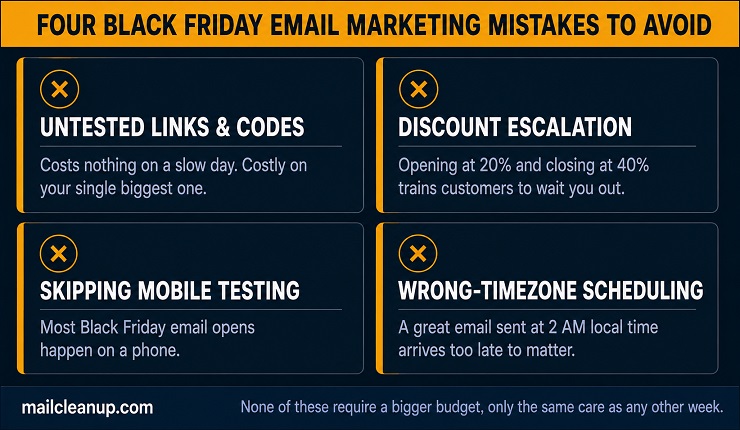
- Sending untested links and codes at scale: A discount code that fails, or a link that goes to the wrong page, costs nothing on a normal Tuesday send to 500 people. The same error on your highest-volume day reaches everyone at once, and there’s no quiet fix once it’s out.
- Letting discount depth escalate day over day: Opening at 20% off and closing at 40% off trains your most loyal customers to wait you out every single year. Pick a depth and hold it, or make later increases apply only to new arrivals rather than the whole catalogue.
- Skipping mobile and dark-mode testing: Most Black Friday email opens happen on a phone, often in a dark-mode inbox. An email that looks fine in a desktop preview and breaks on mobile has effectively not been tested at all.
- Scheduling around your own calendar instead of the recipient’s: A perfectly crafted email sent at 2 AM in the recipient’s time zone arrives too late to matter. So does one sent the day after competitors already claimed the moment, no matter how good the offer inside it is.
None of these require new tools or a bigger budget. They require treating the send with the same care you’d give it on any other week. That care belongs in your Black Friday email strategy well before the week itself arrives.
After Your Black Friday Email Marketing Push: Turning One Week Into Repeat Customers
A Black Friday email marketing programme that stops the moment the sale ends leaves most of its value on the table. The customers you acquired during the rush are, by definition, new and unproven. What you do with them in the following weeks determines whether Black Friday was a one-time transaction or the start of a relationship.
Start with the order confirmation itself. Treat it as your first real engagement opportunity with a new customer, not just a receipt. Use it to set expectations for what they’ll hear from you next, and how often.
The harder problem shows up two or three months later. A customer who bought once during Black Friday and hasn’t engaged since fits a specific profile. Our ecommerce email marketing guide flags exactly this segment as the highest-risk one in the entire customer lifecycle. A win-back campaign aimed at the longest-dormant part of your list reaches precisely where recycled spam traps concentrate. The Grid from earlier in this guide applies here just as much as it did before Black Friday itself.
Finally, review your own numbers while the campaign is still fresh, not next October. Revenue per recipient, which segments converted, and where your complaint rate landed all feed directly into a better-informed plan for next year. That plan beats starting from guesswork again on your next Black Friday email marketing push. It’s exactly how a stronger Black Friday email strategy compounds year over year.
Your Next Step Before Black Friday Email Marketing Week Starts
If you take one thing from this guide, make it this. Pull your list into the four engagement tiers from the Grid before you touch anything else, offers, creative, or send cadence. It’s the one piece of your Black Friday email marketing strategy that makes every other decision in this guide safer.
Here’s why the order matters more than it sounds like it should. Most Black Friday email marketing programmes don’t skip this step on purpose. Your creative takes longer than planned. Your automation flows need another round of testing. By the second week of November, segmentation and verification are the thing still sitting undone in your own plan. Nobody protected the eight weeks this guide’s timeline sets aside for it. A verification pass on your list takes real time to run, and that time doesn’t compress just because your calendar has run out.
Do it early, and every other decision in this guide gets easier. Offer testing runs against real engagement data. Automation flows trigger against addresses that can actually receive them. The volume ramp climbs against a pattern already confirmed safe. Black Friday week itself becomes the week you execute a plan you already trust.
FAQs on Black Friday Email Marketing
How many emails should you send during Black Friday?
Most Black Friday email marketing plans run three to five sends across the week. That typically means a teaser, the main offer, one or two reminders, and a last-chance send. Frequency matters less than sequencing by engagement tier. Your Active segment can handle more touches than a segment you’ve mailed sparingly all year, without adding spam risk.
What’s the best time to send a Black Friday email?
Early morning, typically 6 to 8 AM, works well for Black Friday email marketing since it captures shoppers before inboxes fill up. A second send in the late afternoon reaches people checking email after work. Beyond specific hours, staggering sends by segment matters more for deliverability than chasing one perfect send time.
How early should you start planning Black Friday email marketing?
Ten to twelve weeks out is a realistic starting point for Black Friday email marketing. Offer structure and discount depth get decided first. Segmentation and list quality review follow around eight weeks out, with creative production starting around six weeks before Black Friday itself.
Why do some Black Friday emails end up in spam?
Black Friday email marketing volume alone isn’t the trigger behind most Black Friday email spam filtering. Inbox providers watch for a sharp break from a sender’s established pattern. A normally moderate sender that suddenly blasts its entire list, reaching addresses it hasn’t emailed in a year, produces exactly that break.
What can you send besides a discount for Black Friday?
Early access for your most engaged segment works well, and so do tiered spending unlocks instead of a flat percentage off. A gift or bundle at a set spend threshold is another option. These Black Friday email marketing examples all avoid collapsing into the same discount everyone else sends.
Should you email unengaged subscribers during Black Friday?
Not without preparation. Addresses you haven’t mailed in six months or more carry real risk, including recycled spam traps that damage reputation fast. Verify or re-engage that segment first, or hold it back until your Black Friday email marketing ramp is well underway.
How do you avoid Black Friday email fatigue?
Space sends by segment engagement rather than blasting everyone on the same schedule. Your most active subscribers can handle daily touches without fatigue, while a segment you rarely mail needs fewer, better-timed sends. Cadence matched to engagement protects both your click rates and your Black Friday email marketing deliverability.
Should you clean your email list before Black Friday?
Yes, and earlier than most senders think to. A verification pass before your volume ramp begins catches invalid and high-risk addresses before they factor into your Black Friday email marketing send. That’s better than absorbing the bounce or complaint after it’s already hit your reputation.