
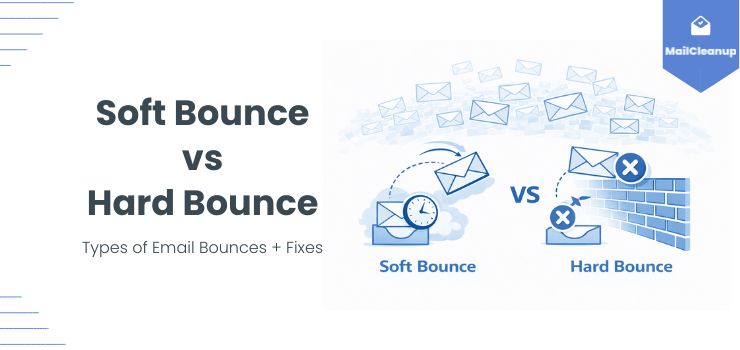
Soft bounce vs hard bounce is one of the most overlooked topics in email marketing. Yet, it plays a huge role in email deliverability. Many marketers focus on opens and clicks. They rarely check bounce reports. As a result, inbox placement drops slowly without any clear warning.
Email bounces may look harmless at first. However, when they add up, they can damage your sender reputation. Internet service providers track how often your emails fail to reach real inboxes. If bounce rates stay high, your emails are more likely to land in spam—or not get delivered at all.
This is why understanding different bounce types matters.
In this guide, we’ll explain what bounce emails are and why they happen. We’ll also break down the key differences between soft bounce vs hard bounce with clear examples. Finally, we’ll share simple ways to reduce email bounces and protect your deliverability.
Let’s start with the basics.
What Are Bounce Emails?
A bounce email is any message that fails to reach the recipient’s inbox and is returned by the receiving mail server, along with an error message explaining why. These are called bounce notifications or bounce reports, and ISPs track them closely as a signal of list quality.
For the full mechanics of what happens at the server level, see our complete guide on why emails bounce.
Types of Email Bounces Explained
When it comes to email marketing, not all bounces mean the same thing. This is why understanding the types of email bounces is important. Each bounce sends a different signal to inbox providers. And each one needs a different response from you.
At a high level, email bounces are grouped based on whether the delivery failure is temporary or permanent. Some emails fail only for a short time. Others fail because the address itself is no longer valid. Treating both in the same way can hurt your email deliverability.
This is where many marketers go wrong.
If you ignore bounce types, you may keep sending emails to bad addresses. Over time, this increases your email bounce rate. It also tells ISPs that your list hygiene is poor. As a result, even valid emails may start landing in spam.
On the other hand, when you understand bounce categorization, you can take the right action. You can retry some emails. You can remove others immediately. Most importantly, you protect your sender reputation.
To do this properly, we need to look at the two main bounce categories. These are soft bounces and hard bounces. In the next sections, we’ll compare soft bounce vs hard bounce in detail and explain how each one affects your campaigns.
What Is a Soft Bounce?
A soft bounce in email marketing happens when your email reaches the recipient’s server but cannot be delivered at that moment. The key thing to remember is this: soft bounces are usually temporary.
In most cases, the email address is valid. The problem is with timing or server conditions. Because of this, email servers may try to deliver the message again later.
Soft bounces are common, especially in large campaigns. However, they should still be monitored. If ignored, they can slowly affect your email deliverability.
Here are some common soft bounce scenarios:
- Mailbox full: The recipient’s inbox has no space left. The server rejects new messages until space is cleared.
- Server downtime: The receiving mail server may be offline or under maintenance for a short time.
- Message size too large: If your email or attachment exceeds size limits, the server may reject it.
- Temporary ISP throttling: Internet service providers sometimes slow down or limit incoming emails to control traffic.
In all these cases, the email may go through once the issue is resolved.
Example: Let’s say you send a campaign to 10,000 subscribers. Some emails bounce because a few inboxes are full or the recipient’s mail server is temporarily down. These emails usually get delivered when the server recovers or the inbox clears. This is a typical soft bounce in email marketing.
Should You Worry About Soft Bounces?
In many situations, soft bounces are harmless. If they happen once or twice, there is usually nothing to worry about. Email service providers often retry delivery automatically.
However, repeated soft bounces can become a problem. If the same address keeps bouncing again and again, ISPs may start seeing it as risky. Over time, repeated failures can hurt your sender reputation and increase your overall bounce rate.
This is how ESPs interpret repeated soft bounces. A few temporary failures are normal. But ongoing soft bounces suggest poor list hygiene or delivery issues. When this happens, your emails may face stricter filtering.
This is why it’s important to track soft bounces closely and take action when they don’t resolve on their own.
What Is a Hard Bounce?
A hard bounce in email marketing happens when your email cannot be delivered at all. Unlike soft bounces, hard bounces are permanent failures. This means the email address will never be able to receive your message.
In most cases, hard bounces occur because the destination itself is invalid. No amount of retrying will fix the problem. Because of this, email servers immediately reject the message and send it back.
Common causes of hard bounces include:
- Invalid or non-existent email addresses: The address does not exist, was typed incorrectly, or was never created.
- Deleted mailboxes: The email account once existed but has been removed by the user or the provider.
- Domain does not exist: The domain name after the “@” is invalid or no longer active.
- Blocked sender reputation: If your sender reputation is poor, some servers may block your emails completely.
Hard bounces are a strong signal that your email list contains bad data.
Example: Imagine sending an email to an address like [email protected], but the mailbox no longer exists. The receiving server rejects the message immediately and reports a permanent failure. This is a hard bounce in email marketing and the address should not be contacted again.
Why Hard Bounces Are Dangerous for Deliverability?
Hard bounces have a direct impact on your sender reputation. When ISPs see emails sent to invalid addresses, they assume poor list hygiene. As a result, your trust score drops.
Email service providers closely monitor hard bounce rates. If your hard bounce rate crosses an acceptable bounce rate threshold, ESPs may take action. This can include warning notices, sending limits, or even pausing your account.
In severe cases, high hard bounce rates can lead to blacklisting. Once this happens, even valid emails struggle to reach inboxes. Recovering from this damage takes time and effort.
This is why removing hard bounce emails from your list is not optional. It is a critical part of email deliverability best practices.
Soft Bounce vs Hard Bounce
Understanding soft bounce vs hard bounce makes it much easier to manage email bounces the right way. While both mean your email was not delivered, the reason and impact are very different. This is why you should never treat them the same.
Let’s break it down side by side.
| Factor | Soft Bounce | Hard Bounce |
|---|---|---|
| Definition | A temporary delivery failure | A permanent delivery failure |
| Temporary or Permanent | Temporary issue | Permanent issue |
| Typical Causes | Mailbox full, server downtime, message too large, ISP throttling | Invalid email addresses, deleted mailboxes, non-existent domains, blocked sender |
| Retry Behavior | Email servers may retry delivery | No retries; delivery fails immediately |
| Impact on Sender Reputation | Low impact if occasional | High impact, damages sender reputation |
| Recommended Action | Monitor and retry for a short time | Remove hard bounce emails from your list immediately |
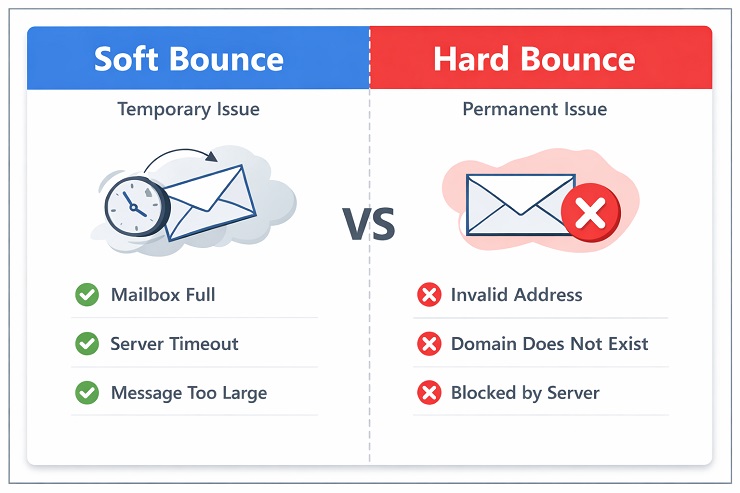
As you can see, the difference between soft and hard bounce in email marketing is clear. Soft bounces usually happen because of temporary conditions. Hard bounces happen because the address itself is bad.
For you as a sender, this difference matters a lot. Soft bounces give you some room to wait and observe. Hard bounces require quick action. If you keep sending emails to hard bounce addresses, your email bounce rate increases fast. Over time, this hurts email deliverability.
This is why smart email bounce management starts with identifying bounce types correctly. Once you do that, you can protect your sender reputation and keep your campaigns healthy.
Knowing the type only matters if you also know when the rate itself is a problem — and soft and hard bounces carry very different risk tolerances. Our complete guide on acceptable email bounce rate breaks down exactly where those thresholds sit and how they shift by campaign type and industry.
How Email Bounces Affect Email Deliverability?
Email bounces have a direct impact on email deliverability. Every time an email fails, inbox providers take note. Over time, a high bounce rate makes it harder for your emails to reach the inbox, even when you send to valid contacts.
There is a clear relationship between bounce rate and inbox placement. When too many emails bounce, ISPs assume something is wrong with your sending practices. As a result, your emails may start landing in spam or get blocked completely. This is why understanding soft bounce vs hard bounce is important for long-term deliverability.
Inbox providers evaluate senders based on trust. One of the biggest trust signals is sender reputation. Bounce behavior plays a major role here. Clean lists and low bounce rates help build trust. Poor list hygiene does the opposite.
Several systems work together to judge your emails:
- Sender score: This is a reputation score based on your sending history. High bounce rates can lower your sender score and reduce inbox placement.
- Spam filters: Spam filters look for risky patterns. Frequent bounces, especially from invalid email addresses, increase the chances of filtering.
- SMTP error codes: When emails fail, servers return SMTP error codes. ISPs analyze these errors to understand why emails are bouncing back and whether the failures are temporary or permanent (SMTP error codes reveal why emails fail and choosing reliable SMTP services can help prevent some delivery issues.)
- ESP feedback loops: Email service providers track bounce data and share it with ISPs. Repeated issues can trigger sending limits or warnings from your ESP.
Together, these signals decide where your emails land. By keeping bounce rates low and maintaining good list hygiene, you improve deliverability and protect your sender reputation.
Email Bounce Management Best Practices
Good email bounce management helps you protect your sender reputation and improve email deliverability over time. The goal is simple. Reduce unnecessary bounces and take action before they turn into bigger problems. When you manage bounces properly, inbox providers trust you more.
Let’s look at how you can do that in practice.
How to Reduce Email Bounces?
revention comes down to a few consistent habits: skip purchased or scraped lists, use double opt-in, watch your bounce reports after every send, and stop mailing contacts who’ve gone quiet. Our complete guide on reducing your bounce rate covers the full acquisition, engagement-segmentation, and monitoring system behind each of those habits. Maintaining strong list hygiene remains one of the most effective habits on its own.
How to Fix a High Email Bounce Rate?
If your rate rises anyway, start by separating hard bounces from soft; you’ve already got the full breakdown above. From there, the spike itself matters more than the numbers: pause sending immediately if it’s sudden (see the Emergency Protocol in our complete fix guide), then work through infrastructure, suppression, and acquisition in the order that guide lays out.
How Email Verification Helps Prevent Bounces
Verification is what keeps a list from drifting back into hard-bounce territory in the first place – catching invalid, disposable, and role-based addresses before they’re ever mailed. That’s what MailCleanup does, and it’s the natural complement to knowing your bounce types: verification stops the hard bounces described above from happening, rather than reacting to them after the fact.
Should You Remove Hard Bounce Emails Immediately?
Yes, as soon as a hard bounce is recorded, suppress that address and never retry it. There’s no recovery path for a hard bounce, and re-sending to one only signals poor list management to ISPs. For the full suppression SOP that teaches you how permanent suppression differs from a temporary flag, and how to keep it synced across your ESP and CRM so a suppressed address doesn’t quietly re-enter your list – see the Hard Bounce Management SOP in our complete guide.
Final Checklist to Keep Bounce Rates Low
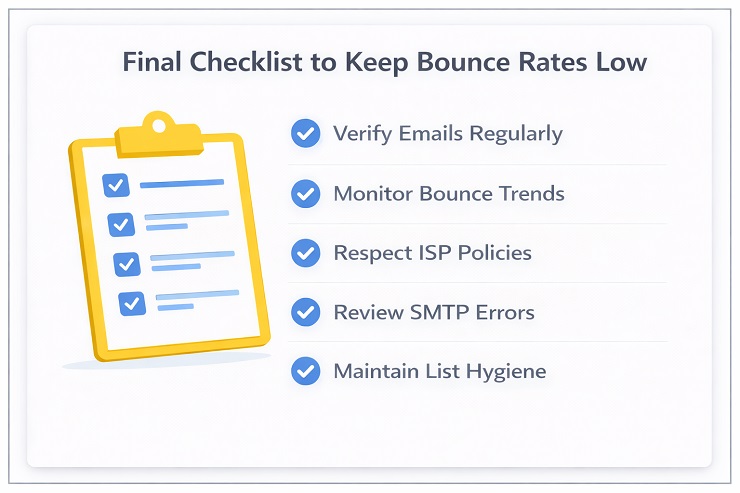
- Verify emails before sending: Always verify your list to catch invalid email addresses early. This simple step supports email bounce management and helps prevent issues related to soft bounce vs hard bounce behavior.
- Monitor bounce trends regularly: Track your bounce data after every campaign. Understanding the email bounce rate meaning helps you stay within the acceptable email bounce rate and spot problems before deliverability drops.
- Respect ISP and ESP policies: ISPs closely watch how you send emails. Ignoring their rules can trigger spam filters, ISP throttling, and long-term damage to your sender reputation.
- Maintain strong list hygiene: Clean your list often by removing inactive users and suppressing repeat offenders. Good list hygiene is one of the most effective email deliverability best practices.
- Review SMTP error codes frequently: Bounce reports and SMTP error codes explain why emails are bouncing back. Reviewing them helps you fix delivery issues like mailbox full errors or blocked servers faster.
FAQs on Soft Bounce vs Hard Bounce
What are bounce emails?
Bounce emails are messages that fail to reach the recipient’s inbox. This usually happens due to invalid email addresses, server issues, or strict ISP rules. Understanding what bounce emails are helps you protect your email deliverability early.
What is the difference between soft bounce and hard bounce?
The main difference between soft bounce vs hard bounce is permanence. A soft bounce is usually temporary, like a mailbox full or server downtime. A hard bounce is permanent and happens when an email address does not exist or the domain is invalid.
Why are my emails bouncing back even with a good ESP?
A good ESP can’t compensate for a poor list – outdated contacts, typos, and inactive domains bounce regardless of platform. For the full breakdown of what’s actually causing your bounces, see our guide on why emails bounce.
What is a good or acceptable email bounce rate?
Under 1% is the target most senders should aim for; 1–2% is still acceptable but worth monitoring. Once you’re consistently above 2%, you’ve moved into risk territory. See our full acceptable email bounce rate guide for how these thresholds shift by campaign type and industry.
Should I remove hard bounce emails from my list?
Yes, you should remove hard bounce emails from your list immediately. Re-sending to these addresses hurts your sender reputation and can lead to ESP warnings or account suspension.
How can I reduce email bounces long term?
To reduce email bounces, focus on strong email bounce management. Use email verification to reduce bounces, monitor SMTP error codes, respect ISP policies, and maintain clean list hygiene over time.
Conclusion: Manage Email Bounces Before They Hurt Deliverability
Email bounces may look like a small technical issue. However, over time, they quietly damage your email deliverability and sender reputation. That is why understanding bounce behavior early matters.
Once you know the difference between soft bounce vs hard bounce, managing them becomes much easier. Soft bounces often fix themselves. Hard bounces do not. Ignoring this difference leads to poor inbox placement and higher risk from ISPs.
The good news is that most bounce-related issues are preventable. Clean lists, strong list hygiene, and regular monitoring can keep your bounce rate within a safe range. These are simple habits, but they make a big difference.
If you want a scalable way to reduce email bounces, email verification plays a key role. It helps remove invalid email addresses before they harm your sender score. Over time, this leads to better inbox placement and more reliable campaign performance.
At the end of the day, email success is not about sending more emails. It is about sending smarter emails to real, reachable people. When you manage bounces correctly, everything else in your email strategy starts to work better.