
Email bounce rate is the percentage of emails that never reach the recipient’s inbox. On paper, it sounds like a simple delivery metric. In reality, what happens when email bounce rate is high goes far beyond numbers in a dashboard.
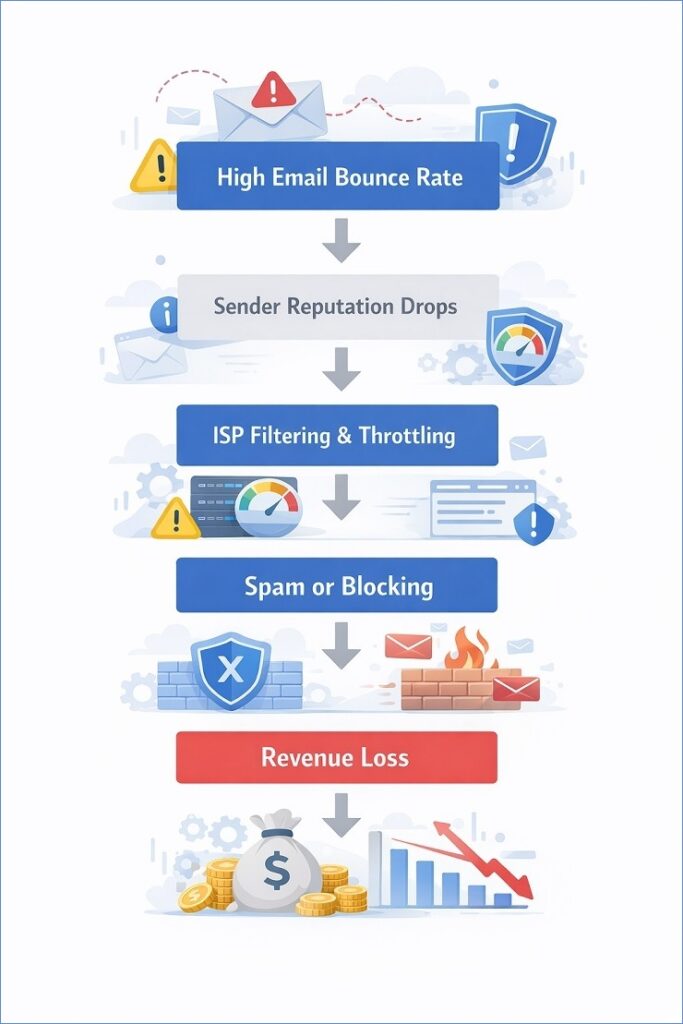
When emails bounce consistently, inbox providers stop trusting us. First, deliverability weakens. Then, sender reputation takes a hit. After that, even valid emails start landing in spam or getting blocked silently. This is why many teams ask what happens if bounce rate is too high, even when campaigns look fine on the surface. The damage often starts quietly and compounds over time.
We’ve seen high bounce rates trigger filtering, reduce inbox placement, distort engagement data, and eventually impact revenue. What looks like a list issue today can become an account or domain problem tomorrow.
Before going deeper, it helps to ground this discussion in benchmarks. We recommend reviewing our acceptable email bounce rate in 2026 guide to understand where healthy limits end and real risk begins.
Why a High Email Bounce Rate Is a Serious Warning Signal
A high email bounce rate is not just a reporting issue. It is an early email bounce rate warning that tells us something is already breaking. This is where many teams get confused. They see bounces as a list hygiene problem. However, what happens when email bounce rate is high is that inbox providers start questioning our overall sending behavior, not just the current campaign.
What we usually see first is inconsistency. One campaign delivers fine. The next struggles. Nothing obvious changes, yet results drift. That’s because bounce rate is treated as a trust signal. Repeated failures suggest poor data practices, risky acquisition, or lack of control over sending inputs. Even before penalties appear, monitoring systems begin adjusting how closely our emails are watched.
At this stage, the damage is subtle. Delivery still “works,” but tolerance drops. Filters tighten. Recovery windows shorten. This is why a rising bounce rate deserves attention immediately, not after it crosses a hard limit. It signals that future deliverability decisions are already being made against us, quietly and automatically.
Immediate Deliverability Consequences When Email Bounce Rate Is High
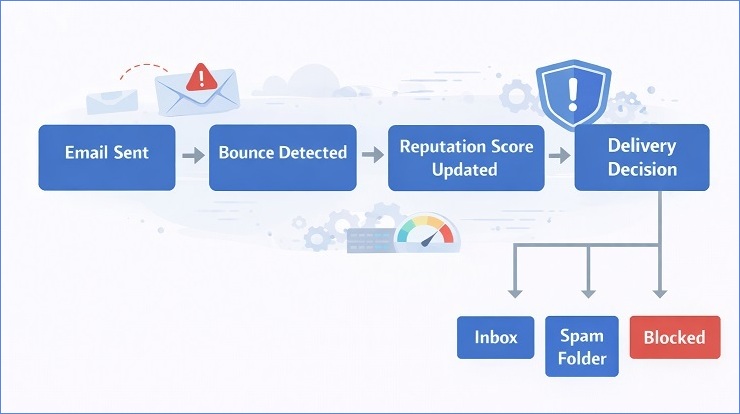
The email bounce impact on email deliverability shows up faster than most teams expect. This is because what happens when email bounce rate is high is interpreted in real time by inbox providers, not reviewed later as a historical metric. Once bounce signals cross certain tolerance levels, systems react automatically. The result is a chain of deliverability issues due to high bounce rate that go well beyond failed deliveries.
What makes this dangerous is that these reactions often happen before any explicit warning appears in your ESP. By the time teams notice inbox placement dropping, the underlying decision has already been made. These are deliverability consequences beyond bounce rate, and they tend to escalate quietly.
How ISPs Interpret High Email Bounce Rates
From an ISP’s perspective, repeated bounces signal loss of sender control. When a high volume of emails fail, especially due to invalid or non-existent addresses, systems assume poor list hygiene or risky acquisition practices. That assumption matters more than intent.
What we usually see is threshold-based interpretation. Bounce rates creeping above low single digits start triggering closer scrutiny. Sustained spikes push the sender into a higher-risk category. Even if the list is later cleaned, the initial signal remains logged. This answers a common question we hear: why did deliverability drop even after we fixed the list? Because ISPs evaluate patterns over time, not single sends.
At this stage, inbox providers don’t block immediately. Instead, they reduce trust, which sets the stage for filtering decisions that follow.
Spam Filtering, Throttling, and Silent Blocking
Once trust declines, filtering behavior changes first. Emails that previously landed in the inbox begin routing to spam. Send speed may slow without explanation. In some cases, messages are accepted by the server but never surface visibly. This is where teams get confused.
The failure sequence is predictable. First comes throttling. Then partial spam placement. Eventually, silent blocking affects even engaged recipients. What looks like an engagement problem is actually a deliverability one. This is why what happens when email bounce rate is high often feels sudden, even though the system response has been building quietly for weeks.
At this point, recovery slows because inbox providers require consistent clean behavior over time before trust is restored.
How a High Email Bounce Rate Damages Sender Reputation
Sender reputation is the real currency of email deliverability. Once it drops, everything else follows. This is what happens when email bounce rate is high and cannot be treated as a temporary campaign issue. The bounce rate sender reputation relationship is direct, cumulative, and difficult to reverse.
Inbox providers don’t evaluate bounces in isolation. They roll bounce behavior into long-term trust models that influence inbox placement across all future sends. As bounce patterns repeat, the email bounce impact on sender score becomes visible. Not as an alert, but as reduced tolerance. Over time, the bounce rate sender reputation effects spread beyond one list or campaign and attach to the sending identity itself.
Why Sender Reputation Declines After Repeated Bounces
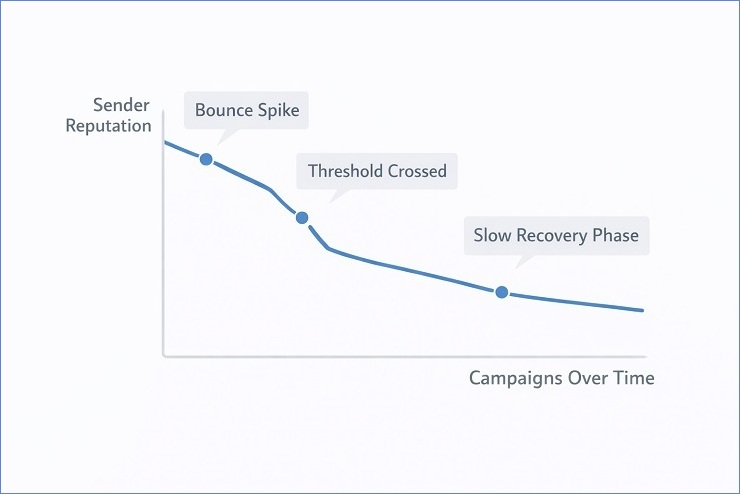
Repeated bounces signal one core problem: loss of control. When messages consistently hit invalid or unreachable addresses, reputation systems assume weak list hygiene or unsafe acquisition methods. Intent doesn’t matter here. Behavior does.
What we usually see is a delayed reaction. A few campaigns bounce heavily, yet delivery still looks fine. Then, weeks later, inbox placement drops across unrelated sends. This is where teams get confused. They ask why deliverability is still bad even though the list was cleaned. The answer is that reputation models evaluate trends, not fixes. Once negative data is logged, recovery requires sustained clean behavior.
This is what happens when email bounce rate is high – it quietly shifts from a data issue into a reputation problem. The sender score impact lingers long after the original bounces stop.
Bounce Rate Thresholds That Trigger Reputation Damage
While exact formulas are private, real-world behavior shows consistent thresholds. Bounce rates pushing beyond low single digits trigger closer monitoring. Sustained rates above that range accelerate reputation decay. At this stage, tolerance drops fast.
What follows is predictable. First, inbox placement becomes inconsistent. Then throttling appears. Eventually, even engaged recipients stop seeing messages reliably. This answers another common question: why did Gmail react faster than others? Because providers apply different sensitivity levels, but all track bounce trends over time.
At this point, recovery slows because reputation rebuilds gradually. This is what happens when high email bounce rate affects not just one campaign, but every future send tied to that sender identity.
ISP and ESP Penalties Caused by a High Email Bounce Rate
When teams ask what happens when email bounce rate is high, they often expect softer consequences – lower opens, maybe some inbox issues. What actually happens is more structural. ISPs and ESPs don’t just downgrade placement. They enforce penalties.
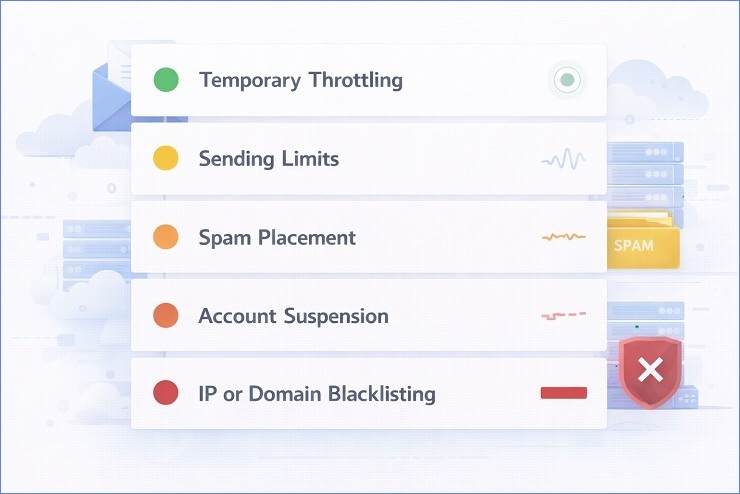
A high bounce rate forces providers to protect their infrastructure. That’s why ISP penalties for high bounce rate escalate in stages. First, systems slow you down. Then they restrict you. In severe cases, they shut you off entirely. This is where high email bounce rate ISP penalties stop being theoretical and start affecting revenue.
What we usually see is confusion around responsibility. Marketers blame content. ESPs blame list quality. Meanwhile, automated enforcement keeps progressing in the background.
Temporary Sending Limits and Throttling
The first visible penalty is throttling. When high email bounce rates crosses internal thresholds, ISPs start limiting how fast and how often your mail is accepted. This is not random. Bounce spikes are treated as a sign that future sends are risky.
Mechanically, the system shifts your sender into a lower-trust lane. Messages queue longer. Delivery spreads over hours instead of minutes. This is where teams notice campaigns “dragging” or stopping mid-send. Open rates look uneven. Engagement drops even among known-good contacts.
This is where teams get confused. They cleaned the list. Bounces are down. Yet throttling continues. The reason is that throttling responds to historical behavior, not just the latest send. Once triggered, recovery requires consistent clean performance across multiple campaigns.
Different providers react at different speeds. Some enforce throttles immediately. Others wait for patterns. That’s why one inbox provider slows delivery while another still accepts mail – until it doesn’t.
Account Suspension and Domain or IP Blacklisting
If bounce behavior continues, throttling escalates into enforcement. This is when email bounce rate account suspension becomes a real risk. ESPs step in because their own reputation is now exposed.
What we’ve seen repeatedly is sudden suspension notices with vague explanations. Sending stops entirely. In extreme cases, domains or IPs are added to suppression lists or external blocklists – classic bounce rate blacklisting scenarios.
At this stage, email bounce rate account suspension ESP actions are no longer reversible with quick fixes. Even after the list is cleaned, recovery is slow. Appeals take time. Re-warming becomes mandatory. And some damage persists silently, especially if the sending domain itself was flagged.
This answers a hard question: why did everything collapse so fast? Because once bounce patterns signal systemic risk, providers act decisively. From their perspective, the cost of letting bad mail through is higher than blocking a legitimate sender temporarily.
This is the final escalation of what happens when email bounce rate is high – not lower metrics, but enforced downtime and long-term trust loss.
Engagement and Performance Issues Caused by High Email Bounce Rates
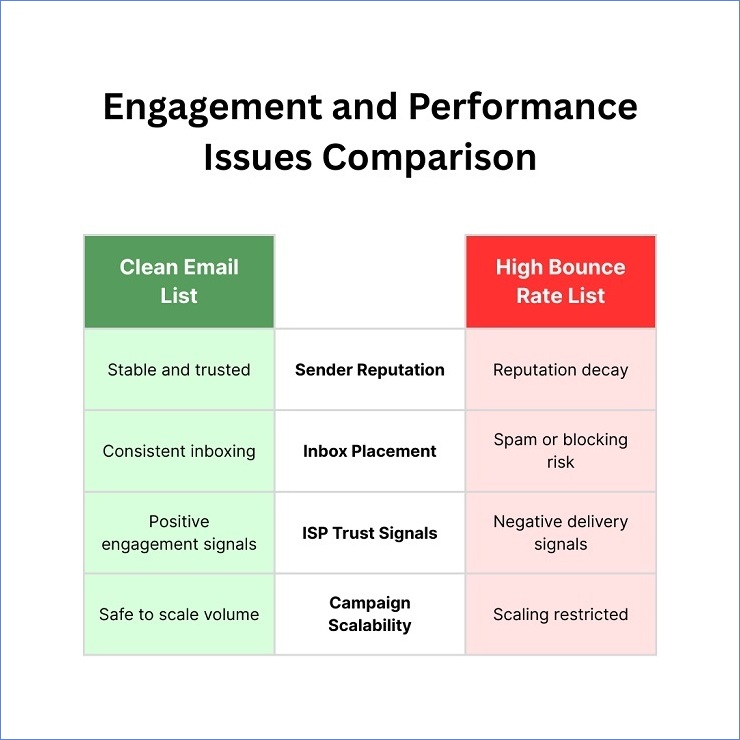
When teams ask us what happens when email bounce rate is high, they usually expect deliverability problems. What catches them off guard is how quickly bounce behavior distorts engagement and performance metrics long before inbox placement completely collapses. This is where bounce rate impact on email engagement becomes dangerous – because the damage hides inside “normal-looking” reports.
What we usually see first is a quiet degradation. Opens dip. Clicks soften. But nothing looks broken enough to trigger alarms. In reality, mailbox providers are already narrowing exposure, which means fewer real users ever see the campaign. The list still looks the same size, but the reachable audience has shrunk.
This is where email performance issues from bounce rate turn into an analytics problem. Engagement metrics are calculated on delivered emails, not eligible emails. When bounces rise, the denominator lies. Campaigns appear weaker, not because content failed, but because fewer inboxes were even given a chance to respond.
Over time, this skews email bounce metrics’ impact on ROI. Teams optimize subject lines, timing, and CTAs based on corrupted signals. Revenue attribution drifts. What looks like creative fatigue is often deliverability suppression triggered by unresolved bounce patterns.
Lower Open Rates and Click Rates
When evaluating what happens when email bounce rate is high, lower opens and clicks are not random drops – they’re a controlled response. Mailbox systems reduce inbox exposure incrementally. Messages still “send,” but they land in secondary tabs, bulk folders, or arrive hours late. Engagement falls without an obvious delivery failure.
What we usually see next is confusion. Teams compare campaigns sent weeks apart and assume audience interest declined. In reality, bounce rate effect on email engagement compounds silently. Once a sender’s reputation dips, ISPs stop testing campaigns broadly. Fewer recipients are sampled, so fewer opens are even possible.
Clicks suffer even more. Click behavior depends on timely inbox visibility. When messages arrive late or land in filtered views, intent decays. This creates a misleading narrative: strong offers “underperform” while the root issue remains bounce-driven trust erosion.
At this stage, fixing copy doesn’t recover performance. Even after list cleanup, opens don’t rebound immediately. This is why teams ask why deliverability still feels broken weeks later. The system remembers bounce behavior longer than most expect.
Why High Bounce Rates Break Campaign Optimization
Understanding what happens when email bounce rate is high is critical for optimization because bounces corrupt the feedback loop marketers rely on. Every A/B test assumes a stable delivery environment. High bounce rates destroy that assumption.
Here’s where teams get misled. Subject line tests show marginal differences. Send-time experiments flatten out. Segments stop responding predictably. The issue isn’t audience fatigue – it’s that mailbox systems are no longer distributing variants evenly due to sender risk signals.
This is how email bounce metrics impact ROI in a non-obvious way. Optimization decisions are made on partial visibility. Winning variants aren’t truly winning; they’re simply less penalized. Losers may never have reached the inbox at all.
Over time, this leads to false confidence or unnecessary pivots. Teams rewrite flows, pause campaigns, or change strategy when the real fix was bounce control. Until bounce behavior stabilizes, optimization data cannot be trusted – and performance gains remain capped no matter how good the creative becomes.
The Business Impact of a High Email Bounce Rate
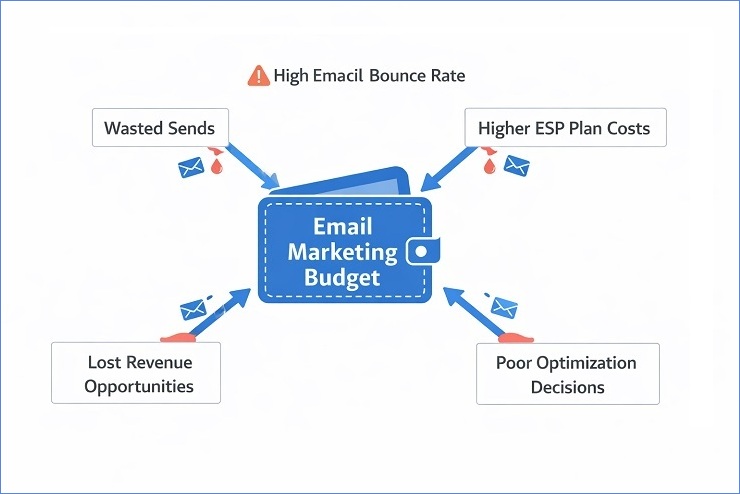
When teams ask us what happens when email bounce rate is high, they often underestimate how directly it hits the business. The email bounce rate business impact is not theoretical. It shows up as lost revenue, wasted effort, and slower growth – even when campaigns appear “sent” and dashboards stay green.
What we usually see is a disconnect between activity and outcome. Teams send the same volume. Spend the same budget. But results quietly shrink. Bounce rate impact on ROI compounds because fewer emails reach buyers and because decision-making starts relying on distorted numbers.
This is where leadership gets confused. Marketing is busy. Pipelines look active. Yet revenue attribution from email weakens quarter over quarter. High bounce rates don’t just reduce reach – they quietly erode the economic efficiency of the entire channel.
Lost Revenue Opportunities
To understand what happens when email bounce rate is high, consider a simple scenario. A list of 100,000 subscribers sends a campaign with a 5% bounce rate instead of a healthy sub-1%. That’s 5,000 additional emails that never had a chance to convert – before engagement even begins.
What we usually see next is undercounted opportunity loss. If that campaign typically converts at 1% with an average order value of $80, those unreachable inboxes represent roughly $40,000 in missed revenue from a single send. Multiply that across weekly campaigns, and the number stops being small very quickly.
This loss is invisible in most reports. Dashboards show “delivered” performance, not potential performance. That’s why bounce rate impact on ROI feels delayed. Revenue doesn’t crash overnight. It slowly leaks out of the funnel.
At this stage, recovery feels frustrating. Even after fixing bounces, revenue doesn’t instantly rebound. That’s because trust – and therefore inbox access – rebuilds slower than it breaks.
Wasted Email Marketing Spend
Another part of high email bounce rate is high is wasted resources – and not just email credits. Teams spend time crafting campaigns, designing templates, segmenting audiences, and running tests that never reach a meaningful portion of recipients.
What we usually see next is a quiet pricing problem. As lists grow, teams upgrade to higher ESP plans based on raw contact count. But when bounce rates are elevated, a meaningful percentage of those “contacts” are already invalid. You end up paying more every month to store and send to addresses that will never receive an email.
This is where teams get confused. The list size keeps increasing. Costs go up. Yet reach and revenue don’t scale proportionally. In reality, the usable audience is much smaller than the billing tier suggests. The spend inflates, but the effective list does not.
There’s also a downstream optimization cost. When bounces remain in the system, automations and campaigns keep firing at dead addresses. ESP usage looks healthy on paper, but real delivery efficiency drops. Over time, email feels expensive not because it underperforms but because budget is tied to unproductive volume.
At this stage, fixing creative or cadence won’t recover the loss. Until invalid addresses are removed and list size reflects reachable humans, spend stays misaligned with outcomes and ROI remains capped even when performance appears “stable.”
Warning Signs That Your Email Bounce Rate Is Becoming Too High
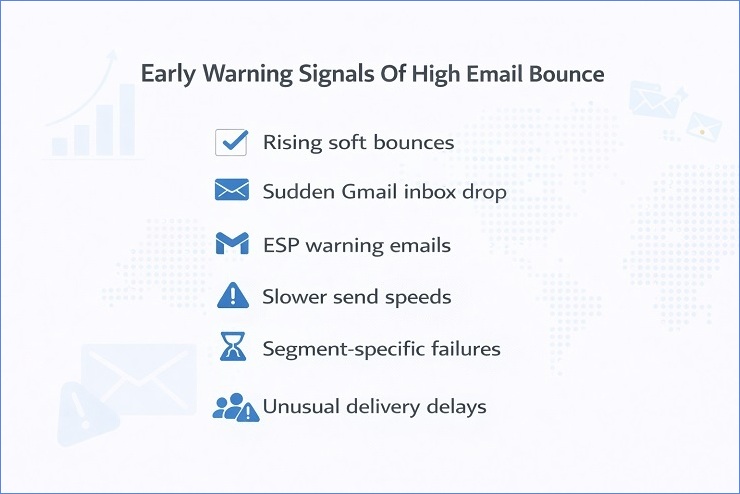
One of the most overlooked parts of what happens when email bounce rate is high is that the damage rarely starts with a penalty. It starts with signals. Quiet ones. The kind teams notice only in hindsight, after deliverability has already slipped. Spotting high bounce rate warning signs early is the difference between routine cleanup and a long recovery cycle.
The first email bounce rate risk usually shows up in trend lines, not alerts. Bounce rate creeps up week over week. Nothing dramatic. Maybe from 0.8% to 1.4%. Then to 2% after a list import or campaign push. This is where teams get confused. Individual sends still “look fine,” so the risk feels theoretical. In reality, reputation systems track cumulative behavior, not single campaigns.
What we usually see next is inconsistency across providers. Gmail placement softens before others. Yahoo delays appear. Open rates dip unevenly, even though content hasn’t changed. This fragmentation is a key warning sign. It means different ISPs are already reacting to bounce patterns at different sensitivity levels.
Weekly monitoring is critical here. Beyond overall bounce rate, teams should watch hard bounce concentration, bounce spikes tied to specific segments, and bounce behavior after re-engagement campaigns. Sudden increases after automation sends are especially telling. They signal that old or decayed addresses are still active in flows.
At this stage, recovery is still fast – if action happens. Ignoring these early signals is how a manageable email bounce rate risk quietly turns into throttling, filtering, or worse. The systems always react first. Penalties only come later.
What to Do Next If Your Email Bounce Rate Is Already High
Once you reach the point where what happens when email bounce rate is high is no longer theoretical, the priority shifts from optimization to containment. At this stage, the goal is not to “improve performance.” It’s to stop further reputation damage while you regain control of your sending environment.
This is where teams often make their biggest mistake. They try to send their way out of the problem. More campaigns. Smaller batches. New subject lines. None of that works if bounce signals are still flowing into ISP systems. Recovery only starts when those signals stop.
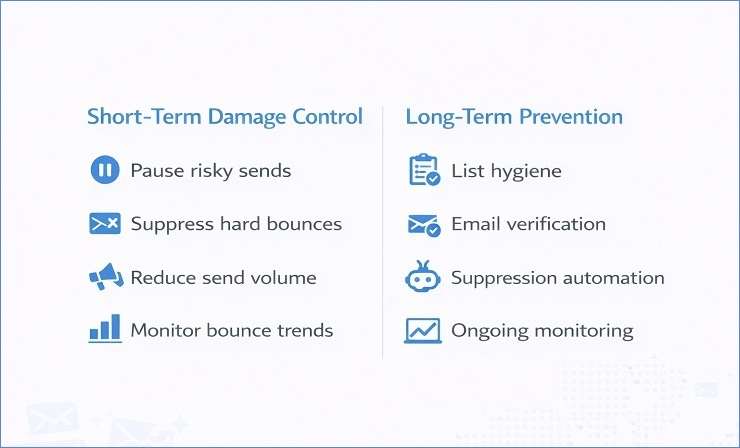
We approach this in two phases: short-term damage control and long-term prevention. Mixing the two slows recovery. Treating them in order speeds it up.
Short-Term Damage Control: Stop the Reputation Bleed
The first step in how to recover from high bounce rate is reducing risk immediately. That usually means pausing non-essential sends. Especially automations that touch old, imported, or re-engagement segments. This is uncomfortable for growth teams, but it’s necessary. Every bounced email sent during this phase extends the recovery window.
Next comes isolation. We look at where bounces are coming from, not just how many. Campaigns tied to purchased lists, legacy CRM imports, or dormant subscribers almost always stand out. This is where teams get confused. They “cleaned the list once,” but bounces keep coming back because the same bad segments remain active in workflows.
At this point, bounce rate reduction isn’t about clever tactics. It’s about removing known risk. Suppress addresses that have bounced recently. Suppress addresses that haven’t engaged in a long time. Suppress sources you can’t vouch for. The goal is to give ISPs a clean stretch of sending behavior with minimal negative signals.
Long-Term Prevention: Build Systems That Prevent Bounce Relapse
Once bounce pressure drops, prevention becomes the real work. This is where most recoveries succeed or fail. Teams fix the spike, then slowly drift back to risky habits. Lists grow faster than hygiene processes. Old addresses sneak back in. Bounce rate climbs again.
Long-term prevention starts with list hygiene as a system, not a one-time task. Every new address should pass through verification before it ever hits your ESP. Not after problems appear. Before sending begins. This alone changes the trajectory of future bounce rates.
Suppression automation is the second pillar. Hard bounces, repeated soft bounces, and long-term inactives should automatically exit your sending universe. When suppression relies on manual cleanup, it always lags behind reality. Automation keeps bounce signals from resurfacing quietly.
Finally, this is where teams usually want a deeper framework. Not just how to recover from high bounce rate, but how to manage bounce behavior continuously as lists grow and campaigns scale. That’s why we break this down further in our dedicated guide on email bounce management and how to reduce email bounce rate long-term.
Recovery is absolutely possible. But only when bounce control becomes part of how you operate – not something you scramble to fix after the damage is done.