
Every guide to double opt-in vs single opt-in repeats the same two claims: single opt-in grows your list faster, and double opt-in protects it better. The first claim holds up. The second one doesn’t, at least not the way people usually argue it.
Ask what double opt-in actually protects you against, and most articles point at spam complaints, unsubscribes, or list quality in general. Real data tells a different story. GetResponse’s own analysis of 2.76 billion sent newsletters found double opt-in subscribers unsubscribe more often than single opt-in subscribers. Their spam complaint rate runs equal to or higher too, not lower. What double opt-in genuinely blocks for you is narrower and more specific: two categories of spam trap, out of five. The other three form after signup, no matter which method got the address onto your list.
That distinction changes what protecting your list actually requires. This guide walks through both methods in full. You’ll see where each one wins on its own terms, and what GDPR and other regulations actually require. You’ll also see exactly which risks double opt-in closes off for you, and which ones it leaves standing.
TL;DR on Single Opt-In and Double Opt-In
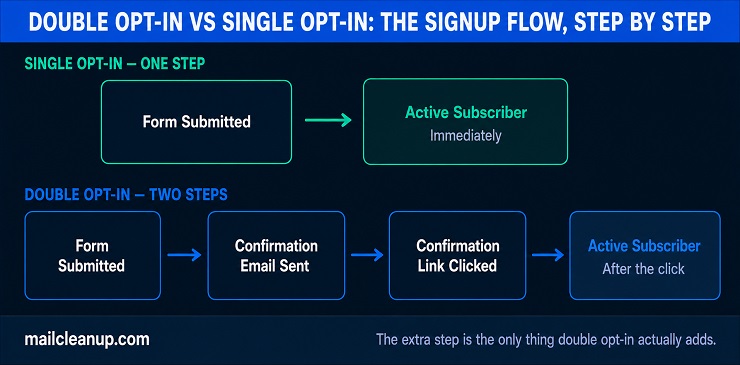
- Single opt-in adds a contact to your list the moment they submit a signup form. Double opt-in adds them only after they click a confirmation link in a follow-up email.
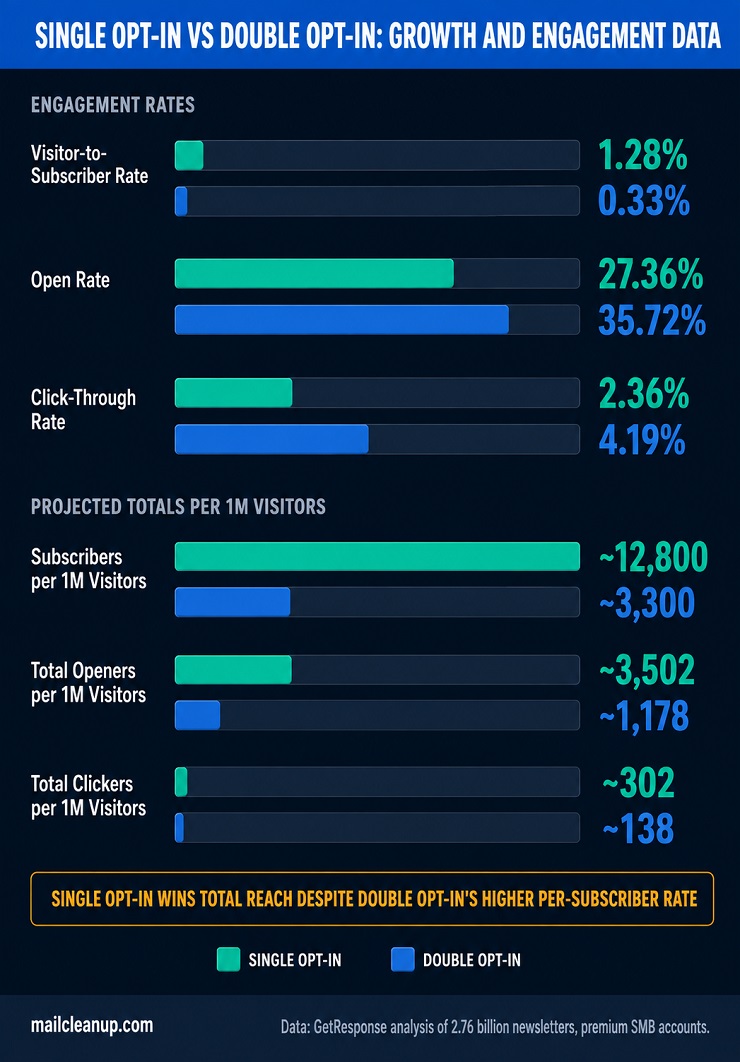
- Single opt-in produces a meaningfully larger list. GetResponse’s own analysis of 2.76 billion newsletters found a 1.28% visitor-to-subscriber rate for single opt-in against 0.33% for double opt-in, a gap wide enough that single opt-in still produced more total email openers and clickers overall, despite double opt-in’s higher per-subscriber engagement rate.
- The same GetResponse data found double opt-in subscribers unsubscribe and report spam at rates equal to or higher than single opt-in subscribers, directly contradicting the common claim that double opt-in reduces complaints.
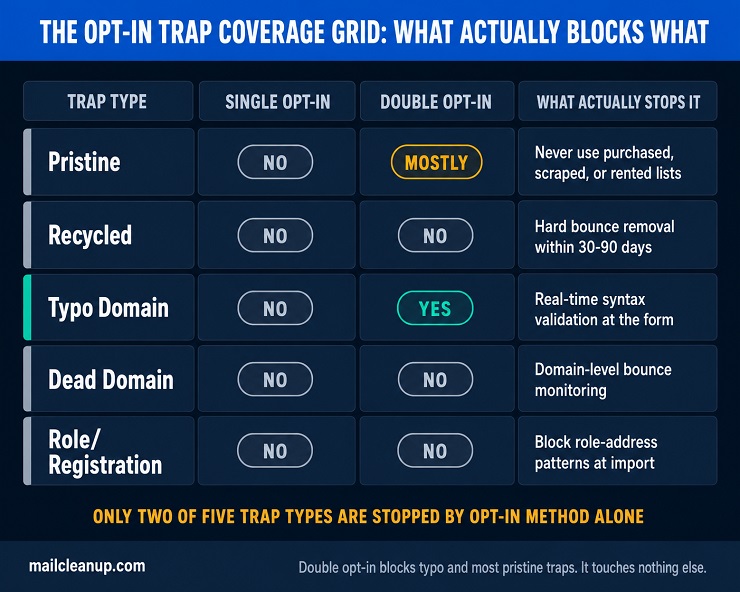
- Double opt-in’s real, defensible benefit is narrower: it blocks typo-domain traps and most pristine traps at the point of signup. It does nothing against recycled, dead-domain, or role-address traps, which form or surface after acquisition regardless of method.
- Double opt-in GDPR guidance is often oversimplified, treating single opt-in and double opt-in as if only one of them could ever be compliant. Article 7 never names a specific opt-in mechanism.
- MailCleanup’s own tracked list data shows decay compounds over time regardless of acquisition method, accelerating more than four times faster in a list’s final tracked quarter than its first.
- A double opt-in confirmation email that actually converts needs four things: a subject line that says exactly what it is, explicit consent language rather than a bare verification link, one clear call to action, and an opt-out option even at this pending stage.
- Neither method replaces ongoing verification. Single opt-in needs it to catch what never got validated at signup. Double opt-in needs it just as much once addresses start aging.
Single Opt-In vs Double Opt-In: What Each One Actually Means
Both methods answer the same question for your list: how does a visitor become a contact you can actually email? They answer it with a different number of steps, and a different point at which consent becomes provable. A double opt-in vs single opt-in decision comes down to this structural difference, and every claim later in this guide traces back to it.
What Is Single Opt-In?
What is single opt-in? In the double opt-in vs single opt-in decision, it’s the one-step version. A visitor fills out a signup form, submits their email address, and becomes an active subscriber on your list immediately, with no further action required. It doesn’t matter which channel brought them there: a homepage form, a lead magnet, a checkout flow. The moment they hit submit, they start receiving your emails.
The appeal is obvious. Nothing stands between interest and inclusion. But that same immediacy means nothing stands between a mistyped address, a fake address, or someone else’s address, and your list, either. Single opt-in has no built-in step confirming the address they typed is real, or that they’re the one who typed it.
What Is Double Opt-In?
What is double opt-in? It’s the other half of the double opt-in vs single opt-in comparison, and it adds exactly one more step to your signup flow. After the same signup form, the new contact receives a confirmation email asking them to click a link before anything else happens. Only after that click does the address move from pending to active, and only then do your regular campaigns start reaching it.
That single extra click does two things at once for you. It confirms the address can actually receive mail, since a working confirmation email had to reach it first. And it confirms a real person acted on it, not a bot, not a scraper, and not someone typing in an address that wasn’t theirs.
| Single Opt-In | Double Opt-In | |
|---|---|---|
| Steps required | 1 | 2 |
| When the contact becomes mailable | Immediately on form submission | After the confirmation link is clicked |
| Confirmation email sent | No | Yes |
| Confirms the address can receive mail | No | Yes |
| Confirms consent came from the address owner | No | Yes |
Choosing between double opt-in vs single opt-in starts with this table, but it doesn’t end there for your list. The real difference shows up downstream, in how fast each one actually grows and which specific risks each one closes off.
Single Opt-In or Double Opt-In: Which Grows Your List Faster
Single opt-in wins this question clearly for you, and by a wider margin than most double opt-in vs single opt-in comparisons suggest.
GetResponse’s own analysis of 2.76 billion newsletters, sent through premium SMB accounts, put real numbers behind the gap.
| Metric | Single Opt-In | Double Opt-In |
|---|---|---|
| Visitor-to-subscriber conversion rate | 1.28% | 0.33% |
| Newsletter open rate | 27.36% | 35.72% |
| Newsletter click-through rate | 2.36% | 4.19% |
| Subscribers per 1M visitors (projected) | ~12,800 | ~3,300 |
| Total openers per 1M visitors (projected) | ~3,500 | ~1,180 |
| Total clickers per 1M visitors (projected) | ~300 | ~140 |
Double opt-in subscribers genuinely engage at a higher rate, a real 8-point lead on opens and nearly double the click rate. But that gap isn’t large enough to close the volume difference. Multiply each method’s engagement rate against the subscriber count it actually produces for your list. Single opt-in still wins on total openers and total clickers, not just total subscribers.
That’s the part most single opt-in or double opt-in content skips for you. Double opt-in’s higher per-subscriber engagement gets cited as a decisive win, without ever multiplying it back out against the smaller list it actually produces. A larger denominator at a lower rate still beats a smaller denominator at a higher one. On raw reach, measured through to who actually opens and clicks, single opt-in wins both questions at once.
None of this means double opt-in has no case for your list. It means the case for it has to rest on something other than growth, since growth is not where it wins.
Single Opt-In and Double Opt-In: Which One Actually Protects List Quality
List quality is the phrase every single opt-in and double opt-in comparison reaches for once growth stops being the argument. It’s almost never defined precisely. Ask what double opt-in is actually protecting your list against, and the honest answer splits into two different claims.
The claim that doesn’t hold up: that double opt-in subscribers file fewer spam complaints and unsubscribe less often. GetResponse’s own data, across that same 2.76 billion newsletters, found the opposite on both counts. Double opt-in’s unsubscribe rate ran higher than single opt-in’s, and its spam complaint rate matched or exceeded single opt-in’s across most industries measured. If anything, the more common explanation fits your data better. Double opt-in subscribers have already clicked once to confirm, so they’re more willing to click again, on unsubscribe or spam, once something feels irrelevant.
The narrower claim that does hold up: double opt-in genuinely blocks certain kinds of bad addresses before they ever reach your list. A typo at signup, gnail.com instead of gmail.com, never receives the confirmation email, so it never confirms and never joins. Most pristine spam traps, addresses seeded specifically to catch senders who skip real consent, fail the same way. Nobody sits behind them to click a confirmation link.
That’s a real, specific protection for your list, but it’s not the whole of what list quality usually implies. Recycled traps, dead-domain traps, and role-address traps don’t get stopped by a confirmation click at all. None of them depend on how the address was originally acquired. They form or surface later, after acquisition, no matter which method brought the address in. A double opt-in vs single opt-in decision at signup has nothing to say about a mailbox deleted eighteen months after it confirmed.
Seeing exactly where that protection stops, and where it doesn’t reach, is worth mapping precisely for your list, not leaving as a general impression.
The Opt-In Trap Coverage Grid: What Double Opt-In Confirmation Email Actually Blocks
Our own spam traps breakdown splits the category into five distinct types. Each one forms through a different mechanism and signals a different failure in your sending programme. Mapping which of those five a signup-stage confirmation step can actually stop tells you something specific. It’s the real substance behind the double opt-in vs single opt-in question, more useful than a flat “which is better” debate. It shows which ones stay untouched no matter how strict your opt-in process is. That turns “protects list quality” from a vague claim into something you can check against your own list.
| Trap Type | Blocked by Single Opt-In | Blocked by Double Opt-In | What Actually Stops It |
|---|---|---|---|
| Pristine | No | Mostly | Never use purchased, scraped, or rented lists |
| Recycled | No | No | Hard bounce removal within 30-90 days |
| Typo Domain | No | Yes | Real-time syntax validation at the form |
| Dead Domain | No | No | Domain-level bounce monitoring |
| Role/Registration | No | No | Block role-address patterns at import |
Two of these five categories, typo and pristine, form at or before the moment of signup, which is exactly when an opt-in method can intervene. A typo domain never receives your confirmation email, so double opt-in blocks it outright. A pristine trap has no real person behind it to click that confirmation either, which is why double opt-in stops most of them. Not all of them. A coordinated bot attack against a signup form can sometimes click through a confirmation link the same way it submitted the original form. So double opt-in sharply reduces this risk rather than eliminating it.
The other three categories don’t form at signup at all. A recycled trap was a real, legitimately-owned address when someone first subscribed, however they subscribed. It only becomes a trap after 12 months or more of dormancy, well after any opt-in step already did its job. A dead domain trap follows the identical timeline, just at the domain level instead of the individual address. A role address like abuse@ or postmaster@ is a genuinely live, mailable inbox from the moment it’s added, whichever method added it. The problem isn’t a fake address; it’s that no individual behind it ever consented to marketing email.
What Double Opt-In Confirmation Email Steps Are Doing (and Not Doing) for Your List
Knowing which category you’re actually exposed to tells you which fix to reach for. The confirmation click in your signup flow isn’t the answer to all five. That’s the piece a flat double opt-in vs single opt-in comparison always misses.
- If your risk is acquisition-driven (purchased data, scraped contacts, bot submissions): double opt-in genuinely helps here, but the confirmation click is a filter, not a fix. The real solution is not acquiring the risk in the first place.
- If your risk is dormancy-driven (recycled or dead-domain traps building up in an older list): your opt-in method is irrelevant to this one. Hard bounce removal on a real cadence is what actually protects you.
- If your risk is import-driven (role addresses entering through a scraped directory or a purchased file): filter for role-address patterns before the import runs, regardless of which opt-in method the new contacts go through afterward.
- If you’re not sure which risk applies to your list: ongoing verification catches all five categories after the fact, the one layer that works no matter what happened at signup.
Does Single Opt-In or Double Opt-In Change How Fast Your List Decays
No. Understanding why not tells you something the Grid above already hinted at. The double opt-in vs single opt-in decision only ever touches what happens at the moment of signup. Decay is what happens to a real, legitimately-added address in the months and years after that.
Our own tracked decay data followed one client’s list of 912,317 addresses that had already passed verification as deliverable. We re-checked them monthly for a full year.
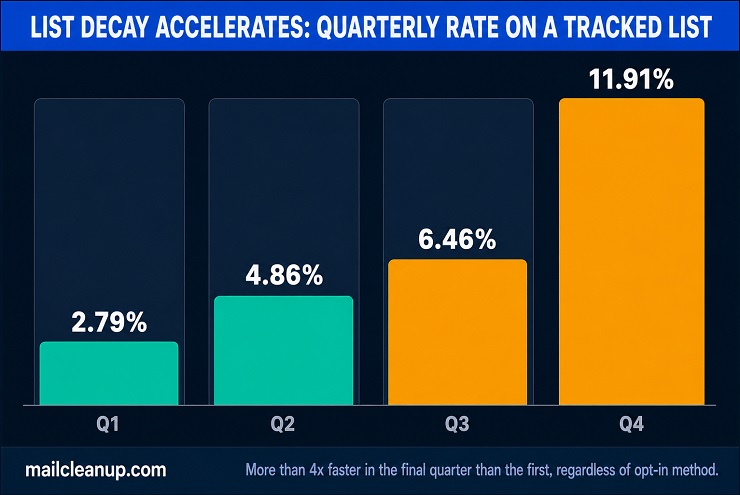
The decay rate didn’t hold steady.
It accelerated, from 2.79% in the first quarter to 11.91% in the final one, more than four times faster by year’s end.
Every reason behind that acceleration is something that happens after acquisition, not because of it. Mailboxes get deleted when someone leaves a job or closes an account. Mailboxes get disabled. Domains expire when a company stops renewing one. None of that traces back to whether the address was single or double opt-in confirmed on day one. It traces back to what happened to the person and the domain since then.
That’s why ongoing list hygiene matters regardless of which opt-in method you’re running. A double opt-in list confirmed as real and consenting on day one is still decaying by month eighteen. That rate only gets steeper the longer it goes unchecked. Choosing between single opt-in vs double opt-in solves an acquisition-stage problem for your list. It doesn’t solve this one.
Is Double Opt-In Required Under GDPR and Other Regulations
Deciding between double opt-in vs single opt-in for your own list is one thing. Deciding whether the law makes that choice for you is a separate question. The honest answer surprises a lot of people who assume GDPR settled it already.
What Double Opt-In GDPR Guidance Actually Says
GDPR never uses the phrase double opt-in. Article 7 sets out what consent has to be, and it never names a specific mechanism for getting there:
- Freely given, with a genuine choice to refuse
- Specific to the actual purpose, not bundled into unrelated terms
- Informed, meaning the person knows what they’re agreeing to
- Unambiguous, backed by a clear affirmative action
- Demonstrable, meaning you can prove it happened after the fact
That’s not a loophole. It’s the reason so much content about double opt-in GDPR requirements ends up vague. The regulation genuinely leaves the mechanism up to you, as long as whatever you land on can prove all four conditions held.
A single opt-in form paired with clear, logged consent language can satisfy Article 7 just as validly as a double opt-in confirmation email can. What actually fails is a checkbox pre-ticked by default, or a signup flow with no record of when or how someone agreed. That failure has nothing to do with which opt-in method sits on top of it.
None of this means the double opt-in vs single opt-in decision is irrelevant to your compliance obligations. It just means GDPR itself isn’t the reason to pick one over the other. The actual reason lives in specific countries, which is where the picture gets more concrete.
Is Double Opt-In Required in Germany and Elsewhere
Germany is where the double opt-in vs single opt-in question stops being theoretical. German courts don’t require double opt-in by name either, but they’ve made single opt-in nearly impossible to defend.
The German Federal Court of Justice ruled in 2011, case I ZR 164/09, that a signup form alone can’t prove consent. Anyone could type in an address that wasn’t theirs. Double opt-in’s confirmation click is what actually closes that gap. That’s why it’s become the de facto requirement there. Enforcement runs less through regulator fines and more through Abmahnungen, formal cease-and-desist letters competitors can send over a single non-compliant email.
| Country/Region | Legal Status |
|---|---|
| Germany | De facto required; courts reject single opt-in as sufficient proof of consent |
| Austria, Switzerland, Greece, Norway, Luxembourg | Recommended by regulators, not legally required |
| Everywhere else under GDPR | Not required; any method that can prove valid consent qualifies |
None of this makes single opt-in vs double opt-in a settled question everywhere else the way it is in Germany. It makes it a genuine choice, one worth basing on your actual audience rather than a blanket rule.
GDPR and Germany aren’t the only regulations in play. CAN-SPAM, the US law, doesn’t require any opt-in step at all. It’s built around opt-out instead, letting you email first as long as unsubscribing is honest and immediate. Canada’s CASL does require consent, but like GDPR, it never mandates a specific confirmation mechanism to prove it. Our email compliance guide covers all four laws in full, CAN-SPAM, GDPR, CASL, and CCPA, for the regulatory picture beyond opt-in alone.
How to Set Up Single Opt-In and Double Opt-In the Right Way
Whichever side of the double opt-in vs single opt-in decision you land on, how you build it matters just as much.
Building a Double Opt-In Confirmation Email That Actually Converts
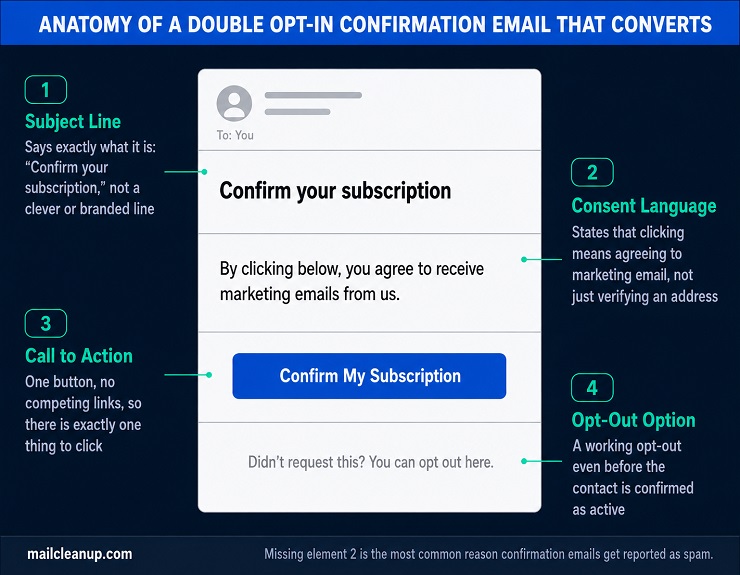
Most double opt-in confirmation email templates that ship by default in an ESP technically work. Four specific elements separate one that converts from one that quietly bleeds subscribers before they ever confirm.
- A subject line that says exactly what it is. “Confirm your subscription” or “Please verify your email” outperforms clever or branded lines, since readers need to instantly recognize why they’re seeing this message.
- Consent language stated explicitly in the body, not just implied. The confirmation link should sit next to a sentence saying clicking it means agreeing to receive marketing email, not just verifying an address. Those are legally different things, and only one of them creates the consent record you actually need.
- One clear call to action, with no second link or button competing for attention. A confirmation email exists to get one click. Every additional element on the page is a chance for that click to go elsewhere instead.
- An unsubscribe or opt-out option, even at this stage. Someone who signed up by mistake, or changed their mind before confirming, should be able to say so directly. They shouldn’t have to report the email as spam just to make it stop.
Get these four right and it stops mattering which side of the double opt-in vs single opt-in decision led you here. The email itself does its job either way.
When Single Opt-In or Double Opt-In Is the Right Call for Your List
Neither method is correct by default. There’s no single opt-in vs double opt-in default that works for every list. The right call depends on where your contacts actually come from, not a general preference for speed or caution. Single opt-in genuinely fits when consent is already established somewhere else in the interaction. A customer who just completed a checkout already gave you their email address for order confirmation. Adding a second confirmation click for marketing emails on top of that adds friction without adding real proof of intent.
Our ecommerce email marketing guide covers this exact scenario, where the purchase itself is the stronger consent signal, not the signup form. The same logic applies to addresses collected in person, at a conference badge scan or an in-store signup, where the interaction itself already confirms identity.
Double opt-in earns its place when the opposite is true: the list-building channel itself carries real fraud or bot risk. A public lead magnet, a giveaway, or an embedded form anyone can find and submit has no verification built into the interaction at all. That’s exactly the gap a confirmation click closes. It’s also the right default whenever German or other regulated-market subscribers make up a meaningful share of your list. The same goes whenever the list feeds high-cost downstream sends, where even a small amount of trap or complaint risk is expensive to absorb.
The double opt-in vs single opt-in choice was never really about a universal default. It’s about matching the method to how your specific list actually gets built.
Common Single Opt-In and Double Opt-In Mistakes
Six mistakes account for most of the damage in a double opt-in vs single opt-in decision. None of them are about which method you picked.
- Treating double opt-in as protection against every spam trap: It blocks typo and most pristine traps. It does nothing for recycled, dead-domain, or role-address traps, which form after acquisition no matter which method brought the address in.
- Skipping ongoing verification because the list is double opt-in: A confirmed address on day one is still a real inbox that can go dead, get disabled, or turn into a trap eighteen months later. Confirmation at signup doesn’t cover any of that.
- Writing a confirmation email that never states what someone is agreeing to: A bare “click to verify your email” link confirms an address works. It doesn’t confirm anyone agreed to receive marketing, which is the actual consent record you need.
- Defaulting to single opt-in without checking where the list’s subscribers actually are: This is the single opt-in vs double opt-in mistake with the highest legal cost. German courts treat single opt-in as effectively indefensible. A list with any meaningful German subscriber base carries real legal exposure that a US-only list doesn’t.
- Letting unconfirmed double opt-in contacts sit in pending status forever: Someone who never clicks isn’t going to click six months later either. Purging unconfirmed contacts on a set schedule, 30 days is common, keeps your pending list from quietly bloating your contact count and ESP bill.
- Never testing whether the confirmation email itself reaches the inbox: A double opt-in flow depends on someone seeing that email in the first place. If it lands in spam or promotions, the whole method fails silently and looks like a list quality problem instead of a deliverability one.
What to Check Before You Choose Single Opt-In or Double Opt-In
The double opt-in vs single opt-in decision isn’t really one decision. It’s three smaller ones, each with its own answer specific to your list rather than a universal rule.
Start with regulatory exposure. If German or other regulated-market subscribers make up any real share of your list, double opt-in stops being optional in practice. Then look at where your contacts actually come from. A checkout flow or an in-person signup already carries a consent signal single opt-in can lean on. A public form with no built-in verification doesn’t, and that’s exactly where double opt-in earns its added cost.
Last, check whether ongoing verification is already running, regardless of which way the first two answers point. Neither method replaces it. A double opt-in list still decays the same way a single opt-in list does. A single opt-in list still needs the validation double opt-in would have provided at signup, just applied afterward instead of before.
Get those three answers right for your own list. The double opt-in vs single opt-in question stops being a debate about which one is generally better. It becomes a specific, checkable decision, the same way everything else in this guide has been.
FAQs on Double Opt-In vs Single Opt-In
Does double opt-in reduce spam complaints?
No, not according to GetResponse’s own analysis of 2.76 billion sent newsletters. Double opt-in subscribers reported spam at a rate equal to or higher than single opt-in subscribers, and unsubscribed more often too. Don’t assume double opt-in alone is protecting your complaint rate. The more likely explanation: double opt-in subscribers, having already clicked once to confirm, are more willing to click again when something feels irrelevant.
Is single opt-in illegal under GDPR?
No. GDPR never names a specific opt-in mechanism; Article 7 only requires that consent be freely given, specific, informed, unambiguous, and demonstrable after the fact. A single opt-in form with clear, logged consent language can satisfy those conditions just as validly as a double opt-in confirmation click can. Germany is the one exception. If your list has any real German subscriber base, treat double opt-in as the safer default regardless of what GDPR technically permits elsewhere.
Does double opt-in stop recycled spam traps?
No. Recycled traps were real, legitimately-owned addresses when they were first added to a list, however that happened. They only convert into traps after 12 months or more of dormancy, well after any opt-in step already ran its course. If you want to catch these, hard bounce removal on a set cadence is what actually works, not a stricter signup process.
How long should I wait before removing an unconfirmed double opt-in contact?
Thirty days is the most common threshold, though some senders use as little as seven or as much as ninety. Someone who hasn’t clicked a confirmation link in that window is unlikely to click one later. Leaving them in pending status indefinitely just bloats your contact count without adding a single active subscriber. Set a fixed window and purge automatically rather than deciding case by case.
Can I switch from single opt-in to double opt-in without losing subscribers?
You can switch the setting for new signups immediately, and it won’t affect anyone already confirmed on your list. Where senders run into trouble is trying to retroactively re-confirm an entire existing single opt-in list at once. A mass re-permission campaign reads like unexpected marketing to people who already consider themselves subscribed, generating the exact complaints you switched methods to avoid.
Is double opt-in required for email marketing in the United States?
No. CAN-SPAM, the US federal law governing commercial email, is built around opt-out rather than opt-in. It doesn’t require any confirmation step before you send. It does require a working unsubscribe mechanism, an honest subject line and header, and a physical postal address in every message. You can legally run single opt-in for a US audience under CAN-SPAM alone, though other regulations may still apply depending on your subscribers’ locations.
Does double opt-in help or hurt email deliverability?
It generally helps, though not by eliminating bad addresses on its own. Double opt-in blocks typo domains and most pristine spam traps at signup, keeping bad addresses off your list before they damage your sender reputation. What it doesn’t do is prevent decay in addresses that were genuinely valid when they joined. Those still need ongoing verification no matter which opt-in method brought them in.
Should B2B email lists use single opt-in or double opt-in?
It depends more on the country than on the fact that it’s B2B. Germany, France, and Spain apply the same strict consent rules to business email as they do to consumer email. Double opt-in remains the safer default there regardless of audience. Ireland, the UK, and the Netherlands are comparatively permissive for B2B and commonly allow single opt-in with a clear opt-out. Check your specific market’s rules rather than assuming B2B automatically means lighter requirements.