
If you are sending the same email to every person on your list, you are not running an email marketing programme. You are running a broadcast. The distinction matters because your subscribers are not a single audience. They are a collection of people at different stages, with different needs, different buying histories, and different reasons for being on your list in the first place.
Email segmentation is the practice that closes the gap between a broadcast and a programme. This guide covers what email segmentation actually means, the six types every marketer should understand, how to build a strategy from the data you already have, and why the quality of your underlying list determines whether any of it works the way it should.
TL;DR on Email Segmentation
- Email segmentation is the practice of dividing your email list into smaller groups based on shared characteristics, behaviours, or lifecycle stage so each group receives content relevant to where they are and what they need.
- Segmented campaigns generate up to 760% more revenue than non-segmented sends, and produce a 100.95% higher click-through rate compared to unsegmented ones.
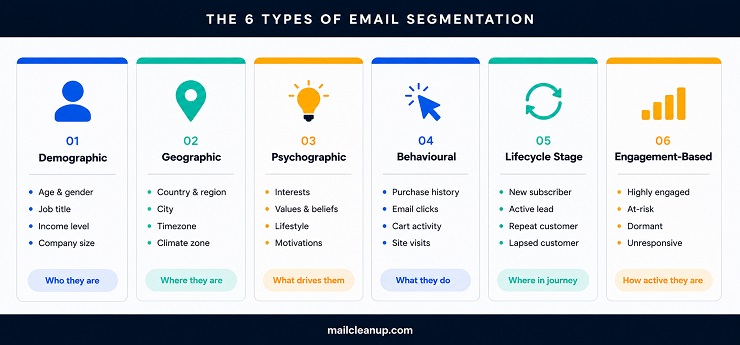
- There are six core types of email segmentation: demographic, geographic, psychographic, behavioural, lifecycle stage, and engagement-based. Each type draws on different data and serves different strategic goals.
- The difference between email segmentation and personalisation is structural: segmentation operates at the group level and organises your programme, while personalisation operates at the individual level and refines your messaging within each segment.
- Effective email segmentation strategy starts with defining the goal first, then selecting the segment criteria that serve that goal, rather than building segments and asking what to do with them afterwards.
- The data that powers your segments comes in four forms: declared, observed, behavioural, and inferred. Each form enables progressively more powerful segmentation.
- Segmentation directly affects deliverability. Sending relevant content to engaged groups produces the positive engagement signals that inbox providers use to determine inbox placement.
- Every segment you build is only as accurate as the list it is built from. Invalid addresses, catch-all domains, and inactive contacts contaminate segment data and undermine the entire strategy.
What Email Segmentation Actually Means
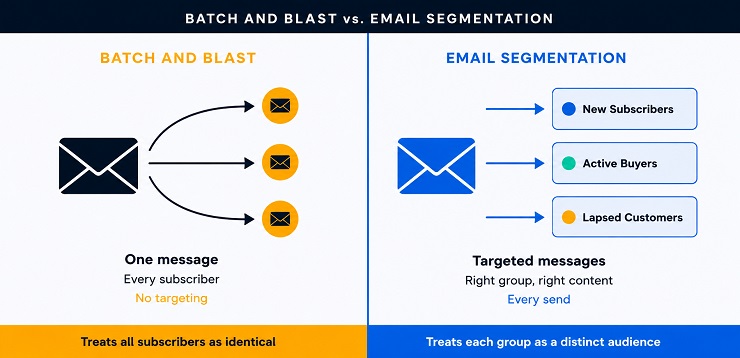
Email segmentation is the practice of dividing an email list into smaller groups, called segments, where each group shares a common characteristic, behaviour, or stage in the customer journey. Instead of sending one campaign to your entire list, you send different campaigns to different groups based on what is most relevant to each of them.
The email segmentation meaning runs deeper than most guides acknowledge. Segmentation is not just about sending different subject lines to different people. It is a structural decision about how your programme is organised. It determines which subscribers receive which messages, at what frequency, and through what sequence. Done well, every person on your list is in a track that reflects their actual relationship with your brand. Done poorly, you have created the appearance of targeting without the substance behind it.
The clearest way to understand email segmentation is to contrast it with what came before it.
| Approach | How it treats subscribers | What it optimises for |
|---|---|---|
| Batch and blast | Every subscriber is interchangeable | Volume and speed |
| Email segmentation | Subscribers are grouped by shared traits | Relevance and engagement |
| Personalisation | Each subscriber is treated individually | Individual-level resonance |
Email marketing segmentation sits at the boundary between two related but separate practices. Segmentation organises your audience into groups. Email personalisation customises the message for individuals within those groups. The two work together, but they are not the same thing. Confusing them leads to programmes that personalise the subject line while ignoring the fact that the underlying audience grouping is wrong. That distinction is covered fully in its own section below.
Why Email Segmentation Matters: What the Data Shows
The email segmentation statistics on this topic are among the most consistent in all of email marketing research. The numbers point in one direction regardless of the source, and the performance gap between segmented and non-segmented sends is not marginal.
| Metric | Segmented Campaigns | Non-Segmented Campaigns |
|---|---|---|
| Revenue impact | Up to 760% increase | Baseline |
| Click-through rate | 100.95% higher | Baseline |
| Open rate | 14.31% higher | Baseline |
| Unsubscribe rate | 9.37% lower | Baseline |
| Marketers reporting improvement | 90% | N/A |
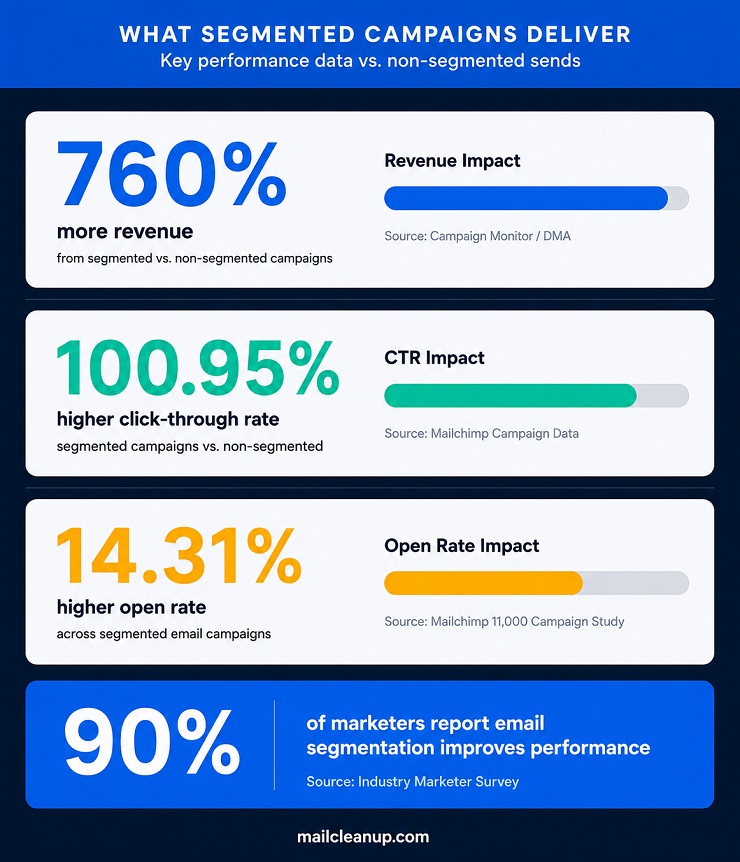
The 760% revenue figure comes from Campaign Monitor research and has been corroborated by the DMA, which found that 25% of total email revenue is attributed to segmented lists, with targeted sends to those segments accounting for 30% of revenue.
The click-through and open rate data comes from Mailchimp’s own analysis of 11,000 segmented campaigns sent to nearly nine million recipients, comparing segmented and non-segmented sends from the same senders. This is not a survey of what marketers believe. It is a measurement of what actually happened.
What these numbers mean in practice: A 100.95% higher click-through rate does not mean you will double your revenue overnight. It means that when you send to a group for whom the content is relevant, approximately twice as many people take action compared to an unsegmented send. Compounded across a full year of campaigns, the revenue differential becomes significant.
The email segmentation statistics are not contested. Ninety percent of marketers report that email segmentation improves email performance. The debate is not whether it works. The debate is how to do it well, which is what the rest of this guide addresses.
The 6 Types of Email Segmentation
Email segmentation draws on different data sources and serves different strategic purposes depending on which type you use. The four types most commonly referenced are demographic, geographic, psychographic, and behavioural. Two further types, lifecycle stage and engagement-based segmentation, are increasingly standard in any programme sending at scale.
Here is how all six types work, what data each requires, and where each fits in an email segmentation strategy.
1. Demographic Segmentation
Demographic segmentation divides your list based on personal characteristics. It is the baseline layer of most programmes and the easiest to implement because much of this data can be gathered at the point of signup.
Common demographic criteria:
- Age and gender
- Job title and seniority level
- Company size and industry (B2B)
- Income level or household income
- Education level
Where it works well: An ecommerce brand selling across age groups sends different product selections to different age segments. A B2B software company sends different messaging to individual contributors than to senior decision-makers. A financial services firm tailors offers based on income band or life stage.
Its limitation: Shared traits do not always mean shared intent. Two people of the same age and job title can have completely different relationships with your brand. Demographic data tells you who someone is. It does not tell you what they are about to do. This is why demographic segmentation works best as a foundation layer, combined with behavioural or engagement data to add intent signals to the profile.
2. Geographic Segmentation
Geographic segmentation groups subscribers by location. It is one of the most straightforward types of email segmentation and immediately useful for any programme operating across multiple markets or time zones.
Common geographic criteria:
- Country and region
- City or local area
- Timezone
- Climate zone or season
Where it works well: A retailer with physical locations sends store-specific promotions to subscribers in those cities. A brand operating across hemispheres aligns seasonal campaigns to actual local weather rather than calendar dates. A global sender uses geographic segmentation simply to deliver emails at the right local time, which improves open rates without changing a word of the content.
Geographic data is often collected passively through IP address at signup, shipping address from a purchase, or timezone inferred from email open behaviour. It requires minimal friction from the subscriber and produces clean, stable segment data.
3. Psychographic Segmentation
Psychographic segmentation groups subscribers based on attitudes, interests, values, and lifestyle. It goes beyond who someone is demographically to address what motivates them and how they make decisions.
Common psychographic criteria:
- Interests and hobbies
- Values and beliefs
- Lifestyle and personality type
- Purchase motivations
Where it works well: A travel brand that segments by traveller type, adventure seeker versus luxury traveller versus family planner, can send fundamentally different content to each group without changing the product. A fitness brand that knows whether a subscriber is motivated by performance, weight loss, or community can build entirely different messaging tracks for each group.
How to collect it: Psychographic data rarely arrives passively. It typically comes from:
- Signup surveys asking about goals or preferences
- Quiz funnels that self-segment subscribers as they complete them
- Preference centres where subscribers indicate their interests
- Behavioural inference over time, drawing conclusions from content interaction patterns
This is the area where progressive profiling delivers the biggest return. Collecting one additional data point per email interaction, rather than asking for everything at signup, builds rich psychographic profiles without the friction that kills signup conversion rates.
4. Behavioural Segmentation
Behavioural segmentation divides your list based on what subscribers actually do. This is the highest-intent type of email segmentation because behaviour reflects real decisions, not assumed characteristics.
Common behavioural criteria:
- Purchase history and frequency
- Pages visited and time on site
- Email opens and link clicks
- Cart abandonment
- Feature usage (SaaS)
- Time since last purchase or engagement
Where it works well: A subscriber who has visited your pricing page three times in a week is signalling decision-stage intent. A customer who has purchased four times in six months is a very different audience from one who purchased once eighteen months ago and has not returned. Behavioural data captures these differences and allows you to act on them in real time.
Concrete email segmentation examples using behavioural data:
- Cart abandonment sequences target subscribers who added items but did not complete a purchase
- Win-back campaigns target subscribers whose engagement has dropped below a defined threshold
- VIP sequences target subscribers whose purchase history places them in your highest-value group
- Renewal reminder sequences target SaaS subscribers approaching the end of their contract period
Behavioural segmentation requires tracking infrastructure. Your email platform needs to record engagement events, and your ecommerce or CRM system needs to feed purchase and activity data back to the platform. The technical setup is more involved than collecting a name and email at signup, but the segment accuracy it produces is substantially higher than any static data type.
5. Lifecycle Stage Segmentation
Lifecycle stage segmentation groups subscribers by where they are in their relationship with your brand. Each stage represents a distinct set of needs and a distinct appropriate message.
| Lifecycle Stage | Who They Are | What They Need |
|---|---|---|
| New subscriber | Just joined the list | Onboarding, trust-building content |
| Active lead | Evaluating your product | Social proof, comparison content |
| First-time customer | Completed one purchase | Post-purchase reassurance, usage guidance |
| Repeat customer | Multiple purchases | Loyalty recognition, early access |
| Lapsed customer | Previously active, now quiet | Re-engagement prompt, win-back offer |
| Churned subscriber | No engagement for extended period | Sunset sequence or removal |
Lifecycle stage segmentation is what separates programmes that treat every subscriber identically regardless of history from programmes that adapt the message to the relationship. Once lifecycle stage segments are defined, automated sequences can be built for each stage that run without manual intervention, moving subscribers through the appropriate track based on their actions.
6. Engagement-Based Segmentation
Engagement-based segmentation divides your list by how actively subscribers are interacting with your emails. This type is directly tied to deliverability and is one of the most important for protecting sender reputation at scale.
Inbox providers including Gmail, Outlook, and Yahoo use engagement signals as a primary factor in filtering decisions. A domain that consistently sends to disengaged subscribers accumulates negative signals: low open rates, high delete-without-reading rates, and spam complaints. Those signals degrade inbox placement across the entire list, including for your most engaged subscribers.
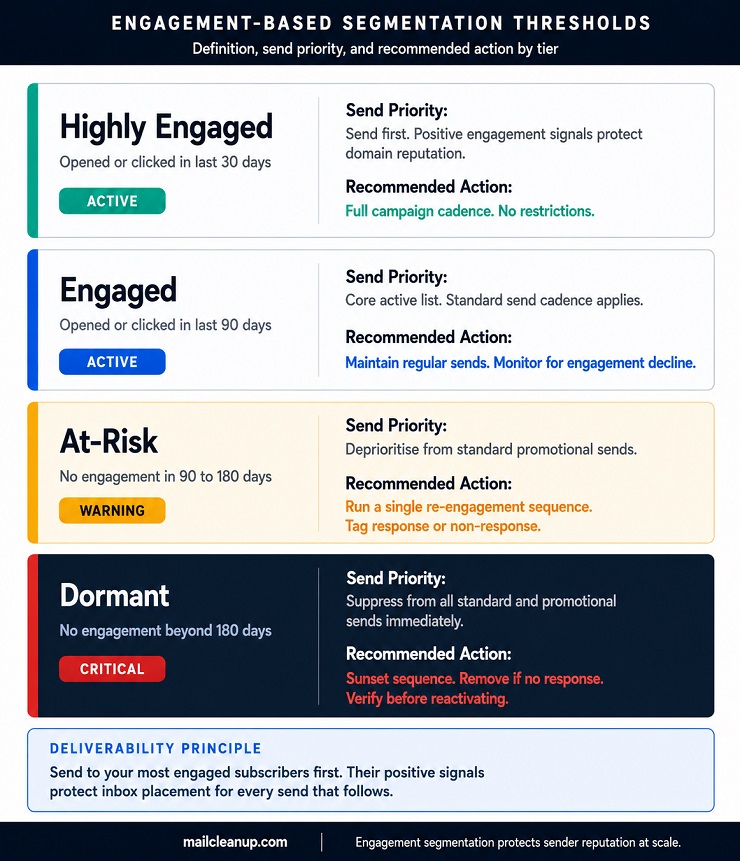
Standard engagement segmentation thresholds:
| Segment | Definition | Recommended Action |
|---|---|---|
| Highly engaged | Opened or clicked in last 30 days | Priority send group. Send first to establish positive signals |
| Engaged | Opened or clicked in last 90 days | Core active list. Standard send cadence |
| At-risk | No engagement in 90 to 180 days | Re-engagement sequence. One targeted campaign |
| Dormant | No engagement beyond 180 days | Sunset sequence. Remove if no response |
Why this matters for deliverability: Sending to your most engaged group first establishes strong positive signals before you send to less active segments. This is not just good practice for performance. It is a practical strategy for protecting inbox placement across your entire programme.
The thresholds above are starting points, not fixed rules. High-frequency senders may tighten these windows. Low-frequency senders may loosen them. The logic remains consistent regardless: send to your most engaged subscribers first, and manage the rest deliberately rather than ignoring them.
The Difference Between Email Segmentation and Personalisation
Email segmentation and personalisation are used interchangeably in most marketing conversations. They are not the same thing, and treating them as synonyms leads to programmes that invest in the wrong layer at the wrong time.
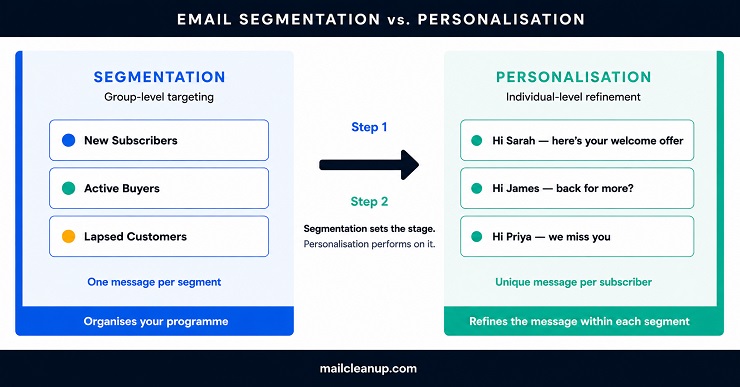
The clearest way to separate them is this:
Segmentation is a marketer-first strategy. It organises your audience into groups that make your programme manageable and your campaigns more relevant at the group level. You are making a structural decision about who receives what.
Personalisation is a subscriber-first strategy. It customises the content within a campaign for the individual receiving it, based on data specific to that person. You are making a content decision about how the message feels to the person reading it.
| Dimension | Email Segmentation | Personalisation |
|---|---|---|
| Operates at | Group level | Individual level |
| Primary beneficiary | The marketer (programme structure) | The subscriber (message relevance) |
| Data used | Shared characteristics of a group | Individual-specific data points |
| Example | Sending a re-engagement campaign to dormant subscribers | Addressing the subscriber by name and referencing their last purchase |
| Dependency | Can work without personalisation | Works best when built on top of segmentation |
The correct order of operations matters here. Segmentation comes first because it determines who receives the message. Personalisation comes second because it refines how that message is expressed for each individual within the segment.
A common mistake is to invest heavily in personalisation without first getting segmentation right. The result is a highly personalised message delivered to the wrong group. A subscriber who churned six months ago receiving a personalised upsell email with their name in the subject line is still receiving the wrong email. The personalisation layer cannot compensate for a broken segmentation layer underneath it.
The practical distinction to remember: Segmentation sets the stage. Personalisation performs on it. Both matter. The sequence matters more.
The Email Segmentation Data Ladder
The data that powers your segments does not all arrive at once, and it does not all carry equal weight. Understanding where your segment data comes from, and what each type of data enables, is what separates programmes that segment accurately from those that segment optimistically.
The Email Segmentation Data Ladder organises segment data into four rungs, each representing a progressively richer data type and the segment sophistication it unlocks.
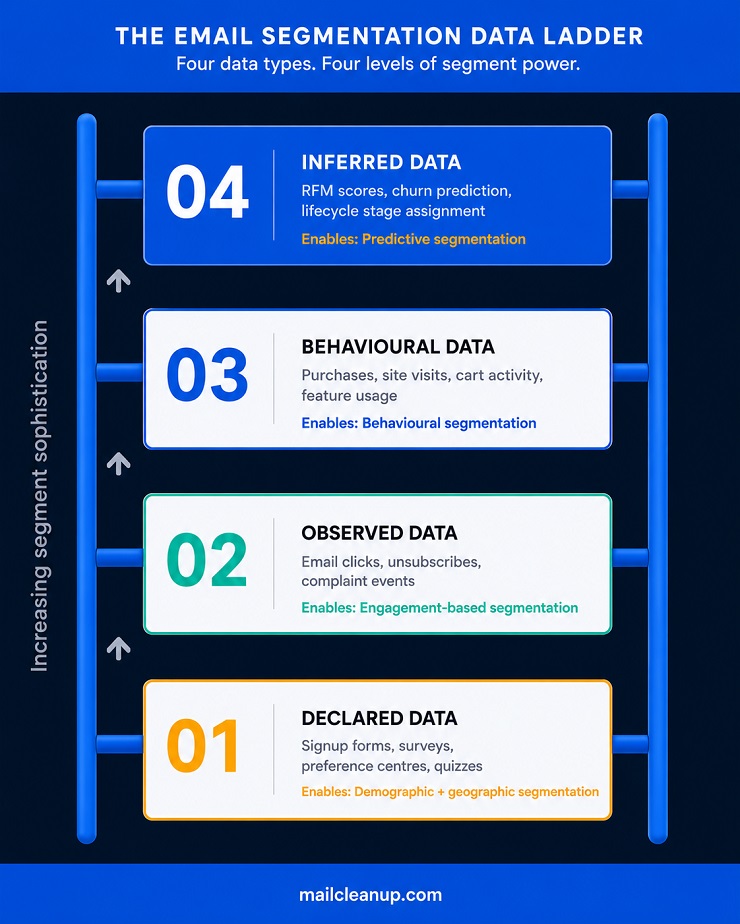
Rung 1: Declared Data
Declared data is information your subscribers give you directly and deliberately. It is the most transparent form of segment data because the subscriber knows they are providing it and has chosen to do so.
Sources of declared data:
- Signup forms asking for name, location, company size, or role
- Preference centres where subscribers indicate content interests or send frequency
- Onboarding surveys collecting goals, challenges, or use case
- Quiz funnels where subscribers self-select into categories based on their answers
What it enables: Demographic segmentation, geographic segmentation, and basic psychographic segmentation. A subscriber who tells you at signup that they manage a team of over 50 people in the financial services industry has declared enough for you to build a meaningful first segment immediately.
Its limitation: People do not always complete long forms, and the data they provide is static. A job title declared eighteen months ago may no longer be accurate. Declared data is the starting point, not the full picture.
Rung 2: Observed Data
Observed data is collected passively from how subscribers interact with your emails. You do not ask for it. Your email platform records it automatically.
Sources of observed data:
- Email open events (with the MPP caveat noted below)
- Link clicks within emails
- Unsubscribe actions
- Spam complaint events
- Forward and reply behaviour
What it enables: Engagement-based segmentation. Observed email data tells you who is actively reading and clicking, who has gone quiet, and who has never engaged since they joined the list. This is the data that powers your engaged, at-risk, and dormant segments.
The MPP caveat: Apple Mail Privacy Protection, introduced in 2021 and now covering approximately 58% of email opens globally based on Litmus data, pre-fetches email content and registers an open event even when the subscriber has not actually opened the email. This means email open data is no longer a reliable standalone signal for engagement segmentation. Click data, reply data, and purchase behaviour are the more reliable observed signals for determining genuine engagement.
Rung 3: Behavioural Data
Behavioural data comes from what subscribers do outside your emails: on your website, in your app, in your store, or with your product. It requires integration between your email platform and your wider data infrastructure.
Sources of behavioural data:
- Website page visits and time on page
- Product or pricing page views
- Purchase history, order value, and purchase frequency
- Cart additions and abandonments
- Feature usage patterns (SaaS)
- Loyalty programme activity
- Customer service interactions
What it enables: Behavioural segmentation and RFM-based segmentation (Recency, Frequency, Monetary value). Behavioural data is the highest-intent signal available because it reflects real decisions made outside the inbox. A subscriber who has visited your pricing page, downloaded your comparison guide, and started a free trial in the same week is telling you something no demographic data point could capture.
What it requires: Tracking pixels, CRM integration, and data sync between your ecommerce or product platform and your email tool. The infrastructure investment is higher than for declared or observed data, but the segment accuracy it produces is substantially greater.
Rung 4: Inferred Data
Inferred data is derived rather than directly collected. It is produced by combining the three data types above and drawing conclusions about subscriber behaviour, intent, or value that are not explicitly stated anywhere in the raw data.
Sources of inferred data:
- RFM scores: combining recency of last purchase, frequency of purchases, and monetary value to rank subscriber value
- Predictive churn scores: calculated from engagement decline patterns to identify subscribers likely to lapse before they do
- Lifecycle stage assignments: inferred from the combination of signup date, purchase history, and engagement patterns
- Lead scoring: combining demographic fit and behavioural signals to rank intent
What it enables: Predictive segmentation and advanced lifecycle automation. Inferred data allows you to act before a subscriber takes the next step. A high churn-risk score means you can trigger a retention sequence before the subscriber cancels, not after.
The Data Ladder in practice: Most programmes start at Rung 1 with declared data from signup forms, move to Rung 2 as observed email engagement accumulates, build toward Rung 3 as integrations are connected, and reach Rung 4 as data volume grows large enough to support reliable scoring models. You do not need all four rungs to start segmenting effectively. You need the rung you are currently on to be accurate, which brings the list quality question directly into the strategy.
Email Segmentation Strategy: How to Build Segments That Work
Knowing the six types of email segmentation and understanding where your data comes from is the foundation. Building a strategy that actually holds up in practice requires a specific sequence of decisions, and most programmes get the sequence wrong.
The most common mistake is building segments first and then asking what to do with them. The correct sequence is the reverse.
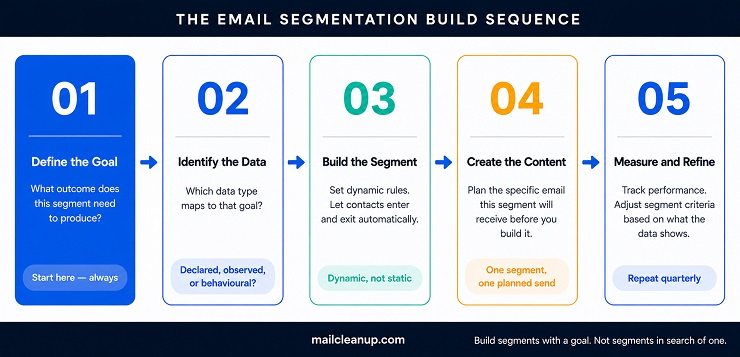
The sequence that works:
- Define the goal the segment needs to serve
- Identify the data that maps to that goal
- Build the segment using that data
- Create the content or sequence for that specific segment
- Measure performance and refine the segment criteria
This sequence matters because every segment you create is a content commitment. A segment without a planned send is overhead without a return. Before you build a segment, you should be able to answer: what specific email will this group receive, and why is this group the right audience for it?
Start with Three to Five Segments, Not Twenty
Over-segmentation is a genuine risk, particularly for lists under 20,000 subscribers. Building twenty micro-segments before you have the list volume or content capacity to support them creates unmeasurable sends and unsustainable workload.
Minimum viable segment sizes to consider:
| List Size | Recommended Starting Segments | Minimum Segment Size |
|---|---|---|
| Under 5,000 subscribers | 2 to 3 segments | 200 to 500 contacts |
| 5,000 to 20,000 subscribers | 3 to 5 segments | 500 to 1,000 contacts |
| 20,000 to 100,000 subscribers | 5 to 10 segments | 1,000 to 2,000 contacts |
| Above 100,000 subscribers | 10 or more segments | 2,000 or more contacts |
Start with your highest-impact segments first. For most programmes, these are: your most engaged subscribers, your lapsed customers, and your new subscribers in the first 30 days. These three segments alone, each receiving a different message, will produce a measurable performance improvement over a single unsegmented send.
Use Dynamic Segments, Not Static Lists
A static segment is a fixed list of contacts captured at a single point in time. A dynamic segment is defined by rules, and contacts enter and exit automatically as their data changes.
Why this distinction matters:
- A static “new subscribers” list built in January still contains those same contacts in July, by which point many of them are no longer new
- A dynamic “new subscribers” segment defined as “subscribed in the last 30 days” always contains the right people regardless of when you look at it
- Static lists require manual maintenance. Dynamic segments maintain themselves
Every major email platform supports dynamic rule-based segments. The setup takes longer than importing a static list, but the accuracy over time is incomparably better. A segment that auto-updates as subscriber data changes is a segment that does not silently decay into irrelevance.
Review and Refresh Segments Regularly
Segment data decays. Email lists lose approximately 22.5% of their valid contacts per year through address changes, job moves, and domain closures. A segment built on accurate data in January may contain a meaningful proportion of inaccurate data by September.
Recommended review cadence:
- Engaged and at-risk segments: review monthly, as engagement status changes quickly
- Demographic and geographic segments: review quarterly, as these change more slowly
- Lifecycle stage segments: review quarterly, ensuring contacts have moved to the correct stage
- All segments: full audit twice per year to remove contacts whose data no longer matches the segment criteria
Email Segmentation Examples Across B2B and B2C
Email segmentation strategy looks different depending on whether you are selling to businesses or consumers. The underlying logic is the same: send the right message to the right group at the right time. The data sources, segment types, and content formats differ significantly between the two contexts.
B2C Email Segmentation Examples
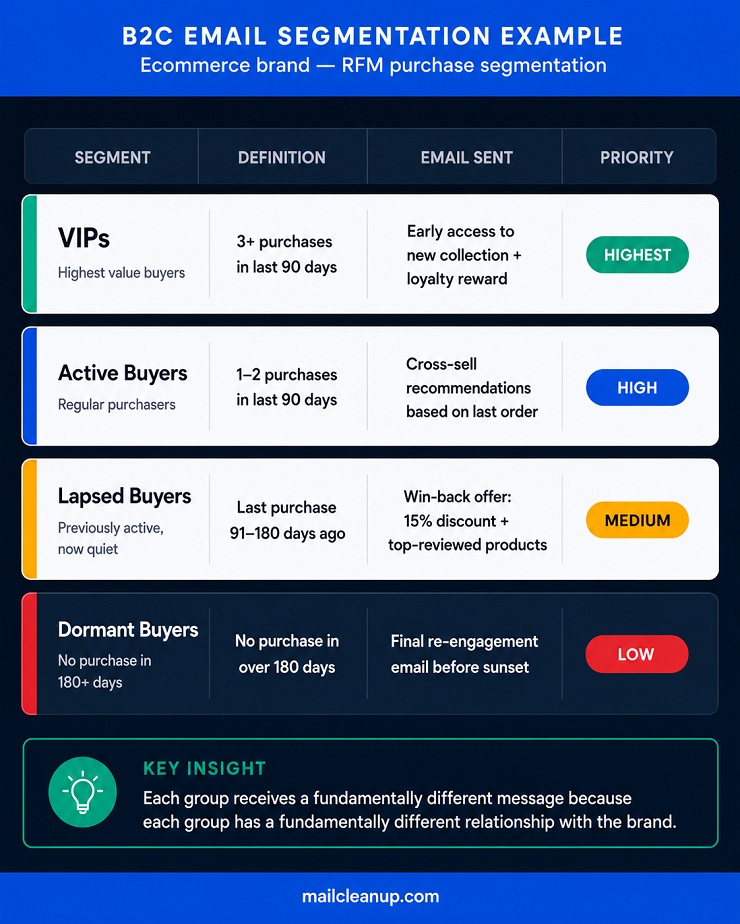
Example 1: Ecommerce brand using purchase history and RFM segmentation
A mid-size ecommerce retailer with 45,000 subscribers segments their list into four groups based on purchase recency and frequency:
| Segment | Definition | Email Sent |
|---|---|---|
| VIPs | 3 or more purchases in last 90 days | Early access to new collection, loyalty reward |
| Active buyers | 1 to 2 purchases in last 90 days | Cross-sell recommendations based on last order |
| Lapsed buyers | Last purchase 91 to 180 days ago | Win-back offer: 15% discount with top-reviewed products |
| Dormant buyers | No purchase in over 180 days | Final re-engagement email before sunset |
The VIP segment receives early access content that non-VIPs do not see. The lapsed segment receives a win-back offer paired with social proof. Each group receives a fundamentally different message because each group has a fundamentally different relationship with the brand.
Example 2: Fitness brand using psychographic and lifecycle segmentation
A fitness subscription brand collects goal data at signup through a three-question onboarding survey. Subscribers self-select into one of three motivation segments: performance improvement, weight management, or general wellbeing. Each segment receives a different welcome sequence, different content types in their regular sends, and different upgrade messaging when the time comes.
New subscribers in the performance segment receive training-focused content and benchmark-based progress frameworks. New subscribers in the wellbeing segment receive habit-building content and lower-intensity guidance. The product is the same. The message is built around what each group has told you they care about.
B2B Email Segmentation Examples
Example 1: SaaS company using firmographic and behavioural segmentation
A B2B SaaS company with a freemium model segments trial users into three groups based on feature usage during the trial period:
| Segment | Definition | Email Sent |
|---|---|---|
| Power users | Used 5 or more features in trial | Upgrade prompt with advanced feature highlight |
| Moderate users | Used 2 to 4 features | Educational sequence showing unused features |
| Low engagement | Used 1 feature or fewer | Re-engagement with use case content and onboarding offer |
Power users already understand the product value. The upgrade email focuses on what they gain by removing trial limits. Low-engagement users may not have reached the moment of value yet. Their sequence focuses on showing them how to get there, not on converting them before they are ready.
Example 2: B2B services company using job title and lifecycle segmentation
A marketing services agency segments their prospect list by seniority level and stage in the sales funnel. Senior decision-makers, CMOs and heads of marketing, receive content focused on commercial outcomes, ROI frameworks, and executive-level case studies. Mid-level practitioners receive content focused on tactical execution, platform comparisons, and implementation guides.
The same agency also segments by sales funnel stage. Prospects who have attended a webinar but not booked a call receive a follow-up sequence that addresses the specific topic covered in the webinar. Prospects who have booked a call but not yet converted receive a sequence focused on social proof and objection handling. Each stage gets a different message built around where they are in the decision process.
How Email Segmentation Affects Deliverability
Most guides treat email segmentation purely as a messaging strategy. The deliverability dimension is either absent or mentioned as a footnote. This is a significant omission, because the connection between segmentation and inbox placement is direct, measurable, and operates through a mechanism that every bulk sender needs to understand.
Inbox providers including Gmail, Outlook, and Yahoo do not make binary decisions about whether your emails are spam. They make probabilistic judgments about whether your emails are wanted by the specific people receiving them. The primary signal they use to make that judgment is engagement: do recipients open, click, and reply to your emails, or do they delete, ignore, and mark them as spam?
The engagement signal loop works like this:
- You send to a well-segmented, engaged group
- Recipients open, click, and engage because the content is relevant to them
- Inbox providers register those positive engagement signals
- Your sender reputation improves, and future sends from your domain receive better inbox placement
- Better inbox placement means more recipients see your emails, which produces more engagement
The reverse loop is equally consistent. Sending irrelevant content to disengaged subscribers produces low open rates, high delete-without-reading rates, and spam complaints. Each of those signals tells inbox providers that your emails are not wanted. Enough negative signals and your domain reputation degrades, affecting inbox placement for your entire list including your most engaged subscribers.
Segmentation breaks the negative loop by ensuring that each send goes to a group for whom the content is genuinely relevant. The result is not just better campaign performance. It is a structurally stronger sender reputation over time.
Segmentation and Spam Complaint Rate
Spam complaints are the most damaging individual signal in the engagement loop. Google Postmaster Tools flags domains whose complaint rate exceeds 0.10%, and a sustained rate above 0.30% will result in deliverability consequences across Gmail inboxes, which represent a substantial share of most consumer lists.
The connection to segmentation is direct. Subscribers who receive emails that feel irrelevant or intrusive are significantly more likely to hit the spam button than to unsubscribe. Unsubscribing requires finding the link and clicking it. Marking as spam requires one tap. When your segmentation is poor and your content is landing with the wrong group, the path of least resistance for the recipient is the complaint button.
Segmentation practices that reduce spam complaint rate:
- Sending re-engagement content to lapsed subscribers rather than standard promotional emails
- Suppressing dormant subscribers from promotional sends entirely
- Matching send frequency to the engagement level of each segment
- Ensuring new subscribers receive onboarding content before commercial offers
Segmentation and Bounce Rate
Bounce rate is a direct signal of list quality, but segmentation interacts with it in a way that is often overlooked. Engagement-based segmentation naturally reduces bounce exposure because dormant segments, which contain a disproportionate share of decayed and invalid addresses, are excluded from or treated separately in standard sends.
An address that has not engaged in 180 days is far more likely to have become invalid, changed domains, or been abandoned than one that clicked last week. By building engagement-based segments and deprioritising dormant contacts, you are also, incidentally, reducing the proportion of invalid addresses in your active send pool.
This is not a substitute for list verification. It is a complementary mechanism. Segmentation reduces bounce exposure by narrowing the active send pool. Verification removes invalid addresses from the list entirely. Both are necessary. Neither replaces the other.
Why Your Segments Are Only as Good as Your List
This is the section that most email segmentation guides skip entirely, and it is the most important one for anyone sending at scale.
Every segment you build is constructed from the data in your list. If that underlying list contains invalid addresses, catch-all domains, disposable emails, inactive mailboxes, and risky contacts, then every segment built from it is contaminated. The contamination is invisible at the segment level. Your behavioural segment labelled “highly engaged, clicked in last 30 days” looks clean. But if the list it was built from contains addresses that have been silently bouncing, addresses registered to domains that accept everything regardless of whether the mailbox exists, and addresses that belong to people who signed up once and have never returned, then your “highly engaged” segment is not as clean as its label suggests.
The problem compounds across every segment type.
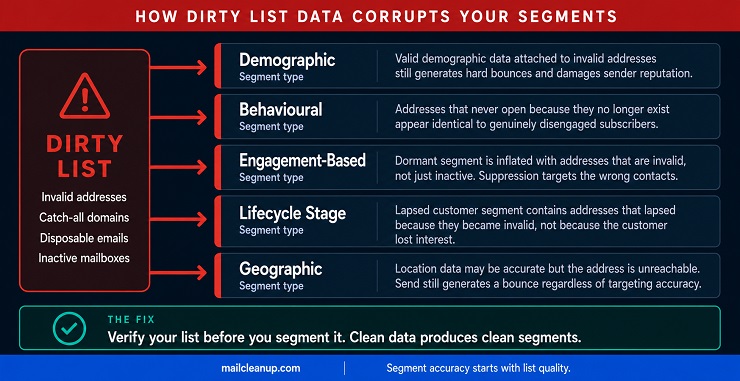
| Segment Type | How Dirty List Data Corrupts It |
|---|---|
| Demographic | Accurate demographic data attached to invalid addresses still produces bounces and damages sender reputation |
| Behavioural | Addresses that never open because they no longer exist appear identical to genuinely disengaged subscribers |
| Engagement-based | Dormant segment is inflated with addresses that are invalid, not just inactive |
| Lifecycle stage | Lapsed customer segment contains addresses that lapsed because they became invalid, not because the customer lost interest |
| Geographic | Location data may be accurate but the address is unreachable |
The practical consequence: You build a win-back campaign for your lapsed customer segment. A portion of that segment consists of addresses that have been invalid for months. Those sends produce hard bounces. Hard bounces damage your sender reputation. Your carefully constructed re-engagement campaign is actively harming your deliverability while it runs.
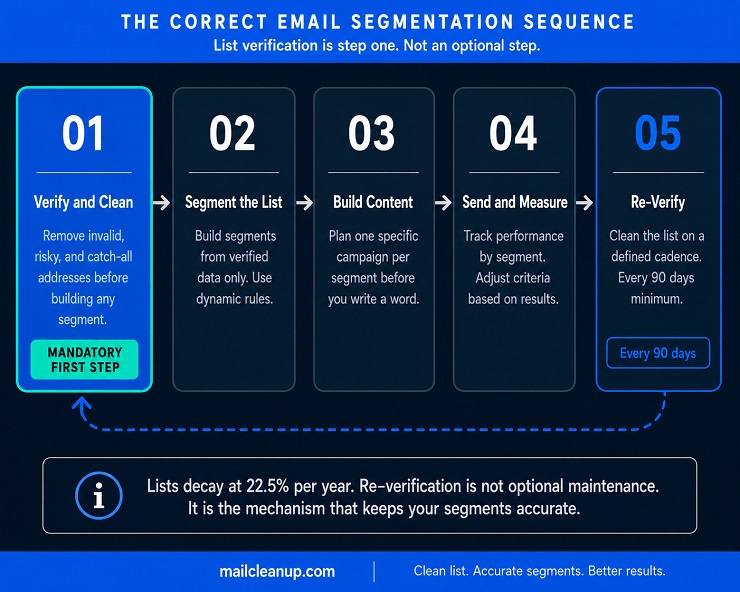
The Prerequisite Nobody States
The logical sequence for a programme that segments effectively is:
- Verify and clean the list
- Segment the verified list
- Build content for each segment
- Send and measure
- Re-verify at a defined cadence to maintain list accuracy
Step one is consistently skipped or deprioritised. The argument is usually that segmentation is the priority and list cleaning can happen later. The problem with that argument is that later never arrives before the first batch of contaminated sends has already done its damage.
Email lists decay at approximately 22.5% per year. A list of 50,000 subscribers that has not been verified in twelve months contains roughly 11,000 contacts whose validity is uncertain. Building segments on that data produces segments with uncertain accuracy. Sending to those segments produces uncertain deliverability outcomes.
What verification does for segmentation specifically:
- Removes hard bounce addresses before they generate reputation damage
- Identifies catch-all domains so you can treat them as a separate, lower-priority segment
- Flags disposable and risky addresses so they can be excluded from engagement-based segments
- Ensures that your dormant segment contains genuinely inactive subscribers, not a mix of inactive and invalid addresses
Clean your list before you segment it. The email list hygiene practices that keep your list accurate over time are the same practices that keep your segments accurate. How to clean your email list covers the full verification and cleaning process for every address type your list is likely to contain. For programmes managing large volumes, email list scrubbing at the engagement layer adds a second level of accuracy by removing contacts who are valid but no longer active.
If you are evaluating tools to do this at scale, the best email list cleaning service guide covers the options matched to list size, budget, and use case. The connection between list quality and segment accuracy is not a technical footnote. It is the foundation the entire strategy sits on. Every decision you make about segmentation type, data collection, and send cadence depends on the list beneath it being worth building on.
Your Segments Are Built on Your List. Make Sure the List Is Worth Building On.
Email segmentation is one of the highest-leverage practices in email marketing. The data makes that clear. The 760% revenue differential between segmented and non-segmented sends is not an outlier finding from a single study. It is a consistent result across multiple independent datasets, and it reflects a straightforward reality: people respond to emails that are relevant to them and ignore emails that are not.
The six types of segmentation covered in this guide give you the full structural picture. Demographic and geographic segmentation give you the baseline. Psychographic and behavioural segmentation add intent and motivation. Lifecycle stage and engagement-based segmentation tie the programme to where each subscriber actually is in their relationship with your brand. The Email Segmentation Data Ladder gives you the framework for collecting the data that makes all of it possible, from the declared data on your signup form to the inferred scoring models that predict what a subscriber will do next.
But none of it works on a list that has not been maintained. Segments built on decayed, unverified list data produce contaminated groups, inflated dormant segments, and sends that generate hard bounces and spam complaints regardless of how well the segment logic was designed. The strategy is sound. The foundation has to match it.
Verify your list before you segment it. Clean it on a defined cadence so the data your segments are built on stays accurate as your programme grows. The email marketing guide covers the broader programme context that segmentation sits within. The email marketing KPIs guide covers how to measure whether your segmentation is producing the outcomes it should. Your segments are only as reliable as the list behind them. Start there.
FAQs on Email Segmentation
What is email segmentation and why is it important?
Email segmentation is the practice of dividing your email list into smaller groups based on shared characteristics, behaviours, or lifecycle stage, so each group receives content relevant to them. It matters because segmented campaigns generate significantly higher engagement and revenue than non-segmented sends, while also protecting sender reputation and reducing unsubscribe rates.
What is the difference between email segmentation and personalisation?
Email segmentation operates at the group level, organising subscribers into distinct audiences based on shared traits or behaviours. Personalisation operates at the individual level, customising the message for each specific subscriber within a segment. Segmentation comes first and sets the audience structure. Personalisation refines how the message is expressed within that structure.
How many segments should I have in my email list?
Start with three to five segments based on the highest-impact criteria for your programme, typically engagement level, lifecycle stage, and one demographic or behavioural variable. Avoid building more segments than you have content to support. For lists under 5,000 subscribers, two to three segments is sufficient. Scale segment complexity as your list and content capacity grow.
What are the six types of email segmentation?
The six types are demographic (who subscribers are), geographic (where they are), psychographic (what motivates them), behavioural (what they do), lifecycle stage (where they are in their relationship with your brand), and engagement-based (how actively they interact with your emails). Each type draws on different data and serves different strategic goals within an email segmentation strategy.
How do I collect data for email segmentation?
Data for email segmentation comes from four sources: declared data from signup forms and preference centres, observed data from email engagement events such as clicks and unsubscribes, behavioural data from website activity and purchase history, and inferred data derived from scoring models built on the first three. Start with declared and observed data, then build toward behavioural and inferred as your infrastructure matures.
Does email segmentation improve deliverability?
Yes, directly. Sending relevant content to well-matched segments produces higher engagement rates, which inbox providers use as a primary signal for filtering decisions. Higher engagement strengthens sender reputation and improves inbox placement over time. Segmentation also reduces spam complaints by ensuring subscribers receive content that is relevant to them, rather than generic sends that prompt complaint behaviour.
What is behavioural segmentation in email marketing?
Behavioural segmentation divides your list based on what subscribers actually do: purchases made, pages visited, emails clicked, cart items abandoned, features used, or time elapsed since last action. It is the highest-intent type of email segmentation because it draws on observed decisions rather than assumed characteristics. Common behavioural email segmentation examples include cart abandonment sequences, VIP programmes based on purchase frequency, and win-back campaigns triggered by engagement drop-off.
Can you do email segmentation without a CRM?
Yes, though with limitations. Most email marketing platforms include basic segmentation tools that allow you to segment by signup source, engagement data, and custom fields collected at signup, without requiring a separate CRM. Where a CRM becomes necessary is for behavioural and purchase-based segmentation, which requires data from outside the email platform to be fed back in. For programmes in early stages, starting with the segmentation your email platform natively supports is a practical first step.