
You’re looking at MyEmailVerifier alternatives for a reason. Maybe the pricing page didn’t add up the way you expected. Maybe a batch of “verified” emails still bounced anyway. Maybe you just want to know if “cheapest” is actually true, or just what the homepage says.
Most “alternatives” posts don’t answer that. They restate a marketing page in a different order and call it a comparison. We did something different. We fetched MyEmailVerifier’s own pricing calculator directly, not a summary of it. We read its FAQ, its terms of use, and its actual homepage copy line by line. We cross-checked what it markets against what independent testers and real reviewers on G2, Capterra, and Trustpilot actually found.
That work turned up real inconsistencies:
- A pricing page that quotes four different rates across four different pages
- A speed claim that contradicts itself on the same page
- A catch-all feature that used to be free and now costs extra
None of it is hidden exactly. It’s just easy to miss until you’re already a paying customer. This guide covers eight MyEmailVerifier alternatives, tested against all of that. We’ll show you where MyEmailVerifier alternatives genuinely win. That includes price, depth, and what happens when a result isn’t a clean valid or invalid. We’ll also show you where they don’t. Not every tool here beats MyEmailVerifier at everything. You deserve the honest version, not the sales pitch.
TL;DR on MyEmailVerifier Alternatives
- MailCleanup ties or beats MyEmailVerifier’s own discounted sale price at three of the four standard volume checkpoints.
- MyEmailVerifier’s own site states four different per-email prices across four different pages; MailCleanup lists one straightforward rate everywhere you look.
- MyEmailVerifier’s base bulk verification returns only four result categories, while Email List Verify tracks 18 distinct status codes for the same job.
- Individual catch-all resolution on MyEmailVerifier is a separate paid product; Bouncer and ZeroBounce build equivalent resolution into their core verification at no extra cost.
- MyEmailVerifier’s own homepage states two different verification speeds for the same claim, nearly a 33-fold gap between them.
- MyEmailVerifier’s native integrations top out around 20 apps; Emailable connects to more than 50, and ZeroBounce to more than 60.
- MyEmailVerifier does not charge for unknown or duplicate results, a genuine strength confirmed directly from its own FAQ.
- Eight MyEmailVerifier alternatives are compared here on real pricing, verification depth, catch-all handling, and integration reach.
Quick Comparison: 8 MyEmailVerifier Alternatives at a Glance
Before the checkpoint-by-checkpoint breakdown, here’s the short version we pulled together first. The table below lines up all eight MyEmailVerifier alternatives on the numbers that matter most: price at scale, marketed accuracy, catch-all handling, and credit expiry.
| Software | Price (10,000) | Marketed Accuracy | Catch-All Handling | Credit Expiry |
|---|---|---|---|---|
| MailCleanup | $15 | Up to 99% | Flagged, not individually resolved | N/A, no balance |
| MyEmailVerifier | $15 (sale) | 98-99% | Flagged; individual resolution sold separately | Never |
| ZeroBounce | $129 | 99.6% | AI-driven scoring, 0-10 | Never |
| Bouncer | $60 | 99.5% | Toxicity Check, deep resolution | Never |
| Emailable | $60 | 99% | Flags as accept-all | Never |
| Kickbox | $70 | 99.5% | Returns Unknown, refunded | 12 months |
| DeBounce | $25 | 97.5%+ | Identified in pipeline, not individually resolved | Never |
| Email List Verify | $27 | 97-99% | Flagged; Deep Scan add-on for deeper resolution | Never |
| MillionVerifier | $39 | 99%+ | Included at no extra cost | Never |
Two things should jump out at you immediately. MyEmailVerifier’s sale price ties MailCleanup exactly at 10,000 credits, so price alone isn’t the deciding factor at this checkpoint. Credit expiry barely separates this group at all; only Kickbox limits how long credits last. The rest of this guide walks through why the real differences show up anyway, tool by tool and checkpoint by checkpoint.
Why Teams Look for MyEmailVerifier Alternatives (And Where It Still Holds Up)
MyEmailVerifier isn’t a bad tool. Its reviewers back that up. Across G2, Capterra, and Trustpilot, MyEmailVerifier holds ratings between 4.3 and 4.8 out of 5. Most of that praise centers on two things: it’s cheap, and it’s simple to use. Neither claim is wrong on its face.
But simple and cheap aren’t the same as complete. We dug into what MyEmailVerifier actually charges once you strip away its site-wide “sale” pricing. We checked its homepage claims against what it actually delivers. We read through its reviews for the specific complaints, not just the star rating. Three patterns kept showing up:
- Verification results that stay shallow
- Features that used to be free, now gated behind a second charge
- Integrations that stop at the basics
That’s where MyEmailVerifier alternatives come in. Some of the eight tools below cost less at scale. Some resolve catch-all addresses without an upsell. Some connect natively to tools MyEmailVerifier only reaches through Zapier. None of them fit every list perfectly. We’ll say so honestly, even where a MyEmailVerifier alternative doesn’t help. But if any of the three patterns above sound familiar, you’re already a candidate for one.
The MyEmailVerifier Fine Print: Four Reasons Teams Choose MyEmailVerifier Alternatives
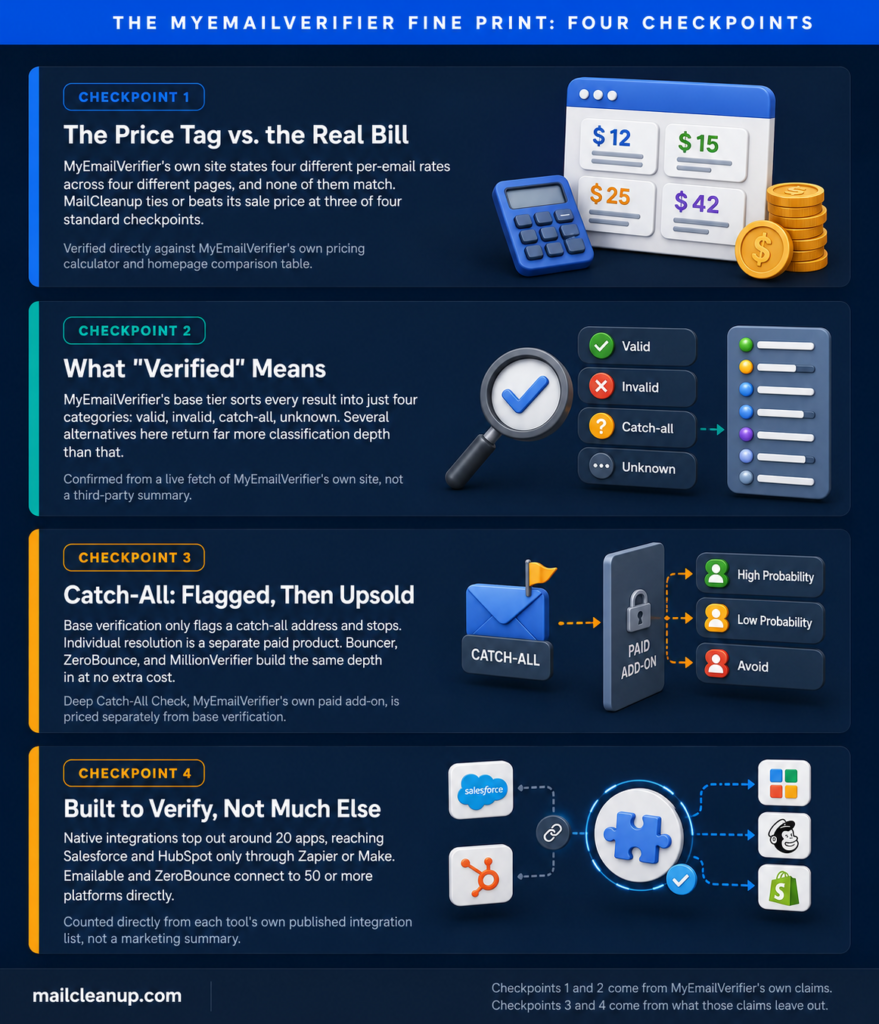
We built this comparison of MyEmailVerifier alternatives around four checkpoints. Each one comes from something MyEmailVerifier’s own site, its own reviews, or its own pricing page told us directly. We call it the MyEmailVerifier Fine Print, because none of these four things are exactly hidden. They’re just easy to miss until you’re already a customer.
The Price Tag vs. the Real Bill: What MyEmailVerifier Alternatives Actually Cost at Scale
MyEmailVerifier calls itself one of the cheapest email verification services around. Its own pricing page runs a permanent-looking “sale,” with every tier crossed out and re-priced lower. At 10,000 credits, the crossed-out price is $42. The price you actually pay is $15.
We ran that $15 figure against MailCleanup’s own pricing at the same volume, side by side. They tie exactly. At 50,000 credits, MailCleanup costs $50. MyEmailVerifier’s sale price is $54. At 100,000 credits, MailCleanup costs $90. MyEmailVerifier’s sale price is $99. MyEmailVerifier only wins outright at the smallest checkpoint, 5,000 credits, where it beats MailCleanup by a single dollar.
Strip away the “sale” and the picture changes further. MyEmailVerifier’s own listed regular price at 100,000 credits is $264, nearly triple MailCleanup’s $90. MyEmailVerifier’s own site doesn’t even agree with itself on the number. Its homepage comparison table states $12 per 10,000 emails. A blog post on the same domain claims $0.0025 per email, which works out to $25 per 10,000. The actual pricing calculator charges $15 at sale price, or $42 at the regular price it discounts from. Four numbers, one company, one product. If you’re choosing MyEmailVerifier alternatives specifically to escape unpredictable pricing, that inconsistency is worth knowing before you buy.
What “Verified” Means: Comparing MyEmailVerifier Alternatives on Result Depth
Run a list through MyEmailVerifier and you get one of four results: valid, invalid, catch-all, or unknown. That’s the whole classification system. We checked each of the eight MyEmailVerifier alternatives on this list. Several return far more detail than MyEmailVerifier does. They flag role-based addresses, disposable domains, and spam traps as their own distinct categories, instead of folding everything into a single bucket.
Depth matters here because “unknown” is doing a lot of work in MyEmailVerifier’s system. We found a Trustpilot reviewer who described uploading 10,000 addresses and getting back 5,000 marked unknown. Running those same unknown addresses through a second tool recovered 3,500 of them as valid. That’s not proof MyEmailVerifier is inaccurate overall. Its own accuracy testing from List Cleaning Advice lines up closely with its marketed claim. Both land around 98 to 99%. We can’t fault MyEmailVerifier there. The real gap isn’t accuracy. It’s resolution, how much MyEmailVerifier actually tells you about the addresses it can’t immediately confirm.
MyEmailVerifier’s own homepage adds a separate wrinkle we noticed while reading it closely. One section states it verifies 1,000 addresses a minute. A different section on the same page claims it can process a million emails in under 30 minutes. That’s a rate roughly 33 times faster than the first claim. Both can’t be true, and you shouldn’t have to guess which one is real.
Catch-All: Flagged, Then Upsold, Unless You Choose a MyEmailVerifier Alternative
Catch-all domains are the hardest problem in email verification. The mail server accepts everything, so a standard check can’t tell which addresses are real. We looked at how each of these MyEmailVerifier alternatives handles that problem, starting with MyEmailVerifier itself. Its base bulk verification handles this the simplest way possible. It labels the address “catch-all” and stops there.
To go further, MyEmailVerifier now sells a separate product called Deep Catch-All Check. We confirmed what it actually does: it scores each catch-all address individually, using its own multi-signal analysis. Results sort into High Probability, Low Probability, or Avoid. It’s a genuinely useful feature, and the pricing is competitive, roughly $0.0075 per email at 10,000-email volume. But it’s a second purchase on top of the first. You verify your list, find your catch-all addresses, then pay again to actually resolve them.
Three of these MyEmailVerifier alternatives take a different approach. Bouncer, ZeroBounce, and MillionVerifier all build deeper catch-all resolution into their core product, instead of selling it separately. Email List Verify takes the same paid-add-on approach as MyEmailVerifier. Its own Deep Scan upgrade costs extra credits too. That means this isn’t a universal advantage across every alternative here. If your list runs heavy on catch-all domains, and corporate B2B lists usually do, that difference will add up fast for you.
Built to Verify, Not Much Else: Where MyEmailVerifier Competitors Go Further
We counted roughly 20 native integrations on MyEmailVerifier: Mailchimp, HubSpot, Sendgrid, ActiveCampaign, Klaviyo, Shopify, and a handful more. Salesforce and Pipedrive aren’t on that list directly. If your team runs on either, reaching them means routing through Zapier or Make, an extra step if you’re not already technical.
We found a narrower library than several MyEmailVerifier competitors offer. Emailable connects to more than 50 platforms natively. ZeroBounce lists more than 60. Neither asks you to add a middleman for the CRMs most sales and marketing teams already run.
MyEmailVerifier also stays narrowly focused on verification itself. It doesn’t test inbox placement, monitor DMARC records, or check blocklist status the way some broader deliverability platforms do. That focus isn’t automatically a flaw. Plenty of teams want a tool that does one job well. But if you need verification to be step one of a bigger deliverability process, MyEmailVerifier stops well short of step two. That gap alone sends plenty of teams looking at MyEmailVerifier alternatives with a wider scope built in.
Marketed vs. Independently Tested Accuracy: How These Alternatives to MyEmailVerifier Compare
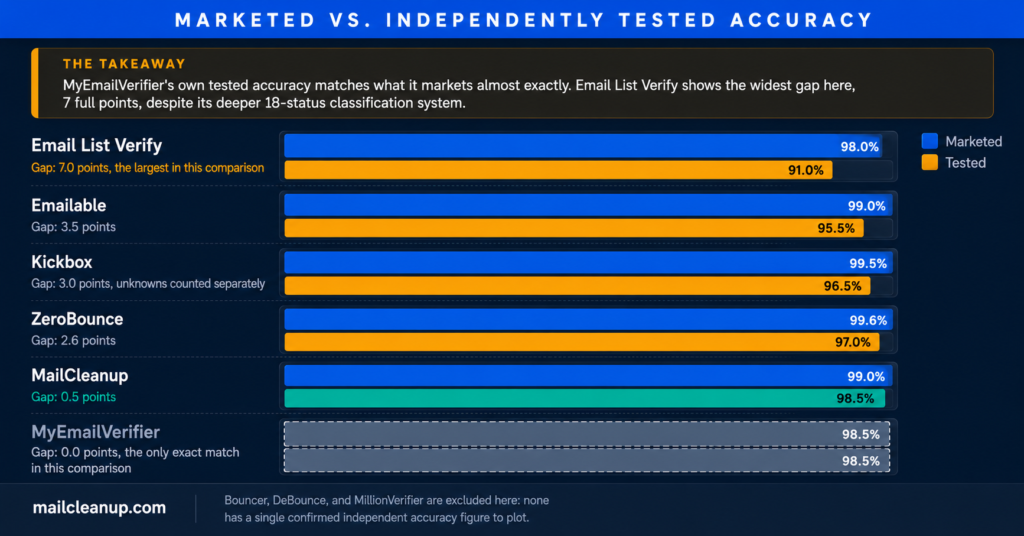
Every one of these MyEmailVerifier alternatives claims high accuracy on its marketing page. Fewer have that number checked by anyone outside the company. Here’s what we found when we looked for independent testing behind each claim.
| Software | Marketed Accuracy | Independently Tested Accuracy |
|---|---|---|
| MailCleanup | Up to 99% | ~98-99% (client-confirmed) |
| MyEmailVerifier | 98-99% | ~98-99% (3rd party claim) |
| ZeroBounce | 99.6% | 96-98% (LaGrowthMachine, Woodpecker) |
| Bouncer | 99.5% | Not independently tested to one figure |
| Emailable | 99% | ~95-96% (Sparkle.io) |
| Kickbox | 99.5% (ecosystem claim) | ~96-97%, or 67.53% counting unknowns as failures |
| DeBounce | 97.5%+ | Not benchmarked to one figure (third-party estimates ~97-99.7%) |
| Email List Verify | 97-99% | ~91% on catch-all-heavy lists |
| MillionVerifier | 99%+ | Not independently tested |
MyEmailVerifier’s own testing lines up with what it markets. That’s a genuine strength, and one of the only tools in this group where it’s true without real qualification. ZeroBounce, Emailable, Kickbox, and Email List Verify all show some daylight between the marketed number and what independent testing found. Bouncer, DeBounce, and MillionVerifier haven’t been independently tested to a single confirmed figure at all. If you’re picking an alternative to MyEmailVerifier specifically because of an accuracy claim, that gap matters more than the raw percentage does.
True Cost at Volume for Every MyEmailVerifier Alternative
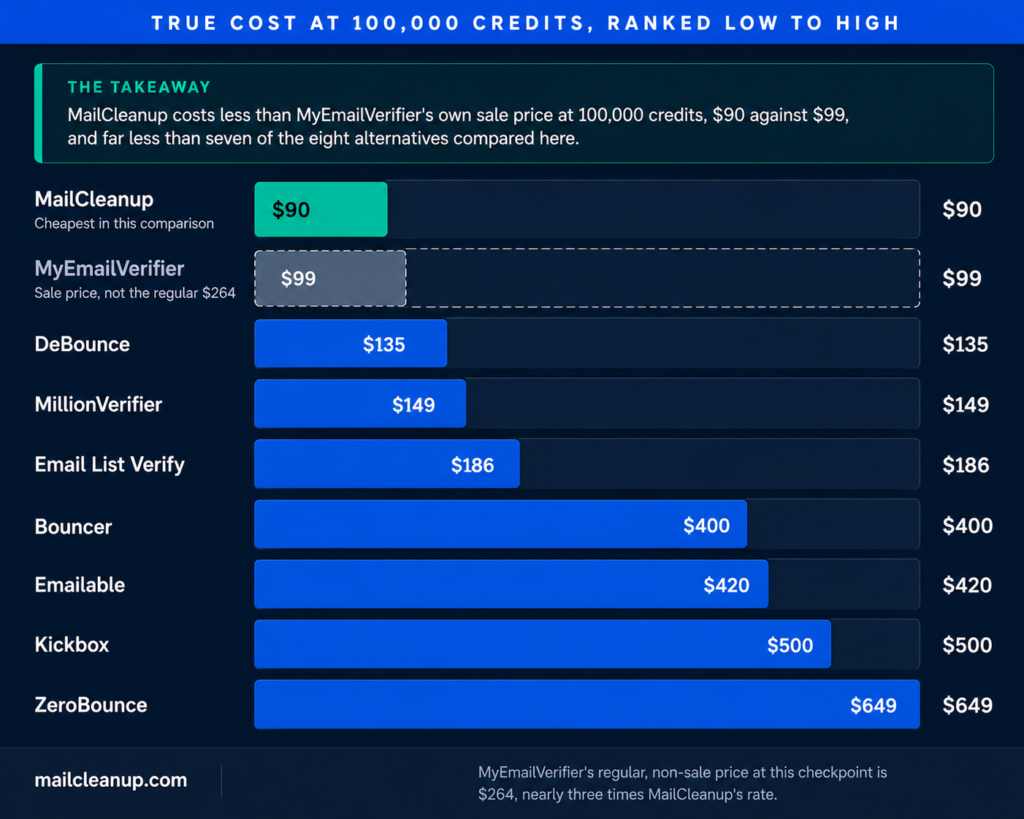
Sticker price at 10,000 credits only tells part of the story. We priced out each of these MyEmailVerifier alternatives at four real volumes, from a small list to a six-figure one. You’ll see exactly what your bill looks like as your list grows.
| Software | 5,000 credits | 10,000 credits | 50,000 credits | 100,000 credits |
|---|---|---|---|---|
| MailCleanup | $10 | $15 | $50 | $90 |
| MyEmailVerifier (sale) | $9 | $15 | $54 | $99 |
| MyEmailVerifier (regular) | $27 | $42 | $144 | $264 |
| ZeroBounce | $69 | $129 | $499 | $649 |
| Bouncer | $35 | $60 | $250 | $400 |
| Emailable | $38 | $60 | $245 | $420 |
| Kickbox | $40 | $70 | $275 | $500 |
| DeBounce | $15 | $25 | $75 | $135 |
| Email List Verify | $17 | $27 | $98 | $186 |
| MillionVerifier | $39 | $39 | $89 | $149 |
We ran these four checkpoints side by side, and the pattern holds up. At small volume, MyEmailVerifier’s sale price beats almost everyone here. The one exception is MailCleanup, which it edges out by a single dollar. That advantage doesn’t hold. By 50,000 credits, MailCleanup is $4 cheaper. By 100,000, the gap widens to $9. And if MyEmailVerifier’s “sale” pricing were to end, or simply not apply to your account, the math changes fast. The regular price at 100,000 credits runs to $264, nearly three times MailCleanup’s rate.
DeBounce and Email List Verify both cost more than MyEmailVerifier’s sale price at every checkpoint, but by a far smaller margin than ZeroBounce does. Both still stay cheaper than MyEmailVerifier’s regular price, too.
Credit Expiry and Billing Fairness: MyEmailVerifier Competitors Compared
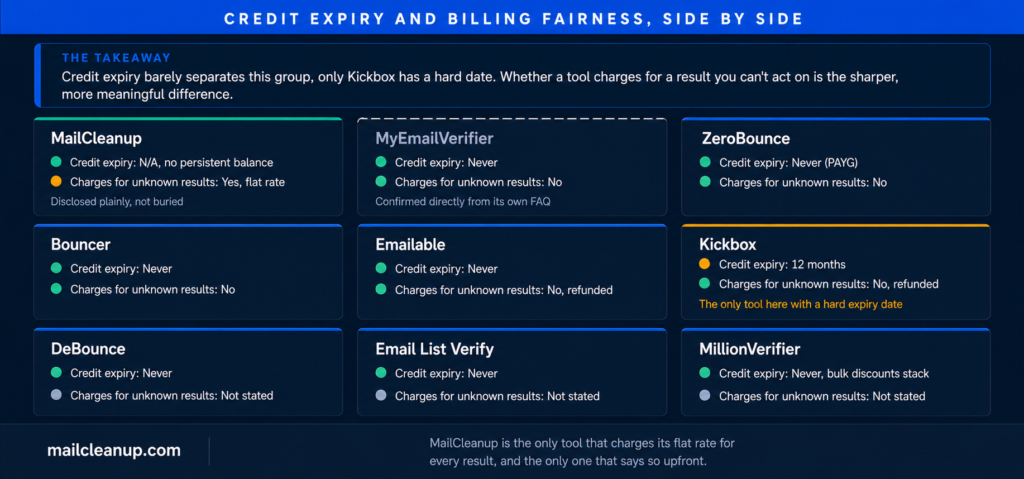
Credit policy and billing fairness round out the comparison. Here’s how these MyEmailVerifier alternatives, and MyEmailVerifier itself, handle expiring credits and results you can’t act on.
| Software | Credit Expiry | Charges for Unknown or Catch-All Results |
|---|---|---|
| MailCleanup | N/A, no persistent balance | Yes, flat per-credit rate covers every result type |
| MyEmailVerifier | Never | No, confirmed directly, unknown and duplicate results are excluded |
| ZeroBounce | Never (PAYG) | No |
| Bouncer | Never | No |
| Emailable | Never | No, refunded automatically |
| Kickbox | 12 months | No, refunded automatically |
| DeBounce | Never | Not stated |
| Email List Verify | Never | Not stated |
| MillionVerifier | Never | Not stated |
Credit expiry barely separates this group. Kickbox is the only tool here with a time limit at all. Charging for results you can’t act on tells a clearer story. We confirmed directly from MyEmailVerifier’s own FAQ that it does not charge for unknown or duplicate results. That puts it alongside ZeroBounce, Bouncer, Emailable, and Kickbox on this specific point.
MailCleanup does charge its flat per-credit rate regardless of outcome, disclosed plainly rather than buried in the fine print. MyEmailVerifier also backs a specific accuracy guarantee. Fall short of its stated 98% threshold, and it refunds six times your validation cost for every percentage point short. Claiming it isn’t simple, though. It requires hard-bounce-only data and a full bounce report, not just a request.
8 MyEmailVerifier Alternatives, Reviewed in Detail
Here’s how each of these eight MyEmailVerifier alternatives actually holds up. We’ll walk through each one, tool by tool, so you can see exactly where it wins and where it falls short.
1. MailCleanup: The Cheapest MyEmailVerifier Alternative at Scale
We built MailCleanup around one idea: verification should cost what it says it costs, nothing more. Among the MyEmailVerifier alternatives on this list, we’re the only one that requires no account and carries no persistent balance at all. There’s no sale to strip away and no separate charge to resolve a catch-all address.
At 10,000 credits, we charge $15, tying MyEmailVerifier’s own discounted price exactly. Past that checkpoint, we pull ahead. At 50,000 credits, we charge $50 against MyEmailVerifier’s $54. At 100,000, we charge $90 against $99. You submit your list through a simple order form and choose your plan. We send your cleaned list back. No login, no dashboard, no account to maintain.
We run a full pipeline on every address:
- Syntax and format checks
- MX record and domain validation
- Real-time SMTP handshakes
- Disposable email and greylisted domain detection
We flag catch-all addresses rather than guessing at them. We back all of it with accuracy of up to 99%, confirmed against our own client results. That order-based model shapes what we don’t do, too. We don’t plug into your CRM or ESP the way a few tools on this list do. You’re sending us a list and getting a cleaned one back, not integrating a platform into your stack. If you want a quick answer while you’re deciding, we offer live chat and prompt email support either way.

MailCleanup Overview
| Field | Detail |
|---|---|
| Pricing model | Pay-per-order, one-time, no account |
| Price (5,000 / 10,000 / 50,000 / 100,000) | $10 / $15 / $50 / $90 |
| Marketed accuracy | Up to 99% |
| Independently tested accuracy | ~98-99% (client-confirmed) |
| Catch-all handling | Flagged, not individually resolved |
| API / integrations | None; CSV in, cleaned list out |
| Charges for unknown results | Yes, flat rate covers every result |
| Support | Live chat and email |
2. ZeroBounce: One of the Most Feature-Rich MyEmailVerifier Alternatives
ZeroBounce doesn’t stop at a flat catch-all label. It scores every ambiguous address on a 0-to-10 scale, using AI-driven Email Scoring. That weighs signals MyEmailVerifier’s four-category system never touches. That’s a real step past labeling an address “catch-all” and moving on.
The scoring carries into everything else ZeroBounce reports. Instead of a single valid-or-invalid split, you get a graded confidence read on every address that isn’t a clean call. You decide for yourself where your risk tolerance sits. We counted a real-time API and more than 60 native integrations on ZeroBounce, well past MyEmailVerifier’s roughly 20.
None of that comes cheap. At 10,000 credits, ZeroBounce charges $129, more than eight times MyEmailVerifier’s sale price at the same volume. We found independent testing (LaGrowthMachine, Woodpecker) puts its real-world accuracy at 96 to 98%. That’s close to its 99.6% marketed figure, but not an exact match. If depth and integration reach matter more to you than price, ZeroBounce is one of the stronger MyEmailVerifier alternatives here. If they don’t, the gap in cost is hard to ignore. We go deeper on ZeroBounce’s own strengths and trade-offs in our ZeroBounce alternatives comparison.
ZeroBounce Overview
| Field | Detail |
|---|---|
| Pricing model | Pay-as-you-go or subscription |
| Price (5,000 / 10,000 / 50,000 / 100,000) | $69 / $129 / $499 / $649 |
| Marketed accuracy | 99.6% |
| Independently tested accuracy | 96-98% (LaGrowthMachine, Woodpecker) |
| Catch-all handling | AI-driven Email Scoring, 0-10 quality score |
| API / integrations | Real-time API, 60+ native integrations |
| Charges for unknown results | No |
| Data retention | Auto-deleted within 30 days |
3. Bouncer: A MyEmailVerifier Alternative With Catch-All Built In
Bouncer runs a dedicated Toxicity Check on every list it verifies. We confirmed it screens for spam traps, serial complainers, and breached-credential addresses, as a separate layer beyond standard syntax and SMTP checks. That’s active resolution, not a flag and a shrug. Its own unknown-result rate runs as low as 0.3 to 3%. That’s well below what a flat four-category system like MyEmailVerifier’s typically leaves unresolved.
You don’t pay extra to turn this on. It’s part of the standard verification run, not a second product you have to discover and buy separately. That’s rare among MyEmailVerifier alternatives. Most either upsell deeper resolution or skip it entirely. Bouncer also never charges for a duplicate or unknown result, and its credits don’t expire, protecting your sender reputation without adding a second bill.
At 10,000 credits, Bouncer charges $60, four times MyEmailVerifier’s sale price at the same volume. We looked for independent testing on Bouncer’s accuracy and didn’t find a single confirmed percentage. You’re weighing its marketed 99.5% against MyEmailVerifier’s own tested figure, not two equally-verified numbers. Support runs email-only, with roughly a 24-hour response time, a real trade-off if you need an answer fast. Among the MyEmailVerifier competitors profiled here, Bouncer is the clearest example of catch-all handling that doesn’t come with an upsell. Our full Bouncer alternatives comparison covers where it fits best.
Bouncer Overview
| Field | Detail |
|---|---|
| Pricing model | Pay-as-you-go |
| Price (5,000 / 10,000 / 50,000 / 100,000) | $35 / $60 / $250 / $400 |
| Marketed accuracy | 99.5% |
| Independently tested accuracy | Not independently tested to one figure |
| Catch-all handling | Toxicity Check, deep resolution, built into standard verification |
| API / integrations | Real-time API, plus separately priced Shield and deliverability suite |
| Charges for unknown results | No |
| Support | Email-only, ~24-hour response |
4. Emailable: An Alternative to MyEmailVerifier With Deeper Integrations
Emailable connects to more than 50 platforms natively, including HubSpot, Salesforce, Klaviyo, Mailchimp, ActiveCampaign, and Brevo. That’s one of the largest libraries in this whole comparison. You add it directly to the CRM or ESP you already run, instead of routing verification through Zapier or Make first.
Speed backs that up. Emailable verifies a 10,000-email batch in roughly 2 to 3 minutes. We found that figure confirmed both by its own site and by an independent Sparkle.io test that landed close behind it. Credits never expire. Both unknown and duplicate results are refunded automatically, so you’re not paying for a result you can’t act on.
At 10,000 credits, Emailable charges $60, four times MyEmailVerifier’s sale price at the same volume. You’ll still see catch-all addresses flagged as “accept-all” rather than resolved individually, the same basic limit MyEmailVerifier has. Among the MyEmailVerifier alternatives compared here, Emailable’s real edge isn’t catch-all depth. It’s how directly the tool plugs into the rest of your stack, something we cover in more detail in our own Emailable alternatives comparison.
Emailable Overview
| Field | Detail |
|---|---|
| Pricing model | Pay-as-you-go, 5,000-credit minimum |
| Price (5,000 / 10,000 / 50,000 / 100,000) | $38 / $60 / $245 / $420 |
| Marketed accuracy | 99% guarantee |
| Independently tested accuracy | ~95-96% (Sparkle.io) |
| Catch-all handling | Flags as accept-all, not individually resolved |
| API / integrations | Real-time API, 50+ native integrations |
| Charges for unknown results | No, refunded automatically |
| Speed | ~2-3 minutes per 10,000-email batch |
5. Kickbox: A MyEmailVerifier Alternative With Graded, Not Flat, Results
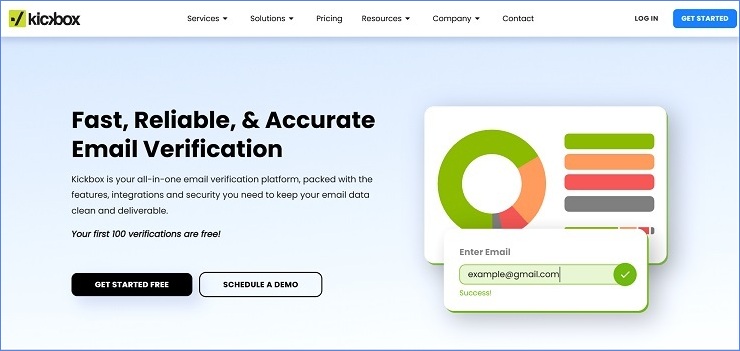
Kickbox scores every address with its own Sendex system, a 0-to-1 gradient rather than a flat pass or fail. Combined with a real-time API and 25-plus native integrations, that gives you more to work with than MyEmailVerifier’s four-category split.
Unknown results on Kickbox are refunded automatically, the same policy MyEmailVerifier itself uses. Neither tool charges you for a result you can’t act on. Where the two genuinely differ is credit expiry. Kickbox credits expire 12 months after purchase. That’s one of only two tools we’ve found anywhere in this comparison with a hard expiry date at all. MyEmailVerifier’s credits never expire. If you buy in bulk and use credits slowly, that difference matters more than the Sendex score does.
At 10,000 credits, Kickbox charges $70, well above MyEmailVerifier’s sale price at the same volume. Independent testing tells two different stories here, depending on methodology. A Sparkle test puts real-world accuracy at 96 to 97% when unknowns are handled separately. A stricter Hunter benchmark counts unknowns as failures instead, and scored it at 67.53%. Kickbox’s own marketed 99.5% is framed as a deliverability prediction, not a guarantee. Among the MyEmailVerifier alternatives here, Kickbox is the clearest reminder that a feature you like can come with a trade-off you’d rather avoid.
Kickbox Overview
| Field | Detail |
|---|---|
| Pricing model | Pay-as-you-go |
| Price (5,000 / 10,000 / 50,000 / 100,000) | $40 / $70 / $275 / $500 |
| Marketed accuracy | 99.5% (deliverability prediction, not a guarantee) |
| Independently tested accuracy | ~96-97% (unknowns separate), or 67.53% counting unknowns as failures |
| Catch-all handling | Returns Unknown, refunded automatically; Sendex score (0-1 gradient) |
| API / integrations | Real-time API, 25+ native integrations |
| Charges for unknown results | No, refunded automatically |
| Credit expiry | 12 months after purchase |
6. DeBounce: An Alternative to MyEmailVerifier With a Longer Track Record
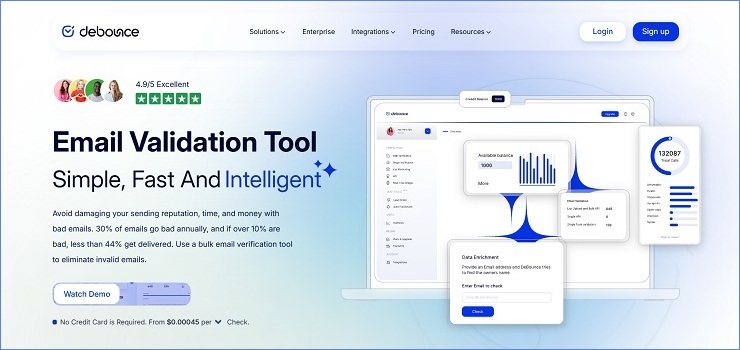
DeBounce runs a six-stage pipeline on every address: syntax, domain and MX lookup, an SMTP handshake, disposable detection, catch-all identification, and role-based filtering. Named enterprise customers, including Western Digital, Samsung, Cornell University, and Siemens, back that up with real usage at scale.
We checked its independent review base directly. DeBounce holds a 4.9-out-of-5 rating across more than 1,300 Trustpilot reviews, a considerably larger sample than several tools in this comparison. Credits never expire here either, matching MyEmailVerifier’s own policy. DeBounce backs its accuracy with a stated 97.5%-plus deliverability guarantee.
Price is where this one gets honest. At 10,000 credits, DeBounce charges $25, more than MyEmailVerifier’s $15 sale price at the same volume, though nowhere near ZeroBounce’s $129. Its catch-all handling stops at identification, the same basic limit MyEmailVerifier has. DeBounce doesn’t individually resolve catch-all addresses either. A proven track record at scale might matter more to you than shaving a few dollars off your bill. If so, DeBounce is one of the sturdier MyEmailVerifier alternatives on this list.
DeBounce Overview
| Field | Detail |
|---|---|
| Pricing model | Pay-as-you-go, credits never expire |
| Price (5,000 / 10,000 / 50,000 / 100,000) | $15 / $25 / $75 / $135 |
| Marketed accuracy | 97.5%+ deliverability guarantee |
| Independently tested accuracy | Not benchmarked to one figure (third-party estimates ~97-99.7%) |
| Catch-all handling | Identified in pipeline, not individually resolved |
| API / integrations | Real-time API, 20+ native integrations |
| Track record | 4.9/5 across 1,300+ Trustpilot reviews; named enterprise customers |
7. Email List Verify: The Deepest Result Classification Among MyEmailVerifier Alternatives
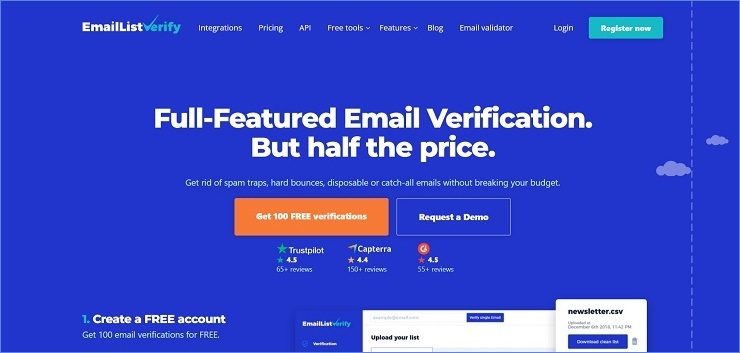
Email List Verify sorts every address into one of 18 status codes, not MyEmailVerifier’s four. Among the MyEmailVerifier alternatives compared here, that’s a real jump in granularity. It’s enough to separate a hard bounce from a full mailbox from a disposable domain, instead of lumping all three into “invalid.”
That depth has a real limit, though. We found a controlled benchmark testing Email List Verify’s catch-all handling directly. On a list of 1,222 enterprise catch-all records, its standard scan correctly identified only 9 of 23 real contacts. Its paid Deep Scan upgrade, which charges triple credits, improved that to 11 of 23. The majority of catch-all addresses still went unresolved. That’s the same upsell pattern MyEmailVerifier uses for its own Deep Catch-All Check, not an advantage over it.
At 10,000 credits, Email List Verify charges $27, nearly double MyEmailVerifier’s sale price. Its G2 composite satisfaction score sits at 55.41, notably lower than several tools in this comparison. ZeroBounce scores 81.55 on the same scale. The 18-status system is a genuine reason to look at Email List Verify. The catch-all upsell and the lower satisfaction score are genuine reasons to look further before you commit. Our full Email List Verify alternatives comparison covers both in more depth.
Email List Verify Overview
| Field | Detail |
|---|---|
| Pricing model | Pay-as-you-go or subscription (~10% cheaper) |
| Price (5,000 / 10,000 / 50,000 / 100,000) | $17 / $27 / $98 / $186 |
| Marketed accuracy | 97-99% |
| Independently tested accuracy | ~91% on catch-all-heavy lists |
| Catch-all handling | Flagged as 1 of 18 status codes; Deep Scan add-on for deeper resolution |
| API / integrations | Real-time API, Mailchimp, AWeber, MailerLite, HubSpot, Campaign Monitor |
| G2 satisfaction score | 55.41 (composite scale) |
8. MillionVerifier: A MyEmailVerifier Alternative With a Real Money-Back Guarantee
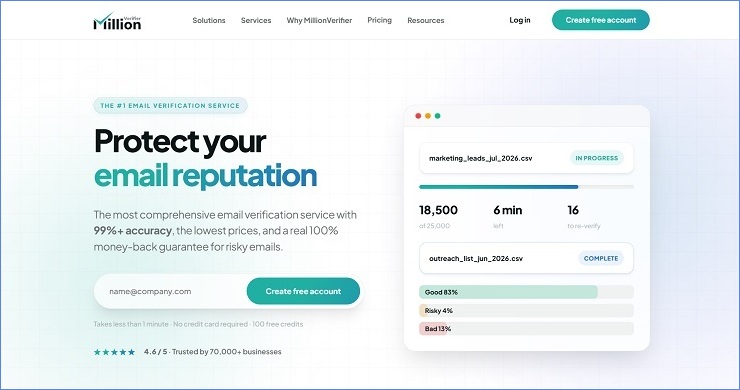
MillionVerifier backs every verification with a 100% money-back guarantee on any email it can’t verify with certainty. That’s a specific, unconditional commitment, not a marketed accuracy figure you have to take on faith.
Catch-all handling comes included at no extra cost here too, the same no-upsell approach Bouncer and ZeroBounce take. We noted an independent review that found it less granular than ZeroBounce’s own scoring, though. MillionVerifier’s credits don’t expire either. Buying in bulk stacks real discounts on top of that: an extra 1 million credits free for every 5 million purchased.
Pricing runs flat at the bottom end. At both 5,000 and 10,000 credits, MillionVerifier charges $39, the same price either way. It drops to $89 at 50,000 and $149 at 100,000. That’s more than MyEmailVerifier’s sale price at every checkpoint. MillionVerifier’s accuracy hasn’t been independently tested to any figure, though. You’re weighing its marketed 99%-plus against MyEmailVerifier’s own tested number, not two verified claims. Among the MyEmailVerifier alternatives compared in this guide, MillionVerifier’s guarantee is the most concrete promise on the table.
MillionVerifier Overview
| Field | Detail |
|---|---|
| Pricing model | Pay-as-you-go |
| Price (5,000 / 10,000 / 50,000 / 100,000) | $39 / $39 / $89 / $149 |
| Marketed accuracy | 99%+ |
| Independently tested accuracy | Not independently tested |
| Catch-all handling | Included at no extra cost |
| API / integrations | Real-time API, one-click Mailchimp, HubSpot, ActiveCampaign, SendGrid |
| Money-back guarantee | 100% on any email it can’t verify with certainty |
| Credit expiry | Never; bulk discount stacking |
Which MyEmailVerifier Alternative Should You Actually Choose?
Four things stood out to us across this comparison. MyEmailVerifier’s sale price doesn’t actually beat MailCleanup at real volume. Its four-category system leaves real depth on the table. Its catch-all resolution costs extra where several alternatives build it in. Its integration library stops short of what larger teams need.
None of that makes MyEmailVerifier a bad choice for every use case. The same honest math applies if you’re evaluating MyEmailVerifier competitors beyond this list: check the real checkpoint price, not just the headline. If you’re verifying small, occasional lists and don’t mind a flat four-category result, it still does the job. But if any of those four gaps sound like your actual problem, one of these eight MyEmailVerifier alternatives almost certainly closes it better.
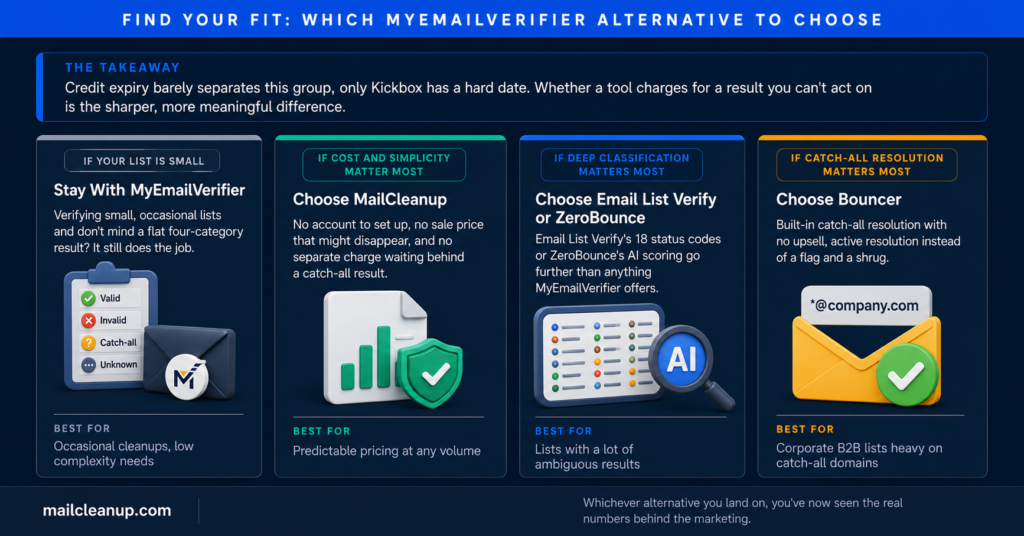
For most teams weighing cost and simplicity together, we’d point you to MailCleanup first. There’s no account to set up, no sale price that might disappear, and no separate charge waiting behind a catch-all result. If deep classification matters more than price, Email List Verify’s 18 status codes or ZeroBounce’s AI scoring go further than anything MyEmailVerifier offers. If built-in catch-all resolution is the priority, Bouncer handles that without an upsell. Whichever MyEmailVerifier alternative you land on, you’ve now seen the real numbers behind the marketing, not just the headline price.
FAQs About MyEmailVerifier Alternatives
Here are the questions we saw most often once people started comparing MyEmailVerifier alternatives directly. We sourced them from real reviews, forum discussions, and MyEmailVerifier’s own published answers to similar questions. That means you’re getting grounded answers, not guesses.
What are the best alternatives to MyEmailVerifier for teams on a tight budget?
We found MailCleanup, DeBounce, and MillionVerifier stay closest to MyEmailVerifier’s own price range among the alternatives to MyEmailVerifier here. MailCleanup ties or beats MyEmailVerifier’s sale price at three of four checkpoints with no account required, one of the cheapest MyEmailVerifier alternatives you’ll find. DeBounce costs more but has a longer track record, and MillionVerifier backs every result with a money-back guarantee.
How accurate are MyEmailVerifier alternatives compared to MyEmailVerifier itself?
We found MyEmailVerifier’s own independent testing lines up closely with its 98-99% marketed claim. That’s one of the tightest gaps among the MyEmailVerifier alternatives we compared here. ZeroBounce, Emailable, and Kickbox all show a real gap between marketed and tested figures. Bouncer, DeBounce, and MillionVerifier haven’t been independently tested to a single confirmed percentage, so you’re relying on their own marketed numbers there.
Do MyEmailVerifier alternatives handle catch-all addresses better than MyEmailVerifier does?
Some do. We found Bouncer, ZeroBounce, and MillionVerifier all build catch-all resolution into their core product at no extra cost to you. MyEmailVerifier’s base tier only flags catch-all addresses; individual resolution requires its separate Deep Catch-All Check product. Among these MyEmailVerifier alternatives, that same upsell pattern shows up again in Email List Verify, so it isn’t unique to MyEmailVerifier.
Which MyEmailVerifier alternatives don’t require a subscription?
We confirmed every one of the MyEmailVerifier alternatives in this comparison offers pay-as-you-go pricing, matching MyEmailVerifier’s own no-subscription-required model. MailCleanup goes further with no account at all, not even a login required. ZeroBounce and Email List Verify also offer optional monthly subscriptions at a discount. None of the eight tools here require one before you can get started.
Does switching to one of these MyEmailVerifier alternatives actually improve deliverability?
Indirectly, the same way MyEmailVerifier itself does. Verification removes invalid and disposable addresses, which lowers your bounce rate and protects your sender reputation. We didn’t find any of the MyEmailVerifier alternatives here touching SPF, DKIM, or DMARC configuration, content quality, or engagement signals. Deliverability is a system-level outcome, and verification is only one input.
Why do teams actually look for MyEmailVerifier alternatives?
We found real reviewers citing three recurring reasons across G2, Capterra, and Trustpilot for choosing MyEmailVerifier alternatives. The first is a flat four-category result system with no deeper classification. The second is catch-all resolution that costs extra beyond the base product. The third is integrations that stop at roughly 20 apps, so you may end up routing through Zapier or Make anyway.
Which MyEmailVerifier alternatives integrate natively with Salesforce or HubSpot?
We confirmed ZeroBounce and Emailable both connect natively to Salesforce and HubSpot, along with 50 or more other platforms each. MyEmailVerifier reaches both only through Zapier or Make, an extra step if your team runs on either. Among the MyEmailVerifier alternatives with the narrowest libraries, Kickbox and DeBounce sit closer to MyEmailVerifier’s own roughly 20 native integrations.
Do MyEmailVerifier alternatives offer free credits to test before buying?
Yes, we found every one of these MyEmailVerifier alternatives offers some form of free testing before you commit. MyEmailVerifier gives 100 free credits daily. MailCleanup, Bouncer, and MillionVerifier all offer 100 free credits on signup. Emailable offers 250, and ZeroBounce offers 100 monthly, though it requires a business or premium email domain to claim them.