
The pitch is always the same. You need contacts. You need them quickly. And somewhere online, a vendor is offering you 50,000 verified, targeted email addresses for less than the cost of a single ad campaign.
It sounds like a shortcut to growth. For businesses under pressure to scale their email marketing, understanding why buying email lists is a bad idea before hitting purchase is the difference between a campaign that builds something and one that destroys something you cannot easily rebuild.
The problem is not just that purchased lists underperform. Every marketer with experience in this space already suspects that. The problem is what a purchased list does to the infrastructure your entire sending programme depends on: your domain, your sender reputation, your inbox placement rate, and ultimately the campaigns you send to people who did consent to hear from you.
This post covers the complete picture. What is actually in a purchased list. The legal exposure by jurisdiction. The specific chain of damage that plays out from the moment you import one. And why every major email service provider will terminate your account if they detect it.
TL;DR on Buying Email Lists
- Purchasing email lists fills your sending programme with spam traps, stale addresses, and contacts who never gave consent to receive email from your organisation.
- Bought lists produce average open rates of 2 to 5 percent versus 25 to 41 percent for organically built lists.
- GDPR fines can reach up to 4 percent of global annual turnover or €20 million; CAN-SPAM penalties run up to $53,088 per non-compliant email sent.
- Every major ESP, including Mailchimp, Klaviyo, Constant Contact, and ActiveCampaign, explicitly prohibits purchased lists and will suspend your account on detection.
- Email addresses on purchased lists decay at 25 to 30 percent per year, meaning a significant portion of the list may already be invalid before your first campaign goes out.
- Hitting a spam trap can reduce your deliverability rate by up to 50 percent and trigger ISP blocklisting that takes months to recover from.
- The domain damage does not stay contained to the purchased list campaign. It reduces inbox placement for every campaign you send afterward, including to your legitimate, consented subscribers.
- Email verification cannot restore consent, but it is the correct first damage-control step if a purchased list has already been imported and not yet sent to.
What You Actually Get When You Buy an Email List
The vendor’s pitch typically includes words like “verified,” “opt-in,” “targeted,” and “fresh.” None of these terms mean what they appear to mean in the context of a purchased list.
List vendors compile addresses through a combination of web scraping, co-registration arrangements, and data reselling. Co-registration means that somewhere on a third-party website, a person ticked a box agreeing to receive offers from “partner companies.” That person has no knowledge of your organisation, no relationship with your brand, and gave no consent specific to receiving marketing from you. The “opt-in” label is technically accurate for the original data collector. It has no legal or practical relevance to your campaign.
What the file actually contains
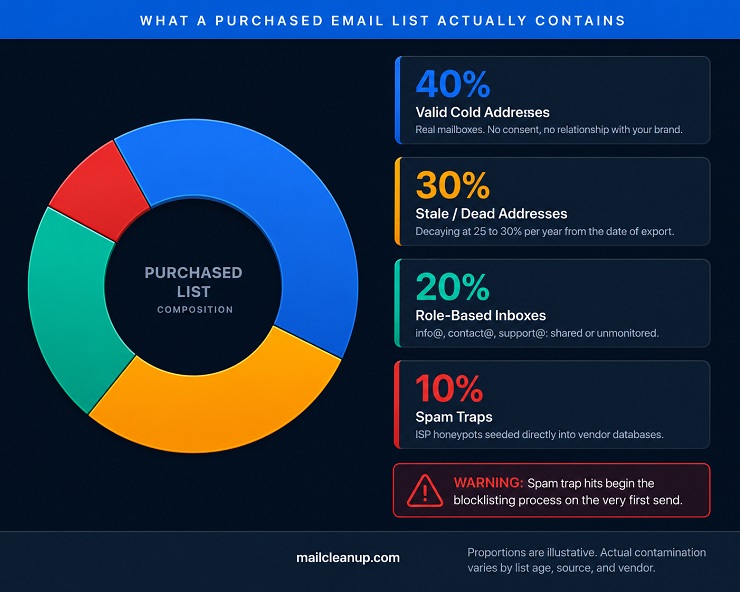
A purchased email list is not a homogeneous dataset. It is a mixture of address types, each carrying a different risk profile:
- Valid but cold addresses: Real people who have no awareness of your brand and no reason to engage with your email. These are the best-case addresses on a purchased list.
- Stale and dead addresses: Email data decays at 22 to 30 percent per year. A list compiled six months ago has already shed a significant portion of its validity. People change jobs, abandon accounts, and switch providers continuously.
- Role-based and shared inboxes: Addresses like info@, contact@, and support@ are monitored by multiple people, if anyone. They carry near-zero individual engagement potential and elevated complaint risk.
- Spam traps: ISPs embed deactivated and purpose-built honeypot addresses into the same databases that list vendors draw from. Their presence in a purchased list is not a freak outcome. It is structurally guaranteed. Our full guide to spam traps explains the three types and how each one damages your sender reputation differently.
The shared-list problem
The same file is sold to dozens or hundreds of buyers simultaneously. By the time it reaches you, those contacts have already received waves of unsolicited email from other businesses who purchased the same list. Your campaign does not arrive to a cold but neutral inbox. It arrives into an environment where the recipient is already irritated, already filtering, and already primed to hit “mark as spam.”
No “verified opt-in” label from a list vendor fixes this. The consent was given once, to someone else, and it has been monetised repeatedly before you sent a single campaign.
Why Buying Email Lists Is a Bad Idea: What the Data Shows
The performance gap between purchased lists and organic opt-in lists is not a marginal difference. It is a category difference. Every metric that determines whether an email campaign is worth running diverges sharply the moment the list was bought rather than built. This is what makes why buying email lists is bad a question of data, not just principle.
| Metric | Purchased List | Organic Opt-In List |
|---|---|---|
| Average open rate | 2 to 5% | 25 to 41% |
| Conversion rate | Under 1% | 2 to 5% |
| Bounce rate on first send | 5 to 30%+ | Under 2% |
| Annual list decay rate | 25 to 30% | 10 to 15% |
| Spam complaint rate | High | Low |
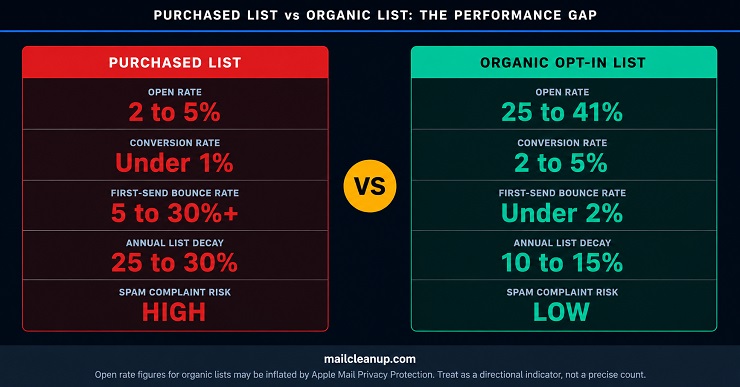
A note on open rates: Open rate figures for organic lists may be inflated by Apple Mail Privacy Protection, which prefetches email pixels automatically regardless of whether the recipient actually opened the message. Treat open rate as a directional engagement indicator rather than a precise count. The directional gap between purchased and organic lists remains significant regardless.
The bounce rate comparison is the most immediately consequential. A bounce rate above 2 percent sends a negative signal to ISPs. Our acceptable email bounce rate benchmarks break down exactly how Gmail, Outlook, and Yahoo each respond when that threshold is crossed. Purchased lists routinely produce first-send bounce rates of 5 to 30 percent. That is not a deliverability problem you recover from within the same campaign cycle.
The conversion rate figure deserves attention too. Email marketing to a clean, engaged organic list returns $36 to $42 for every $1 spent. That return assumes contacts who opted in because they wanted to hear from you, who open your emails because they recognise your brand, and who click because the content is relevant to them. A purchased list cannot replicate any of those conditions. The conversion rate collapses accordingly, and the ROI comparison becomes no comparison at all.
The Legal Reality: Is Buying Email Lists Legal?
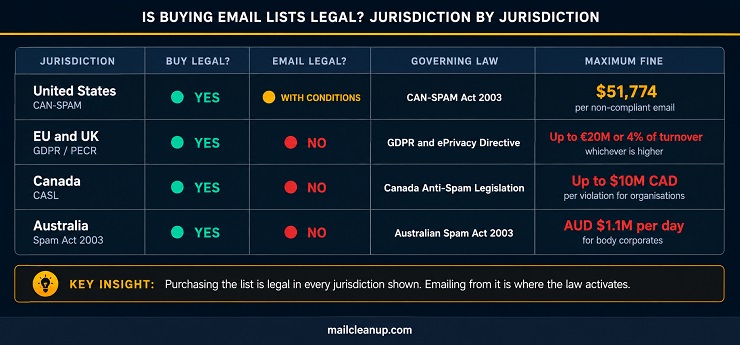
The answer depends on which part of the process you are asking about and which jurisdiction your recipients fall under. In most countries, purchasing a list is not explicitly prohibited. Emailing from it is a different matter entirely. The compliance exposure activates at the send, not at the purchase, and the consequences across every major jurisdiction range from severe to structurally unavoidable.
The United States: CAN-SPAM
CAN-SPAM is one of the most permissive major email laws in the world. It does not require prior consent to send commercial email, which means the act of buying email lists is not, by itself, a legal violation in the United States.
The compliance obligations activate on sending. CAN-SPAM requires a functioning opt-out mechanism, no deceptive subject lines or headers, a physical postal address in every commercial email, and immediate honouring of unsubscribe requests. The structural problem with a purchased list is that it almost certainly contains previous unsubscribers from other senders. Emailing someone who previously unsubscribed from any commercial email from you is a direct CAN-SPAM violation. The first campaign to a purchased list is likely non-compliant before a single email lands. Penalties reach up to $53,088 per non-compliant email.
The European Union and United Kingdom: GDPR and ePrivacy
Under GDPR, consent must be “freely given, specific, informed, and unambiguous.” The word specific is where purchased lists fail unconditionally. Consent given to a third-party company for a third-party purpose does not satisfy the specificity requirement for your organisation to send marketing email to that person.
GDPR fines operate on two tiers. Violations involving unlawful processing of personal data attract fines up to €20 million or 4 percent of annual global turnover, whichever is higher. The ePrivacy Directive, and its UK equivalent the Privacy and Electronic Communications Regulations post-Brexit, adds an explicit opt-in requirement for electronic direct marketing that reinforces the GDPR position and closes the limited exceptions that might otherwise exist.
Canada: CASL
Canada’s Anti-Spam Legislation is among the strictest email marketing frameworks in operation anywhere in the world. CASL requires documented, explicit consent before any commercial electronic message is sent. That consent must be on record, traceable, and attributable to a specific person agreeing to receive email from your specific organisation.
No purchased list has a consent trail that satisfies CASL’s documentation requirements, because the consent trail runs to the original data collector, not to you. Fines reach up to $1 million CAD per violation for individuals and up to $10 million CAD per violation for organisations.
Australia: Spam Act 2003
The Australian Spam Act requires express or inferred consent before commercial messages are sent. Inferred consent requires a prior commercial relationship between the sender and the recipient, meaning the recipient has previously dealt with your organisation in a relevant context. A purchased list cannot demonstrate this relationship for any contact on it. Fines for body corporates reach up to AUD $1.1 million per day for ongoing contraventions.
The picture across all four jurisdictions is consistent. Either purchasing email lists and emailing from them is a direct legal violation, or the compliance requirement is one that a purchased list is structurally incapable of meeting. The nuance between jurisdictions matters for understanding your specific exposure. The conclusion does not change.
The Purchased List Damage Chain
Most writing about why buying email lists is a bad idea presents the consequences as a collection of separate problems. Legal risk in one section. Deliverability damage in another. ESP bans somewhere further down. The structure implies these are independent concerns that a careful sender might manage selectively.
They are not independent. They unfold as a connected sequence, where each stage directly causes the next and where the damage accumulates rather than resets. Understanding this as a chain is what reveals the full exposure, because it shows why stopping the process at any later stage is progressively more difficult and more expensive than it would have been at the one before.
The Purchased List Damage Chain has four stages.
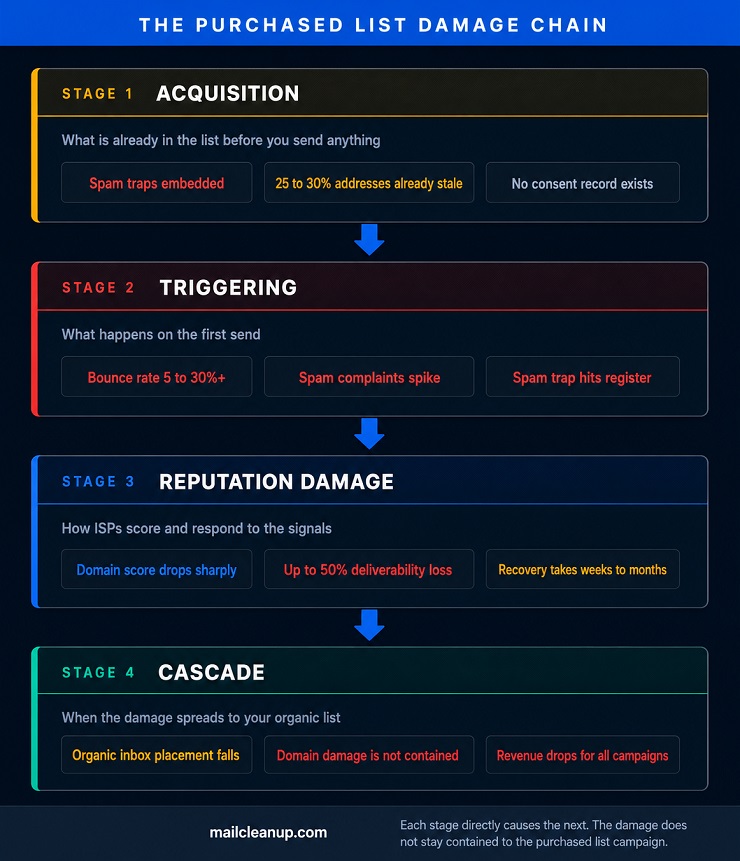
Stage 1: Acquisition – What Is Already in the List Before You Send Anything
The damage begins at the moment of purchase, not at the moment of sending.
List vendors compile their databases through web scraping, co-registration data sharing, and the resale of data acquired from other list vendors. The scraping process is indiscriminate. It collects every address it finds across publicly accessible pages, contact directories, forum registrations, and data broker aggregators. It does not distinguish between active addresses, abandoned ones, incorrectly entered ones, and addresses that ISPs have deliberately seeded into public datasets as traps.
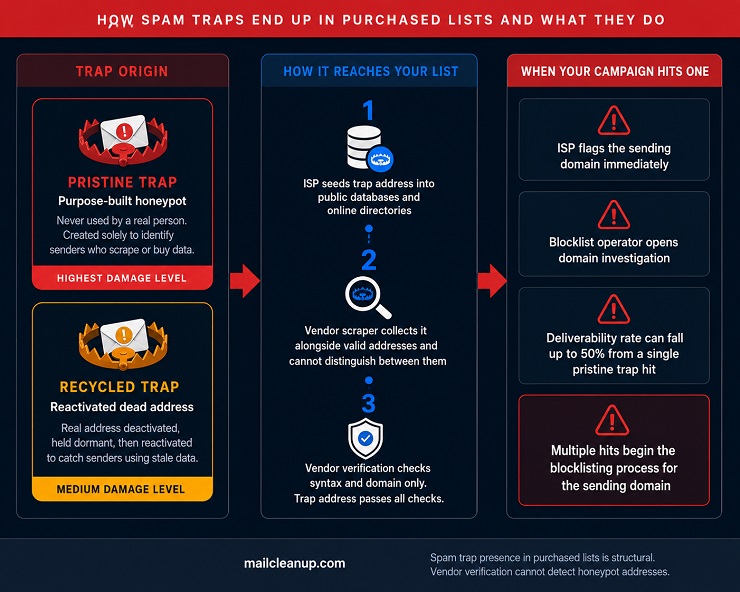
Spam trap seeding is the critical mechanism that makes purchased list contamination structural rather than incidental. ISPs and anti-spam organisations create two categories of trap address. Pristine traps are purpose-built honeypots that have never been used by a real person and exist solely to identify senders who scraped or bought data. Recycled traps are real addresses that were deactivated after their original owner stopped using them, held dormant for a defined period, then reactivated as monitoring instruments.
Both types propagate naturally into the datasets list vendors draw from, because the scrapers collecting those addresses cannot distinguish them from valid ones. A list vendor’s verification process checks address format and domain existence. It cannot detect whether an address is a trap, because trap addresses are specifically engineered to pass those checks. Our detailed breakdown of spam traps covers all three types and how each produces a different level of reputation damage when hit.
The stale address problem sits alongside this. Email data decays at 22 to 30 percent per year. A list sold six months ago has already shed a significant proportion of its accuracy. Those invalid addresses will generate hard bounces the moment the first campaign sends, and hard bounces are among the most damaging reputation signals a domain can produce.
Stage 2: Triggering – What Happens on the First Send
Three events happen simultaneously when a purchased list campaign goes out.
Hard bounces spike – Invalid and dead addresses reject the campaign immediately. Keeping hard bounce rates below 2 percent is the accepted safe threshold for sender reputation. Purchased lists routinely produce first-send bounce rates between 5 and 30 percent depending on list age and origin. A single campaign at that rate tells every receiving mail server that the sender does not have control of their list data. Our acceptable email bounce rate benchmarks break down exactly how Gmail, Outlook, and Yahoo each respond when those thresholds are crossed.
Spam complaints register – Recipients who do not recognise the sender mark the email as spam. One complaint per 1,000 emails approaches the threshold at which ISPs begin reducing inbox placement. On a purchased list, where none of the recipients consented to hear from the sending organisation, complaint rates arrive well above that threshold from the first send.
Spam trap hits occur – A single pristine trap hit can trigger an immediate investigation by the ISP or blocklist operator monitoring it. Multiple hits within the same campaign begin the blocklisting process for the sending domain. Because trap addresses are distributed throughout the list rather than clustered in one segment, there is no practical way to send to a portion of a purchased list while avoiding the traps embedded within it.
These three signals reach the ISP simultaneously, within the same campaign window. Each one in isolation creates a reputation problem. Together, they create the conditions for Stage 3.
Stage 3: Reputation Damage – How ISPs Score and Respond
Email sender reputation is the trust score that ISPs assign to your sending domain and IP address based on accumulated sending behaviour. It determines inbox placement before any content is evaluated. A domain with strong reputation lands in the inbox. A domain with damaged reputation lands in spam, is throttled, or is rejected at the server level entirely.
Gmail, Outlook, and Yahoo all monitor the same three signals: bounce rate, complaint rate, and spam trap hits. When all three spike within the same campaign, the domain reputation score drops sharply. Deliverability rate can fall by up to 50 percent following spam trap hits alone. The score does not resolve between campaigns. ISPs do not reset reputation after a period of inactivity. Recovery requires an extended period of clean, low-volume, high-engagement sending, and that process cannot begin until the damaged campaign has been halted and the offending addresses fully removed.
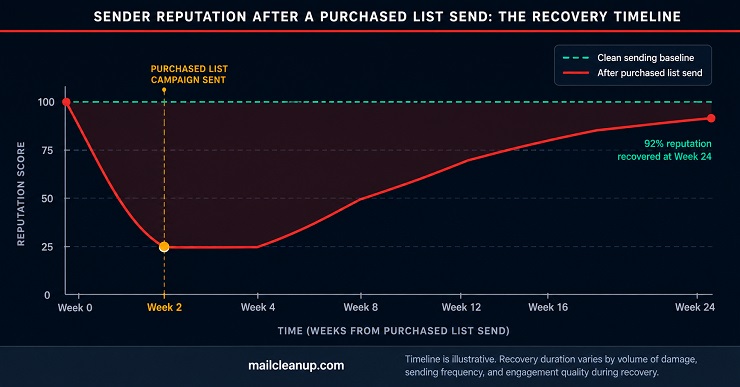
The critical point is that the reputation damage from Stage 2 is already recorded before the sender has any opportunity to intervene. By the time bounce reports return and complaint data becomes visible in the platform dashboard, the domain’s standing with receiving mail servers has already changed.
Stage 4: Cascade – When the Damage Spreads to Your Organic Subscribers
This is the consequence most discussions of purchased list risk do not reach, and it carries the most direct financial impact.
The sending domain is shared across every campaign that goes out under that domain name, regardless of which list it was sent to. A domain flagged by ISPs after a purchased list campaign does not direct its reputation damage selectively at the campaign that caused it. The damage applies to the domain. Every subsequent email sent from that domain, to any list, inherits the lowered reputation score.
The practical consequence: legitimate subscribers who opted in through your own forms, who have engaged with your content, and who want to receive your campaigns will experience lower inbox placement rates after a purchased list campaign runs on the same domain. Emails to the organic list start landing in spam folders at higher rates. Open rates fall. Clicks fall. Revenue from email falls.
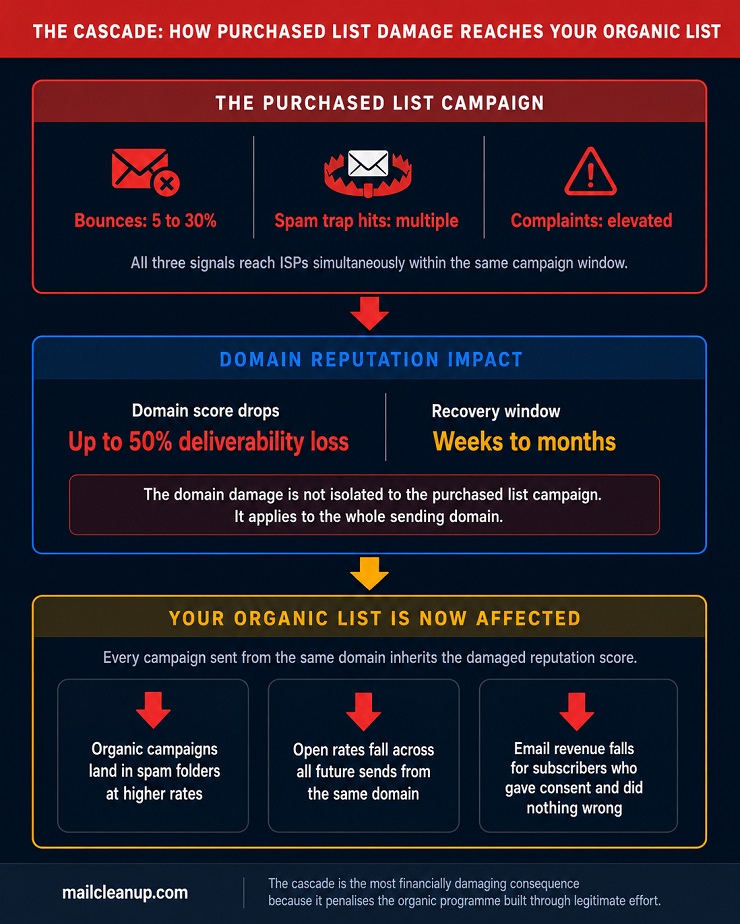
Deleting the purchased list and resuming normal sending does not undo this. The domain reputation built through months of clean, consistent sending has been spent, and the recovery process described in Stage 3 begins from a lower baseline. During that window, the organic list’s performance is suppressed even though nothing about the organic list or its campaigns has changed. The email delivery failure guide covers how domain reputation damage produces silent delivery failures, where no bounce notification arrives but inbox placement collapses without an apparent cause.
Why Purchasing Email Lists Gets Your ESP Account Terminated
Deliverability damage and legal exposure are the consequences that play out with ISPs and regulators over time. The risk of ESP account termination operates on a faster timeline and produces an immediate, concrete business continuity threat.
Mailchimp, Klaviyo, Constant Contact, ActiveCampaign, and AWeber all prohibit the import and use of purchased lists in their acceptable use policies. The prohibition is not a soft recommendation. Violation results in account suspension followed, on confirmation, by account termination.
Detection does not require a manual review. It is triggered algorithmically by the same signals the ISPs monitor: a large list import with no prior engagement history, followed by high bounce rates and elevated complaint rates relative to list size. All major ESPs have automated systems in place to flag this pattern.
Once flagged, the termination sequence moves in four steps:
- Campaign suspended: The send is paused or blocked during or immediately after the campaign goes out.
- Account placed under review: All sending is frozen across the account, including to the organic list.
- Consent documentation requested: The platform asks for proof of consent, which a purchased list cannot provide.
- Account terminated: The account is closed and re-registration is blocked at the domain level on most platforms.
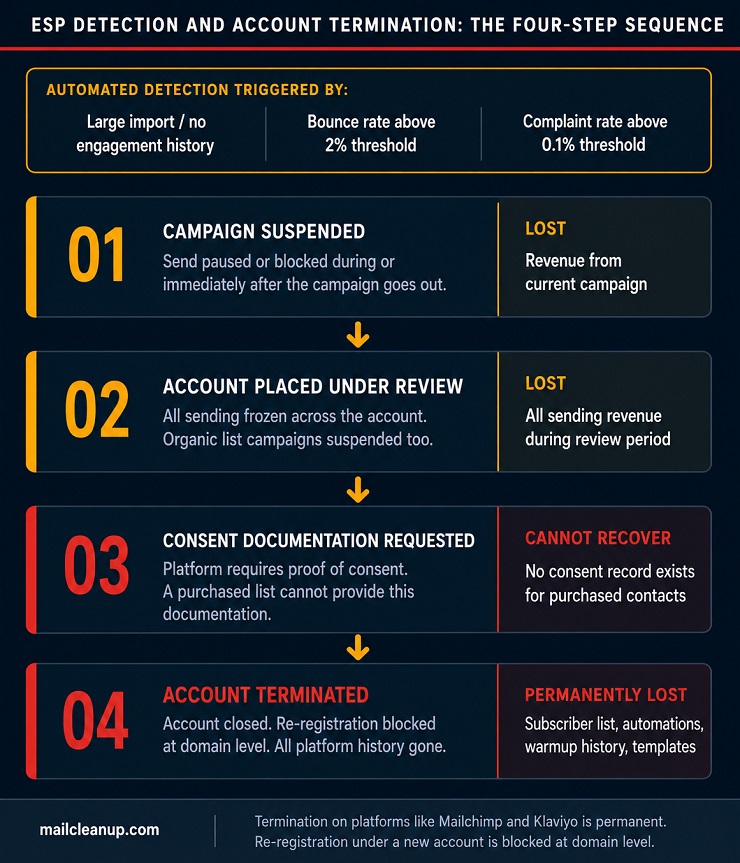
What is lost at termination extends far beyond the failed campaign. The entire sending infrastructure built on that platform is gone: the organic subscriber list, automation sequences, campaign history, template library, integration configurations, and the sending warmup history that took months to accumulate. Some platforms flag the domain permanently, making re-registration under a new account address ineffective rather than simply inconvenient.
The business continuity implication is concrete. An ESP account built and warmed over months, integrated into the broader marketing stack, and representing real list-building effort can be terminated within days of a purchasing email lists decision. The operational cost of rebuilding that infrastructure from scratch significantly exceeds the price of the list that caused the termination.
Is Buying Email Lists Worth It? The ROI Case Against
The purchase price of a list is the visible cost. It appears on one line in a spreadsheet and it looks manageable. The full cost structure is substantially larger, and it only becomes legible after the damage is already done.
The visible costs are the list purchase price, the campaign production investment (copywriting, design, and setup time), and the ESP send cost. These are quantifiable in advance.
The hidden costs are larger and delayed:
| Cost Category | What It Includes |
|---|---|
| Domain reputation repair | Suppressed campaign revenue during the recovery window, which runs weeks to months |
| ESP account recovery | Platform rebuilding, list re-import, warmup restart, integration reconfiguration |
| Legal exposure | Potential fines under CAN-SPAM, GDPR, CASL, and the Australian Spam Act |
| Organic list suppression | Lower inbox placement and reduced revenue from legitimate campaigns during recovery |
| Staff time | Investigation, remediation, and infrastructure rebuilding hours |
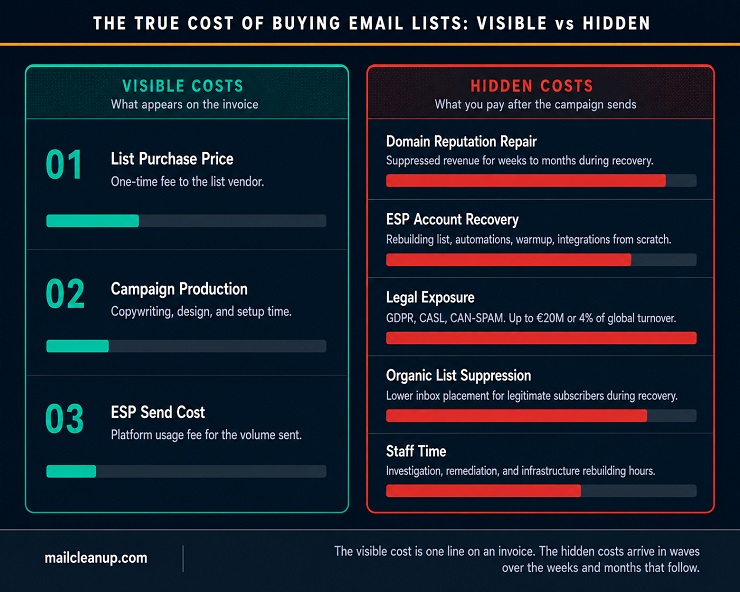
Against that cost structure, the return: open rates of 2 to 5 percent, conversion rates under 1 percent, and near-zero qualified leads from contacts who have no relationship with the brand, no prior awareness of what is being marketed to them, and no reason to engage.
The organic benchmark makes the comparison concrete. Email marketing to a permission-based, maintained list returns $36 to $42 for every $1 spent. That return is produced by subscribers who opted in intentionally, whose engagement history informs every send, and who can be segmented based on real behaviour. A purchased list eliminates every variable that generates that return before the first campaign is sent.
Even the most favourable scenario for a purchased list, a targeted B2B dataset used through a dedicated cold-email infrastructure on a domain separate from the primary sending domain, still carries GDPR exposure for any campaign reaching EU recipients, decays from the moment of export, and requires an infrastructure investment that removes the cost advantage the list was supposed to provide. The question of whether buying email lists is worth it has a consistent answer across every scenario in which it is honestly evaluated.
Can Email Verification Salvage a Purchased List?
This is the question most posts on this topic avoid, because the honest answer is more complicated than a simple no. If a purchased list has already been acquired, understanding exactly what verification can and cannot do is more useful than a blanket dismissal.
What email verification can do
Running a purchased list through a bulk email verification service before any campaign is sent will remove hard-bounce addresses and known invalid emails, reducing the bounce rate the first send would otherwise produce. It will flag recognised spam trap addresses, role-based inboxes, disposable addresses, and high-risk catch-all domains, allowing those contacts to be suppressed before they damage the sending domain. A properly verified list sends cleaner than an unverified one. That is a real and measurable improvement.
What email verification cannot do
Verification confirms that a mailbox exists and is capable of receiving mail. It does not confirm that the person who owns that mailbox consented to receive email from your organisation. Those are entirely different questions, and only one of them is answerable through technical validation.
GDPR, CASL, and equivalent legislation are consent-based frameworks. A verified address is not a consented address. Sending to a verified purchased list is legally identical to sending to an unverified one under every privacy law that requires documented, specific consent. Verification cannot repair domain reputation already damaged by a prior send to an unverified version of the same list. It cannot convert a disengaged, unaware recipient into someone likely to open or engage. It cannot remove the shared-list saturation problem: the contacts were sold to other buyers before and alongside you, and no technical process changes that history.
The practical conclusion
If a purchased list has been imported and no campaign has yet been sent, running it through email verification is the correct first step. It limits the deliverability damage that would otherwise occur on the first send. But this is damage control, not a solution. The consent problem, the legal exposure in GDPR and CASL jurisdictions, and the shared-list engagement reality remain entirely intact after verification.
The better and more valuable application of email verification is on the organic list being built through permission-based growth. An organic list degrades over time regardless of how carefully it was built. Addresses go stale, hard bounces accumulate quietly, and inactive subscribers drag down engagement rates in ways that compound into inbox placement problems over months. Regular verification before major campaign cycles removes those risks before they register as reputation signals, protecting the sender score that months of clean sending built. That is what email verification is designed to do, and it is where it delivers its full return.
How to Build an Email List You Do Not Have to Apologise For
Every competitor post on this topic ends with a list of alternatives to buying. Most of them cover the same four or five generic tactics in roughly the same order. This section takes a different angle. The tactics for growing an organic list are well understood. The principle underneath them, and the ongoing practice required to keep what you build performing the way it should, gets less attention.
Before we jump into that, we have a dedicated guide on how to build an email list that categorizes the risk involved in channels and sources involved for list building. You also get to learn the best practices and mistakes you can avoid while building your email lists.
1. Start with Permission-Based Double Opt-In
Double opt-in is the non-negotiable foundation. Single opt-in is CAN-SPAM compliant and widely used, but it introduces a set of list quality problems that compound over time: typos that become hard bounces, fake addresses entered to access gated content, and low-intent signups who disengage immediately and suppress open rates across the segment.
Double opt-in eliminates all three. The confirmation step removes invalid and mistyped addresses before they enter the active list. It filters out contacts who are not genuinely interested in receiving email from you, because anyone who is not interested will not complete a two-step process to receive it. The list that results is smaller than a single opt-in list built over the same period. It consistently outperforms it across every metric that determines campaign value: open rate, click rate, complaint rate, conversion rate, and long-term engagement retention.
The volume comparison between a double opt-in list and a purchased list is not the relevant frame. A purchased list of 50,000 unverified, non-consented addresses will underperform a double opt-in list of 5,000 engaged subscribers in every campaign, on every metric, and without the domain damage, legal exposure, and ESP termination risk that the purchased list carries alongside it.
2. Use Lead Magnets, Gated Content, and Signup Forms
The practical mechanics of organic list growth operate on one principle: give people a specific reason to exchange their email address that is directly relevant to what your product or service does. Contacts who opted in because of something precise you offered are self-selected as interested in your category. That interest is what produces the engagement numbers that make email marketing worth running.
The implementation options include website signup forms placed at header, footer, and mid-content positions, exit-intent overlays triggered when a visitor moves to leave, gated content such as guides, templates, checklists, or tools that require an email address to access, and social media campaigns directing followers to a dedicated opt-in landing page.
The quality principle applies throughout. A lead magnet that attracts anyone generates a list of people with no specific interest in what you do. A lead magnet that is precisely relevant to your product category attracts contacts who are already thinking about the problem your product solves. The second list is smaller. It is substantially more valuable to every campaign that follows.
3. Verify and Clean Your List Regularly
This is the step most email marketers skip after investing effort into organic growth, and it is the step that determines whether that investment holds its value over time.
An organic list built through careful double opt-in and relevant lead magnets is not permanently clean. It degrades. Email data decays at 22 to 30 percent per year on permission-based lists. People change jobs, abandon accounts, and switch email providers. Hard bounces accumulate on addresses that were valid at signup and have since been deactivated. Inactive subscribers who never formally unsubscribed drag down engagement rates across the segment, and suppressed engagement rates translate directly into lower inbox placement scores over time.
Good email list hygiene means running verification before major campaign cycles, not only when deliverability problems become visible. By the time the symptoms appear in bounce reports and open rate declines, the reputation signals causing them have already been recorded by ISPs. The operational practice is verification before damage rather than verification in response to it. That distinction is what separates a sender whose deliverability holds consistently over years from one whose campaigns gradually erode toward the spam folder.
What to Do Right Now If You Have Already Bought a List
Purchasing email lists is not a fringe mistake made only by inexperienced marketers. It is a step businesses at every stage take under growth pressure, often without fully understanding the sequence of consequences it sets in motion. If a purchased list has already been acquired, the situation is recoverable, but the recovery path has a specific order that matters.
The first action is to run the list through bulk email verification before any campaign is sent. This removes hard-bounce addresses, flags spam trap risks, and suppresses role-based and invalid contacts before they damage the sending domain. This step needs to happen before the list is imported into any ESP, because importing alone can trigger automated review on most platforms.
Before sending anything to a purchased list, take these three steps:
- Run the full list through email verification to remove invalid addresses and flag embedded spam trap risks.
- Isolate any campaign to a domain separate from the primary sending domain used for organic campaigns.
- Do not send to any EU, UK, or Canadian recipients on the list without documented, specific consent on file.
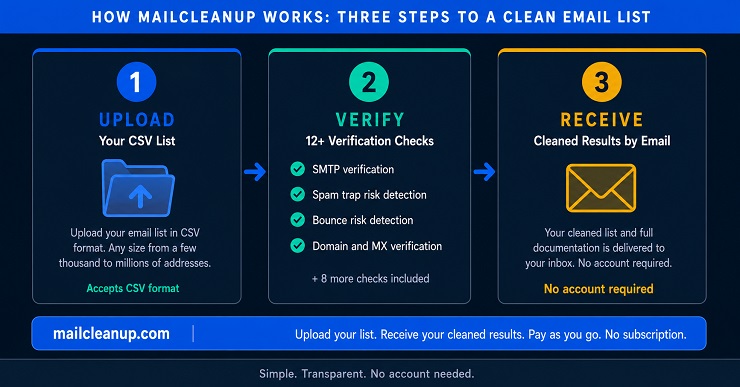
The forward path from here is a permission-based list maintained with regular verification. That combination, contacts who opted in because they wanted to hear from you and a list kept clean through ongoing hygiene, is what email marketing’s documented returns are actually built on. MailCleanup handles the verification side of that: upload your list, run it through 12-plus verification checks, and receive your cleaned results by email. No account required.
FAQs on Email List Purchasing
Is buying email lists legal?
Purchasing a list is legal in most countries. Emailing from it is where the law activates. GDPR requires specific, documented consent your organisation must hold directly, making any send to EU or UK contacts a direct violation. In Canada, CASL demands a traceable consent record. In the US, CAN-SPAM is more permissive but a purchased list almost certainly contains previous unsubscribers, creating immediate non-compliance.
Is buying email lists worth it?
No. Open rates average 2 to 5 percent versus 25 to 41 percent for organic lists, and conversion rates fall below 1 percent. When domain reputation repair, ESP account recovery, organic list suppression, and legal exposure are factored in, the true cost consistently exceeds the list purchase price by a significant margin, against returns that cannot justify it.
What happens when you email a purchased list?
Hard bounces spike immediately, spam complaints register from unaware recipients, and spam traps embedded in the list are hit simultaneously. All three signals reach ISPs within the same campaign window, dropping your domain reputation score sharply and reducing inbox placement for every campaign you send afterward, including to your organic subscribers.
Can you use a purchased email list with Mailchimp or other ESPs?
No. Mailchimp, Klaviyo, Constant Contact, ActiveCampaign, and AWeber all explicitly prohibit purchased lists. Detection is algorithmic, triggered by bounce rate and complaint spikes on newly imported contacts. The result is campaign suspension, account review, and termination, including loss of your organic list, automation workflows, and sending warmup history.
Is buying email lists GDPR compliant?
No. GDPR requires consent that is freely given, specific, informed, and unambiguous. Consent on a purchased list was given to a different organisation for a different purpose and cannot be transferred to yours. Sending to those contacts in the EU or UK is a direct violation, carrying fines of up to €20 million or 4 percent of global annual turnover, whichever is higher.
Does buying email lists actually work?
Not by any measure that justifies the cost. Open rates run 2 to 5 percent, conversions fall below 1 percent, and the contacts have no prior relationship with your brand. The domain damage and ESP termination risk mean even marginal activity from the list comes at a net cost that exceeds what it generates.
How do you build an email list without buying one?
Start with permission-based double opt-in through your own channels. Website signup forms, gated content such as guides and templates, exit-intent overlays, and social media campaigns directing followers to a dedicated opt-in page all attract contacts who joined because your offer was directly relevant to them. Run verification before every major campaign cycle to keep the list performing over time.
What is the difference between buying and renting an email list
Buying gives you the file of addresses to email yourself. Renting means a vendor sends on your behalf without you receiving the addresses. The risks are the same in both cases: no consent to your organisation, elevated complaint rates, and reputation damage from a disengaged audience. Neither model produces the results of a permission-based organic list.