
Building an email list gets treated as a single problem with one answer. Get more addresses, as many as you can, as fast as you can. That’s only half the problem.
The other half shows up months later. The pop-ups have converted, the contest has ended, and the list looks bigger than it did last quarter. Some of those new addresses open every email you send. Others never open a single one, sitting quietly on your list and dragging down your engagement numbers and, eventually, your deliverability. The channel that brought each address in predicts which group it lands in.
This guide covers how to build an email list using every channel that actually works, the complete picture, channel by channel. It also does something rarer: it tells you honestly which channels tend to produce subscribers worth keeping. It also tells you which tend to produce a bigger number that costs you later. List building is one piece of the wider email marketing guide, which covers what happens once that list actually exists.
TL;DR on Email List Building
- Building an email list well means choosing acquisition channels deliberately, since different channels produce meaningfully different long-term list quality, not just different signup speeds.
- The Email List Building Strategies Ladder ranks all eleven channels into two risk tiers. Content, SEO, referrals, and deliberate on-site signups sit in the lower-risk tier; gamified pop-ups, contests, and co-registration sit in the higher-risk one.
- Buying or renting a list isn’t a faster way to build one. It starts with addresses that never opted in and typically trips Gmail’s 0.3% spam-complaint threshold on its very first send.
- Opt-in comes in six real forms, not just single versus double, and even “confirmed opt-in” means different things by platform.
- The fastest-growing channels, gamified giveaways and auto-filled lead ads especially, frequently carry the highest long-term decay and complaint risk.
- The right channel mix depends on business type. Newsletters and content brands, B2B and SaaS teams, ecommerce, affiliate marketing, and authors each lean on a different primary channel and define list quality differently.
- What happens in the first month after signup, verification, a welcome sequence, and source tagging, determines how much early subscriber quality actually survives.
Email List Building Starts With Getting the Basics Right
Email list building starts with a definition worth getting right before anything else. A list is not just a collection of addresses sitting in a spreadsheet or a CRM export. It is a group of people who agreed, in some checkable way, to hear from you again. That agreement is the foundation everything else in this guide rests on.
An email list is also one of the only marketing channels you actually own outright. Your social media following belongs to whichever platform hosts it, and one algorithm change can cut your reach overnight. Your search rankings depend on rules you don’t control, and a single update can undo years of work. Your email list answers to none of that. Every address on it is a direct line you keep for as long as you maintain the relationship. That holds regardless of any platform’s decisions about who sees what.
That’s what building an email list well actually means: growing that direct line on purpose. Choosing channels, running real signup mechanisms, and protecting the list’s health as it grows, not just accumulating addresses and hoping engagement follows. Not every way of collecting an address produces the same kind of subscriber. A name from a purchased database and a name from a confirmed signup form both count as “an address on your list.” They behave nothing alike once you actually start sending to them.
We have watched this pattern hold across enough client lists to state it plainly. The channel an address comes through predicts more about its long-term value than almost anything you do to it afterward. A slow, deliberate signup process filters out people who were never going to engage in the first place. A fast, frictionless one lets almost anyone through, including plenty of people who will never open a single email you send them. Both outcomes look identical on the day someone subscribes. They diverge completely within a few months.
Knowing how to build an email list well means holding two things at once: covering every real channel available to you. It also means being honest about which of those channels quietly cost you subscribers later. Choosing channels on purpose beats running every tactic available and hoping the good subscribers outnumber the bad ones. That’s the real difference between casually collecting addresses and knowing how to build your email list. It’s also the foundation of how to build an email marketing list that survives past its first few sends. The email list building strategies this guide ranks later on all come back to that same foundation.
Why Buying a List Isn’t Building an Email List
Buying a list feels like a shortcut around everything the last section just described. You skip the slow filtering process, skip the frictionless-but-risky channels, and get a finished database in one transaction instead. That shortcut fails for a structural reason, not a moral one.
Every method this guide covers for how to build an email list runs through the same basic gate. A real person did something, however small, that signaled they wanted your email. A purchased list has no gate at all. The names on it agreed to nothing from you specifically. Someone may have opted into a completely different company’s marketing. A data broker may have compiled the list from public records instead, with no opt-in involved anywhere in the chain. Either way, you’re the first sender in that relationship. The person receiving your email has no context for why you’re in their inbox.
That gap shows up immediately in your metrics, not eventually. Google and Yahoo’s own bulk sender rules set a hard spam complaint threshold of 0.3% at Gmail. Consequences above it are permanent, with no path back once you cross it enough times. A cold, purchased list routinely produces complaint rates several multiples higher than that threshold on its very first send. Recipients who never asked to hear from you have no reason to do anything but complain or ignore you.
The short version belongs here: every channel in this guide asks you to earn an address. Buying one is the only method that skips that step entirely. Skipping it is the actual reason it fails, not just the fact that it’s frowned upon. Why buying email lists is a bad idea covers the fuller cost breakdown, including what it does to your domain reputation over time. It’s also the clearest example of what knowing how to build your email list is not.
How to Build an Email List: The Decisions to Make Before You Start
Before you touch a single signup form, two decisions shape how to build an email list that actually holds up. Where your list will live is the first. What it takes for an address to count as genuinely subscribed is the second. Get either one wrong at the start and you’ll spend months untangling it later.
Choosing a Platform for Email List Building
Every channel this guide covers for how to build an email list needs somewhere to send the addresses it collects: your email service provider. Getting this choice right before you start matters more than most people assume. Getting it wrong doesn’t just mean inconvenience. It costs you real list-building capability later, once you’ve already built processes around a platform that can’t support what you need.
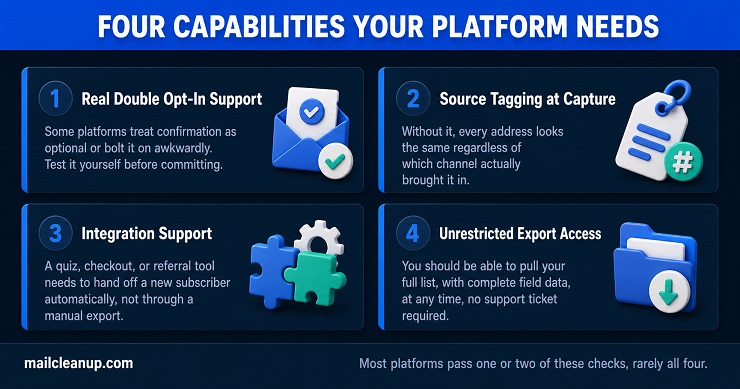
Four capabilities matter specifically for building a list well, separate from whatever else you need a platform to do:
- Real double opt-in support: Not every platform implements this the same way. Some treat confirmation as optional or bolt it on awkwardly. Test it yourself before committing rather than trusting a feature list.
- Source tagging at the point of capture: If your platform can’t tag a new subscriber by which channel brought them in, popup, checkout, contest, or referral, you lose something important. You lose the ability to ever separate your best channels from your worst ones. Every address looks the same regardless of where it came from.
- Integration support for the channels you actually plan to use: A quiz platform, a checkout flow, or a referral tool needs to hand a new subscriber to your ESP automatically. Not every platform accepts that handoff cleanly, and some require manual exports that quietly delay every new signup.
- Clean, unrestricted export access to your own list: You should be able to pull your full list, with complete field data, at any time. No support ticket or upsell conversation should stand in the way.
[What is an email service provider] covers the full comparison, feature breakdown, and pricing across specific platforms. What belongs here is narrower. These four capabilities determine whether you can actually execute the rest of this guide, regardless of which specific platform you land on. Getting this right is also part of knowing how to create an email list for business use specifically, not just a personal one.
The Different Types of Opt-In (and Why They Matter for Building an Email List)
Opt-in usually gets reduced to a binary: single opt-in is fast, double opt-in is safe, pick one. That binary hides four other variations most explanations of how to build an email list skip entirely. The difference between them isn’t a style preference. It’s the difference between a list you can actually trust and one you’re guessing about.
| Opt-In Type | How It Actually Works | Consent Strength |
|---|---|---|
| Implied / No Opt-In | An address is added with no signup action at all: an imported contact list, a business card, a name pulled from a public record | None |
| Single Opt-In | One action, usually a form submission, adds the address to your active list immediately | Low |
| Preselected (Pre-Checked) | A checkbox is checked by default during an unrelated transaction; the person has to actively notice it and uncheck it to avoid subscribing | Low, and increasingly non-compliant under stricter consent laws |
| Co-Registration | Agreeing to one signup also enrolls the address with unrelated third-party senders, often through vague or buried language | Low, with a high spam-complaint rate attached |
| Confirmed Opt-In | A welcome or confirmation message goes out after signup, but no click is required from the subscriber to activate sending | Medium, and genuinely disputed, more on that below |
| Double Opt-In | The subscriber must click a confirmation link in a follow-up email before the address becomes active on your list | High |
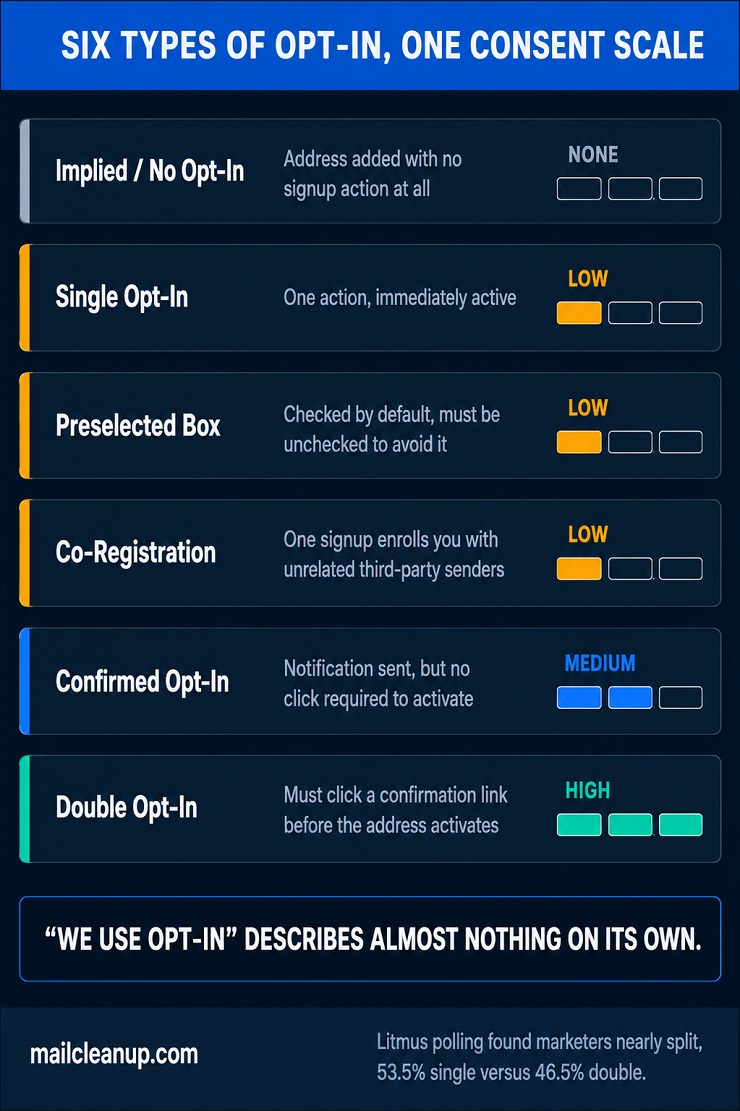
That “confirmed opt-in” row carries a caveat worth stating directly: the industry itself doesn’t agree on what the term means. Some providers use “confirmed opt-in” as a synonym for double opt-in. Others use it for exactly what the table describes above, a notification with no required click. That’s a meaningfully weaker standard than double opt-in despite the similar name. If a platform or a vendor tells you they use confirmed opt-in, ask directly whether a click is required. The answer changes which row of this table you’re actually in.
The tradeoff between single and double opt-in specifically is the one you’ll face most often. It’s real in both directions. A global poll of email marketers by Litmus found preferences nearly split, 53.5% favoring single opt-in against 46.5% for double. That alone tells you this isn’t a settled question with one obviously correct answer. GetResponse’s own benchmark research backs up why marketers still lean single. Teams using it typically see meaningfully faster list growth than teams requiring a confirmation click. Every extra step between form submission and active subscriber loses some percentage of people who intended to sign up but never finished.
Mailchimp is the most visible example of a major platform weighing that tradeoff and choosing volume. In 2017 they stopped recommending double opt-in company-wide after their own data showed confirmation completion rates had fallen to 37%. That means most people who started the process never finished it, the same tradeoff you’re weighing right now.
None of that makes single opt-in the wrong choice: it’s a real cost either way. Which cost you’d rather carry depends on what you’re building the list for. Double opt-in vs single opt-in breaks down that decision on its own terms. It covers the deliverability data and the regional legal differences that go beyond what fits here. What belongs in this guide is narrower: know which of the six rows in that table you’re actually implementing. “We use opt-in” describes almost nothing on its own.
On-Site and Content Channels for Building an Email List
Two mechanisms fall under how to build an email list through channels you already control. One is the forms and pages you design. The other is the content that earns organic traffic on its own.
Signup Forms and Landing Pages for Email List Building
Every method for how to build an email list eventually comes down to one moment. A person looks at a form and decides whether to fill it in. Where you put that form, and how much it asks for, changes the odds dramatically.
Independent benchmarking gives you a real range for each format. The exact figures vary by study, worth stating honestly rather than picking one number and calling it settled:
| Form Type | Typical Conversion Range | Best Use Case |
|---|---|---|
| Embedded (on-page) | Roughly 1% to 2% | Footer, sidebar, always-visible capture |
| Standard Popup / Modal | Roughly 3% to 5% | General-purpose, timed or scroll-triggered |
| Slide-In / Flyout | Roughly 3% to 4% | Less intrusive than a full popup |
| Exit-Intent | Roughly 2% to 4% | Last-chance capture before a visitor leaves |
| Fullscreen / Welcome Mat | Roughly 5% to 8%, sometimes higher | High-intent offers, worth the interruption |
| Dedicated Landing Page | Roughly 5% to 10%, sometimes higher | Paired with one specific lead magnet or campaign |
Stripo’s compiled benchmarks and Wisepops’s own data both land in this range, so you can trust the order even where the exact numbers differ. Both agree embedded forms convert lowest and dedicated landing pages highest. The gap between them is wide enough that where you place a form matters as much as how it’s designed.
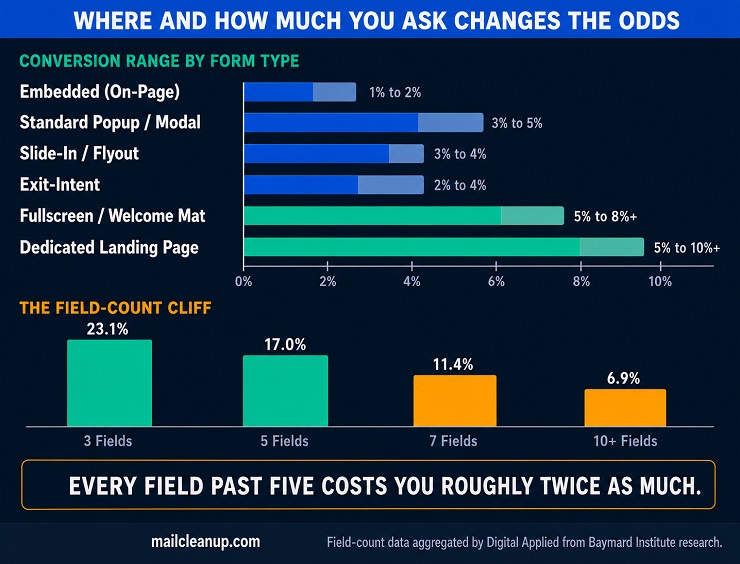
Field count matters even more than format. Independent research aggregated by Digital Applied, drawing on Baymard Institute’s usability studies, found a real cliff. Conversion runs about 23.1% at three fields. It drops to 17.0% at five, then collapses to 11.4% at seven and 6.9% at ten or more. Every field past five costs you roughly twice what it cost before that point. For your list-building form specifically, that argues for asking for nothing but an email address. Foundry CRO’s benchmark data puts single-field forms at roughly 25.5% conversion, well above every multi-field alternative here.
None of this means shorter or higher-converting is automatically better for building an email list that lasts. These numbers tell you who fills out a form, not who stays engaged six months later. A dedicated landing page paired with a relevant lead magnet tends to attract people who already know what they’re signing up for. A generic embedded footer form catches people almost by accident. Both count as a conversion in these benchmarks, but they don’t behave the same way afterward.
How to Build Your Email List Through Content and SEO
Content and SEO are the slowest channel in this guide, and for a lot of businesses, the highest-quality one. Someone who finds your article through a search engine came looking for an answer to a specific question. That’s a stronger intent signal than almost anything a popup can manufacture.
The mechanism is straightforward. You write something genuinely useful, and you rank for the terms people already search. Then you gate a related resource, like a deeper guide, behind an email address at the point where the reader is most engaged. This is usually called a content upgrade. It works because the offer matches exactly what the reader was already looking for, not a generic newsletter ask.
Three things set this channel apart from the paid and social channels covered next:
- The traffic is free once your content ranks: A blog post can keep bringing in subscribers for years after you publish it, with no ongoing spend.
- The intent is pre-qualified: Someone who searches how to build an email list for authors already knows what they want. Landing on a page written for that exact audience is a stronger signal than a random ad ever produces.
- It compounds slowly: Unlike a paid campaign or a viral post, content and SEO rarely spike for you. They build a steady baseline that keeps growing as more pages rank.
The tradeoff is time. Content you publish today can take months to rank meaningfully. This channel rewards your patience in a way the paid and social channels covered next don’t. This channel is the clearest general answer to how to build an email list for marketing, not tied to one business type. The same logic explains how to build an email list for affiliate marketing. Comparison and review content pre-qualifies a reader’s trust before they ever see a signup form.
How to Build an Email List Through Social, Paid, and Offline Channels
Social platforms, paid campaigns, and offline moments all offer a real path for how to build an email list. Each comes with its own mechanics, and its own tradeoffs.
How to Build Your Email List From Social Media
Social media offers another real path for how to build an email list, though each platform comes with its own limits. Those limits have gotten more specific, not less, over the past few years.
TikTok allows exactly one clickable link in your bio. That link only unlocks once an account reaches 1,000 followers or switches to a business profile. Captions themselves can’t carry clickable links at all. That makes the verbal call to action inside the video, not the caption, the thing that actually drives traffic.
Instagram offers a Notes feature at the top of DMs, visible to your followers. It works well for a short, direct promotion of a lead magnet. LinkedIn has its own native Newsletter feature, which builds a subscriber base directly inside the platform.
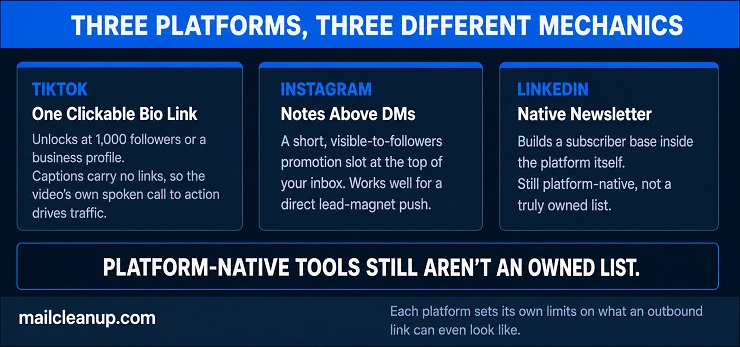
That last one deserves a caveat this guide has already made once: a LinkedIn Newsletter subscriber list lives inside LinkedIn, not in your own database. It behaves like a social following more than an owned list. It’s often high-quality, since a professional LinkedIn audience is already self-selected, but it’s still one platform decision away from disappearing on you.
Native lead ad formats on Facebook, Instagram, and LinkedIn deserve a specific quality note before you use them. These ads auto-fill a person’s email from their platform profile, so signing up takes one tap. That low friction is exactly why the completion rate looks great, and exactly why the signal is weaker. Someone who types their own email has done more to demonstrate intent than someone whose email filled itself in.
Paid Ads and Landing Pages for Building an Email List
Paid advertising offers another route for how to build an email list. The trade is straightforward: you convert rented attention on someone else’s platform into an owned address in your own database. You pay for that privilege.
The landing page you send that traffic to matters as much as the ad itself. Send paid traffic to your homepage and conversion drops. Send it to a dedicated page built around the exact offer, and it holds up close to the benchmarks shown earlier.
The quality question here is sharper than with most other channels, since you’re actively choosing who sees the offer. Broad, low-cost targeting brings in volume at the expense of relevance. Narrow, more expensive targeting brings in fewer signups that tend to look more like your actual customers. Neither approach is wrong on its own. The mistake is not knowing which one you’re running, then being surprised when a cheap campaign produces a list that barely engages. None of this replaces knowing how to build your email list through the slower, cheaper channels covered earlier.
Offline and Cross-Channel Ways of Building an Email List
Screens aren’t the only answer to how to build an email list. QR codes on packaging, receipts, event signage, or in-store displays route straight to a signup page. They close the gap between noticing something and signing up better than asking someone to type a URL from memory. Trade shows and in-person events work the same way, usually through a tablet or a paper form entered later.
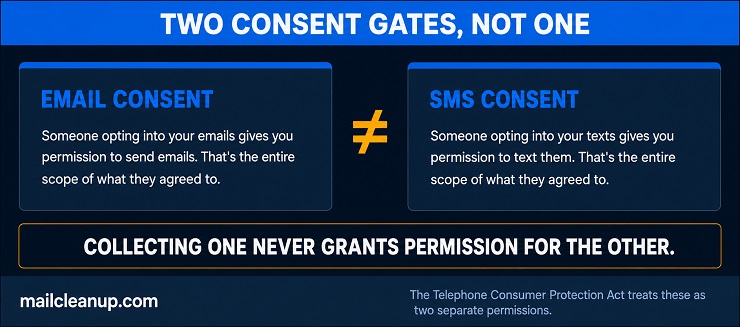
SMS-to-email cross-promotion is common, and worth one specific correction. SMS consent and email consent are legally separate. Under the Telephone Consumer Protection Act, having someone’s email address, even with full marketing consent, doesn’t give you permission to text them. The reverse is also true. Each channel needs its own opt-in, collected and documented on its own. That holds even when you’re building both lists at the same event or campaign. Treating one as automatic permission for the other is a common compliance mistake in cross-channel list building. It’s an easy one to avoid once you know the two aren’t linked.
Lead Magnets, Quizzes, and Other Incentive-Driven Ways of Building an Email List
The channels covered so far ask for an email address in exchange for access: to your content, your social presence, your ad, your storefront. This next group of channels answers how to build an email list around a different trade. You offer something specific in return for the address, and what you offer changes who signs up.
Lead Magnets and Gated Content for Building an Email List
A lead magnet is one of the most direct answers to how to build an email list. It’s whatever you’re trading for an address: a guide, a template, a calculator, a checklist, a short email course. The format matters less than one thing you control directly.
Specificity is the real lever, more than format. A broad “10 Email Marketing Tips” PDF underperforms a narrow, immediately usable resource. Think a subject-line swipe file for a specific industry, or a calculator that hands someone their own number back. The narrow version filters itself. Someone downloading a general tips guide could be almost anyone. Someone downloading a calculator built for their exact situation has already told you a lot about who they are before they’ve even typed their email.
This connects back to the earlier point about content and SEO. A specific lead magnet promoted through a specific piece of content reaches people who already searched for that exact problem. A generic one attached to a generic popup reaches whoever happens to be on the page. Both produce a signup. Only one produces a subscriber who already knows why they’re on your list.
How to Build Your Email List With Quizzes and Interactive Content
Quizzes and interactive content answer how to build an email list differently than a plain form does. A quiz offers value before it asks for anything, gives you segmentation data as a byproduct, and feels like a conversation rather than an interrogation. Someone who’s answered five questions about their own situation has invested more than someone who’s stared at a blank form. That investment is itself part of how to build your email list around genuine interest, not just a faster click.
Here’s the honest caveat this guide owes you, since almost nothing else covering this topic states it directly. Published conversion numbers for quizzes are unusually unreliable, and the pattern behind why is worth knowing. Search for quiz conversion benchmarks and you’ll find figures ranging from the high 20s to over 40 percent. Often, the source is a company that sells quiz-building software and happens to publish a number that flatters its own category. That doesn’t make quizzes ineffective. It means you should treat any single vendor’s headline statistic as marketing, not research, and test your own numbers rather than plan around someone else’s.
What you can trust is the direction, not the size. A well-built quiz tied to a specific, useful result tends to outperform a generic form. How much depends on your audience, your offer, and how good the result page actually is. It doesn’t depend on which company’s blog post you happened to read.
Contests, Giveaways, and Gamified Ways of Building an Email List
Gamified mechanics are one answer to how to build an email list fast: spin-to-win wheels, contests, giveaways. They’re the fastest way to grow raw numbers in this entire guide. The data backing that up is more credible than the quiz claims above. Claspo’s own platform data puts gamified forms at 9.18% conversion against a 3.53% baseline across all form types, roughly a 2.6x lift. Sleeknote’s analysis of over 26,000 popup campaigns found a 4.13% blended average across every conversion goal it tracked, including quiz completions and giveaway entries.
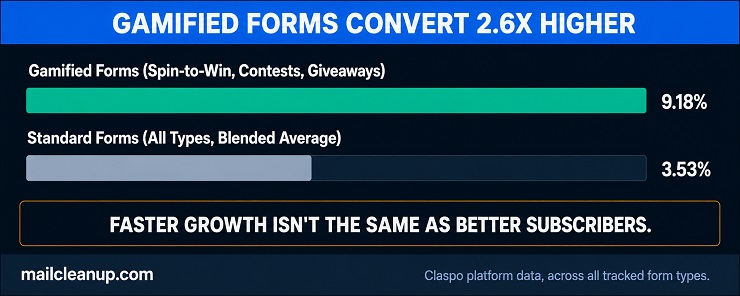
This is the clearest moment in the whole guide to apply the acquisition-quality lens directly. A giveaway entrant wants the prize, not necessarily your newsletter. That’s not a criticism of the tactic. It’s a description of what you’re actually optimizing for when you run one. The people gamification brings in skew toward whoever wants the reward most. That’s a different group than whoever wants what you’ll actually send them afterward.
That doesn’t mean skip it. It means running gamified campaigns with your eyes open about what they’re actually for. Use them for a specific push, like a launch or an event, not as the foundation of a list you’ll email for years. Pair a giveaway with a genuinely relevant prize, something only your actual audience would want, and you narrow the gap between entrant and subscriber considerably. That gap is exactly what separates knowing how to build your email list fast from knowing how to build one that lasts.
Referral Programs and Partnerships for Email List Building
Two distinct mechanisms fall under how to build an email list through referrals, and they behave differently. The first is direct referral. An existing subscriber shares a unique link. You reward them with a discount, a digital product, or a milestone perk when someone signs up. The second is newsletter-to-newsletter cross-promotion, where you pay another publication to recommend you to its readers, or vice versa. Typical payouts across this second model run roughly $1 to $3 per referred subscriber, sometimes higher for niche or high-intent audiences.
The quality story here is genuinely favorable, better than most of the channels covered in this guide. A direct referral carries an implicit endorsement. Your subscriber vouched for you to someone they know. That transferred trust tends to produce a more engaged signup than a cold ad ever could. Cross-promotion partnerships work almost as well when the two audiences genuinely overlap. They work considerably worse when the audiences don’t overlap, since the recommendation itself is doing less of the persuading.
Neither mechanism works without an existing base willing to participate. A referral program needs subscribers engaged enough to bother sharing. A cross-promotion partnership needs a list worth including as the recommended party in the first place. That makes this the one channel in this guide that compounds rather than starts your list from nothing. Keep that in mind if you’re building an email list from zero rather than trying to grow one that already exists.
The Email List Building Strategies Ladder: Ranking Every Channel by Risk
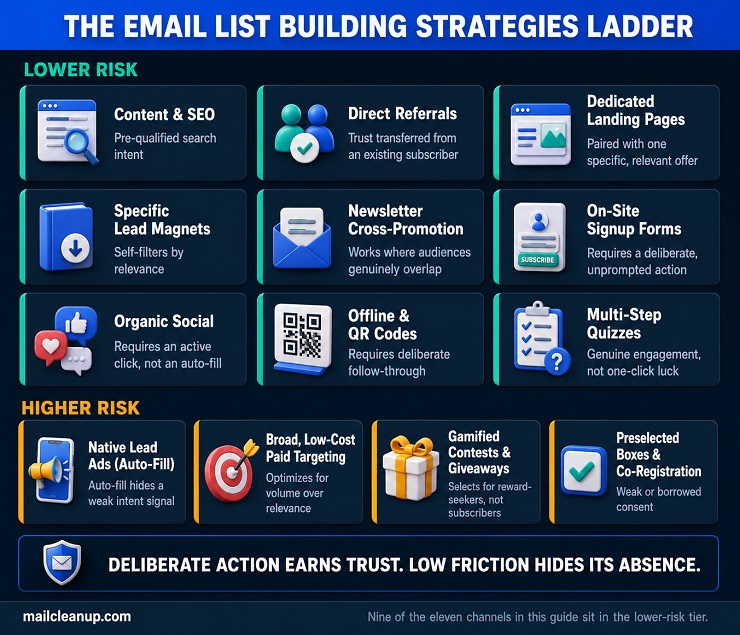
Every channel covered so far answers how to build an email list in its own way. None of them tells you which one to trust most. That’s what this section is for: ranking every real channel from this guide by long-term quality risk. Not by how fast it grows your number.
One honest limit before the table. This ranking runs on general, well-established logic. Verified intent beats unverified, a deliberate action beats an auto-filled one, and a channel you own beats one you’re renting. It isn’t a claim that MailCleanup’s own data proves any specific channel causes more decay than another. We don’t have a data cut that ties decay to acquisition method, and we won’t pretend otherwise. What our own tracking does show, in the Email List Decay Report, is that an unmanaged list decays fast regardless of how it was built. One 12-month cohort we tracked lost 23.79% within a year. That’s the general stakes this Ladder is trying to help you avoid, not a channel-by-channel scorecard.
| Channel | Tier | Why |
|---|---|---|
| Content & SEO | Lower | Pre-qualified search intent |
| Direct referrals | Lower | Trust transferred from an existing subscriber |
| Dedicated landing pages | Lower | Paired with one specific, relevant offer |
| Specific lead magnets | Lower | Self-filters by relevance |
| Newsletter cross-promotion | Lower | Works where audiences genuinely overlap |
| On-site signup forms | Lower | Requires a deliberate, unprompted action |
| Organic social (bio links, Notes) | Lower | Requires an active click, not an auto-fill |
| Offline & QR codes | Lower | Requires deliberate follow-through |
| Multi-step quizzes | Lower | Genuine engagement, not one-click luck |
| Native lead ads (auto-fill) | Higher | Low friction hides a weak intent signal |
| Broad, low-cost paid targeting | Higher | Optimizes for volume over relevance |
| Gamified contests and giveaways | Higher | Selects for reward-seekers, not subscribers |
| Preselected checkboxes, co-registration | Higher | Weak or borrowed consent |
Lower-Risk Tiers for Building an Email List
What unites the lower-risk tier isn’t speed or cost. It’s that the subscriber did something deliberate, and that action tells you something real about intent. That’s the actual test for how to build an email list that lasts, not how quickly the number moves.
That’s the whole premise behind these email list building strategies: rank by risk, not by raw speed. Content and SEO sit at the top for a reason already covered in this guide. Someone who searched for your exact topic and read your article has shown more genuine interest than almost any ad could manufacture. Direct referrals sit just as high, since the subscriber’s trust in the person who referred them transfers, at least partly, to you.
The rest of this tier shares a common trait: friction that filters rather than friction that annoys. A dedicated landing page paired with one specific offer. A lead magnet narrow enough to self-select its audience. A signup form someone chose to fill out unprompted. None of these guarantee you a highly engaged subscriber. All of them require the kind of deliberate action that a purely passive or auto-filled signup never asks for.
Multi-step quizzes belong here too, with one condition worth restating. The quiz has to actually require engagement, not just a single click framed as a game. A quiz that gives you five real questions and a genuinely personalized result earns its place in this tier. A “spin the wheel” mechanic dressed up as a quiz belongs in the tier below, regardless of what it’s called.
Higher-Risk Tiers for Building an Email List
What unites the higher-risk tier is the inverse: low friction that hides a weak signal, or consent that never really happened. This is the risk side of how to build an email list fast, and it’s worth naming plainly.
Native lead ads convert beautifully because the platform auto-fills the email field for you. That same convenience is exactly why the completion says less about intent than a typed-in address does. Broad, low-cost paid targeting has the identical problem at a larger scale. It buys you volume by deliberately relaxing relevance, which means the list grows faster and gets less engaged at the same time. Someone who searches how to create an email list for business use is usually asking exactly where on this Ladder to start.
Gamified contests and giveaways sit here for a reason this guide already named directly: an entrant wants the prize, not necessarily your emails afterward. That doesn’t make the tactic wrong. It makes the resulting list a different kind of asset than one built through deliberate action, and worth treating that way.
Preselected checkboxes and co-registration close out this tier, and they’re the two tactics closest to buying a list outright. A pre-checked box counts on someone not noticing it. Co-registration counts on vague language doing the work that a real opt-in should. Both will hand you a number. Neither produces the kind of consent this whole guide has been building toward. Every tier in this Ladder serves the same purpose: how to build an email marketing list that holds up months later. Understanding this Ladder also prevents most email list building mistakes before they happen, which the next section covers directly.
Email List Building Mistakes That Quietly Cost You Subscribers
Most lists of email list building mistakes repeat the same two items: don’t buy a list, don’t skip double opt-in. Both are true. Neither is the whole picture once you’ve read this far about how to build an email list well.
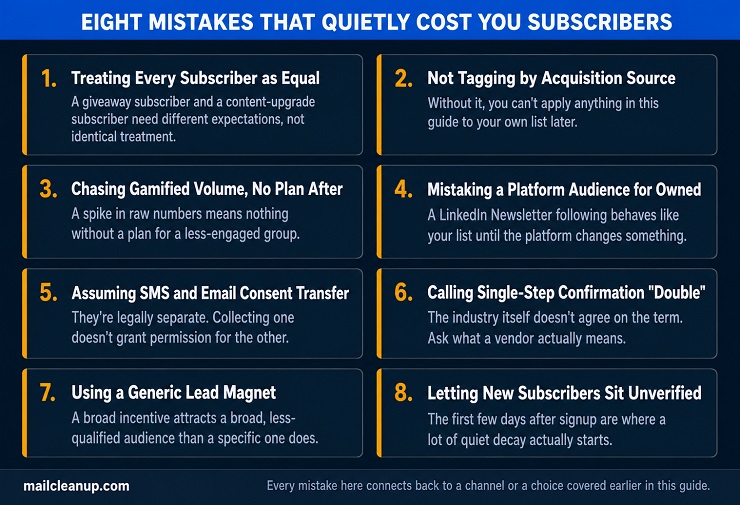
- Treating every subscriber as equal the moment they join: The entire Ladder above exists because that assumption is false. A subscriber from a giveaway and a subscriber from a content upgrade need different expectations, not identical treatment.
- Not tagging subscribers by acquisition source: If your platform can’t tell you where a subscriber came from, you can’t apply anything in this guide to your own list later. This is worth fixing before you scale any single channel.
- Chasing gamified volume with no plan for afterward: A spike in raw numbers from a contest means nothing on its own. It matters only if your welcome sequence and the weeks after account for a less-engaged group mixed into your list.
- Mistaking a platform-native audience for an owned list: A LinkedIn Newsletter following or a social audience behaves like your list until the platform changes something, and then it doesn’t.
- Assuming SMS and email consent are interchangeable: They’re legally separate. Collecting one doesn’t grant permission for the other, even at the same signup moment.
- Calling single-step confirmation “double opt-in”: The industry itself doesn’t agree on the term, which this guide covered directly. Ask what a platform or vendor actually means before you rely on the label.
- Using a generic lead magnet instead of a specific one: A broad incentive attracts a broad, less-qualified audience. Specificity does the filtering work for you before the signup even happens. Someone who searches how to build an email list for marketing usually finds this exact mistake near the top of the list.
- Letting new subscribers sit unverified: Whatever channel brought someone in, the first few days after signup are where a lot of quiet decay actually starts. Knowing how to build your email list well doesn’t stop at the signup form. The next section covers what to do about that.
How to Build an Email Marketing List for Different Business Types
Everything covered so far applies broadly, but the right mix of channels shifts once you factor in who you actually are. A B2B software company and a self-published novelist are both trying to figure out how to build an email list. They shouldn’t run the same playbook as you, and you shouldn’t run theirs either.
The five business types below aren’t equally weighted toward every channel this guide covers. Each one has a clear primary channel worth prioritizing first. Each also has a distinct answer to what “quality” actually means for that specific business type. None of this changes how to build your email list mechanically. It changes which channels deserve your first effort.
| Business Type | Primary Channel | Secondary Channel | What “Quality” Means Here |
|---|---|---|---|
| Marketing-led newsletters & content brands | Content & SEO | Referral & cross-promotion | The reader already wants your voice, not a product underneath it |
| B2B & SaaS teams | Specific, gated content | LinkedIn’s self-selected audience | Sales cycles run long; source tagging is what makes that survivable |
| Ecommerce | Checkout & post-purchase opt-in | Content & SEO | Purchase intent already demonstrated before signup |
| Affiliate marketing | Content & SEO | Referral & cross-promotion | Reader trust in your research, transfers to your list |
| Authors & content creators | Personal list for ARC recruitment | Referral & cross-promotion | A small, engaged list beats a big, generic one |
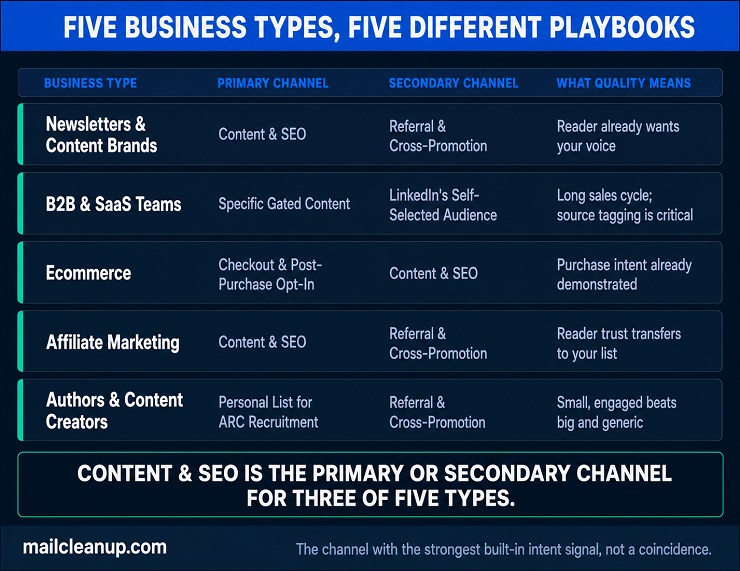
The pattern worth noticing: content and SEO shows up as the primary or secondary channel for three of these five types. That’s more than any other single channel in this guide, and it’s not a coincidence. It’s the channel with the strongest built-in intent signal. Intent matters more once you’re optimizing for a specific business model rather than a generic subscriber count.
How to Build an Email List for Marketing-Led Newsletters and Content Brands
If your business is the content itself, this guide’s answer to how to build an email list leans hard on one channel. Content and SEO should carry most of your weight. Readers who find you through search or a shared link already want what you’re offering, your writing, not a product underneath it. Referral and cross-promotion networks, covered earlier in this guide, do disproportionately well here too. One newsletter recommending another to a genuinely overlapping audience is close to a perfect match for this business type.
Paid acquisition works less well for a pure content brand than it does elsewhere in this guide. You’re asking someone to pay attention to writing, not to solve an urgent problem. That’s a harder sell through a cold ad than a specific product ever is.
How to Create an Email List for Business and B2B/SaaS Teams
B2B teams need a different answer to how to build an email list than a consumer brand does. It leans on two things this guide already covered: LinkedIn’s self-selected professional audience, and specific, gated content over generic newsletters. A whitepaper or a case study aimed at one clear role converts better than a general “subscribe for updates” ask. That’s the same specificity reason lead magnets work better narrow than broad.
The sales cycle changes what “quality” means for your list. A B2C list rewards fast engagement. Your B2B list often sits quiet for months before a subscriber becomes a real opportunity. That makes source tagging, covered in the platform section earlier in this guide, especially important. Without it, you can’t tell a slow-moving, high-value lead apart from an address that was never going anywhere.
Building an Email List for Ecommerce
Ecommerce has its own full answer to how to build an email list. Ecommerce email marketing covers the flows and lifecycle specific to your store. What belongs here is narrower: checkout opt-in and post-purchase capture are the two channels unique to selling something directly. A checkbox at checkout, left unchecked by default, catches subscribers who’ve already shown real purchase intent. That’s about as strong a signal as this guide covers anywhere.
How to Build an Email List for Affiliate Marketing
Affiliate marketers have a clear answer to how to build an email list: content and SEO, more than any other business type in this guide. Someone reading a detailed comparison or review has already done real research. Capturing their email at that moment produces a subscriber who trusts your judgment before they’ve even joined your list.
One compliance note specific to this business type. FTC disclosure requirements follow the content, not the platform. If your comparison post discloses affiliate links, the email version of that same content needs the same disclosure. Penalties run into the tens of thousands of dollars per violation. The requirement doesn’t relax just because the medium changed from a web page to an inbox.
How to Build an Email List for Authors and Content Creators
Authors have a use case none of the other business types in this guide share. It reshapes how to build an email list around one specific goal: recruiting an ARC team. ARC readers get an early copy of your book in exchange for an honest review at launch. If you’re a debut author, even 100 engaged subscribers typically yields enough volunteers for a real ARC team. Starting that list well before your book is finished, six to twelve months out is common advice, matters more than starting it big.
Referral and cross-promotion networks apply to your list just as they do for newsletters. Content, in your case chapters, short stories, or behind-the-scenes writing, functions as both the lead magnet and the reason readers stay.
Email List Building Best Practices for New Subscribers
Everything before this section covered how to build an email list, channel by channel. What happens in the first month after an address joins determines how much of that channel’s own quality actually survives. These are the email list building best practices that matter most once an address actually joins, not before. None of the practices below are complicated. All of them get skipped in practice.
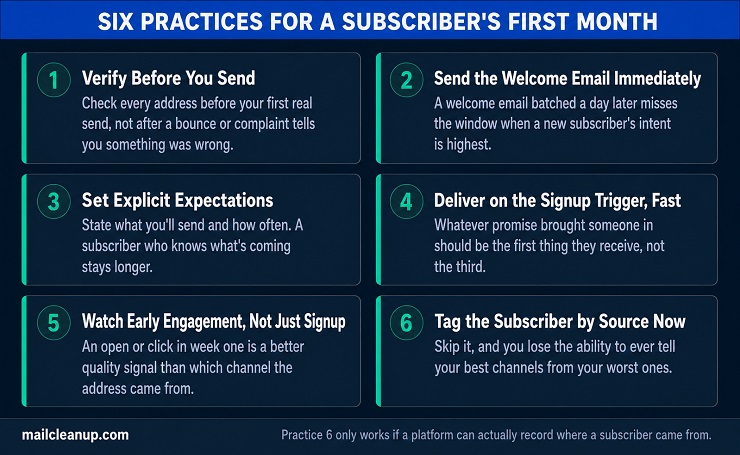
- Verify before you send anything real: Every channel in this guide funnels into the same first moment: an address joins your list. Check it before your first real send, not after a bounce or a complaint tells you something was wrong. This is squarely what we do at MailCleanup, and it’s worth doing regardless of which tool you use for it.
- Send the welcome email immediately, not batched: A new subscriber’s intent is highest in the minutes right after signup. A welcome email that arrives a day later, batched with everyone else who joined that week, misses that window entirely.
- Set explicit expectations in that first message: State what you’ll send and how often. A subscriber who knows what’s coming stays longer than one left to guess.
- Deliver on whatever triggered the signup, fast: If a lead magnet, a discount, or a specific promise brought someone in, that’s the first thing they should receive, not the third.
- Watch engagement in the first few sends, not just the signup itself: An open or a click in week one is a far better quality signal than which channel the address came from. Low engagement this early is worth acting on before it becomes six months of dead weight on your list.
- Tag the subscriber by source now, if your platform hasn’t already: The platform section earlier in this guide covers why this matters. Skip it, and you lose the ability to ever tell your best channels from your worst ones.
Someone who searches how to build an email list for affiliate marketing still needs every practice on this list. A trusted subscriber from a review post still decays without verification and a real welcome sequence.
Email list hygiene picks up from here. Regular cleaning, re-engagement, and the ongoing discipline that keeps a list healthy well past its first month.
Your Next Step After Building an Email List
Every channel in this guide, every tier on the Ladder, every business type above, converges on one action. That’s how to build an email list that actually lasts: verify what joined it before you build a sending reputation around it. Every one of the email list building best practices this guide covers points back to the same habit: verify first. That holds whether you searched how to build an email list for authors or arrived here from any other angle.
That’s not abstract advice. A syntax and domain check catches a mistyped address before it ever bounces on a real send. An MX-record check catches an address that looks fine but has nowhere real to deliver. That shows up as a hard bounce against your own sender reputation instead, if it’s never caught first. Neither check needs to know which channel the address came from.
That’s exactly the point: a subscriber from a confirmed opt-in form can still turn out to be a role-based inbox nobody reads. A subscriber from a gamified giveaway can still turn out to be a real, engaged reader. The channel predicts a tendency, not a guarantee for any single address, and verification is what actually tells you which one you’ve got.
Skip that step and the stakes are already on the record earlier in this guide. An unmanaged list decays regardless of how carefully it was built: 23.79% within a year, in the single cohort this guide’s own Ladder section cited. Whatever channel got someone onto your list, that’s the number working against you from day one. Verification is the one habit that applies no matter which of the eleven channels covered here you leaned on to get there. It’s the one part of how to build your email list that never becomes optional.
FAQs on Email List Building
How many subscribers do I need before I start seeing results?
It depends entirely on what you’re building an email list for. An author recruiting an ARC team gets real value from 100 engaged subscribers. Even a modest list yields 15 to 30 volunteers willing to read an early copy. A B2B list often needs far fewer, higher-value contacts instead. Results track engagement, not raw size.
Is it ever okay to buy an email list?
No. Every channel for how to build an email list, fast or slow, starts with a real person taking some action that signals consent. A purchased list skips that step entirely, and it shows immediately. Cold, purchased addresses routinely produce spam complaint rates several times higher than Gmail’s 0.3% threshold on the very first send.
Single opt-in or double opt-in: which should I use?
Neither is universally right. Litmus polling found marketers nearly split, 53.5% preferring single opt-in against 46.5% for double. GetResponse’s data shows single opt-in typically produces faster list growth, while double opt-in produces stronger proof of consent. Choose based on whether growth speed or verified intent matters more for how you’re building an email list.
How long does it take to build an email list?
There’s no fixed timeline, and anyone promising an exact number is guessing. Content and SEO-driven growth can take months to compound meaningfully. Authors typically start building an email list for ARC recruitment six to twelve months before a launch. Faster channels like paid ads or gamified signups can produce numbers within days, at a real quality cost.
Do I need a website to build an email list?
No, though it helps. Social media bio links, LinkedIn’s native Newsletter feature, and offline channels like QR codes all capture addresses without one. A website does make content and SEO possible, the highest-intent channel for building an email list this guide covers. It also gives you a dedicated landing page to pair with any lead magnet.
What’s a good lead magnet if I don’t have a big audience yet?
Specificity matters more than audience size for building an email list from a small starting point. A narrow, immediately useful resource, a calculator, a template, a swipe file for one specific situation, filters for relevance. It self-selects a real audience even without an existing following. A broad, generic incentive underperforms a specific one regardless of how many people see it.
How much does it cost to build an email list?
It can cost close to nothing to start building an email list. Content and SEO, referral programs, and organic social conversion require time more than money. Paid ads and gamified contests cost more directly but grow a list faster, often at a real cost to long-term engagement. Most businesses combine free and paid channels rather than choosing one exclusively.
What’s the fastest way to grow an email list?
Gamified signups, spin-to-win wheels, contests, and giveaways grow raw numbers fastest, sometimes 2.6 times faster than a standard form. That speed comes with a real tradeoff: entrants often want the prize, not necessarily your future emails. The fastest channel and the highest-quality channel for how to build an email list are rarely the same one. That’s the core tension in email list building.