
A welcome email series for a $15 candle and one for a 90-day SaaS trial aren’t the same problem wearing different colors. One needs to convert a decision the subscriber has basically already made. The other needs to prove real value before anyone commits to paying for it. Most advice on the welcome email series skips past that difference entirely. It hands you one generic length anyway: three or four emails, a discount somewhere in the middle, regardless of what you’re actually selling.
The length question is really a complexity question. How much justification does the buying decision, or the activation goal, actually need before someone’s ready to act? An ecommerce brand selling a low-consideration product can close that gap in a handful of emails. A SaaS company asking someone to adopt a new tool for their whole team needs more room to earn that decision. So does a nonprofit asking a stranger to trust it with a donation. That’s the actual variable driving every number in this guide, not a fixed rule to copy from somewhere else.
This guide walks through what a welcome email series actually is and how to size the length to your own business. It also covers what changes structurally at each length. It also covers how ecommerce, SaaS, B2B, newsletter, and nonprofit sequences differ in practice, with real examples for each. Then it covers the components, subject lines, CTAs, offer timing, and personalization that every high-converting welcome email shares regardless of length or business type.
TL;DR
- A welcome email series is a set of automated emails triggered by signup, moving through four stages: welcome, brand story, value showcase, and offer or close.
- The right length – 3 to 4 emails, 5, or 7 or more – depends on how much justification the purchase or activation decision needs.
- Ecommerce, SaaS, B2B, newsletter, and nonprofit welcome series each follow a different structure, since each is built around a different business goal.
- Sequencing an offer after real value has been shown builds a more durable relationship than leading with a discount.
- A welcome email fires on the freshest, least-verified segment of a list, making list verification part of welcome series performance.
- Click rate, activation rate, revenue per recipient, and 30/60/90-day retention lift measure welcome series performance more reliably than open rate, which Apple’s Mail Privacy Protection inflates.
What Is a Welcome Email Series?
A welcome email series is a set of automated emails triggered the moment someone joins your list, subscribes, or creates an account. It’s one piece of the broader picture our complete email marketing guide covers in full. Your platform watches for that one signup event, then releases each message in the sequence on a pre-set schedule, no manual sending involved. You set the trigger, the timing, and the content once. It runs for every new subscriber going forward, whether that’s your fifth or your five-thousandth.
It’s not one email. It’s a short campaign with its own arc:
- Introduce yourself
- Build the relationship
- Move the subscriber toward a specific action: a first purchase, an activated account, or a completed onboarding step
One Welcome Email vs. a Welcome Email Series
Sending a single thanks-for-signing-up note is better than nothing. But it wastes most of the opportunity in front of you.
The first email in a welcome sequence gets read at a rate that outperforms almost every other email you’ll send. Industry benchmarks put it anywhere from the low 50s to the high 80s percent. Open rate has gotten less reliable since Apple’s Mail Privacy Protection started pre-loading images for a large share of inboxes. That inflates the raw number, so treat it as directional for your own list. The relative gap between a welcome email and a routine promotional send still holds, though.
A single welcome email spends that attention once. A welcome email series spreads it across several emails, each with one job:
- Set expectations
- Tell your story
- Show what you actually offer
- Only then, make an ask
Welcome Email Series vs. Drip Campaigns and Other Automated Flows
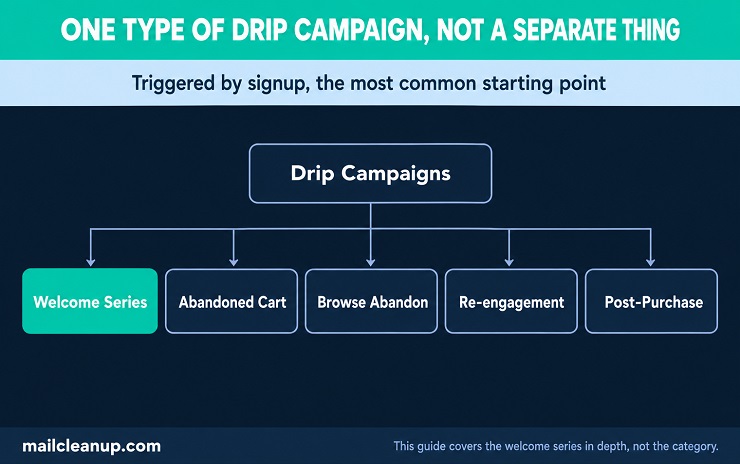
Your welcome email series is one specific type of drip campaign: the one triggered by signup. It’s usually the first automated flow you’ll set up as a business.
Drip campaigns as a category cover far more ground:
- Abandoned cart
- Browse abandonment
- Re-engagement
- Post-purchase follow-up
- Any other sequence triggered by a specific action or a gap in activity
If you’re deciding whether you need drip campaigns generally or a welcome series specifically, the welcome series is your starting point. It’s also the most common example [our full guide to email drip campaigns] uses to explain the mechanism.
How Long Should Your Welcome Email Series Be, and What Goes Into Each Length
Length isn’t one-size-fits-all for a welcome email series. Here’s what determines it, and what changes inside the sequence at each length.
The Decision Criteria: Matching Your Welcome Email Series Length to Complexity
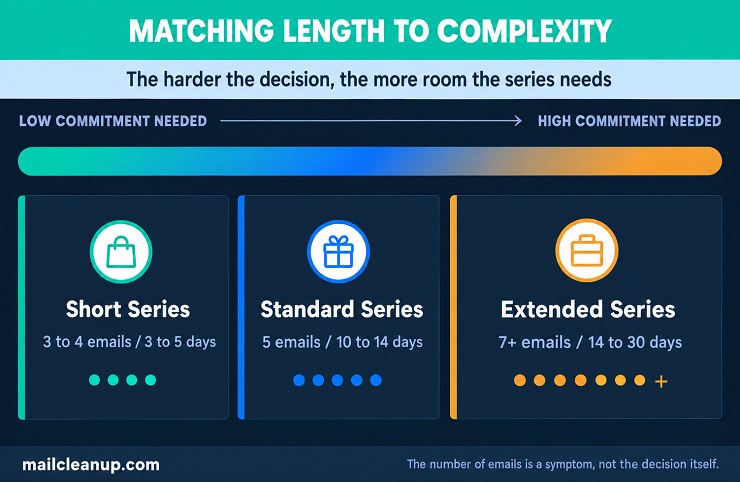
Mapping your welcome series email flow starts with one question: how long should your welcome email series run? That’s a business-model decision, not a preference. It comes down to how much justification the buying decision, or the activation goal, actually needs before someone acts. A subscriber deciding whether to buy a $15 candle needs almost none. A subscriber deciding whether to adopt a SaaS tool for their whole team needs to see it prove itself first. That’s exactly why the two shouldn’t run the same sequence.
If you’re selling something simple and low-consideration, most ecommerce at a low price point:
- 3 to 4 emails over 3 to 5 days
- First-email open rate commonly 60 to 86 percent
For a higher-consideration purchase or a brand-affinity goal, your mid-priced ecommerce, fashion, beauty:
- 5 emails over 10 to 14 days
- First-email open rate typically 55 to 78 percent, tapering to 30 to 40 percent
If you’re running SaaS onboarding, high-consideration goods, B2B, or subscription boxes:
- plan on 7 or more emails over 14 to 30 days for your series
- Your first-email open rate typically runs 50 to 70 percent, tapering to 25 to 35 percent
Treat those percentages as directional, not exact. Apple’s Mail Privacy Protection now pre-loads images for a large share of inboxes. That pushes every open-rate number upward, whether or not anyone actually read the email. The drop-off pattern across a longer series is the part worth trusting.
The most common mistake is going too long. A 10-email series for a $20 impulse purchase reads as harassment, not care.
A Short Welcome Email Series (3-4 Emails): What Gets Combined
Running a short welcome email series, you don’t have room for a dedicated email per stage. Two stages usually merge into one message. What a short series drops isn’t depth. It’s the number of separate moments you use to deliver that depth:
- A 3-email version, $60 home-goods brand – Email one leads with a free-sample offer. Email two combines the product story with the practical case for buying: materials, guarantee, support. Email three closes with a founder note and customer reviews together, doing the story and the social proof in one send.
- A 2-email version, specialty food brand – One email delivers a free sample plus a behind-the-scenes video. One reminder follows before it expires. You could run either shape if your own product has a strong enough hook to lead with.
- A 3-email version with no discount, mission-led apparel brand – Its sourcing practices, its repair program, its bestselling categories, no offer anywhere in the sequence. That filters for subscribers who want the brand for reasons beyond a coupon.
A Standard Welcome Email Series (5 Emails): The Default Structure
Five emails is the most common length for your welcome email series. Your series gives each of the four core stages its own moment, with room to split the busiest one.
Here’s the default structure:
- Email 1, Day 0: Welcome, deliver the promised value, often a discount, one clear CTA
- Email 2, Day 2: Brand story, no sales pressure, ideally from a named founder or team member
- Email 3, Day 4: Showcase specific products or use cases
- Email 4, Day 7: Reviews and social proof to address remaining hesitation
- Email 5, Day 10: Urgency, the original offer is about to expire
That five-email shape is one of the most common welcome email sequence templates to start from if you have nothing else to go on. It’s also consistent with what a well-built welcome series typically runs: three to five emails across the first one to two weeks. Conversion lands on the higher end, 30 to 50 percent, when the offer and audience line up.
A jewelry brand might layer a wishlist feature with a time-limited discount across that same 14-day window. A meditation app running the identical five-email shape over the same stretch would point it at habit formation instead of a purchase. It might close with a reflection prompt rather than an expiring code. A productivity tool might lead with a duplicate-this-template CTA in place of a discount, since its value is easier to show than to explain.
An Extended Welcome Email Series (7+ Emails): What Gets Added
If your welcome email series runs long, it doesn’t just repeat the same stages more slowly. It adds a stage you won’t find in a shorter series: one email per specific action, not one email per broad theme.
You’ll find a real SaaS company’s full seven-email breakdown, step by step, in the Business Type section below. The shape that repeats across your extended series generally looks like this:
- One email per milestone, not per broad topic
- A dedicated customer-story or social-proof email once trust needs reinforcing, not before
- A usage or progress summary near the end that prompts your next step: an upgrade, a renewal, a bigger ask
If you’re running B2B, expect to go even longer: 7 to 10 emails over 30 to 60 days. Lean on gated reports, case studies, and webinar invitations before the sequence asks for a sales call. That ask typically converts at only 1 to 4 percent of your list, far below ecommerce purchase rates. The deal sizes involved make the math work anyway.
| Length | Typical goal | What’s added or combined |
|---|---|---|
| 3-4 emails | First purchase | Two stages routinely combine into one email; a discount is optional |
| 5 emails | First purchase or brand affinity | Each core stage gets its own email; the busiest one occasionally splits |
| 7+ emails | Activation or long-cycle nurture | Action-specific emails get added on top of the core stages, one per milestone |
The Anatomy of a High-Converting Welcome Email Sequence
Every email inside your welcome email series is built from the same handful of components, regardless of business type or series length. These welcome email series best practices apply whether you’re running three emails or ten.
1. Subject Lines That Get Your Welcome Email Series Opened
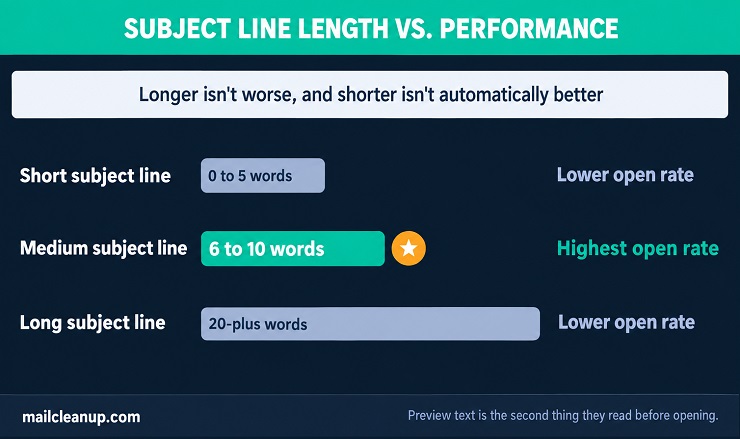
Shorter tends to perform better for your welcome email series, though not at the extreme. 6-to-10-word subject lines outperform both very short, 0-to-5-word, and very long, 20-plus-word, ones.
Personalize your own the same way if it fits. A jewelry brand naming the subscriber directly, tied to a wishlist feature rather than a generic greeting, is a strong illustration. It’s one of the better welcome email examples for personalization specifically.
Keep the preview text working too. It’s the second thing a subscriber reads before deciding to open, and a default snippet wastes that chance. Avoid manufactured curiosity here specifically: a subscriber who just opted in expects clarity, not a guessing game.
2. The Single Clear CTA Your Welcome Email Sequence Needs
Each email in your welcome email series should ask for one thing.
A welcome message crammed with five links and three calls to action doesn’t fail because the reader didn’t want to act. It fails because you never told them clearly which action mattered most. A jewelry brand’s welcome email layering value without diluting the ask is a good illustration. The primary CTA is building a wishlist, and a time-limited discount rides alongside it rather than competing with it.
Pick the single next step that matters most for that email, and build the message around it. That kind of restraint is what separates good welcome email examples from cluttered ones.
3. Offer Strategy: Why Your Welcome Email Series Needs More Than a Discount
Leading your welcome email series with a discount trains subscribers to wait for one before buying at full price.
Sequencing the offer later builds a more durable relationship, since by then you’ve already shown what makes your brand worth paying for. That doesn’t mean skip the offer. It means placing it deliberately, after the story and the value showcase.
A beauty brand or an outdoor apparel brand skipping the discount entirely are two welcome email series examples that lean on brand story instead. Both can outperform discount-led sequences on long-term value. That holds even when the initial conversion number looks lower.
4. Design and Personalization in a Welcome Email Sequence
In your welcome email series, personalization means more than a first name. It means using what the subscriber already told you:
- What they clicked to sign up for
- What they browsed
- What plan they’re evaluating
Use that to shape which product, feature, or story you lead with.
Match your own design to intent too. Most welcome email templates default to one visual style, regardless of what you’re selling. Most welcome email sequence templates make the same mismatch. A physical product can lean on rich imagery. A SaaS trial or newsletter usually reads better text-forward and lightweight, since the goal there is trust, not a visual sell.
A mattress brand makes the opposite case well. Because that’s a genuinely high-consideration purchase, its welcome series can lean on data-forward design: customer ratings and sleep-science graphics, not paragraphs. That same visual weight would feel cluttered coming from a newsletter.
Welcome Email Series by Business Type
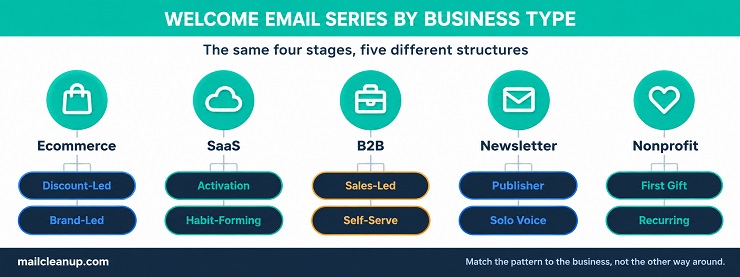
The four core stages hold regardless of what you’re selling. What changes is which stage gets emphasis, how much room the sequence gets, and whether a discount belongs in it at all.
Five business types cover most of what your welcome email series needs to handle: ecommerce, SaaS, B2B, newsletters, and nonprofit organizations.
Welcome Email Series for Ecommerce
A welcome series is one piece of a larger ecommerce email program, alongside abandoned cart, browse abandonment, and post-purchase flows. Our full guide to ecommerce email marketing covers how they all fit together. This section covers welcome sequences on their own.
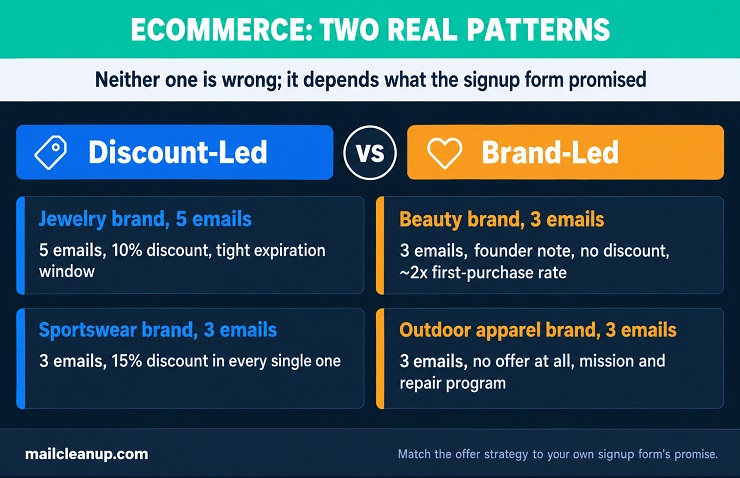
Ecommerce welcome sequences split into two real patterns, not one, and most guides only cover the first. The discount-led pattern leads with an offer because the signup itself, an exit-intent popup or a checkout-adjacent form, was usually traded for one. The brand-led pattern skips the discount entirely and leads with story instead, betting that the relationship converts on its own terms.
Neither pattern is wrong for your store. Picking between them depends on what your own signup form actually promised, and how differentiated your brand already is.
Discount-Led Ecommerce Welcome Email Examples: Structuring the Offer
These ecommerce welcome email examples show what that looks like. If your signup form promised a discount, your first email has to deliver it immediately. Holding it back after promising it reads as a bait-and-switch, and it costs you the trust the rest of your sequence depends on. Here’s what that looks like for you in practice:
- Jewelry brand Pandora, five emails over two weeks. The wishlist prompt in email one does double duty. It’s useful to your subscriber on its own, and it also captures exactly the sizing data Pandora needs to make later recommendations relevant. A 10 percent code rides alongside it, timed to run out soon enough that it doesn’t just sit unused. Every email after that keeps surfacing the same code, until the final one drops the soft reminders and states the deadline outright.
- Adidas takes the opposite approach: the same 15 percent code appears in all three of its emails, not just the first. None of the three runs long, either. That brevity is deliberate. A shorter email makes it harder to miss the one thing it wants a new subscriber to notice.
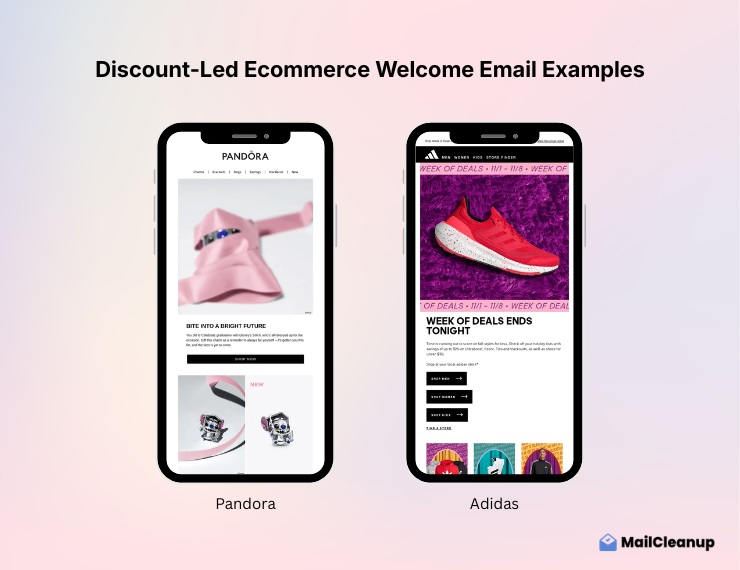
Design matters here as much as your copy does. A discount-led sequence tends to work best with fast-scanning, visually dense layouts, product shots front and center. Your reader already knows why they’re here and just needs a reason to click. Button copy is worth testing on its own, too. Phrases like Shop Now, Claim Your 15% Off, and See What’s New routinely produce different click-through rates, and the winner isn’t consistent across brands.
What is consistent is the failure mode: leading with the discount and never following up with anything else. A code alone gets you the first purchase and does nothing to justify a second one at full price. The same discipline matters in abandoned cart email, the other place a discount-led sequence shows up constantly in ecommerce.
Brand-Led Welcome Email Examples: Skipping the Coupon Entirely
A brand-led sequence bets that story and differentiation convert better for you than a percentage off does. It tends to work best when you already have a clear point of view, something distinct enough to lead with instead of a code.
- Beauty brand Glossier compresses its whole pitch into three emails, and none of them ask for a sale directly. You’ll notice the first is signed by the founder personally. It doesn’t push toward checkout at all, just an invitation to look around. The second narrows in on bestsellers matched to whatever category the subscriber said they cared about. Only the third asks you to consider anything transactional, and even then it’s the loyalty program, not a coupon. Glossier’s reported first-purchase rate on this sequence runs about double the category average. That’s a strange result for a brand you’d expect to lean on discounts, given its welcome series never once asks for a purchase.
- Patagonia goes further still: three emails, no discount mentioned anywhere. One covers its environmental commitments, one its repair program, one what actually sells well. The message underneath all three is blunt about who it’s for. If you’re hoping to find a coupon here, you’ll be disappointed, and that’s by design. Filtering out the discount-hunters at signup is what leaves Patagonia with a smaller list that’s worth more per subscriber.
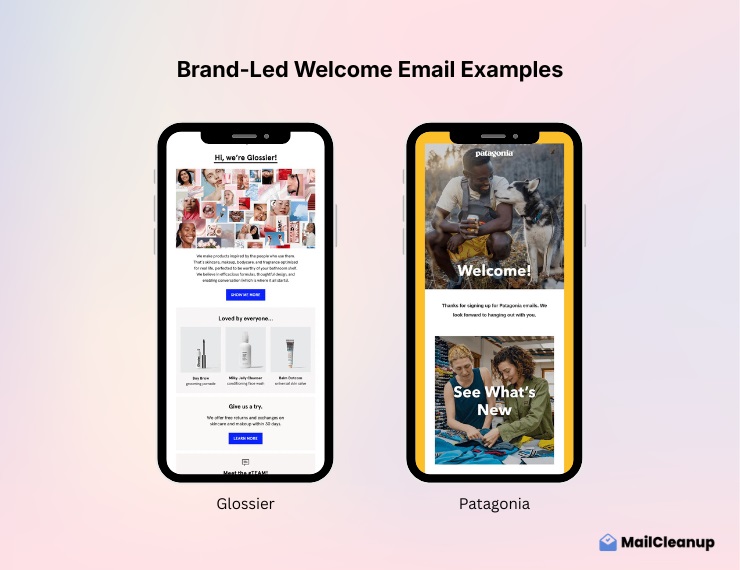
The tradeoff here is real, not theoretical. A brand-led welcome email series will likely convert fewer first-time buyers in the first few days than a discount-led one does. There’s no immediate incentive pushing anyone to act right now. What you tend to win back instead is long-term value. A subscriber who buys because they believe in your brand is worth more over the following year than one who bought for a code.
Weak sequencing, not the absence of a discount, is what actually sinks this pattern. A brand-led email with no product showcase anywhere in your first three sends reads as content marketing that forgot it’s supposed to sell something.
Welcome Email Sequence Examples for SaaS and Apps
A SaaS welcome email series isn’t measured by whether it gets opened. It’s measured by whether your subscriber does something specific inside the product.
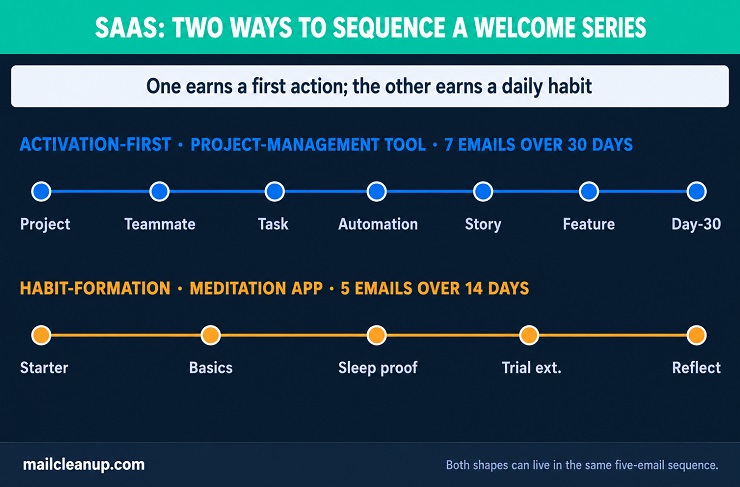
Two shapes cover most of what actually works for you here. Activation-first is built entirely around one measurable first action. Habit-formation is built around getting a user back often enough that your product becomes a routine, not a tool they forgot about.
Activation-First SaaS Welcome Email Examples: Structuring Around One Action
These SaaS welcome email examples start from the same problem. Roughly two-thirds of SaaS signups never reach the moment your product was actually built to deliver. Your welcome series is one of the few places you can push back against that directly.
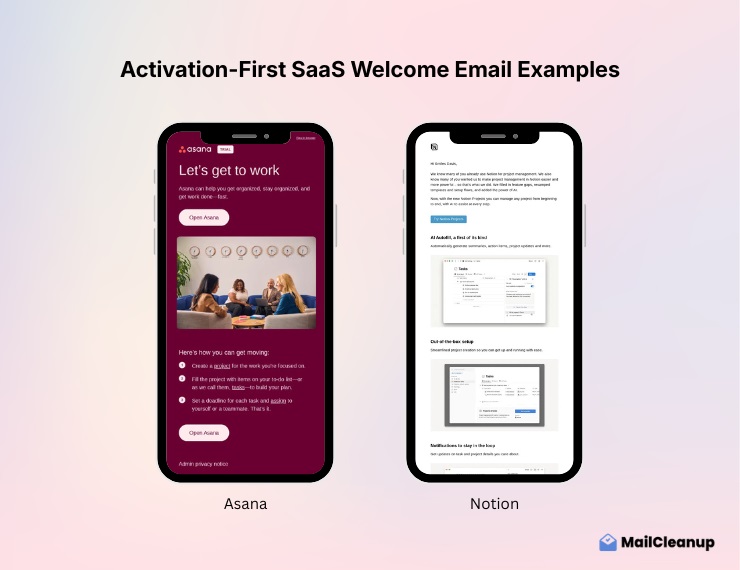
Your own version could look like Asana’s, which spaces seven emails across a full month and never asks for two things at once:
- A first project gets started before anything else is asked
- Only then does the sequence ask the user to bring in a teammate
- Then to hand that teammate an actual task
- From there it shifts tone, from setup instructions to proof, by way of a customer story
- Then to possibility, by way of a premium feature most users haven’t tried
- It closes at day thirty with a plain summary of what the account has actually done and an upgrade prompt sized to that usage
You could compare that to Notion, a shorter five-email version over the same two weeks, and its whole strategy is showing rather than telling. Instead of a blank workspace, you get something already built: a template ready to copy. The second keeps that logic going, offering ten more templates sorted by what the subscriber is actually trying to do. A product this abstract to describe in words earns more from one good example than from three paragraphs of explanation. Both tools send the identical first email to everyone, but you’ll see them branch hard after that.
A calendar-based “day 5 tips” email sent to someone who already activated on day one wastes that moment. The same email sent to someone still stuck arrives too late to actually help.
The average SaaS activation rate sits close to a third of signups. Treat every subscriber identically, and you’ll end up writing for the two-thirds who need help while boring the third who already got there.
Habit-Formation in a Welcome Email Sequence: Building the Daily Loop
Activation gets someone to try your product once. Habit formation asks for something harder from you: getting them back often enough that stopping would actually be noticed.
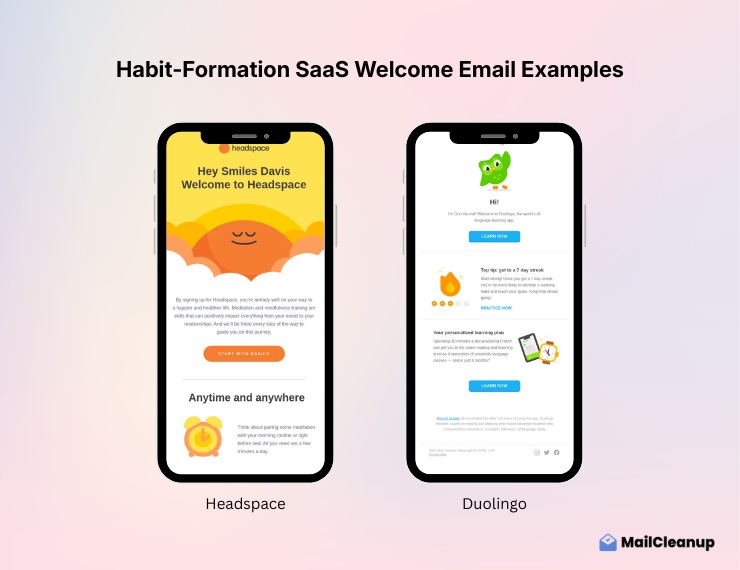
You could build your own the way Headspace does: five emails, aimed at a habit instead of a purchase:
- The opening email hands over something usable right away, a three-minute meditation, rather than explaining the app first
- The basics follow on day two
- Real user accounts of better sleep land on day four
- A trial extension arrives once the subscriber has had a week to actually notice a difference
- The last email, at day fourteen, doesn’t sell anything, it just asks how the two weeks went
Duolingo takes a pushier approach. Day one introduces the mascot and a five-minute first lesson tied to whatever language you picked. If you don’t come back the next day, the second email doesn’t stay neutral about it. It leans on the same mascot, now framed as disappointed that practice didn’t happen. A third message shows up only once there’s an actual streak worth celebrating.
The pattern only makes sense once you notice what Duolingo is really selling: a habit, not a one-time signup. A product like that needs its welcome series to keep doing re-engagement work long after the first email. That job doesn’t get handed off to a separate campaign.
You don’t have to pick one SaaS shape for your whole series. A five-email sequence commonly opens activation-first, since there’s no habit yet to reinforce. It then shifts into habit-formation language once activation fires. Building both into one sequence is what separates a real welcome series from a plain checklist with a subject line attached.
Welcome Email Series for B2B
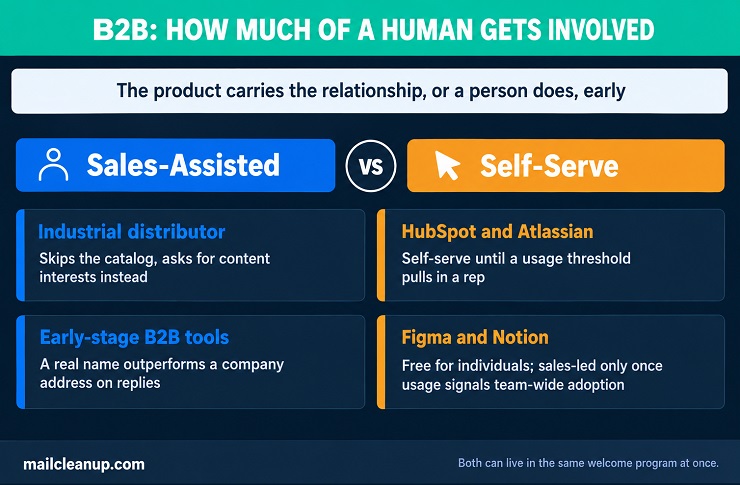
Your B2B welcome email series splits along a different line than ecommerce or SaaS does. It’s not offer versus story. It’s how much a human gets involved in closing the deal. Sales-assisted B2B leans on a real person early. Self-serve B2B lets the product carry the relationship until a usage threshold pulls a rep in.
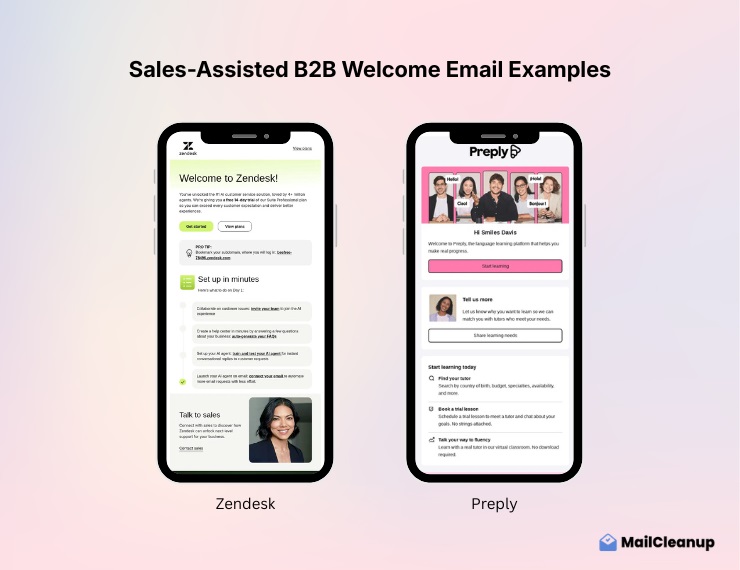
B2B Welcome Email Examples: The Sales-Assisted Sequence
Roughly three-quarters of B2B buyers say they’d rather avoid a sales rep entirely, at least at first. That’s exactly why your welcome sequence carries more weight in B2B than almost anywhere else. It’s often the only touchpoint you get before a real conversation happens.
If you’re running this pattern yourself, skip the catalog entirely in your email one. Ask the new subscriber for their actual content interests instead, a technique called progressive profiling. Build every email after that around what that account buys, not a generic product list.
Early-stage B2B tools push this further, often by having a real founder sign the first email instead of the brand. The reply rate difference is real. A name and a face gets treated as correspondence; a logo gets treated as a notification to dismiss. That only holds if your email earns the informality. A founder note stretched to five paragraphs with three links reads like a company email wearing a disguise. Aim for a couple of sentences and one request from you, not a pitch dressed up as a personal note.
B2B Welcome Email Examples: The Self-Serve, Product-Led Sequence
HubSpot and Atlassian both run a hybrid model now: fully self-serve at the bottom, sales-assisted once a usage threshold gets crossed. Their welcome sequences reflect that split directly.
You’ll notice the early emails here look almost identical to a SaaS activation sequence, one action per email, no sales language. What changes is what happens once an account crosses a defined product-qualified threshold: five seats invited, a usage cap hit, a key feature touched. At that point, your sequence hands off to a person instead of continuing as automated email.
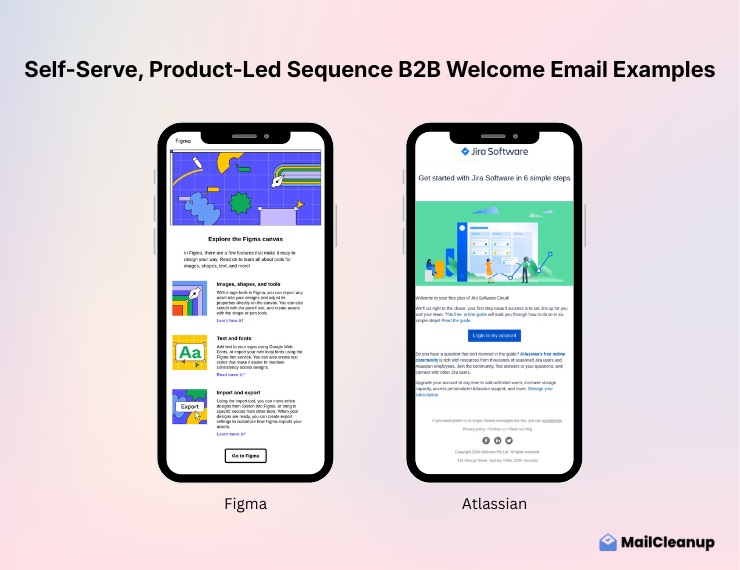
Design tool Figma and workspace tool Notion run recognizable versions of the same idea. The welcome series onboards individuals for free, and a completely separate, sales-led sequence starts only once an account shows signs of team-wide, paid-tier usage. You don’t have to pick sales-led or self-serve for your whole account base. Building both into the same welcome program is what actually captures both ends of a B2B buyer base at once.
Welcome Email Sequence Examples for Newsletters and Publishers
A newsletter welcome sequence answers a narrower question than any other business type here: will this subscriber open your second issue, not your tenth. Large publishers and solo creators solve that question differently enough to treat as two real patterns.
Welcome Email Series Examples: Large Publisher Cross-Sell
The New York Times runs close to a hundred newsletters. Its own team has said the point of that spread is exposing readers to coverage they’d otherwise miss. Your welcome email is a natural place to put that same strategy to work. Thank the new subscriber, then point them toward whichever other newsletter actually fits what they signed up for.
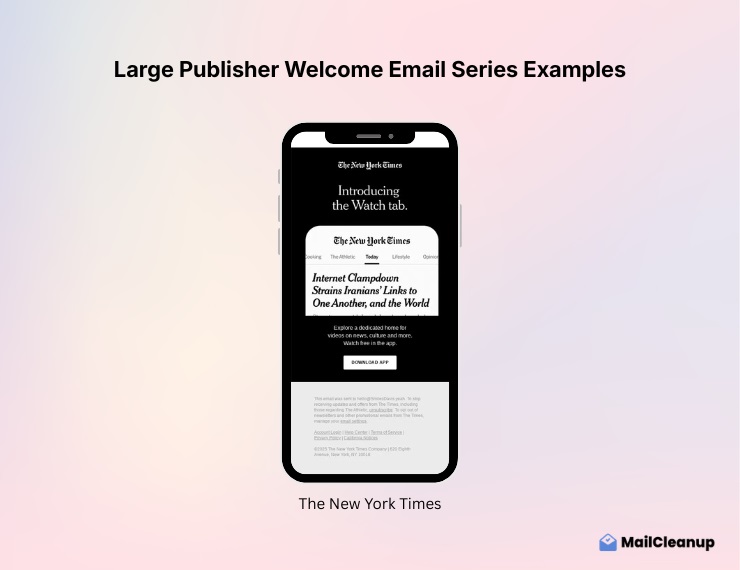
That cross-sell only works because the publisher already has genuine breadth to offer. If you’re running a single newsletter, you can’t borrow this pattern directly, since there’s nothing else to cross-sell into yet. What does transfer to your own list is the underlying instinct. Turn one subscription into a chance to build a habit reader, not just a one-off open.
Welcome Email Flow Examples: The Solo Creator’s Personal Voice
Independent writer Monica Lent runs Blogging for Devs, a newsletter and community for developers who want to grow their audience by writing online. Her welcome email reads like a note from her personally, not a brand. For a one-person newsletter, the writer’s voice is the entire product you’re subscribing to.
Anne-Laure Le Cunff’s Maker Mind, part of her Ness Labs newsletter, puts the same personal-voice thinking into its subject line rather than its body. Your subject line has room for exactly one strong impression before someone decides whether to open it. A flat “please confirm your subscription” wastes that whole slot on something the confirmation link inside your email was already going to handle.
Neither creator has a second product to cross-sell you into. What they’re selling instead is themselves: a specific voice worth returning for every week. That’s the entire value proposition your own solo welcome email needs to prove in one send.
Welcome Email Series for Nonprofit and Membership Organizations
Your nonprofit welcome email series isn’t selling a next purchase. It’s trying to turn a single gift into a second one. The data here isn’t encouraging: only 23 percent of first-time donors give again, per Association of Fundraising Professionals research. That makes this welcome series arguably higher-stakes for you than any other business type covered here.
Good Welcome Email Examples: The First-Time Donor Sequence
Charity: water is one of the clearest examples of storytelling doing the retention work a discount would do elsewhere. Its welcome message doesn’t lead with another donation ask. It leads with a specific story about where the donor’s money actually goes. Someone who already gave once doesn’t need to be sold again immediately.
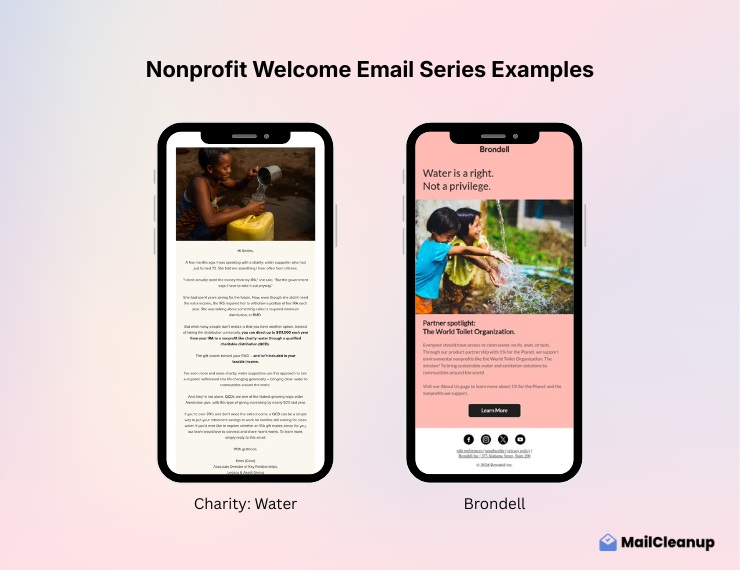
Brondell runs a similarly direct first email. It covers what the organization does, the mission it stands for, and how your contribution gets used. All of that lands concisely, rather than spread across a long series. Sixty-eight percent of donors say knowing the specific impact of their gift matters to them. That’s exactly what both organizations lead with instead of a second ask.
Welcome Email Sequence Templates for Membership and Recurring Donors
A membership or recurring-donor welcome series answers a different question than a first-time gift does. This person has already committed to an ongoing relationship, so your sequence’s job shifts from proving trust to reinforcing a decision they’ve already made.
Professional associations and membership organizations typically lead with logistical clarity: what the membership includes, when renewal happens, how to access member-only benefits. That’s a deliberately different opening than a first-time donor gets. A recurring member needs orientation from you, not persuasion.
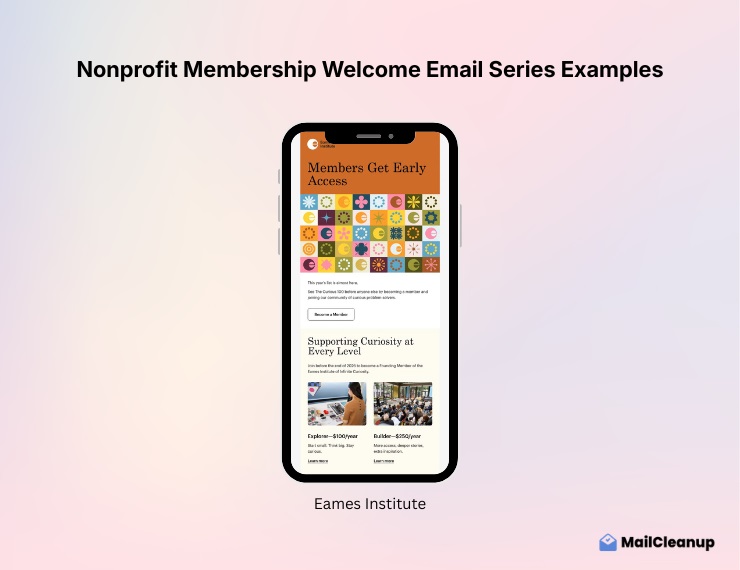
The best version of this sequence treats the relationship as ongoing from message one. Give the member a way to manage or adjust their own commitment, rather than only thanking them and moving on. A member who feels some control over the relationship stays in it longer than one who doesn’t.
Best Practices for a High-Performing Welcome Email Series
Everything below applies across business type and series length. These welcome email series best practices are what separate a sequence that performs from one that just exists. The welcome series email flow decisions behind them matter just as much.
1. Deliver the Promised Value in Your Welcome Email Series
Whatever your signup form promised, discount code, free guide, account access, deliver it in the first email, not the third. Most welcome email templates get this part right by default; where they fail is everywhere else in the sequence. A new subscriber who has to wait or dig for what they were told they’d get starts the relationship on the wrong foot.
This sounds obvious. It’s also one of the most common gaps between what a signup form promises and what the first email actually contains.
2. Personalize Your Welcome Email Sequence on Intent Signals
Real personalization uses what someone actually did to sign up. That might be a lead magnet they downloaded, a product page they viewed, or a plan they selected. A first name in the subject line isn’t personalization. It’s a mail-merge field.
3. Collect Preferences Early in Your Welcome Email Series
Ask new subscribers what they want, and your welcome series gets measurably easier to build well. A short preference question in email one or two, content type, frequency, category interest, gives you real signal early. You get that signal before you’ve sent anything that could go wrong.
The mistake isn’t skipping this step. It’s asking the question and then sending the same generic sequence to everyone regardless of the answer. A preference center only works if it actually changes what gets sent.
4. Protect Your Welcome Email Series with Suppression Rules
This is the single most under-used lever in welcome automation, and the one most welcome series skip entirely.
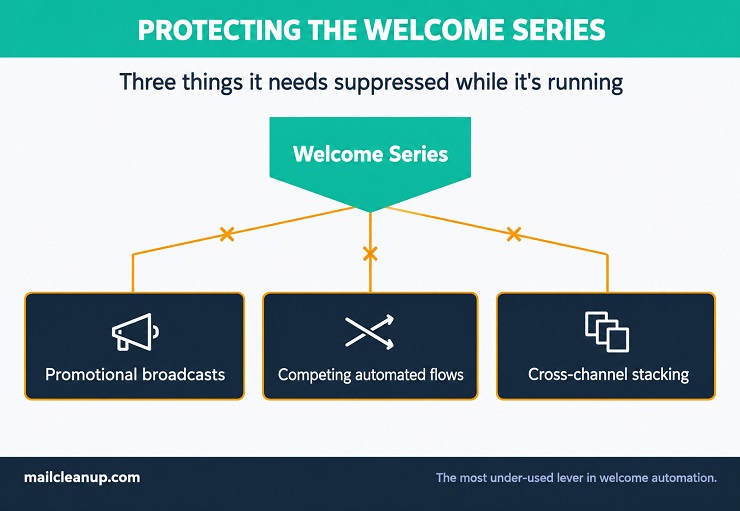
While someone is actively moving through your welcome sequence, suppress them from:
- Promotional broadcasts and calendar-triggered campaigns, seasonal sales, flash promos, that don’t match a new-subscriber context
- Other automated flows that could fire at the same time. A welcome email and a re-engagement email shouldn’t stack in the same inbox on one day
- Cross-channel sends stacking on top of email, SMS and push notifications competing for the same attention window
Without this, a new subscriber can get your welcome email at 9am and an unrelated promotional blast at 2pm the same day. That teaches them to tune out before the relationship has even started. Eric Miller, director of CRM and email at Tinuiti, put it plainly: subscribers still in a welcome series “aren’t ready for your full cadence. They’re still evaluating you and you haven’t earned their trust yet.”
5. Treat Your Welcome Email Series as a Living Program
A welcome series built once and never revisited degrades quietly. Audiences shift, offers change, and a sequence that converted well a year ago can underperform today without anyone noticing until the numbers are reviewed.
Review it on a set schedule, quarterly at minimum. Check three things: whether the offer still matches what you’re promoting, and whether the examples and proof are current. Also check whether performance has drifted from launch.
A/B Testing Your Welcome Email Series: What to Test First
Testing your welcome email flow examples against each other, one variable at a time, is how you find out what actually works. A welcome email series has more testable variables than almost any other email you send. Test one variable at a time across your full sequence, not one email in isolation. Keep the winner, then move to the next test.
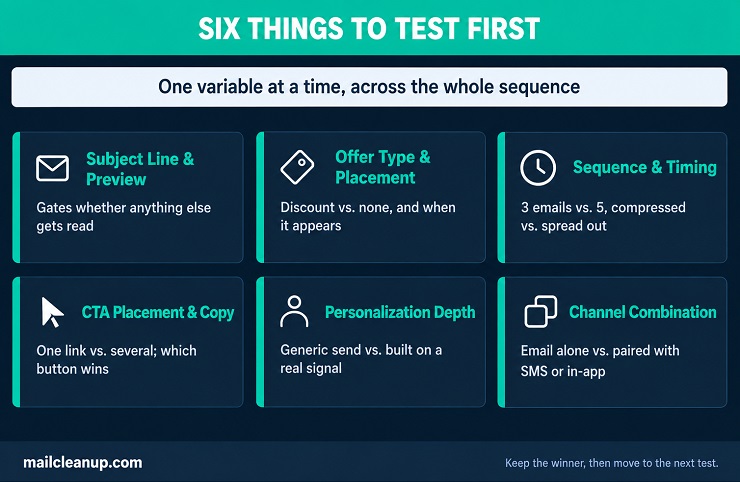
- Subject line and preview text: The highest-leverage test in the whole series, since it gates whether anything else gets read at all.
- Offer type and placement: Discount versus no discount, and whether it appears in email one or later in the sequence.
- Sequence length and timing: Three emails versus five, or the gap between sends, compressed versus spread out.
- CTA placement and copy: One link versus several, and which specific button language earns more clicks.
- Personalization depth: A generic send versus one built around your subscriber’s actual signup signal, lead magnet, plan tier, browsed category.
- Channel combination: Email alone versus email paired with SMS or in-app messaging for the same sequence.
Track outcomes on activation, conversion, and retention, not opens alone. Open rate is the least reliable signal available to you here, for the same Apple Mail Privacy Protection reasons covered earlier in this guide.
Measuring Welcome Email Series Performance
Open rate is the wrong primary metric for your welcome email series, for the same reason covered earlier in this guide. Mail Privacy Protection inflates it regardless of whether anyone actually read the email. Use it as a rough directional signal only, never as the headline number.
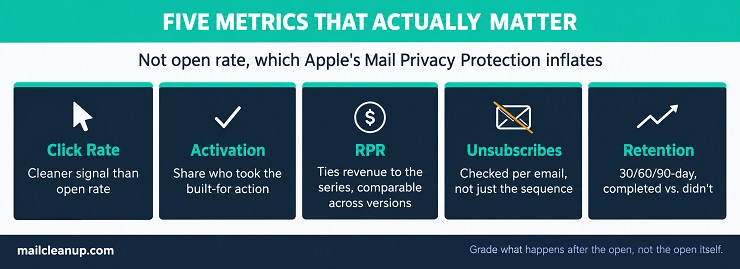
| Metric | What it actually tells you |
|---|---|
| Click rate | Someone did more than glance at the subject line, which is where genuine interest starts to show up |
| Activation or completion rate | The share of subscribers who took the specific action the series was built to drive |
| Revenue per recipient (RPR) | Ties real money to the series itself, the only way to know if one version genuinely beats another, not just gets more attention |
| Unsubscribe and complaint rate | Whether the series itself is driving people away, checked per email, not just for the sequence as a whole |
| 30/60/90-day retention lift | Whether the people who made it through the whole series stick around longer than the ones who didn’t finish it |
A welcome series that looks strong on open rate alone and weak on every metric in that table isn’t actually working. Grade it on what happens after the open, not the open itself.
Why Your Welcome Email Series Carries More Deliverability Risk Than It Gets Credit For
The welcome email in your series gets read at a higher rate than almost anything else you’ll ever send. That’s exactly what makes it risky in a way most advice never mentions.
It fires on the freshest, least-verified segment of your entire list. Those addresses were collected minutes or hours earlier through a signup form, with no history and no track record. That’s also the precise moment a mailbox provider is forming its first real opinion of you as a sender. A typo, a disposable address, or a fake signup lands in your welcome series before anything downstream ever catches it. That’s the exact problem double opt-in is built to filter out before it ever reaches this stage.
MailCleanup’s own verification data puts this in perspective, across our most recent two-month dataset:
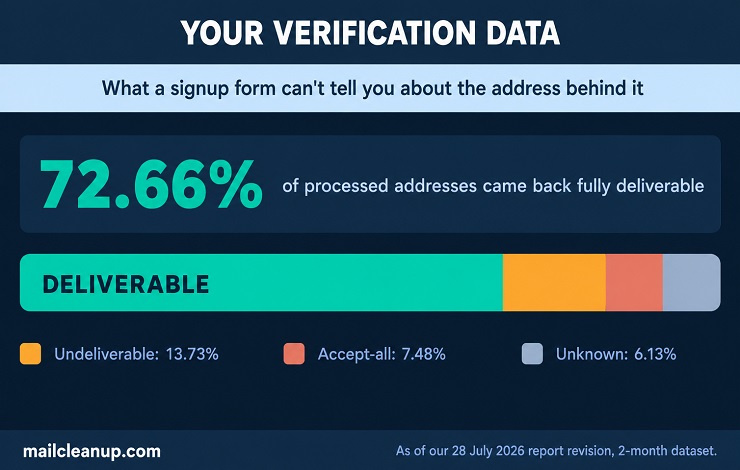
| Result | Share |
|---|---|
| Deliverable | 72.66% |
| Undeliverable | 13.73% |
| Accept-all | 7.48% |
| Unknown | 6.13% |
The bottom three rows, 27.34 percent combined, are categories a welcome series can’t distinguish from a genuine new subscriber on its own. None of that shows up in your open-rate or click-rate numbers directly. It shows up later, in sender reputation. Inbox providers quietly learn what your list actually looks like from the emails you send it most often. The practical fix isn’t complicated: run new signups through real-time email verification before the series fires, not after problems are already visible. Keep the rest of the list current with the same list hygiene discipline you’d apply anywhere else.
Welcome Email Series Mistakes to Avoid
- Running the identical sequence for every segment: A three-email template built for a low-consideration purchase, stretched across a SaaS trial or a B2B sales cycle, wastes what either one could do. That’s the core problem this entire guide is built around.
- Sending the first email late: Anything beyond a few minutes after signup gives up on the highest-attention window you’ll ever get with that subscriber.
- Treating personalization as a first-name field: A mail-merge token isn’t personalization. Real personalization uses what your subscriber actually did to sign up.
- Ignoring mobile rendering: Most welcome emails get opened on a phone first. A layout that only works on desktop loses the moment before the message is even read.
- Making every email an equally hard sell: A series that pushes an offer in every single message reads as pressure, not welcome. It trains subscribers to expect nothing else from you.
- Treating a reply as a dead end: A closing question that invites a real reply is one of the strongest engagement signals in the whole sequence. Most welcome series never ask one.
Turning This Into Your Own Welcome Email Series
Start with the length decision. Match it to how much justification your product or your ask genuinely needs, not to whatever number a template defaults to.
From there, build around the four core stages and adjust their weight to your business type. Use the patterns above as a starting point, not a script to copy exactly. Your ecommerce sequence should look different from your SaaS one. Both should look different again from a B2B or nonprofit sequence built for a longer relationship.
In addition to this, after finalizing your sequence, you should focus on email copywriting. This is because the email copywriting for all these industries also differ as they tend to have different style and follow different marketing formulas.
Lastly, verify the list your welcome series is about to run against before it fires. It’s the one step that protects everything else in this guide, and it’s the step most welcome series skip entirely.
FAQs About Welcome Email Series
How many emails should be in a welcome email series?
Most welcome email series run three to seven emails, depending on business type. Simple, low-consideration purchases need fewer, often just three or four. SaaS activation and B2B sales cycles need more room, typically five to seven or more, to earn a bigger decision.
When should the first welcome email send?
Send the first email in your welcome email series immediately, within minutes of signup, not hours or days later. Attention peaks right after someone subscribes, and that window closes fast. Even a same-day delay costs you meaningfully lower engagement across the whole sequence that follows.
Should a welcome email series include a discount?
Only if your signup form promised one. Discount-led and brand-led are both legitimate patterns for a welcome email series. Leading with a coupon you never promised trains subscribers to expect one before every future purchase, which costs you margin for no real reason.
Who should a welcome email series come from?
Either works, but they serve different purposes in a welcome email series – a founder-signed email tends to earn more replies, especially in B2B. A brand-voice email scales better once volume grows past what one person can personally read and respond to.
Does a welcome series actually outperform a single welcome email?
Yes. A single email spends the highest-attention moment in a subscriber’s lifecycle once, and then it’s gone. A welcome email series spreads that same attention across several emails instead, using each one to do a specific job rather than trying to do everything at once.
How long should a welcome email series run?
Typically three days to four weeks, matched to what you’re selling. A short ecommerce welcome email series wraps in under a week. An extended B2B or SaaS activation sequence can reasonably run thirty days or more, since those decisions take longer to earn.
What’s the difference between a welcome series and a drip campaign?
A welcome email series is one specific type of drip campaign, the one triggered by signup. Drip campaigns as a broader category cover far more ground, including abandoned cart, browse abandonment, re-engagement, and post-purchase flows, each triggered by a different action or gap in activity.
How do you measure whether a welcome email series is working?
Track click rate, activation or completion rate, revenue per recipient, and 30/60/90-day retention lift, not open rate alone. Open rate is inflated by Apple’s Mail Privacy Protection regardless of whether anyone actually reads the email, so it shouldn’t be your welcome email series’s headline metric.