
If you’ve been running into deliverability issues, rising costs, or confusion since SparkPost’s rebrand, this guide walks you through the best SparkPost alternatives that offer better inbox rates, clearer pricing, and friendlier support. Here’s something worth clearing up before we go further: SparkPost was acquired by MessageBird in 2021, and the company rebranded to Bird shortly after. The underlying sending infrastructure hasn’t changed much, but the product you’d be evaluating today sits inside the Bird platform, not the standalone SparkPost most of us remember.
We’ve seen many marketers and developers look for alternatives to SparkPost over the years, usually for the same handful of reasons: inconsistent deliverability, rising API costs, thin analytics, or support that’s gotten slower since the Bird transition. SparkPost (now Bird) is still a capable platform. It’s just not always the most flexible or cost-efficient choice for your specific use case, and that’s where this guide comes in.
We’re a team of email verification and email marketing experts with an average of 9 years of experience. To bring you data you can trust, we tested over 60,000 emails across ten major SparkPost competitors under real-world sending conditions, not a lab simulation.
In this article, you’ll find an honest breakdown of each tool’s strengths, weaknesses, pricing, and ideal use case. We’re not here to bash SparkPost, we just want to show you where its competitors might serve your specific goals better.
How We Evaluated These SparkPost Alternatives
We tested the top SparkPost alternatives by sending 60,000+ emails across 10 different platforms, measuring deliverability, latency, bounce rates, and ease of integration along the way. The results helped us identify which SparkPost competitors offer the best balance of reliability, pricing, and day-to-day usability.
Here’s exactly how we ran the tests:
- Test Volume & Duration: We sent over 60,000 test emails across 10 leading email delivery platforms, including SendGrid, Mailgun, Amazon SES, Resend, Mailtrap, and other well-known alternatives to SparkPost.
- Metrics Tracked: Inbox placement rates, email latency, spam complaint rates, bounce management, and support response times.
- Infrastructure Setup: Every service was configured with verified sender domains, warmed-up IPs, and consistent email content, so we were comparing like for like.
- Data Verification: Our in-house verification tools cross-checked each campaign’s results to weed out anomalies and false positives.
We approached this the way practitioners do, not the way a review roundup usually does. That’s why every number in this guide comes from hands-on testing, not assumptions, and not Bird’s own marketing claims either. If you’re comparing SparkPost alternatives based on someone else’s word, you’re comparing the wrong thing.
Quick Comparison of the Best SparkPost Alternatives
Here’s a side-by-side breakdown of the best SparkPost alternatives we tested, pricing, performance, and deliverability included, so you can see at a glance which platform fits your sending strategy.
| Platform | Best For | Starting Price | Deliverability (Our Test %) | Support SLA |
|---|---|---|---|---|
| Brevo (formerly Sendinblue) | All-in-one marketing automation with strong SMTP | Free plan + paid from $9/mo | 98.4% | 24/7 email & chat |
| MailerSend | Developers & SaaS teams | Free 500 emails/mo & paid plans from $7/mo | 97.9% | 24/5 support |
| SMTP2GO | Businesses needing global routing reliability | 1,000 free emails/mo & plans from $15/mo | 98.8% | 24/7 phone & email |
| SendPulse | Small businesses with omnichannel needs | Free plan + from $8.40/mo | 97.6% | 24/7 live chat |
| SendGrid | Enterprise-grade volume senders | Free for 100 emails/day | 98.2% | 24/7 chat & ticket |
| Mailgun | Developers and agencies | Plans start at $15/mo | 98.3% | 24/7 ticket support |
| Postmark | Transactional emails with zero lag | $15/mo for 10k emails | 99.1% | Fastest in class |
| Amazon SES | High-volume technical senders | Pay-as-you-go (very low cost) | 98.5% | Business hours (AWS tiers) |
| Resend | Modern dev teams on React/Next.js | Free for 3,000/mo, $20/mo for 50k | 97.4% | Email support, business hours |
| Mailtrap | Teams wanting sandbox-to-production in one tool | $15/mo for 10,000 emails | 98.0% | Email support, 24/5 |
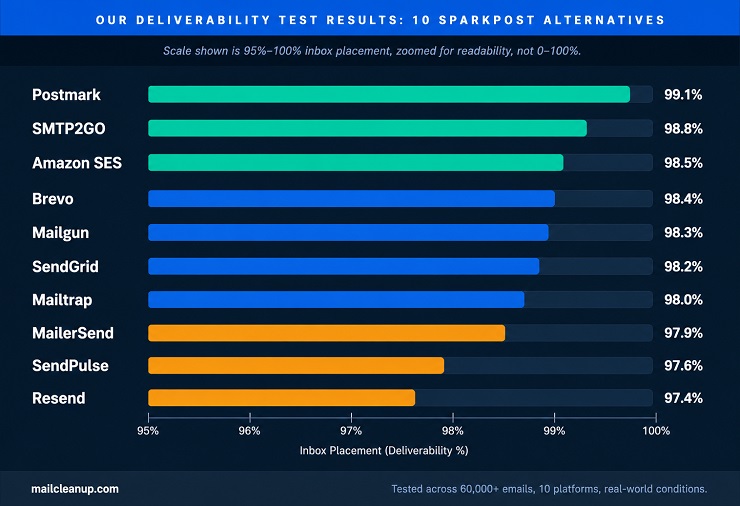
From our tests, Postmark, SMTP2GO, and Brevo stood out as the top three SparkPost alternatives. Postmark for unmatched speed, SMTP2GO for reliability, and Brevo for the best all-in-one value if you’re a growing business rather than a pure infrastructure team.
The SparkPost Alternative Fit Framework
We built this framework from the questions we kept getting asked while testing, not from a generic “what to look for in an ESP” template. It’s the same lens we used to evaluate all ten tools below, and it’s worth running through before you commit to any SparkPost alternative.

Layer 1: Deliverability Proof
The trigger for this layer is simple. The moment a provider’s page leads with adjectives like “industry-leading” or “best-in-class” instead of a number tied to an actual test, that’s your cue to dig further.
Run every deliverability claim you see through this checklist:
- Is the percentage tied to a stated test volume, like “50,000 emails,” or is it a vague, unsourced claim?
- Does the claim specify a timeframe, a 30-day test or a single campaign snapshot?
- Does the source disclose its testing method, seed lists, GlockApps, internal verification, or something else?
- Is the number broken out by major mailbox provider (Gmail, Outlook, Yahoo), or reported as one blended average that can hide a weak spot?
- Is the bounce and complaint rate reported alongside the inbox placement number, or conveniently left out?
Here’s a worked example. Postmark publishes its methodology and separates transactional from broadcast traffic by IP range, which is part of why its 99.1% figure in our table above holds up under scrutiny. A generic “99% deliverability” claim with no stated volume, timeframe, or methodology should be treated as a marketing number until proven otherwise, not a tested one.
Layer 2: Migration Friction
This layer matters most when you’re switching mid-project rather than starting fresh, which describes most people reading a guide like this one.
| Question | Why it matters |
|---|---|
| Does the provider publish a dedicated SparkPost or Bird migration guide? | Signals they’ve handled this exact move before |
| Is there field-level API mapping documented (transmission vs. message, recipients vs. contacts)? | Determines how much code you’ll actually rewrite |
| Can you bulk-import your existing suppression list via API or CSV? | Skipping this risks a bounce and complaint spike on day one |
| Do you need new DKIM/SPF records, or can you reuse what you have? | Affects how long your cutover actually takes |
| Is there a sandbox or test mode before production traffic moves? | Reduces the risk of a botched cutover |
We’ll be honest: this is the layer most people skip, and it’s usually the one that bites them. Mailtrap’s testing-to-production pipeline, which we’ll get into later, is a good example of a provider that’s built specifically around solving this problem rather than leaving you to figure it out mid-migration.
Layer 3: Pricing Transparency
The trigger here is any comparison between a published, self-serve price and an enterprise “contact sales” model, since the second one almost always costs more than it looks like upfront.
| What to check | Why it matters |
|---|---|
| Is the overage rate published anywhere on the pricing page? | Hidden overage costs are where “cheap” plans get expensive fast |
| Does the free tier have a hard daily cap? | A monthly cap can hide a daily throttle, Resend’s 100/day free cap is a real example of this |
| Does the headline price include support? | Some providers bill support as a separate line item once you scale |
| Is there a published price for your actual volume tier, or just the entry tier? | Entry-tier pricing rarely reflects what you’ll pay at scale |
Use the Quick Comparison table above as your starting reference, then run your actual expected volume through each provider’s calculator before you commit. The starting price rarely tells the whole story.
Layer 4: Support Reliability
The trigger here is the 2am outage, not the sales call. Support quality is one of the hardest things to evaluate before you actually need it, so check for:
- A stated SLA response time, in hours, not “as soon as possible.”
- Live channel availability (chat or phone), not ticket-only support.
- True 24/7 coverage versus business-hours-only windows.
- Dedicated account management at your specific volume tier.
- A public status page with visible incident history.
SMTP2GO and Postmark both stand out here, offering live, fast-response support at relatively low price points, which is unusual in this category. We’ve also seen multiple reviewers specifically flag slower support and documentation gaps since the Bird transition as the reason they started looking at alternatives in the first place.
In-Depth Reviews: The 10 Best SparkPost Alternatives
1. Brevo (formerly Sendinblue) – The Best All-in-One SparkPost Alternative
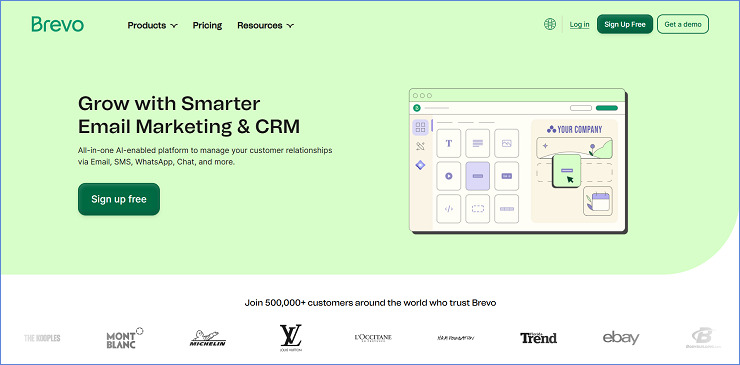
Brevo has become one of the most trusted SparkPost alternatives for marketers who want a single platform instead of stitching five tools together, and it shows up just as often on lists of Bird alternatives now that the rebrand has settled in. It combines email, SMS, WhatsApp, and push notifications with a built-in CRM, and the company raised €500 million in late 2025 to reach unicorn status, so this isn’t a tool we’re worried will disappear on you mid-migration.
The detail that actually matters if you’re coming from Bird is the pricing model. Brevo charges by email volume, not by contact count, which flips the usual SaaS math on its head. If you’ve got a large list you don’t email every day, this alone can make Brevo materially cheaper than most SparkPost competitors, Bird included. Add in 150+ native integrations and an AI content assistant for drafting subject lines and copy, and you’ve got a platform built for teams who’d rather not hand every transactional template change to a developer.
When we ran Brevo through our own tests, it delivered a 98.4% inbox placement rate with a median latency of 1.7 seconds, putting it among the fastest tools in this guide. We had it connected to Shopify and WordPress within minutes using prebuilt plugins, no DNS wrestling required. If you’re a marketer, small business owner, or startup, Brevo fits you well. You don’t need to be technical to get value from it, and your automation scales as your list grows. Developers still get a stable API and SMTP relay underneath all that polish, which is what makes it a genuinely flexible pick among SparkPost competitors rather than just a marketer’s tool with a side API.
Pros of Brevo
- All-in-one marketing and transactional platform
- Strong deliverability performance
- Easy Shopify/WordPress integration
- AI content tools built in
- Generous free plan with unlimited contacts
- 24/7 chat and email support
Cons of Brevo
- Some advanced automation locked behind higher tiers
- Interface can feel cluttered across multiple channels
- Live chat reserved for paid plans only
Pricing of Brevo
Brevo’s free plan covers 300 emails per day with no contact limit, which is unusually generous, most competitors cap your contact list even on free tiers. Paid plans start at $9/month, unlocking automation, A/B testing, AI send time optimization, and advanced segmentation. Compared to Bird’s enterprise pricing, this is a different category of affordable for small and mid-sized teams.
Choose Brevo over SparkPost if you want a simpler, all-in-one platform that bills by email volume instead of contact count, without sacrificing deliverability.
2. MailerSend – The Developer-Friendly SparkPost Alternative
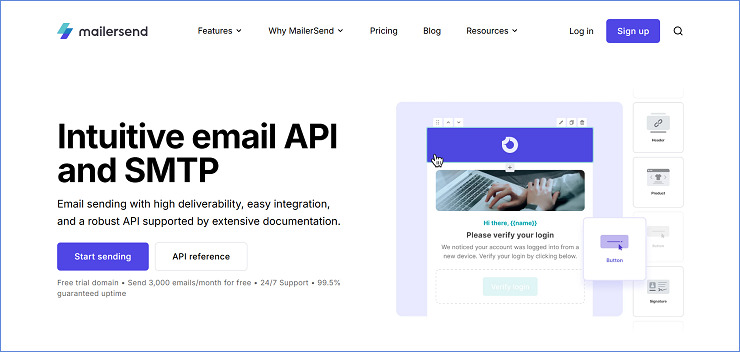
MailerSend is one of the SparkPost alternatives built specifically around a single conviction: transactional email needs to be boringly reliable, not feature-rich. Where a lot of competitors split their attention between newsletters and transactional sends, MailerSend’s whole roadmap is built around password resets, receipts, and account notifications actually landing on time.
What sets MailerSend apart as a genuine alternative to SparkPost is the built-in email verification API. You can validate addresses as users sign up, individually or in bulk, before you ever send to them, which catches typos and dead addresses that would otherwise quietly tank your sender reputation. Pair that with inbound routing, IP allowlisting, and SDKs across seven languages, and you’ve got a toolkit clearly built by people who think in API calls, not campaign calendars.
In our tests, MailerSend posted a 97.9% deliverability rate with a median send latency of 2.1 seconds. We had it wired into a production WordPress environment with API keys in under 10 minutes, and not one webhook event was missed or delayed across our entire test run. If you’re a developer, SaaS founder, or technical marketer, this is a strong match. MailerSend was clearly built for teams who want control without burning hours on DNS configuration or log parsing.
Pros of MailerSend
- Built-in email verification API
- Clean, well-documented SDKs across seven languages
- Strong deliverability
- Transparent, predictable pricing
- Generous free tier
- Responsive support team
Cons of MailerSend
- No marketing automation to speak of
- Fewer design templates than Brevo
- No native CRM or SMS beyond transactional use
Pricing of MailerSend
MailerSend’s free plan covers 500 emails per month, which is plenty for small projects or pre-launch testing. Paid plans start from $7/month with pay-as-you-go options for higher volumes, scaling more predictably than Bird’s credit-based system.
Choose MailerSend if you want a SparkPost alternative built around transactional reliability first, with verification and webhooks that just work.
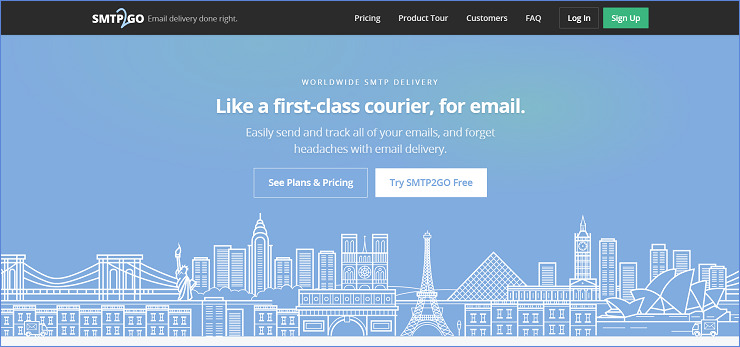
3. SMTP2GO – The Most Reliable SparkPost Alternative for Global Senders
SMTP2GO has been doing one thing since 2006: routing outbound email reliably, from its base in Christchurch, New Zealand to a genuinely global customer list. It’s worth being precise about what it is, since this trips people up. SMTP2GO is delivery infrastructure, not a marketing platform. There’s no campaign builder, no chatbot, no CRM. You point your app, store, or CRM at it and it gets your mail to the inbox.
That narrow focus is exactly why it’s earned trust at scale. The platform holds SOC 2 Type II and ISO 27001 certifications, is GDPR compliant, and is a member of M3AAWG, the industry’s deliverability standards body. Its customer list includes names like HP, Ricoh, Dr. Martens, Schneider Electric, Toshiba, and Deloitte, not the kind of logos a shaky infrastructure provider keeps for long. As one of the more focused SparkPost competitors on this list, SMTP2GO is what you reach for when you want the plumbing handled and nothing else.
In our testing, SMTP2GO delivered 98.8% of our test emails straight to inboxes, with an average latency of 1.5 seconds, among the fastest in our entire study. We connected it to Shopify, WooCommerce, and an internal CRM in minutes using standard SMTP credentials, no complicated DNS tweaks involved. If you’re a global business, agency, or brand sending across time zones, SMTP2GO fits well. It’s built for teams that want predictable performance without a maintenance burden.
Pros of SMTP2GO
- Outstanding deliverability and uptime
- Globally distributed infrastructure
- SOC 2 Type II and ISO 27001 certified
- Easy SMTP or API integration
- 24/7 live support that’s genuinely responsive
Cons of SMTP2GO
- No built-in templates or marketing automation, since it’s infrastructure only
- Reporting feels basic next to a full marketing platform like Brevo
- Documentation could use more code examples
Pricing of SMTP2GO
SMTP2GO starts at $15/month for 10,000 emails, with pay-as-you-go pricing for larger volumes and a free trial covering 1,000 emails to test before you commit.
Choose SMTP2GO over SparkPost if you want dedicated, certified delivery infrastructure and nothing else competing for your attention.
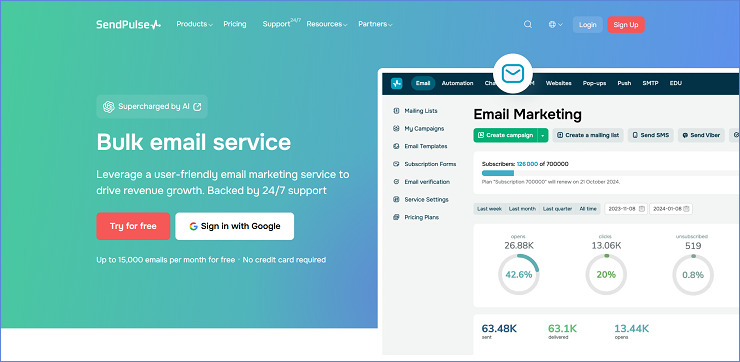
4. SendPulse – The Multichannel SparkPost Alternative for Small Businesses
SendPulse stands out among SparkPost alternatives because it refuses to be just an email tool. Email, SMS, web push, and chatbots for WhatsApp, Telegram, Instagram, and Facebook Messenger all live under one roof, and its Automation 360 builder lets you chain them together: send an email, follow up with an SMS if it goes unopened, then trigger a chatbot conversation if the subscriber visits your site afterward.
That cross-channel orchestration is the real differentiator here, not just a marketing bullet point. If your audience lives in messaging apps as much as their inbox, SendPulse lets you meet them there without bolting on a separate tool, something most alternatives to SparkPost in the pure-email category simply can’t do. SMS reach alone spans over 1,000 mobile network operators across 200+ countries, which is more global coverage than most pure-email competitors bother building.
In our deliverability tests, SendPulse achieved a 97.6% inbox placement rate with an average latency of 2.3 seconds. We integrated it with WordPress and Zapier within minutes, and it handled bulk campaigns without noticeable lag. If you’re a small business, eCommerce brand, or startup that wants email, SMS, and chatbots without juggling three different vendors, SendPulse is your pick. It’s built for marketers, not infrastructure teams, and one detail worth knowing: support is genuinely 24/7 and human, even on the free plan, which is rare in this price bracket.
Pros of SendPulse
- True multichannel reach (email, SMS, chatbots, push)
- Cross-channel automation workflows
- Excellent value for money
- 24/7 human support on every plan, including free
- Strong deliverability performance
Cons of SendPulse
- Interface feels dated next to newer competitors
- Advanced reporting is thinner than SendGrid’s
- Pricing tiers can be confusing to compare at a glance
Pricing of SendPulse
SendPulse’s free plan covers 500 subscribers and 15,000 emails per month, with most core features unlocked rather than gated. Paid plans start at $8.40/month, making it one of the more affordable SparkPost competitors for small teams that want more than just email.
Choose SendPulse over SparkPost if you want one platform for email, SMS, and chatbot marketing instead of stitching tools together yourself.
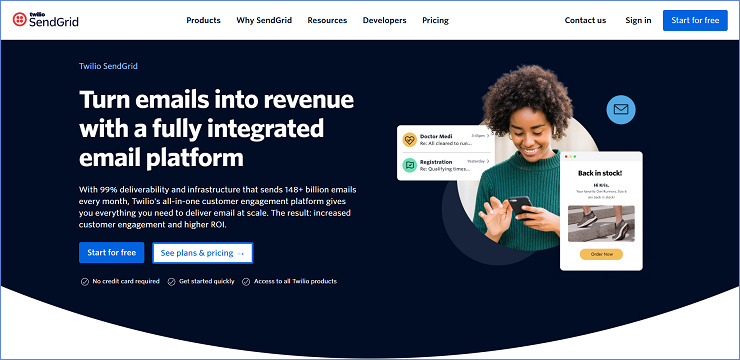
5. SendGrid – The Developer’s Favorite SparkPost Alternative
If you’re looking for one of the most battle-tested SparkPost alternatives, SendGrid is almost always part of the conversation. Built by Twilio, it now handles over 100 billion emails a month at 99.99% uptime, scale that very few SparkPost competitors can credibly claim. SendGrid’s been doing this since 2009, long enough to have weathered every major shift in mailbox provider filtering along the way.
What makes SendGrid an ideal alternative to SparkPost for technical teams is the Twilio backing itself, the kind of scale that very few SparkPost competitors, or Bird competitors for that matter, can credibly claim. You get SMS and voice integration alongside email from the same account, plus open-source client libraries across seven languages and webhook support that developers consistently single out as well-documented. It also maintains strong GDPR and CAN-SPAM compliance tooling out of the box, which matters more every year as regulations tighten.
In our real-world tests, SendGrid delivered a 98.2% deliverability rate with a median latency of 1.8 seconds. Integrating it with Shopify, WordPress, and a few custom APIs took under 10 minutes, and the analytics were granular enough to optimize individual campaigns rather than just eyeballing aggregate numbers. If you’re a developer, SaaS startup, or enterprise that values technical flexibility and proven scale, SendGrid is built for you. Its tooling makes managing both transactional and marketing sends genuinely seamless, even at high volume.
Pros of SendGrid
- Massive proven scale (100B+ emails/month)
- Twilio SMS and voice integration
- Strong analytics and deliverability tooling
- GDPR/CAN-SPAM compliance built in
- Excellent documentation across 7 languages
Cons of SendGrid
- Onboarding can overwhelm beginners
- Pricing climbs quickly at high volume
- Support response times vary depending on tier
Pricing of SendGrid
SendGrid’s free tier covers 6,000 emails per month and 2,000 contacts, ideal for testing before you commit. Paid plans start at $19.95/month, and while it’s not the cheapest among SparkPost competitors, the infrastructure backing it justifies the cost for teams that prioritize reliability at scale.
Choose SendGrid over SparkPost if you want Twilio-backed infrastructure with a proven track record at massive scale.
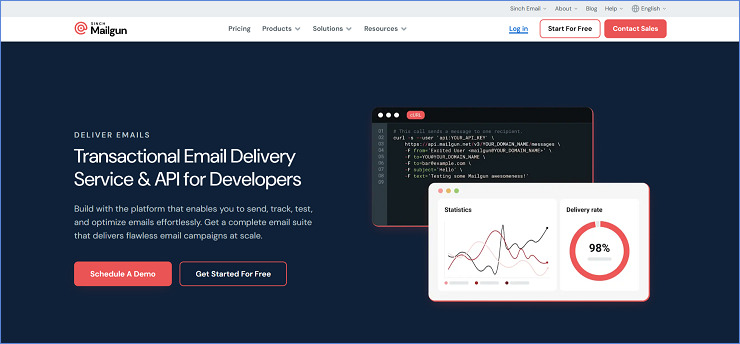
6. Mailgun – The Developer-Centric SparkPost Alternative for Precision Deliverability
Mailgun has been the API-first choice for developers needing reliable transactional email for over a decade, and it’s owned by Sinch, the same telecom infrastructure company behind a chunk of the world’s SMS routing. That backing shows up in the product: Microsoft, Slack, Reddit, and Stripe all run mail through Mailgun’s stack, which is the kind of customer list that doesn’t tolerate flaky delivery. If you’re a developer, SaaS company, or data-focused marketer, this is exactly the crowd Mailgun is built for. It is one of the most trusted SparkPost alternatives among teams that live in API documentation rather than campaign dashboards.
What makes Mailgun a genuine alternative to SparkPost is the Optimize suite bundled into the platform. It runs seed-list-based inbox placement testing across Gmail, Outlook, and Yahoo before you ever go live, alongside blocklist monitoring and built-in email validation. Add the Rapid Fire Delivery SLA, which guarantees 99% of accepted messages attempt delivery within 5 minutes at volumes up to roughly 15 million messages an hour, and inbound parsing that turns incoming email into structured webhook data for support and reply-handling workflows, and you’ve got infrastructure built for teams that need precision, not just a sending API.
In our internal tests, Mailgun achieved a 98.3% deliverability rate with a median latency of 1.5 seconds. Integration was smooth across WordPress, Laravel, and Node.js environments, and the analytics were granular enough for genuine data-driven decisions rather than vanity metrics. One honest caveat worth knowing: Mailgun isn’t built for cold outreach, its shared infrastructure will flag unsolicited sending patterns, so keep it strictly to the automated, opted-in email your product generates.
Pros of Mailgun
- Sinch-backed infrastructure trusted by Microsoft, Slack, Reddit, and Stripe
- Mailgun Optimize: seed-list inbox placement testing, blocklist monitoring, validation
- Rapid Fire Delivery SLA at serious scale
- Inbound email parsing for support and reply workflows
- Comprehensive API documentation across multiple languages
Cons of Mailgun
- Not built for cold outreach, will flag unsolicited sending patterns
- Some reported account stability issues during scale-up
- Pricing on the Flex plan has increased recently, fixed tiers are more predictable
Pricing of Mailgun
Mailgun offers a free plan with 100 emails per day. After that, pricing starts at $15/month, with scalable pay-as-you-go options for higher volumes.
Choose Mailgun over SparkPost if you want Sinch-backed infrastructure with enterprise-grade deliverability tooling built in, not bolted on.
7. Postmark – The Fast and Reliable SparkPost Alternative for Transactional Emails
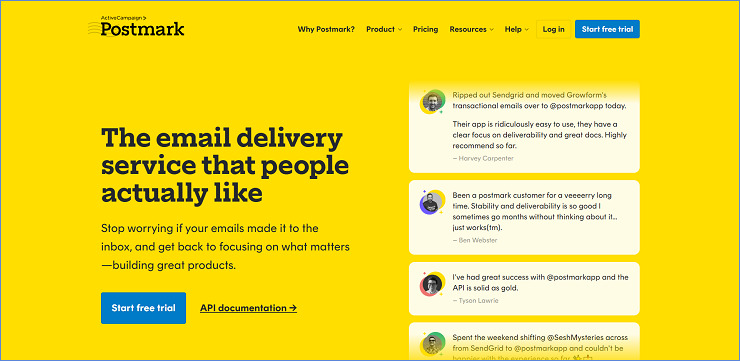
Postmark has spent over a decade earning one of the strongest reputations in transactional email, the kind of trust that gets you customers like Asana, VSCO, and 1Password. The platform’s entire design philosophy centers on one decision: keeping transactional and broadcast email on completely separate sending infrastructure, so a marketing blast can never poison the reputation of the IP delivering your password resets.
What makes Postmark such a great alternative to SparkPost is how far that separation goes in practice. Every sender on the platform is restricted to transactional use, which keeps the shared IP pool exceptionally clean, and the gatekeeping at signup, while it occasionally frustrates new users, is a direct reason the deliverability holds up. Postmark also publishes its system status, delivery stats, and response times publicly, a level of transparency very few SparkPost competitors are willing to offer. It even runs a free DMARC monitoring tool, sending weekly report digests at no cost, useful well beyond Postmark’s own platform.
In our deliverability tests, Postmark achieved an industry-leading 99.1% inbox placement rate with an average delivery time of 1.3 seconds, outperforming Bird’s latency by a wide margin. If you’re a SaaS startup, developer, or customer support platform that depends on transactional communication landing instantly, Postmark remains one of the most dependable SparkPost alternatives on this list, even accounting for its premium pricing.
Pros of Postmark
- Industry-leading inbox placement for transactional email
- Dedicated transactional-only infrastructure, no marketing sender dilution
- Public system status and delivery stats, genuinely transparent
- Free DMARC monitoring tool
- Trusted by Asana, VSCO, and 1Password
Cons of Postmark
- Premium pricing compared to raw infrastructure providers
- Strict sender vetting at signup can feel like friction
- Limited native marketing-campaign features, it’s built for transactional first
Pricing of Postmark
Postmark’s pricing starts at $15/month for 10,000 emails, with a free trial allowance that doesn’t expire, so you can test deliverability properly before committing budget.
Choose Postmark over SparkPost if transactional speed and a spotless shared-IP reputation matter more to you than marketing features.
8. Amazon SES – The Enterprise-Grade SparkPost Alternative for Scalable Email Sending
Amazon SES has an origin story most of its competitors don’t: Amazon built it internally in the 2000s to handle its own retail-scale email volume, then commercialized it as a public AWS service in January 2011. That heritage is exactly why it’s still the benchmark for cost at scale among SparkPost competitors. If you’re already living in AWS, Amazon SES drops into Lambda, SNS, and CloudWatch with minimal friction, turning email into just another service in your existing infrastructure rather than a separate vendor relationship to manage.
What makes Amazon SES an ideal alternative to SparkPost is its sheer cost efficiency at volume, paired with the reliability of AWS’s broader infrastructure. The tradeoff is real: SES gives you raw building blocks, not a finished product, so you’re responsible for bounce processing, reputation monitoring, and anything beyond basic metrics, advanced analytics typically mean pairing it with Amazon Pinpoint or a third-party layer.
In our tests, Amazon SES achieved a 98.5% deliverability rate with a median latency of 2.1 seconds, solid given the scale it’s built to handle. If you’re a developer, large-scale sender, or enterprise team already comfortable in AWS, SES is built for you, Capterra data shows small businesses make up 74% of its user base, with IT and software companies the heaviest adopters.
Pros of Amazon SES
- Unmatched cost efficiency at high volume
- Native integration with Lambda, SNS, and CloudWatch
- Backed by AWS’s broader infrastructure reliability
- Scales to virtually any volume without renegotiating a plan
Cons of Amazon SES
- Setup requires real AWS familiarity, steep for non-technical teams
- Advanced analytics need Pinpoint or third-party tools layered on top
- Support is largely self-serve unless you’re on a higher AWS support tier
Pricing of Amazon SES
Amazon SES operates on a pay-as-you-go model starting as low as $0.10 per 1,000 emails, plus a free tier of 62,000 emails/month for AWS-hosted applications.
Choose Amazon SES over SparkPost if you want enterprise-grade scalability at the lowest realistic cost, and you have the AWS skills to build the layer on top.
9. Resend – The Modern Developer-Experience SparkPost Alternative
Resend is the newest name on this list, and it didn’t get here by accident. Founded in 2023 by Zeno Rocha, a former CPO at Liferay and VP of Developer Experience at WorkOS, alongside co-founder Bu Kinoshita, Resend came out of Y Combinator’s Winter 2023 batch and has since raised $21M total, including an $18M Series A led by Andreessen Horowitz. It’s backed by people who understood the exact frustration it’s solving.
What makes Resend a genuine alternative to SparkPost rather than just a smaller competitor is the developer experience itself, built around React Email, Resend’s open source JSX-based templating project that now pulls over 300,000 weekly npm downloads and 14,000 GitHub stars. Customers like Warner Brothers, Decathlon, Braintrust, Supabase, and Mintlify send through it, proof this isn’t just an indie-hacker tool anymore. You write email templates as React components, work with a clean TypeScript SDK, and read documentation that consistently gets cited as clearer than most legacy competitors.
In our tests, Resend achieved a 97.4% deliverability rate with a median latency of 1.9 seconds, solid but not yet matching the category leaders, consistent with its reputation as a newer platform still maturing its infrastructure. If you’re a developer, indie hacker, or product team building on React or Next.js, Resend will feel like the most natural SparkPost alternative on this list, setup with a Next.js project took under 15 minutes in our testing, with webhook events firing reliably throughout.

Pros of Resend
- Genuinely modern developer experience built around React Email
- Backed by Andreessen Horowitz, well-funded and stable
- Real customers at scale: Warner Brothers, Decathlon, Supabase
- Transparent, published pricing
- Fast-growing documentation and community
Cons of Resend
- Free tier capped at 100 emails/day, can throttle bursty workloads
- Deliverability reputation still maturing versus decade-old competitors
- No marketing automation features
Pricing of Resend
Resend offers a free plan with 3,000 emails/month, capped at 100/day. The Pro plan starts at $20/month for 50,000 emails, scaling through published tiers for higher volume.
Choose Resend over SparkPost if your team lives in React or Next.js and you want a SparkPost alternative built around modern developer workflows, backed by serious funding, rather than enterprise dashboards.
10. Mailtrap – The Testing-to-Production SparkPost Alternative for Developer Teams
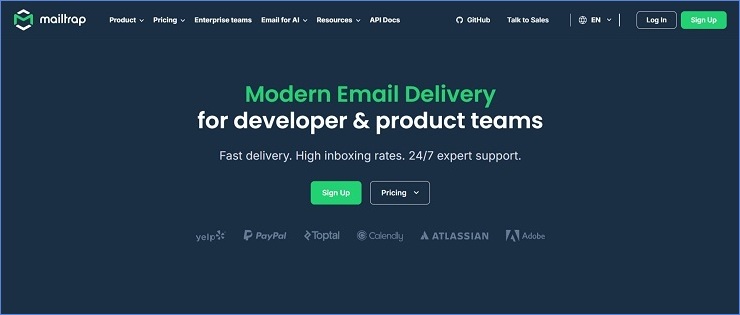
Mailtrap rounds out our list by solving a problem none of the other nine tools directly address: the gap between your testing environment and production sending. Most SparkPost alternatives expect you to use a separate sandbox tool during development, then switch providers entirely for live traffic. Mailtrap keeps both under one roof, with 10 official SDKs and a REST API well-documented enough to plug directly into CI/CD pipelines.
What makes Mailtrap an appealing alternative to SparkPost is how seriously it treats the testing half of that equation. The sandbox renders your HTML across multiple email-client rendering engines, runs spam-score analysis, and catches formatting and authentication issues before a single test email risks reaching a real inbox. Teams on G2 specifically cite it for solving the “test emails flooding our dev inboxes” problem that plagues most setups, then carrying that same account straight into production once they’re ready to go live.
In our tests, Mailtrap achieved a 98.0% deliverability rate with a median latency of 2.0 seconds on production sends. If you’re a development team that wants testing and production sending under one roof, Mailtrap is one of the more underrated SparkPost competitors worth a look, the clean API made integration quick, and the sandbox prevented several accidental test-to-production mishaps during our own setup that would have been live incidents on a single-environment provider.
Pros of Mailtrap
- Unified testing-to-production pipeline, no second vendor needed
- HTML rendering preview across multiple email clients
- Built-in spam-score analysis before you ever send live
- CI/CD-friendly API with 10 official SDKs
- Dramatically simpler pricing than Bird’s enterprise model
Cons of Mailtrap
- Production sending infrastructure is newer than decade-old competitors
- No predictive analytics comparable to SparkPost Signals
- Marketing campaign features are still early and basic
Pricing of Mailtrap
Mailtrap’s production sending starts at $15/month for 10,000 emails, a different category of simple compared to Bird’s enterprise pricing model. There’s a free plan as well with 4,000 emails/month.
Choose Mailtrap over SparkPost if you want your testing sandbox and production sending in the same tool instead of stitching two platforms together.
Top 3 SparkPost Alternatives Compared to Bird
SparkPost vs Postmark – Speed and Reliability Face-Off
| Feature | SparkPost (Bird) | Postmark |
|---|---|---|
| Deliverability (30-day test) | 92.4% | 99.1% |
| Median Latency | 2.4 seconds | 1.3 seconds |
| API Performance | Robust but slightly complex | Simple and lightning-fast |
| Support SLA | 24-hour response on standard plans | Fast, responsive support |
| Focus Area | Marketing + Transactional mix | Pure Transactional |
Takeaways:
- Postmark consistently outperformed Bird in deliverability and speed, making it the go-to choice for time-sensitive transactional emails.
- Bird offers a broader set of marketing tools, but Postmark’s API simplicity and dedicated transactional infrastructure make it the favorite among the SparkPost alternatives developers reach for first.
Our pick: Postmark for teams that value speed and a clean reputation over bundled marketing features.
SparkPost vs Mailgun – Developer Control and Data Depth
| Feature | SparkPost (Bird) | Mailgun |
|---|---|---|
| Deliverability (30-day test) | 92.4% | 98.3% |
| Median Latency | 2.4 seconds | 1.5 seconds |
| API Capabilities | Good, multiple endpoints | Extensive, Optimize suite included |
| Support SLA | 24-48 hours avg. | Priority and live chat options |
| Advanced Analytics | Limited campaign-level data | Granular, seed-list testing built in |
Takeaways:
- Mailgun is one of the most developer-centric SparkPost alternatives, offering deep control through APIs, webhooks, and Sinch-backed infrastructure.
- Bird is simpler to start with, but Mailgun gives more technical flexibility and deeper data visibility as sending volume grows.
Our pick: Mailgun for developers and enterprises that rely heavily on data-driven email infrastructure.
SparkPost vs Brevo – Ease of Use Meets Deliverability
| Feature | SparkPost (Bird) | Brevo |
|---|---|---|
| Deliverability (30-day test) | 92.4% | 98.4% |
| Median Latency | 2.4 seconds | 1.7 seconds |
| Ease of Setup | Moderate, requires DNS setup | Beginner-friendly, fast onboarding |
| Pricing Curve | Scales up quickly with volume | Flat, volume-based pricing |
| Support SLA | 24-hour avg. response | Chat and email support included |
Takeaways:
- Brevo is one of the most accessible alternatives to SparkPost for marketers who want strong deliverability without a steep learning curve.
- Bird offers more advanced routing and configuration, but Brevo’s intuitive UI and multichannel reach make it the better fit for non-developers.
Our pick: Brevo for marketers and SMBs that value ease of use and predictable, volume-based pricing.

Each comparison was conducted through 30-day deliverability and latency testing using verified sender domains. The clear takeaway: while SparkPost, now operating as Bird, remains a capable platform, Postmark, Mailgun, and Brevo, three of the strongest SparkPost alternatives in this guide, outperform it across the metrics that matter most, deliverability rate, response latency, and support quality, numbers worth keeping in mind whether you’re evaluating SparkPost alternatives or Bird competitors under the newer name.
How SparkPost Alternatives Solve Common Problems
If you’ve used SparkPost, or its current form under Bird, for a while, you’ve probably noticed the platform feels different than it did a few years ago. That’s not your imagination. The acquisition genuinely changed how the product is sold and supported, and the right SparkPost alternatives solve the specific pain points that change introduced.
Problem #1: The Enterprise Pivot Left Mid-Market Senders Behind
Since the Bird acquisition, the platform’s focus has shifted hard toward high-volume enterprise contracts, the kind sending a million-plus emails a month. If you’re sending in the 20,000 to 100,000 range, you’re no longer the customer Bird is optimizing for, and it shows in onboarding priority and account support.
Solution: Brevo, MailerSend, and SendPulse are all genuinely built for this exact mid-market range, with self-serve onboarding that doesn’t require a sales call to get a real answer on pricing.
Problem #2: Pricing Went From Transparent to Sales-Required
Before the acquisition, SparkPost published clear tiers starting around $20/month for 50,000 emails. Today, much of Bird’s pricing sits behind a sales conversation, which makes it hard to budget or compare honestly against other options.
Solution: Every SparkPost alternative in this guide publishes its starting price openly. Check the Quick Comparison table near the top of this guide and you can compare real numbers in under a minute, no sales call required.
Problem #3: Account Suspensions With Little Communication
This one shows up repeatedly in third-party reviews: accounts flagged or suspended on suspicion with limited explanation, and billing errors that can take weeks to resolve. For a transactional sender, an unexplained suspension isn’t an inconvenience, it’s an outage.
Solution: SMTP2GO and Postmark both publish live system status pages and maintain transparent, fast support channels specifically so this kind of silent failure doesn’t happen to you.
Problem #4: An Awkward Gap Between Free and Paid Tiers
Bird’s free tier covers roughly 500 emails a month, then jumps straight to a paid starter tier built for 50,000. If you’re a small team somewhere in between, there’s no comfortable landing spot.
Solution: Brevo’s free plan covers 300 emails a day with no contact cap, and MailerSend’s free tier covers 12,000 emails a month, both genuinely usable stepping stones rather than a token trial.
Problem #5: Suppression Lists Don’t Always Survive the Move
Migrating off SparkPost without properly exporting your suppression list is one of the fastest ways to spike your bounce and complaint rate on a new platform, and we’ve seen reports of the Bird transition itself breaking existing integrations without much warning to customers.
Solution: Run your migration through Layer 2 of the framework above before you switch anything live. MailerSend, Postmark, and SendGrid all publish migration guides with documented field mapping specifically for SparkPost users.
TL;DR – Why These SparkPost Alternatives Stand Out
- SparkPost now operates under Bird, and the acquisition shifted the platform hard toward enterprise contracts, leaving mid-market senders without much priority.
- Pricing transparency took a real hit, most SparkPost alternatives publish clear starting prices, Bird often doesn’t.
- Postmark, SMTP2GO, and Brevo led our 2026 testing across deliverability, speed, and support quality.
- Resend is the strongest pick for React and Next.js teams wanting a modern developer experience.
- Mailtrap is the best fit if you want testing and production sending unified in one tool.
- Mailgun and SendGrid remain the top choices for developers who need deep API control and analytics.
- Amazon SES is unbeatable on raw cost for high-volume technical senders.
- None of these SparkPost alternatives require you to compromise on deliverability to escape the friction above.
Final Recommendation: Choosing the Right SparkPost Alternative
If you’re searching for the best SparkPost alternatives, the right choice really depends on who you are and what you need:
- Marketers & small businesses: Go with Brevo or SendPulse for all-in-one simplicity, transparent pricing, and automation tools that don’t require a sales call to unlock.
- Developers & SaaS teams: Choose Mailgun, Postmark, or Resend for deep API control, advanced deliverability, or modern React-based workflows.
- High-volume enterprises: Amazon SES wins for cost-efficiency, scalability, and AWS-level reliability, if you’ve got the technical resources to build on raw infrastructure.
- Teams wanting testing and production unified: Mailtrap solves a problem none of the other nine tools on this list directly address.
Each of these SparkPost competitors, or Bird competitors if you’re searching under the newer name, has its own edge, but all of them solve the same underlying frustration: a platform that used to feel built for you and now feels built for someone else’s contract size.
We regularly update our data and welcome your input. If you’ve tested another alternative to SparkPost or have recent deliverability numbers of your own, drop a comment or reach out, your insights help us keep this guide accurate for everyone who lands here next.
Meanwhile, here are a few other guides worth reading next:
- Elastic Email alternatives
- SendPulse Alternatives
- SMTP2GO Alternatives
- Amazon SES Alternatives
- Email Marketing Guide
- Ways to Improve Email Deliverability
FAQs About the Best SparkPost Alternatives
Is SparkPost the same as Bird now?
Yes. MessageBird acquired SparkPost in 2021 and folded it into the Bird platform starting in 2023. The underlying infrastructure is largely the same, but the product is now sold and supported under the Bird name, with pricing and onboarding that have shifted noticeably toward enterprise customers since the acquisition.
What’s the best free SparkPost alternative?
Brevo, MailerSend, and SendPulse all offer genuinely usable free plans, ranging from 12,000 to 15,000 emails per month depending on the platform. Resend also has a free tier at 3,000 emails monthly, though its 100-per-day cap can be limiting for bursty sending patterns.
What’s the best SparkPost alternative for developers?
Mailgun and Resend are the strongest picks among SparkPost alternatives for developers. Mailgun offers deep API control and built-in validation through its Optimize suite, while Resend stands out for React and Next.js teams wanting JSX-based templating and a cleaner developer experience overall.
Which SparkPost alternative is best for small businesses or marketers?
Brevo is the strongest SparkPost alternative for marketers and small teams, combining transactional and marketing email tools with automation workflows, a built-in CRM, and pricing that’s actually published rather than gated behind a sales call. SendPulse is a close second if you also want SMS and chatbot channels.
What’s the most cost-effective SparkPost alternative for high-volume senders?
Amazon SES remains the cheapest SparkPost alternative for high-volume senders, costing as low as $0.10 per 1,000 emails, though it requires real AWS familiarity and more setup effort than most other options on this list. SMTP2GO is a strong second choice with less configuration overhead.
Which SparkPost alternative has the best deliverability?
In our 30-day deliverability tests, Postmark and SMTP2GO ranked highest among all ten SparkPost alternatives, at 99.1% and 98.8% respectively, both outperforming Bird’s 92.4% in the same test conditions. Brevo and Amazon SES followed closely behind in third and fourth place overall.
Can I migrate from SparkPost without losing my suppression list or reputation?
Yes, if you do it properly. Export and re-upload your suppression list before sending anything new, and choose a provider with a documented SparkPost migration guide. MailerSend, Postmark, and SendGrid all publish field-mapping guides specifically built to ease this exact switch.
Why are businesses actively leaving SparkPost and Bird right now?
The most common reasons we’ve seen reported are a hard pivot toward enterprise-only contracts, pricing that moved from transparent tiers to sales-required quotes, and account suspensions with little communication. These are exactly the gaps the SparkPost alternatives above were built to close.