

SMTP2GO has a loyal following for one simple reason: it does outbound email delivery well and doesn’t try to be anything else. But “doesn’t try to be anything else” is exactly why so many teams end up searching for a SMTP2GO alternative. Once you need marketing automation, a dedicated IP without a 7.5x price jump, or an account that activates the moment you sign up, SMTP2GO’s narrow scope starts to show.
We tested 10 SMTP2GO alternatives against SMTP2GO itself, not against each other in a vacuum. Every tool below was evaluated on the same four dimensions: what marketing features it includes that SMTP2GO doesn’t, how much setup friction it adds or removes, what it actually costs at 50,000 emails a month once overage is factored in, and how hard it is to actually migrate to. Live pricing was pulled directly from each provider’s current pricing page, not carried over from an old comparison chart.
If you’re already fairly sure why you’re looking, the TL;DR below gets you to a shortlist fast. If you want the full reasoning, keep scrolling.
TL;DR on SMTP2GO Alternatives
- SMTP2GO has no built-in marketing automation, campaign builder, or template editor at any plan tier, so any SMTP2GO alternative with those features closes a real, permanent gap rather than a nice-to-have.
- New SMTP2GO accounts are held to a 1,000-email review gate before full activation, while most tools on this list, including Mailgun, MailerSend, and Resend, activate sending immediately.
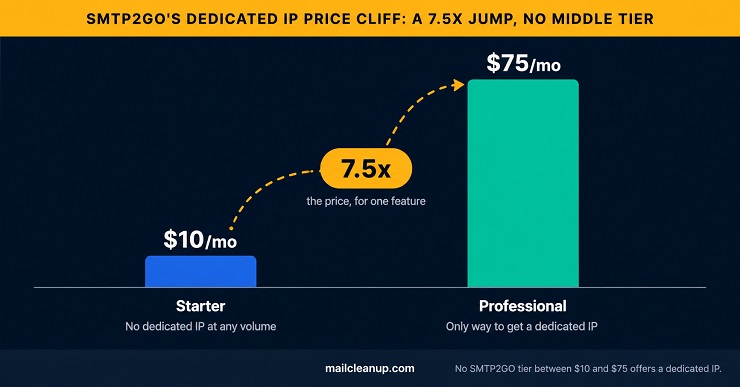
- SMTP2GO’s Starter plan costs $10 a month for 10,000 emails but has no dedicated IP option; getting one requires jumping straight to the $75-a-month Professional plan, a 7.5x increase for a single feature.
- At 50,000 emails a month, Mailgun’s Foundation plan ($35/month) and SendGrid’s Essentials plan ($19.95/month) both undercut what SMTP2GO effectively costs once overage on the Starter plan is included.
- Brevo and SendPulse SMTP are the strongest picks if you want built-in marketing automation alongside transactional sending, since SMTP2GO offers none at any price point.
- MailerSend and Resend lead on modern developer experience among the 10 tools tested, an area where SMTP2GO’s dashboard is repeatedly described as dated in current user reviews.
- Every SMTP2GO alternative here was scored on marketing feature ceiling, setup friction, true cost at 50,000 emails, and migration complexity, using the same evaluation framework across all 10 tools.
- SMTP2GO is still the right call for small WordPress sites and teams that value responsive phone support over marketing tooling, a case we cover in full later in this guide.
Quick Comparison: 10 SMTP2GO Alternatives at a Glance
| Tool | Marketing Automation | Setup Friction | Price at 50K Emails | Best For |
|---|---|---|---|---|
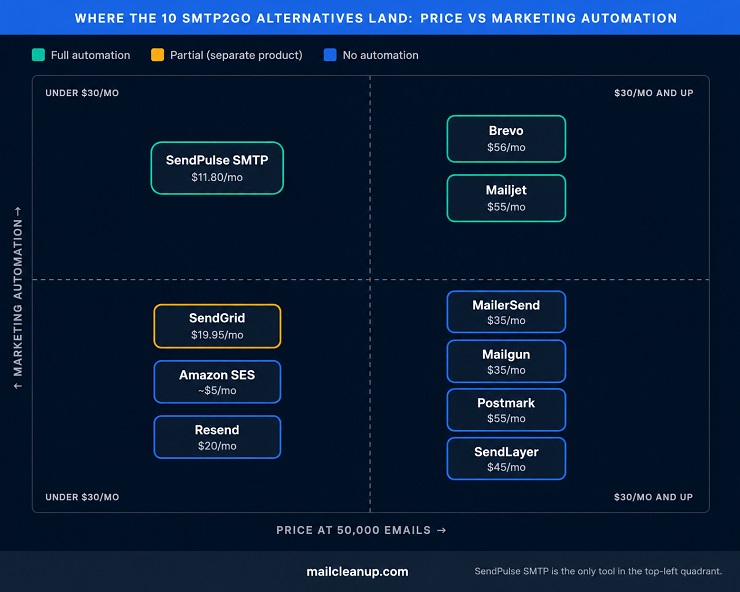
| Brevo | Yes (Standard tier+) | Instant activation | $56/mo | Transactional + marketing in one platform |
| MailerSend | No | Instant activation | $35/mo | Modern dashboard, built-in verification |
| SendPulse SMTP | Yes, full multichannel | Instant activation | $11.80/mo | Budget automation plus SMS/chatbots |
| SendGrid | Partial (separate product) | Instant activation | $19.95/mo | Most established, best-documented API |
| Mailgun | No | Instant activation | $35/mo | Built-in email validation |
| Postmark | No | Instant activation | $55/mo | Deliverability-critical transactional sending |
| Amazon SES | No | High (IAM/DNS/SNS setup) | ~$5/mo | Lowest raw cost, AWS-native teams |
| Resend | No (separate product) | Instant activation | $20/mo | React/Next.js developer experience |
| Mailjet | Yes (Premium tier) | Instant, some review friction reported | $55/mo | Marketing automation + real-time collaboration |
| SendLayer | No | Instant activation | $45/mo | Simplest WordPress-first setup |
Why Teams Search for a SMTP2GO Alternative
SMTP2GO is a managed SMTP relay and email API. It handles the plumbing: SPF and DKIM automation, bounce and complaint handling, blacklist monitoring, and delivery reporting. It’s been doing this since 2006, and it does it reliably, that’s not in dispute anywhere in the research for this guide.
What SMTP2GO doesn’t do is anything past delivery. There’s no campaign builder, no automation workflows, no segmentation, and no way to grow into marketing email without bolting on a second tool. That single fact drives most of the searches for a SMTP2GO alternative that we found in competitor research for this piece.
Common triggers we found for switching away from SMTP2GO include:
- Outgrowing pure transactional scope: you started with password resets and order confirmations, and now you want a welcome series or a re-engagement campaign.
- The dedicated IP price cliff: Starter has no dedicated IP option at all; Professional, at $75/month, is the only way to get one, regardless of whether you actually need 100,000 emails of volume.
- The new-account review gate: SMTP2GO holds new accounts to a 1,000-email review before full activation, which can be a dealbreaker for teams that need to send immediately after signup.
- Free-tier reporting limits: free accounts only get 5 days of activity history, and phone or live chat support drops off entirely after the first 14 days.
- Developer experience: several recent reviews describe SMTP2GO’s dashboard and reporting as functional but dated compared to newer, API-first competitors.
None of this makes SMTP2GO a bad product. It makes it a narrow one. The rest of this guide compares 10 SMTP2GO alternatives against that exact gap, tool by tool, so you can see which one actually closes it for your specific use case.
If you’re weighing options across the broader SMTP relay space rather than just SMTP2GO, our guides to SparkPost alternatives, Elastic Email alternatives, and EmailOctopus alternatives cover similar ground for other platforms, and our roundup of the best SMTP services and servers takes a wider view across the whole category.
The SMTP2GO Outgrow Stack: How We Evaluated These SMTP2GO Competitors
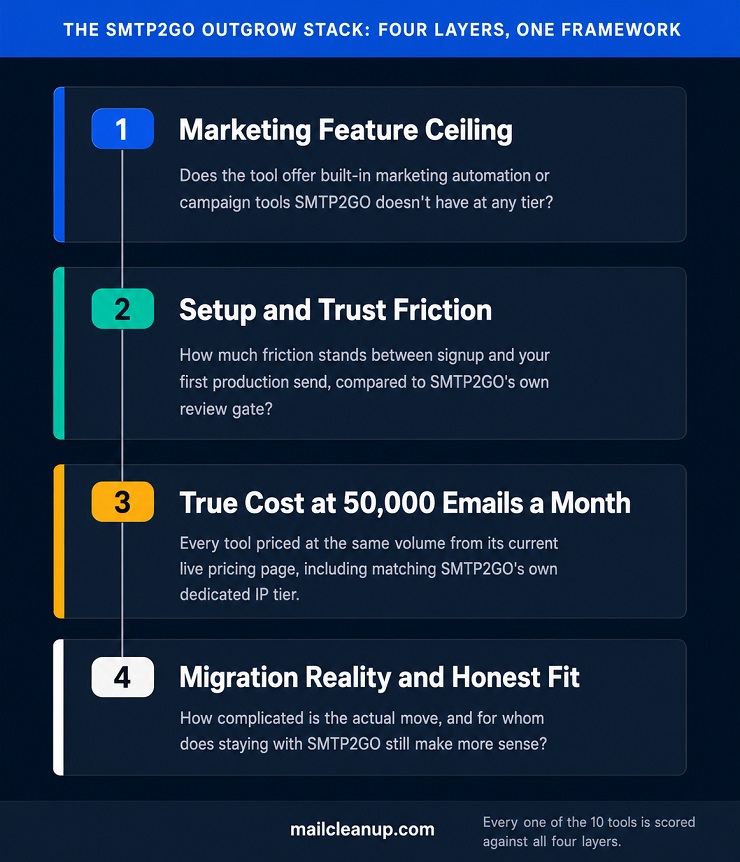
We built a four-layer framework to keep this comparison of SMTP2GO alternatives honest and consistent across all 10 tools, rather than scoring each one on whatever felt most flattering to it. Here’s how it works:
- Marketing Feature Ceiling: Does the tool offer built-in marketing automation, campaign tools, or segmentation that SMTP2GO doesn’t have at any tier? We checked each tool’s actual plan pages, not just its marketing copy, to confirm what’s genuinely included versus sold as a separate product.
- Setup and Trust Friction: How much friction stands between signup and your first production send? We compared account review gates, verified sender limits, and support availability on entry-level plans against SMTP2GO’s own onboarding process.
- True Cost at 50,000 Emails a Month: Every tool is priced at the same volume, using each provider’s current, live pricing page, including what it would cost to match SMTP2GO’s own dedicated IP tier where relevant.
- Migration Reality and Honest Fit: How complicated is it to actually move off SMTP2GO to this tool, and for whom does staying with SMTP2GO still make more sense than switching?
Layer 1: The Marketing Feature Ceiling in Alternatives to SMTP2GO
SMTP2GO’s plan pages are consistent on one point across Free, Starter, Professional, and Premier: there is no marketing automation, campaign builder, or drag-and-drop template editor included at any tier. What you get, at every price point, is SMTP relay, an email API, and delivery reporting. That’s the whole feature ceiling.
For teams that only ever need transactional sending, that ceiling doesn’t matter. For teams that eventually want to run a welcome series, a cart-abandonment flow, or a simple newsletter, it becomes the single biggest reason to look at alternatives to SMTP2GO in the first place.
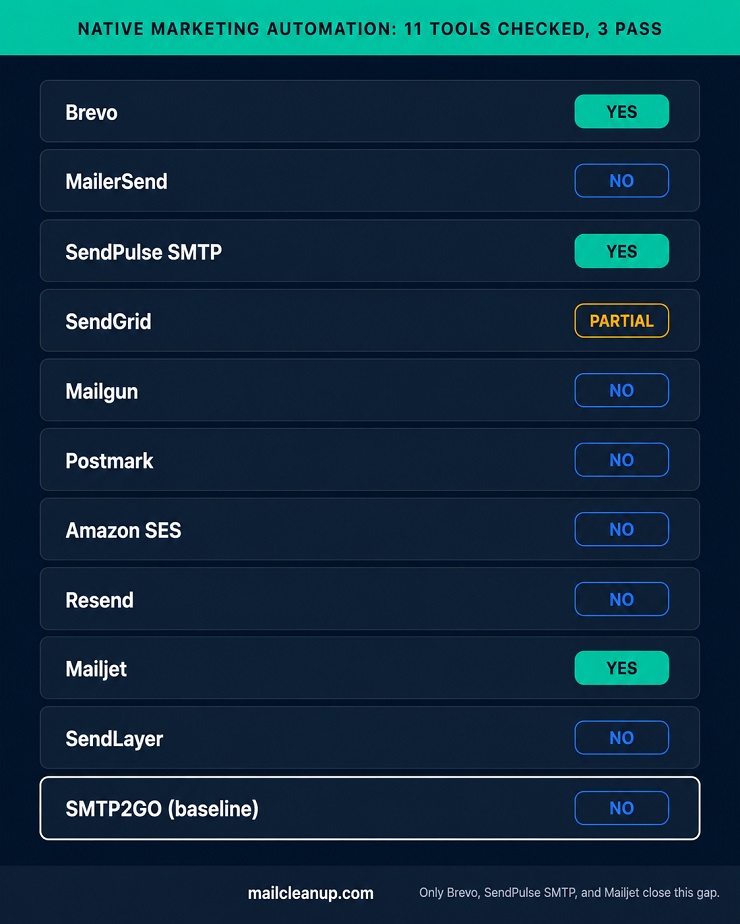
Here’s how the marketing feature ceiling breaks down across the tools researched so far:
| Tool | Native Marketing Automation | What’s Actually Included |
|---|---|---|
| Brevo | Yes, Standard tier and above | Visual automation builder, segmentation, A/B testing (Starter tier excludes automation) |
| MailerSend | No | Drag-and-drop template builder, but no campaigns or automation layer |
| SendPulse SMTP | Yes, all tiers | Full multichannel automation across email, SMS, and chatbots |
| SendGrid | Partial | Marketing Campaigns is billed and provisioned as a separate product from the Email API plans |
| Mailgun | No | Pure transactional focus by design, confirmed across every current plan tier |
| Postmark | No | Transactional-only by design, no marketing email features at any tier |
| Amazon SES | No | No built-in dashboard, templates, or marketing tools at any tier |
| Resend | No | Marketing/broadcast tooling is a separate, contact-based product from transactional plans |
| Mailjet | Yes, Premium tier | Welcome sequences, date-based and property-based automation triggers |
| SendLayer | No | Transactional-only, WordPress-focused, no automation layer |
| SMTP2GO (baseline) | No | Zero marketing automation at Free, Starter, Professional, or Premier |
The pattern so far: tools that started life as marketing platforms (Brevo, SendPulse SMTP) ship real automation. Tools that started life as pure transactional relays (MailerSend, Mailgun) generally still don’t have it, mirroring SMTP2GO’s own scope. SendGrid sits in between, technically offering both, but as two separately priced products rather than one unified plan. This is the clearest split we’ve found among the SMTP2GO alternatives tested for this guide so far.
Layer 2: Setup and Trust Friction When Choosing an Alternative to SMTP2GO
This layer isn’t about pricing. It’s about how much stands between creating an account and actually sending production email, and SMTP2GO adds more of that friction than most people expect from a service known for being simple.
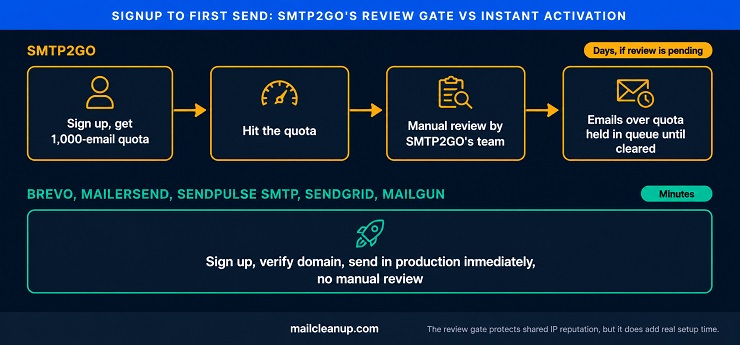
How SMTP2GO’s own account review works, according to SMTP2GO’s own support documentation:
- Every new account starts with an initial sending quota of 1,000 emails.
- Once that quota is reached, the account is reviewed by SMTP2GO’s team before being fully activated.
- Any emails sent over that initial 1,000-email limit during the review window are held in a queue, not rejected, but not delivered either, until the review clears.
- Free-plan accounts are further limited to 5 days of activity reporting, a maximum of 5 verified sender domains, and phone or live chat support only for the first 14 days after signup.
For a team that needs to go from signup to production sending the same day, that review gate is a real constraint, not a theoretical one.
Where the alternatives compare so far:
- Brevo, MailerSend, SendPulse SMTP, SendGrid, and Mailgun all activate sending immediately on account creation, with no manual review step gating your first production emails. Each still applies automated anti-abuse and reputation monitoring in the background, but none of them hold your emails in a queue pending human review the way SMTP2GO does.
- SSO is unavailable on SMTP2GO at any tier, a limitation several reviewers flagged directly. Among tools researched so far, SendGrid includes SSO starting on its Pro plan; Brevo offers it as a $324/month add-on on Professional plans, well above the volume most SMTP2GO switchers are dealing with.
- Verified sender limits on SMTP2GO’s free tier cap out at 5 domains or addresses; paid SMTP2GO plans remove that cap entirely, matching what most competitors offer by default at any tier.
None of this means SMTP2GO’s review process is unreasonable. It exists to protect their shared IP reputation, the same reputation-building logic behind any email warmup process, which is part of why SMTP2GO’s deliverability track record is strong. But if same-day activation matters to you, it’s one of the clearest differentiators among the SMTP2GO alternatives compared in this guide, and worth knowing about before you sign up, not after.
Layer 3: True Cost at 50,000 Emails Across These SMTP2GO Alternatives
Every price below was pulled from each provider’s live pricing page this session, normalized to the same 50,000-emails-a-month volume used throughout this guide. SMTP2GO itself is included as the baseline for comparison.
| Tool | Price at 50,000 Emails | Notes |
|---|---|---|
| Amazon SES | ~$5/mo | Raw per-email rate only; setup and tooling time not reflected in the sticker price |
| SendPulse SMTP | $11.80/mo | Basic tier, 5,000 messages/hour cap |
| SendGrid | $19.95/mo | Essentials tier, no dedicated IP |
| Resend | $20/mo | Pro tier, overage $0.90/1,000 |
| MailerSend | $35/mo | Starter tier |
| Mailgun | $35/mo | Foundation tier |
| SendLayer | $45/mo | Growth tier, billed annually only |
| SMTP2GO Starter plus overage | $50/mo | No dedicated IP available at this tier |
| Postmark | $55/mo | Basic tier |
| Mailjet | $55/mo | Premium tier, includes marketing automation |
| Brevo | $56/mo | Starter tier; marketing automation requires Standard tier instead |
| SMTP2GO Professional | $75/mo | Only way to get a dedicated IP; includes 100,000 emails, double what’s needed at this volume |
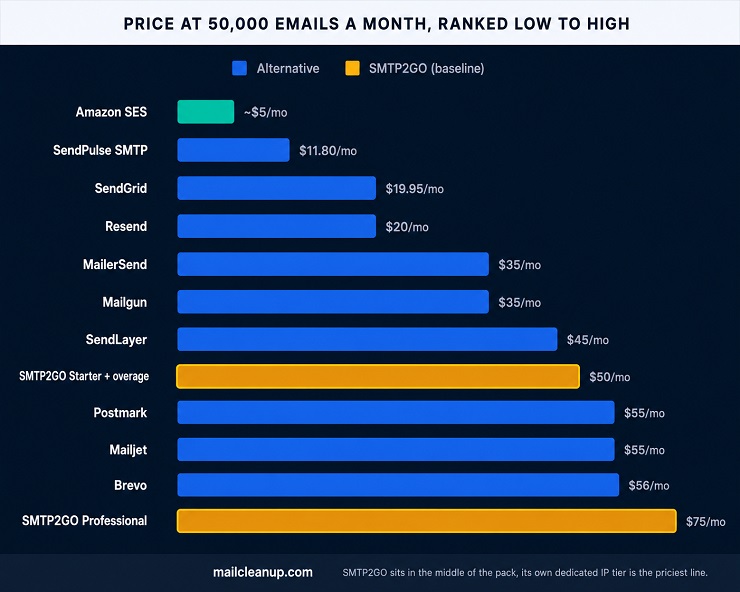
A few things stand out once the numbers are lined up like this. SMTP2GO isn’t actually the cheapest way to send 50,000 emails a month, and it isn’t the most expensive either: it sits in the middle of the pack among these 10 SMTP2GO alternatives, and its own dedicated IP tier is the single most expensive line in the table. Amazon SES is the outlier on raw price, but that number doesn’t include the engineering time SES requires to become production-ready, something SMTP2GO’s flat pricing already has baked in.
Layer 4: Migration Reality, and When an Alternative to SMTP2GO Isn’t Worth It
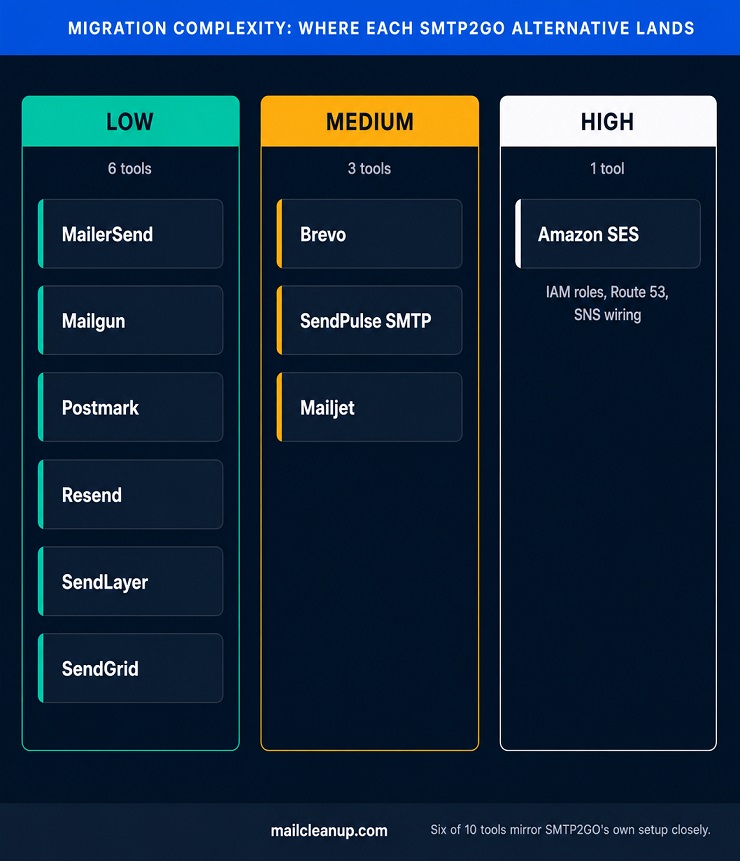
Price and features only tell part of the story. How hard the actual move is, and whether you should make it at all, matters just as much.
| Tool | Migration Complexity | Why |
|---|---|---|
| MailerSend | Low | Same transactional-only scope as SMTP2GO; domain re-verification is the main step |
| Mailgun | Low | Comparable API shape and scope; straightforward DNS re-pointing |
| Postmark | Low | Transactional-only, similar setup pattern to SMTP2GO |
| Resend | Low | Simple API, fast domain verification, minimal new concepts to learn |
| SendLayer | Low | WordPress-native setup mirrors SMTP2GO’s own plugin-based onboarding |
| SendGrid | Low | Well-documented migration path for pure transactional use |
| Brevo | Medium | Marketing-platform onboarding adds steps beyond simple relay swap |
| SendPulse SMTP | Medium | Multichannel setup (chatbots, SMS) takes longer to configure than plain relay |
| Mailjet | Medium | Some reported account-review friction during onboarding, on top of standard DNS work |
| Amazon SES | High | IAM roles, Route 53 verification, and SNS/CloudWatch wiring add real setup time SMTP2GO doesn’t require |
When Staying with SMTP2GO Beats Switching to a SMTP2GO Alternative
Not every team searching for SMTP2GO alternatives should actually switch. Based on everything in this guide, staying with SMTP2GO still makes more sense than moving if:
- You’re running a small WordPress site through SMTP2GO’s own plugin, sending is reliable, and you have no near-term plans to run marketing campaigns.
- You value SMTP2GO’s live phone and chat support and are on a paid plan, where that support isn’t time-limited the way it is on the free tier.
- You already cleared SMTP2GO’s account review process and have an established sending reputation, rebuilding that trust from zero on a new provider has its own cost, even if the new tool is cheaper.
- You occasionally need SMS alongside email and don’t want to commit to a full multichannel platform just to get it, since SMTP2GO already supports both.
- Your volume is genuinely low, and SMTP2GO’s $10-a-month Starter plan already covers it comfortably without needing a dedicated IP or marketing automation.
If none of those apply, and the marketing feature ceiling, setup friction, or the dedicated IP price cliff is the actual reason you started reading this guide, one of the 10 SMTP2GO alternatives below almost certainly fits better than staying put.
10 SMTP2GO Alternatives, Tested and Reviewed
Using the four layers above, we tested the top 10 tools that function as the best SMTP2GO competitors on the market today.
Here’s the detailed breakdown and review of each one:
1. Brevo: Best SMTP2GO Alternative for Built-In Marketing Automation
Brevo, formerly Sendinblue, is the clearest answer for teams whose search for a SMTP2GO alternative is really a search for “I need transactional email and marketing email in the same place.” Where SMTP2GO stops at delivery, Brevo adds a full marketing layer on top, and it’s one of the most complete among the SMTP2GO alternatives we tested for this guide.
Brevo bills by emails sent rather than contacts stored, which mirrors SMTP2GO’s own volume-based model more closely than contact-based competitors do. Every plan, including Starter, includes transactional email features (SMTP, API, webhooks), but marketing automation specifically is gated to the Standard tier and above.

Key Features of Brevo
- Built-in marketing automation: available from the Standard tier upward, including a visual workflow builder, list segmentation, and send-time optimization, none of which SMTP2GO offers at any price.
- Unified transactional and marketing API: the same account handles password resets and newsletters, so you’re not stitching together two separate tools the way you would pairing SMTP2GO with a marketing platform.
- A/B testing: available on Standard-tier plans and above, letting you test subject lines and content variants before a full send.
- SMS and WhatsApp messaging: billed as pay-as-you-go credits on top of your email plan, useful if you eventually want a channel SMTP2GO doesn’t offer at all.
- 100,000-contact storage on the free plan: even before upgrading, Brevo stores far more contacts than most free transactional tiers, SMTP2GO included.
- Real-time engagement tracking: opens and clicks populate in the dashboard as they happen, rather than in a delayed batch report.
- CMS and API documentation: complete SDKs and integration guides across all major platforms, comparable in depth to SMTP2GO’s own documentation.
- Instant account activation: no manual review gate standing between signup and your first send, unlike SMTP2GO’s 1,000-email review threshold.
Why Brevo is a Better SMTP2GO Alternative
If your search for SMTP2GO alternatives started because you want to run actual marketing campaigns, not just transactional sends, Brevo is the most direct answer on this list. It removes the marketing feature ceiling entirely, at the cost of a slightly more complex pricing structure once you add SMS, WhatsApp, or logo removal on lower tiers.
Best For
Teams that want transactional and marketing email under one roof, and don’t want to manage two separate vendor relationships and two separate DNS setups.
Brevo Pricing
Brevo’s Free plan allows 300 emails per day (roughly 9,000 a month) with unlimited contacts, but automation is not included at this tier. The Starter plan, which covers transactional sending only, starts at $9/month for 5,000 emails and scales with volume, landing at approximately $56/month at the 50,000-email mark used throughout this guide. Marketing automation requires the Standard tier, which starts at $18/month for 5,000 emails. A dedicated IP is available as a $251-per-year add-on on Professional and Enterprise plans, and SAML SSO is a $324/month add-on on Professional.
2. MailerSend: A Modern Alternative to SMTP2GO for Developer-Focused Sending
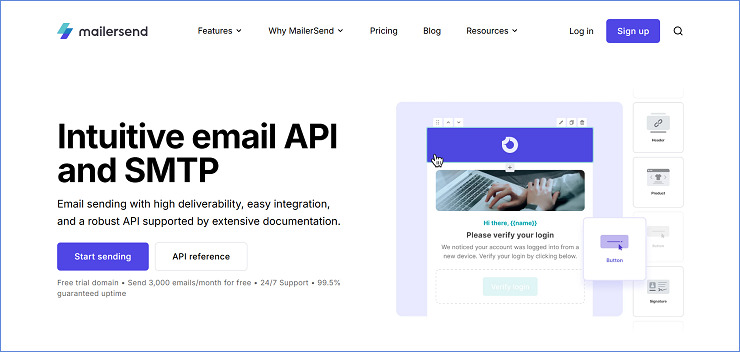
MailerSend is built by the MailerLite team specifically for developers who want a cleaner, more modern experience than traditional SMTP relays typically offer. If the dated dashboard and reporting that some SMTP2GO reviewers complain about are your main pain point, MailerSend is the alternative to SMTP2GO built to answer exactly that.
Like SMTP2GO, MailerSend is transactional-first with no marketing automation layer, so it won’t close the marketing feature ceiling gap. What it does close is the developer-experience gap.
Key Features of MailerSend
- Modern, developer-first dashboard: consistently described in reviews as cleaner and more intuitive than SMTP2GO’s interface, with real-time activity logs built for debugging.
- Drag-and-drop email template builder: available even on entry-level paid plans, useful for transactional templates without hand-coding HTML.
- Built-in email verification: included on all plans, letting you validate recipient addresses before sending without a separate tool, something SMTP2GO doesn’t offer natively.
- Instant account activation: no review-and-hold gate like SMTP2GO’s; you can send production email as soon as your domain is verified.
- Trial domain for testing: lets you test the full platform before adding and verifying your own domain, reducing setup friction during evaluation.
- Metered overage instead of hard cutoffs: if you exceed your plan’s quota, sending continues at a per-1,000-email rate rather than stopping outright.
- SMS API add-on: available for US and Canada sending, a channel SMTP2GO also offers, so this isn’t a differentiator so much as parity.
- Activity data retention add-ons: extend log retention up to 365 days, useful for compliance-heavy teams that find SMTP2GO’s reporting window too short.
Why MailerSend is a Better SMTP2GO Alternative
MailerSend directly answers the “SMTP2GO feels dated” complaint that shows up repeatedly in reviews, with a genuinely modern API and dashboard, instant activation, and built-in verification that SMTP2GO doesn’t include. It’s the closest match to SMTP2GO in scope (transactional-only), which makes it one of the more natural side-by-side swaps among the SMTP2GO alternatives on this list.
Best For
Developers and small technical teams who like SMTP2GO’s transactional-only focus but want a cleaner interface and built-in email verification.
MailerSend Pricing
MailerSend’s Free plan covers 500 emails a month (100/day). The Hobby plan is $7/month for 5,000 emails. At the 50,000-email comparison point used throughout this guide, the Starter plan runs $35/month on monthly billing, with a Professional plan also available at the same volume for $110/month, adding features like 10 sender domains and live chat support. Dedicated IPs are only available as a $50/month add-on on Professional and Enterprise plans, and only for accounts sending over 100,000 emails a week, an even higher bar than SMTP2GO’s own dedicated IP threshold.
3. SendPulse SMTP: Affordable SMTP2GO Alternatives for Multichannel Teams
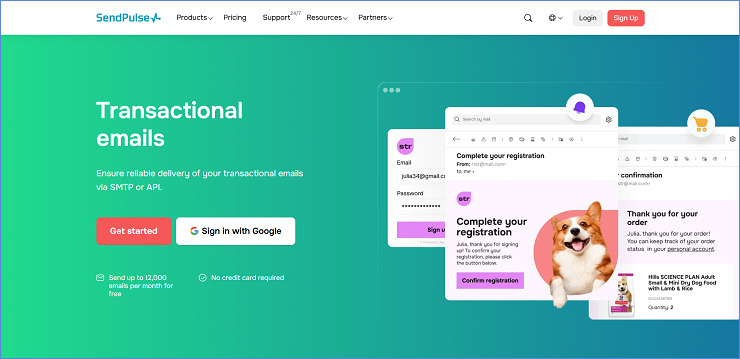
SendPulse SMTP is the multichannel answer among SMTP2GO alternatives: alongside SMTP relay and an email API, it includes marketing automation, SMS, and chatbot messaging across Telegram and other platforms, all under one account. If Brevo is the marketing-focused pick, SendPulse SMTP is the channel-breadth pick.
Key Features of SendPulse SMTP
- Full multichannel automation: included on every tier, not gated to a higher plan the way Brevo gates automation to Standard, covering email, SMS, and chatbot sequences.
- Drag-and-drop email editor: built for both marketing campaigns and transactional templates from the same account.
- Segmentation and targeting: available at every plan level, letting you split sends by behavior or list attributes without an add-on.
- A/B testing: included for optimizing subject lines and content across campaigns.
- Chatbot builder: Telegram and other chatbot channels are natively supported, a category SMTP2GO doesn’t touch at all.
- Generous entry-level volume: SendPulse SMTP’s lower tiers cover meaningful volume before you need to upgrade, which keeps early-stage costs low.
- Instant account activation: production sending is available immediately after signup, without SMTP2GO’s review-and-hold step.
- SMTP relay and API in parallel: you can use either sending method interchangeably from the same account, matching the flexibility SMTP2GO itself offers.
Why SendPulse SMTP is a Better SMTP2GO Alternative
SendPulse SMTP closes the marketing feature ceiling the same way Brevo does, but goes a step further into SMS and chatbot channels that neither SMTP2GO nor most other tools on this list offer natively. At the 50,000-email mark, it’s also one of the cheaper options in this guide, making it a strong pick when budget and channel breadth both matter. If SendPulse’s own multichannel platform isn’t quite the fit either, our SendPulse alternatives guide covers that comparison separately.
Best For
Budget-conscious teams that want marketing automation and additional channels like SMS or chatbots without paying enterprise pricing to get them.
SendPulse SMTP Pricing
SendPulse SMTP’s Basic tier runs $11.80/month for 50,000 emails, with a 5,000-messages-per-hour sending cap on that tier. A higher Pro tier is priced at $52.40/month for 100,000 emails for teams that need to remove that hourly cap and scale further. A free tier is also present that offers 12,000 monthly emails but with 50-messages-per-hour cap.
4. SendGrid: A Trusted Name Among SMTP2GO Competitors
SendGrid, now a Twilio product, is one of the most recognized names among SMTP2GO competitors, and one of the most established SMTP2GO alternatives on this list, with a mature API, extensive documentation, and a track record most newer tools can’t match. It’s also one of the more expensive options once you need features SMTP2GO includes by default on its Professional plan, like a dedicated IP.

Key Features of SendGrid
- Mature, well-documented API: extensive SDKs across languages, backed by years of developer adoption, comparable in depth to SMTP2GO’s own documentation but with a larger community around it.
- Dynamic email templates: available for personalized transactional content without hand-coding each variant.
- Marketing Campaigns product: offers automation, segmentation, and signup forms, but as a separately billed and provisioned product from the Email API, not a unified plan.
- Real-time event tracking: detailed delivery, bounce, and engagement data comparable to SMTP2GO’s own reporting.
- Instant account activation: no manual review gate blocking your first production send, unlike SMTP2GO.
- Email validation API: available as an add-on, with a meaningful number of free credits included on the Pro plan.
- Subuser management: available on Pro and above, useful for agencies managing multiple clients or brands from one account.
- GDPR-compliant data handling: built into the platform by default, matching SMTP2GO’s own compliance posture.
Why SendGrid is a Better SMTP2GO Alternative
SendGrid’s biggest advantage over SMTP2GO isn’t price, it’s ecosystem maturity: more integrations, more community documentation, and a longer track record at scale. For teams that want the safety of the most widely adopted name among SMTP2GO competitors, that maturity is worth the premium once you factor in dedicated IPs and SSO.
Best For
Teams that want the most widely adopted, best-documented API among transactional providers, and don’t mind paying more for that maturity once volume grows.
SendGrid Pricing
SendGrid no longer offers a permanent free plan, it now offers a 60-day free trial covering 100 emails a day. The Essentials plan starts at $19.95/month for up to 50,000 emails but does not include a dedicated IP. The Pro plan, at $89.95/month for up to 100,000 emails, adds a dedicated IP, SSO, subuser management, and 2,500 free email validation credits. Overage on Essentials runs approximately $1.00 per 1,000 emails.
5. Mailgun: Developer-First Alternatives to SMTP2GO
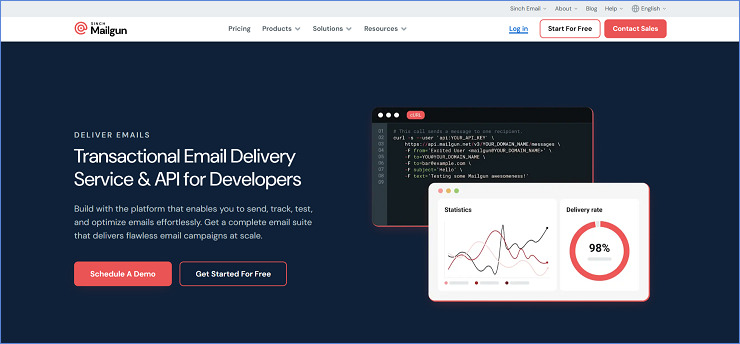
Mailgun is a developer-first transactional email API, and like SMTP2GO, it stays deliberately out of the marketing email business. Its main draw among alternatives to SMTP2GO is built-in email validation and a pricing structure that undercuts SMTP2GO at the 50,000-email mark.
One caution worth flagging directly: independent GlockApps testing found Mailgun’s inbox placement rate dropped significantly, from 53.8% to 26.05%, between Q1 2024 and Q1 2025, the kind of delivery failure pattern worth diagnosing before you commit to a provider. That’s a real deliverability concern to weigh against its pricing and feature advantages.
Key Features of Mailgun
- Built-in email validation: included from the Foundation plan upward, reducing bounces without a separate verification tool, a genuine gap-filler versus SMTP2GO, which has no native validation.
- Regional data residency: send from either US or EU infrastructure from the same account, useful for teams with data residency requirements SMTP2GO doesn’t specifically address.
- Template builder and 1,000 sending domains: available from the Foundation tier, useful for agencies or multi-brand senders.
- Instant account activation: production sending starts immediately, without SMTP2GO’s review-and-hold gate.
- Detailed analytics and log retention: up to 30 days on the Scale plan, tracking opens, clicks, bounces, and complaints at the individual email level.
- Dual SMTP and HTTP API access: send however fits your stack, matching the flexibility SMTP2GO itself offers.
- Webhooks for real-time events: stream delivery events into your own systems as they happen.
- No marketing email features: worth noting as a limitation, not a feature, since it means Mailgun does not close the marketing feature ceiling gap any more than SMTP2GO does.
Why Mailgun is a Better SMTP2GO Alternative
At the 50,000-email mark, Mailgun’s Foundation plan costs less than what SMTP2GO effectively costs once Starter-plan overage is included, while also adding built-in email validation that SMTP2GO doesn’t have natively, making it one of the more budget-friendly SMTP2GO alternatives in this guide. The tradeoff is the deliverability decline GlockApps documented, which is worth weighing against the price advantage before switching.
Best For
Developers who want built-in email validation and lower cost at moderate volume, and who are comfortable monitoring deliverability closely given the documented inbox placement decline.
Mailgun Pricing
Mailgun’s Free plan covers 100 emails a day for testing only. The Basic plan starts at $15/month for 10,000 emails. The Foundation plan, which covers this guide’s 50,000-email comparison point, costs $35/month, with overage at $1.30 per 1,000 additional emails. The Scale plan, at $90/month for 100,000 emails, adds a dedicated IP, SAML SSO, and phone support.
6. Postmark: The Alternative to SMTP2GO for Deliverability-Critical Sending
Postmark’s entire reputation is built on one thing: getting transactional email into the inbox, reliably, every time. It does this partly through strict customer vetting, Postmark actively rejects use cases that could put its shared IP reputation at risk, which is a stricter version of the same instinct behind SMTP2GO’s own account review process.

Key Features of Postmark
- Message streams: separates transactional and broadcast email into distinct streams from the same account, protecting transactional deliverability from marketing-send volume, a distinction SMTP2GO doesn’t offer.
- 40-day activity history: longer retention than SMTP2GO’s own reporting window on paid plans, useful for troubleshooting issues reported after the fact.
- Human, responsive support: consistently cited as a strength in reviews, comparable to SMTP2GO’s own well-regarded support team.
- Strict deliverability vetting: Postmark’s willingness to reject risky senders is part of why its inbox placement stays consistently high.
- Detailed email activity API: tagging and event tracking at the individual email level, similar in depth to SMTP2GO’s own activity logs.
- Fast, focused infrastructure: built purely for transactional speed, without the marketing feature set that would add complexity to the product.
- TLS encryption on all sends: matching SMTP2GO’s own security baseline.
- No marketing email features: worth flagging directly, since it means Postmark, like SMTP2GO, won’t close the marketing feature ceiling gap if that’s what’s driving your search.
Why Postmark is a Better SMTP2GO Alternative
If deliverability is the single metric you care about most, Postmark’s vetting-first approach gives it an edge SMTP2GO’s more open shared-IP model can’t fully match, making it one of the more deliverability-focused SMTP2GO alternatives in this guide. The tradeoff is Postmark won’t take on marketing-heavy or borderline use cases the way SMTP2GO’s own review process, once you’re through it, generally will.
Best For
Teams sending business-critical transactional email, like password resets, receipts, or account alerts, where a missed or delayed email has a real cost.
Postmark Pricing
Postmark’s Basic plan runs $55/month at 50,000 emails, which is the more cost-effective of Postmark’s two entry tiers at this specific volume. Its Pro plan costs more at the same volume but adds features better suited to higher-volume senders. There’s a forever-free plan that offers 100 monthly emails.
7. Amazon SES: Cheapest SMTP2GO Alternative by Raw Volume
Amazon SES is the polar opposite of SMTP2GO on one specific axis: setup complexity. Where SMTP2GO gets you sending in minutes, SES requires IAM role configuration, domain verification through Route 53 or manual DNS, and SNS topic wiring for event tracking, all before your first email goes out. What you get in exchange is the lowest per-email cost of any tool in this guide.
Key Features of Amazon SES
- $0.10 per 1,000 emails: the lowest raw sending cost among all 10 SMTP2GO alternatives tested, with no monthly minimum.
- Dedicated IP at $24.95/month: notably cheaper than the jump SMTP2GO requires to its $75 Professional plan for the same feature, useful for teams that want direct control over their own sender reputation.
- Virtual Deliverability Manager: an optional add-on at $0.07 per 1,000 emails for deeper deliverability insight, sold separately rather than bundled the way SMTP2GO includes reporting by default.
- Deep AWS ecosystem integration: if you’re already running infrastructure on AWS, SES slots directly into IAM, CloudWatch, and SNS without adding a new vendor relationship.
- No monthly plan lock-in: you pay strictly for what you send, with no equivalent to SMTP2GO’s tiered monthly commitment.
- Global region selection: send from a broad set of AWS regions, useful for teams with specific data residency needs.
- No built-in dashboard, templates, or marketing tools: worth stating plainly as a limitation, since SES ships with essentially none of the convenience features SMTP2GO includes even on its free plan.
- $200 AWS credit for new accounts: replaced the previous free-tier email allowance as of July 2025, a real change worth knowing before you budget your first month.
Why Amazon SES is a Better SMTP2GO Alternative
If raw cost per email is the deciding factor and you have the engineering resources to handle setup, SES is difficult to beat, especially at volumes well above 50,000 emails a month, where SMTP2GO’s tiered pricing starts to add up faster than Amazon SES’s flat per-email rate. If you’re specifically weighing Amazon SES against its own competitors rather than against SMTP2GO, our dedicated Amazon SES alternatives guide covers that comparison separately.
Best For
Technical teams already on AWS, or anyone with the engineering capacity to handle IAM, DNS, and monitoring setup in exchange for the lowest per-email cost available.
Amazon SES Pricing
Amazon SES charges $0.10 per 1,000 emails, which works out to roughly $5 for 50,000 emails, dramatically below every other tool in this guide. A dedicated IP costs $24.95/month, Virtual Deliverability Manager is $0.07 per 1,000 emails, and attachment fees run $0.12/GB. New accounts receive a $200 AWS credit rather than a recurring free-tier allowance.
8. Resend: A Modern Alternative to SMTP2GO, Built for React Developers
Resend answers the “SMTP2GO feels dated” complaint about as directly as any tool in this guide. It’s built specifically for modern web development workflows, with first-class React Email support that lets you write email templates as JSX components instead of hand-coded HTML.

Key Features of Resend
- React Email integration: write and maintain email templates as React components, a genuinely different workflow from anything SMTP2GO offers.
- 3,000 free emails a month: triple SMTP2GO’s own free-tier allowance of 1,000 emails a month.
- Instant account activation: no review-and-hold gate; production sending starts as soon as your domain is verified.
- Clean, modern API and SDKs: repeatedly praised in developer reviews as a meaningfully better experience than older transactional APIs.
- Pay-as-you-go overage: exceeding your plan’s quota bills automatically per additional 1,000 emails rather than pausing your sends.
- Multi-region sending: send from infrastructure closer to your users’ geography, useful for teams outside North America.
- Dedicated IP as a $30/month add-on: available on the Scale plan for senders above 500 emails a day, a lower bar than SMTP2GO’s own dedicated IP threshold.
- Separate marketing product: Resend’s marketing/broadcast tooling is a different, contact-based product from its transactional plans, similar in structure to how SendGrid splits its own two product lines.
Why Resend is a Better SMTP2GO Alternative
For developers who specifically want a modern API and templating workflow, Resend is the clearest upgrade among the SMTP2GO alternatives in this guide, at a price that undercuts SMTP2GO’s own effective cost at 50,000 emails.
Best For
Developers building with React or Next.js who want templates written as code, plus a cleaner API experience than SMTP2GO’s more traditional interface.
Resend Pricing
Resend’s Free plan covers 3,000 emails a month with a 100/day cap. The Pro plan, which covers this guide’s 50,000-email comparison point, costs $20/month, with overage billed at $0.90 per 1,000 additional emails. The Scale plan, at $90/month for 100,000 emails, adds a $30/month dedicated IP option and 1,000 sending domains.
9. Mailjet: A SMTP2GO Alternative Built for Marketing & Transactional Collaboration
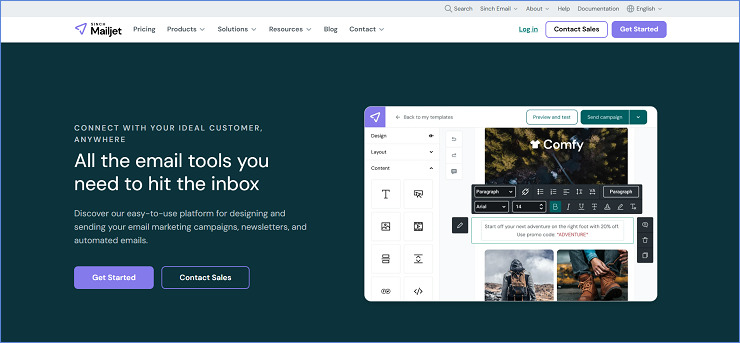
Mailjet’s standout feature among SMTP2GO alternatives is real-time collaboration: multiple team members can edit the same email template simultaneously, closer to a shared document than a typical email builder. It also includes full marketing automation on its top tier, something SMTP2GO doesn’t offer anywhere in its lineup.
Key Features of Mailjet
- Real-time template collaboration: multiple users editing the same campaign at once, a feature no other tool in this guide offers, let alone SMTP2GO.
- Unlimited contacts on paid plans: contact storage isn’t capped or metered, only email volume is, which mirrors SMTP2GO’s own volume-based approach.
- Marketing automation on Premium: welcome sequences, date-based triggers, and property-based scenarios, none of which SMTP2GO offers at any tier.
- A/B testing: available on Premium, letting you test up to 10 variants of a single email.
- 500 to 2,000 included email validations: built into Essential and Premium plans respectively, something SMTP2GO doesn’t include natively.
- EU-based data hosting: relevant for teams with GDPR-driven data residency requirements.
- Email previews across 90+ clients: pre-send rendering checks that go beyond what SMTP2GO’s own testing tools cover.
- Reported account-review friction: worth flagging honestly, since some users report accounts being paused for review with limited warning, a friction point not unlike SMTP2GO’s own new-account review gate, so this isn’t a clean win on setup friction specifically.
Why Mailjet is a Better SMTP2GO Alternative
Mailjet closes the marketing feature ceiling the same way Brevo and SendPulse SMTP do, with the added differentiator of real-time collaborative editing, useful for teams where more than one person touches the same campaign.
Best For
Teams that want marketing automation and collaborative template editing in one platform, and don’t mind the EU-based infrastructure and occasional account-review friction some users have reported.
Mailjet Pricing
Mailjet’s Free plan covers 6,000 emails a month with a 200/day cap. Starter runs $9/month for 8,000 emails. Essential is $17/month for 15,000 emails with unlimited contacts but no automation. Premium, which includes full marketing automation and covers this guide’s 50,000-email comparison point, runs approximately $55/month. A dedicated IP is only included at the 100,000-email-and-above Premium tier.
10. SendLayer: The Most WordPress-Friendly Alternative to SMTP2GO
SendLayer was built by the team behind several popular WordPress plugins, and it shows: setup is built around WordPress from the ground up, in a way that mirrors SMTP2GO’s own reputation for simplicity, just narrower in focus.
Key Features of SendLayer
- Native WordPress plugin: built by a team with deep WordPress plugin experience, overriding the default wp_mail function with minimal configuration.
- All features included at every tier: no feature-gating between plans; SendLayer’s tiers differ by volume and domain count, not by what’s unlocked, unlike SMTP2GO’s own Free-to-Professional feature gaps.
- Guided DNS setup: step-by-step SPF, DKIM, and DMARC configuration inside the dashboard, comparable to SMTP2GO’s own guided authentication setup.
- 14-day money-back guarantee: on all paid plans, giving a low-risk trial window for teams switching from SMTP2GO.
- Simple, flat pricing by volume: easy to predict costs as you scale, similar in spirit to SMTP2GO’s own tiered structure.
- Automatic bounce processing: flagged hard bounces are surfaced through the dashboard and webhooks for list cleanup.
- No free tier: worth noting as a real limitation compared to SMTP2GO, which offers a genuine 1,000-email-a-month free plan indefinitely; SendLayer only offers a 200-email trial.
- Annual billing only: another real constraint compared to SMTP2GO, which offers monthly billing at every tier.
Why SendLayer is a Better SMTP2GO Alternative
For WordPress-first teams, SendLayer’s setup experience is arguably even more streamlined than SMTP2GO’s own plugin, and it comes in cheaper at the 50,000-email mark, making it one of the more budget-friendly SMTP2GO alternatives for that specific use case. The tradeoffs, no free tier and annual-only billing, are worth weighing before switching, since they cut the other way compared to SMTP2GO’s more flexible commitment options.
Best For
WordPress site owners and small teams who want the simplest possible setup and are comfortable committing to annual billing upfront.
SendLayer Pricing
SendLayer has no free tier, only a 200-email trial. The Starter plan is $5/month for 1,000 emails. The Growth plan, which covers this guide’s 50,000-email comparison point, costs $45/month. All SendLayer plans are billed annually.
How to Choose the Right SMTP2GO Alternative for Your Situation
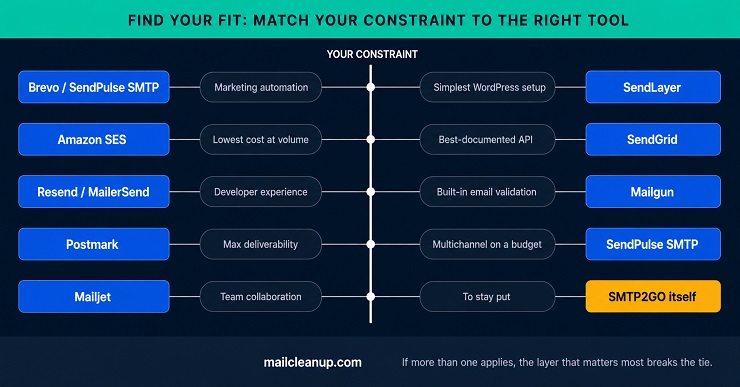
With all 10 tools and all four layers covered, here’s the fast version: match your actual constraint to the right column below.
| If you need… | Choose |
|---|---|
| Marketing automation alongside transactional email | Brevo or SendPulse SMTP |
| The lowest raw cost at high volume | Amazon SES |
| A modern developer experience and clean API | Resend or MailerSend |
| Maximum deliverability for business-critical transactional email | Postmark |
| Real-time template collaboration for a team | Mailjet |
| The simplest possible WordPress setup | SendLayer |
| The most widely adopted, best-documented API | SendGrid |
| Built-in email validation without a separate tool | Mailgun |
| Multichannel automation (SMS, chatbots) on a budget | SendPulse SMTP |
| To stay put | SMTP2GO itself, if you match the criteria in Layer 4 |
If more than one row applies to you, go back to whichever layer, Marketing Feature Ceiling, Setup and Trust Friction, True Cost at 50,000 Emails, or Migration Reality, matters most for your specific constraint, and let that be the tiebreaker among these SMTP2GO alternatives.
Choosing the Right SMTP2GO Alternative Comes Down to What You’ve Outgrown
SMTP2GO isn’t broken, and nothing in this guide argues that it is. It’s a narrow, reliable relay service that does exactly what it says on the tin, and for plenty of small WordPress sites and low-volume senders, that’s still exactly enough. None of the 10 SMTP2GO alternatives covered here make that untrue.
But narrow means something specific stops being enough eventually: a marketing campaign you can’t run without a second tool, a dedicated IP that costs 7.5 times more than your current plan, or a review gate that holds your first 1,000 emails while you’re trying to launch. Whichever one of those is true for you is really the whole decision. Match it to the right row in the comparison table above, and you’ll land on the SMTP2GO alternative that actually solves your specific problem, not just the one with the best marketing.
FAQs About SMTP2GO Alternatives
What Are the Best SMTP2GO Alternatives for Small Businesses?
Brevo and MailerSend are the strongest picks for small businesses among the SMTP2GO alternatives tested in this guide. Brevo adds marketing automation SMTP2GO doesn’t offer at any price, while MailerSend keeps transactional-only simplicity with a modern dashboard and built-in email verification, both starting under $10 a month.
Which SMTP2GO Alternative Has the Best Deliverability?
Postmark leads on deliverability among the tools compared here, largely because it actively vets and rejects customers who could damage shared IP reputation. Amazon SES and Mailgun are also reliable, though Mailgun’s inbox placement dropped from 53.8% to 26.05% between Q1 2024 and Q1 2025, according to GlockApps testing.
Which of These SMTP2GO Competitors Is Cheapest for High Volume?
Amazon SES is the cheapest of these SMTP2GO competitors at high volume, charging a flat $0.10 per 1,000 emails with no monthly minimum, roughly $5 for 50,000 emails. The tradeoff is significant setup time for IAM roles, domain verification, and event tracking that SMTP2GO doesn’t require.
Can I Use SMTP2GO Alternatives for Marketing Emails?
Yes, several SMTP2GO alternatives support marketing email, though SMTP2GO itself doesn’t. Brevo, SendPulse SMTP, and Mailjet all include built-in marketing automation, segmentation, and campaign tools. MailerSend, Mailgun, Postmark, Resend, and SendLayer remain transactional-only, so they won’t close that particular gap.
How Difficult Is It to Migrate from SMTP2GO to an Alternative to SMTP2GO?
It depends on the tool. MailerSend, Mailgun, Postmark, Resend, and SendLayer rate Low migration complexity since their setup closely mirrors SMTP2GO’s own. Amazon SES rates High, requiring IAM roles, Route 53 verification, and SNS wiring SMTP2GO doesn’t need. Most others just mean re-verifying your domain.
Which SMTP2GO Alternative Is Best for Startups?
MailerSend and Resend are strong fits for startups, both offering instant account activation and modern dashboards with no review-and-hold gate like SMTP2GO’s. Resend’s free tier covers 3,000 emails a month, well above SMTP2GO’s 1,000; MailerSend’s Hobby plan starts at just $7 for 5,000 emails.
Do These Alternatives to SMTP2GO Offer Free Plans?
Most do. Resend offers 3,000 free emails a month, and SendPulse SMTP and Brevo both offer generous free volume, while MailerSend’s free tier covers 500 emails. Amazon SES has no free tier but a near-zero starting cost, and SendLayer skips a free plan entirely, offering only a 200-email trial.
Are There Limits on How Many Emails I Can Send with SMTP2GO Alternatives?
Yes, every tool in this guide caps free and entry-level plans by monthly volume, then charges overage or requires an upgrade beyond that. SMTP2GO itself is no exception: its Starter plan covers 10,000 emails before $1-per-1,000 overage applies. Check each provider’s current plan page before committing.