
Amazon SES is the cheapest way to send email at scale, and that’s exactly why so many teams end up stuck with it long after it stops being the right fit. At $0.10 per 1,000 emails, nothing else comes close on paper. But SES hands you raw sending infrastructure and nothing else: no dashboard, no templates, no bounce handling, no automation. Everything beyond “accept this payload and deliver it” is something your team has to build, wire up, and maintain inside AWS.
We built this guide for the moment that build-it-yourself math stops working. Below, we compare 10 Amazon SES alternatives on the three things that actually decide whether a switch is worth it: how much AWS-specific setup each one removes, what’s built in versus what you’d still have to build, and what each one really costs at 50,000 emails a month once SES’s hidden fees are factored in. Every price below was pulled from each provider’s live pricing page during this review, not carried over from an old screenshot.
If you’re earlier in this decision and just want the short version, the TL;DR below covers it. If you want the full reasoning, the comparison framework and all 10 reviews follow after that.
TL;DR on Amazon SES Alternatives
- Amazon SES charges $0.10 per 1,000 emails, but dedicated IPs ($24.95/month), Virtual Deliverability Manager ($0.07/1,000), and attachment fees ($0.12/GB) push the real cost well past the headline rate.
- New AWS accounts created after July 15, 2025 no longer get 3,000 free SES messages a month; they receive a $200 AWS credit instead, which behaves very differently once it runs out.
- Every one of the 10 Amazon SES alternatives in this guide removes at least one piece of AWS-specific setup: IAM role configuration, Route53 domain verification, SNS webhook wiring for bounces and complaints, or CloudWatch monitoring.
- At 50,000 emails a month, Mailgun’s Foundation plan and SendGrid’s Essentials plan both land in the $20 to $35/month range, while Postmark’s Pro plan runs closer to $68.50/month once its included volume and overage rate are calculated together.
- Brevo and SendPulse SMTP are the only two tools in this list that combine marketing automation with transactional sending in a single plan, which matters if you’re using SES for more than password resets and receipts.
- Mailtrap offers separate transactional and bulk sending streams, mailbox-provider-level deliverability analytics, and a modern developer experience come standard from the free tier, with native MCP server support for teams building with AI coding tools.
- Resend is the newest addition to this category with native MCP server access, increasingly relevant if your team is building with AI coding tools.
- Migration complexity varies sharply across this list, from a 15-minute SMTP credential swap to a multi-week project involving DNS reconfiguration and a full domain warmup sequence.
- Staying on Amazon SES is still the right call for teams with dedicated engineering resources sending millions of emails a month, and we cover exactly when that’s true later in this guide.
Quick Comparison Table: 10 Amazon SES Competitors at a Glance
The table below summarizes all 10 Amazon SES alternatives covered in this guide, so you can scan pricing and fit before reading the full reviews.
| Tool | Best For | Free Tier | Price at 50K Emails/Month | Dedicated IP |
|---|---|---|---|---|
| Mailtrap | Deliverability infrastructure and analytics | 4,000/month | $20/mo (Basic) | Business plan and up |
| Brevo | Combined marketing and transactional | 300/day, unlimited contacts | $56/mo (Starter) | Add-on, $251/yr |
| Postmark | Transactional deliverability | 100/month, no expiration | $55/mo (Basic) | $50/mo add-on, 300K+ min |
| SendGrid | Developer ecosystem at scale | 60-day trial, 100/day | $19.95/mo (Essentials) | Pro plan and up |
| Mailgun | Developer-first infrastructure | 100/day | $35/mo (Foundation) | Scale plan and up |
| Resend | React and modern dev workflows | 3,000/month, 100/day | $20/mo (Pro) | Scale plan, 3K+/day |
| MailerSend | Email and SMS in one API | 500/month, 100/day | $35/mo (Starter) | Enterprise, 100K+/week |
| SMTP2GO | Predictable SMTP relay pricing | 1,000/month, 200/day | $30/mo (Starter) | Professional plan and up |
| SendPulse SMTP | Largest free transactional tier | 12,000/month, 50/hour | $11.80/mo (Basic) | Included on monthly Pro plans |
| Elastic Email | Lowest price, closest to SES | 100/day | $19/mo (Starter) | Add-on, approx. $40/mo |
What Is Amazon SES, and Why Do Teams Search for Alternatives to Amazon SES?
Amazon SES (Simple Email Service) is a cloud-based email sending service built into AWS. It lets businesses and developers send transactional, marketing, and bulk email at scale through a pay-as-you-go API, billed at $0.10 per 1,000 emails with no monthly minimum.
That low price is the entire reason SES has the reputation it does. It’s also, paradoxically, the reason so many teams eventually start searching for alternatives to Amazon SES.
Why Teams Search for Amazon SES Alternatives
SES is infrastructure, not a product. It hands you a sending engine and almost nothing else, which means several real gaps show up once a team is actually running it in production:
- No dashboard for non-engineers. Checking delivery rates or verifying a customer received an email means either querying CloudWatch metrics or asking a developer to do it for you.
- No templates or visual editor. Every email is a raw HTML string passed to the API, with no built-in way to design, preview, or version templates.
- Manual bounce and complaint handling. SES surfaces events through SNS, but building suppression list logic, retry handling, and alerting on top of those events is entirely on your team.
- AWS-specific setup at every step. Domain verification through Route53, IAM role configuration, and SNS topic wiring for webhooks all assume someone on the team is comfortable inside the AWS console.
- No native marketing capabilities. Automated workflows, A/B testing, segmentation, and campaign scheduling don’t exist on SES at all, so marketing-minded teams end up running a second platform alongside it regardless.
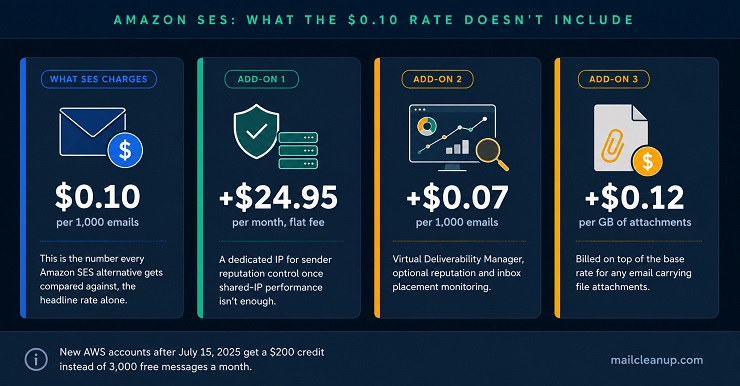
- Hidden costs beyond the headline rate. Dedicated IPs cost $24.95/month each, the Virtual Deliverability Manager adds $0.07 per 1,000 emails, and attachments are billed at $0.12/GB, all on top of the base $0.10/1,000 rate.
- A changed free tier. As of July 15, 2025, new AWS accounts no longer receive 3,000 free SES messages a month. They get a $200 AWS credit instead, which behaves very differently once it runs out, since it applies across all AWS services, not just SES.
None of this makes Amazon SES a bad product. It makes it exactly what it claims to be: low-level sending infrastructure for teams with the engineering capacity to build everything around it. The 10 Amazon SES alternatives reviewed above exist because that tradeoff stops making sense for a lot of teams once they actually run the numbers on engineering time.
The Amazon SES Exit Stack: How We Evaluated These AWS SES Alternatives
Most roundups of Amazon SES competitors compare price per email and stop there. That misses the actual reason teams leave SES, which is rarely the price tag itself. It’s everything SES makes you build around that price tag. We evaluated all 10 Amazon SES alternatives in this guide against four layers, built specifically around what switching away from SES actually changes.
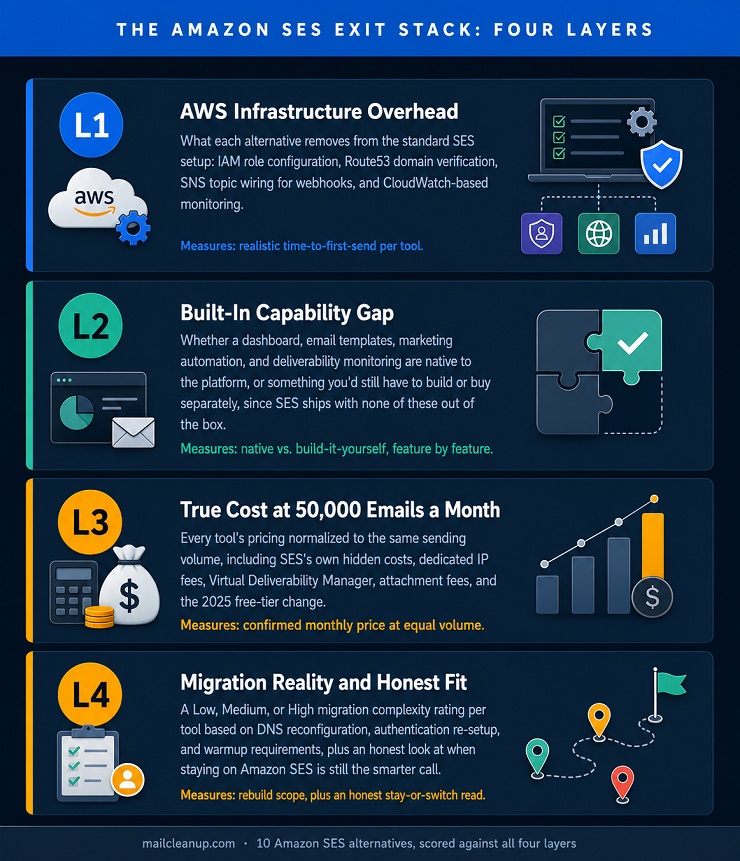
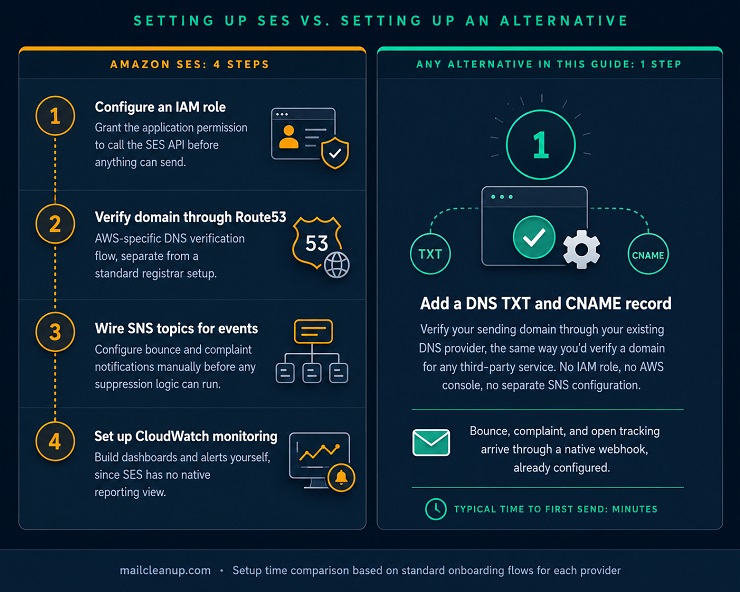
- AWS Infrastructure Overhead. What each alternative removes from the standard SES setup, including IAM role configuration, Route53 domain verification, SNS topic wiring for bounce and complaint webhooks, and CloudWatch-based monitoring. We note realistic time-to-first-send for each tool against SES’s multi-step AWS console process.
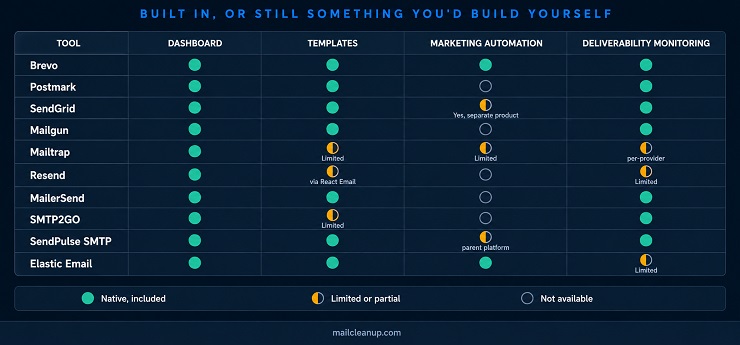
- Built-In Capability Gap. Whether a dashboard, email templates, marketing automation, and deliverability monitoring are native to the platform or something you’d still have to build or buy separately, since SES ships with none of these out of the box.
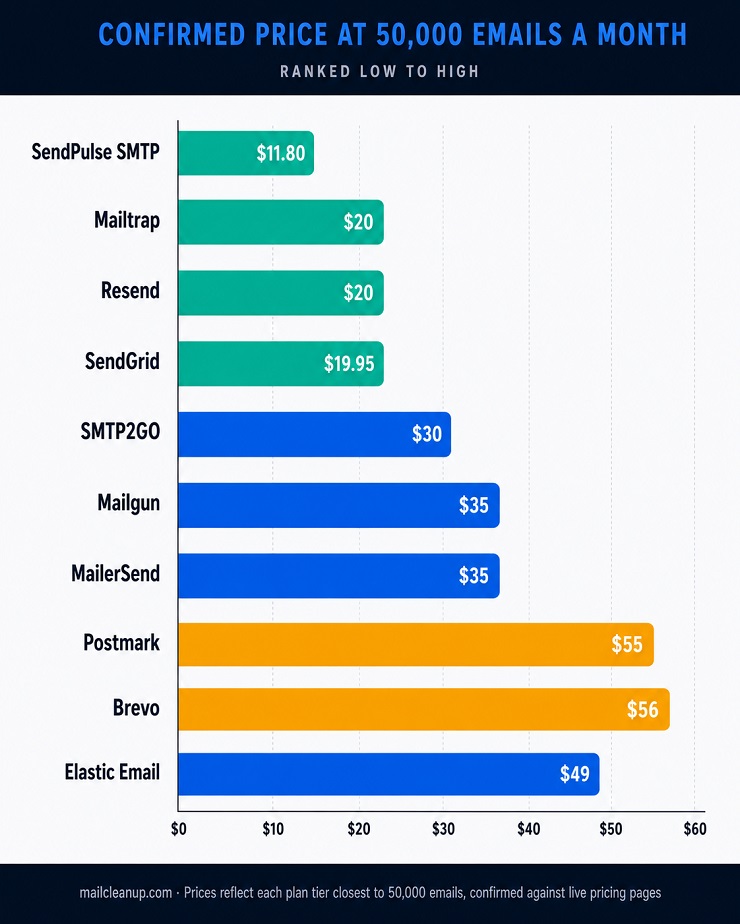
- True Cost at 50,000 Emails a Month. Every tool’s pricing normalized to the same sending volume, including SES’s own hidden costs (dedicated IP fees, Virtual Deliverability Manager, attachment fees, and the 2025 free-tier change) so the comparison reflects what you’d actually pay, not just the advertised starting price.
- Migration Reality and Honest Fit. A Low, Medium, or High migration complexity rating per tool based on DNS reconfiguration, authentication re-setup, and warmup requirements, plus an honest look at when staying on Amazon SES is still the smarter call.
The 10 Best Amazon SES Alternatives, Reviewed
We tested and reviewed each of the following Amazon SES alternatives against the four layers above. Pricing reflects each provider’s published rate at 50,000 emails a month as of this review, verified directly from their live pricing pages.
1. Mailtrap: Best Amazon SES Alternative for Deliverability and Analytics
Mailtrap is an email delivery platform for developer and product teams, with separate sending streams for transactional and bulk email so a marketing send can’t affect password-reset deliverability. DKIM keys rotate automatically every month, and analytics break delivery down by mailbox provider.
SDKs cover Node.js, PHP, Ruby, Python, .NET, Elixir, and Java, and Mailtrap also ships an official MCP server, skills, and an Agent Inbox for inbound email, so an agent can send, check delivery, and handle replies through one connection.
Key Features of Mailtrap
- Separate transactional and bulk sending streams. Reputation isolation between message types is built in from the entry plan, rather than something you architect yourself across multiple SES configuration sets.
- DKIM keys that rotate automatically every month. Authentication stays current without a manual rotation schedule, closing a gap SES leaves entirely to you to track.
- Per-mailbox-provider analytics. Delivery, bounce, and spam complaint rates are broken down by Gmail, Outlook, Apple, and Yahoo individually, replacing the generic CloudWatch metrics SES provides with no provider-level detail.
- REST API and SMTP with 7 SDK languages. Comprehensive documentation and 25-plus copy-paste SMTP snippets shorten the integration timeline compared to SES’s AWS SDK setup.
- Native MCP server support. AI coding tools like Claude Code and Cursor can self-configure and send through Mailtrap directly, a capability with no SES equivalent at all.
- ISO 27001 and SOC 2 Type II certification. Compliance documentation that’s ready for security review out of the box, useful for teams whose procurement process would otherwise need to evaluate SES plus whatever else you’ve bolted onto it.
- Free migration support above 200,000 emails a month. Mailtrap’s deliverability team handles the transition for high-volume senders, an offer no AWS support tier extends specifically for moving off SES.
Why Mailtrap Is a Better Amazon SES Alternative
The clearest advantage Mailtrap has over Amazon SES is that deliverability management is genuinely built in rather than something you assemble from separate AWS services. Separate sending streams for transactional and bulk sending solve a reputation problem SES leaves entirely to you to architect, DKIM keys rotate on their own every month, and per-provider analytics give you diagnostic detail that SES’s CloudWatch integration doesn’t surface on its own.
Setup follows the same pattern as the rest of this list: standard DNS verification instead of Route53, native webhooks instead of SNS topic wiring, and SDKs across seven languages that get a working integration running in minutes rather than an afternoon in the AWS console. For teams already building with AI coding tools, the native MCP server support extends that same account to agent-driven workflows, a capability with no SES equivalent and one most alternatives to AWS SES still haven’t matched.
Best For
Developer and product teams that want deliverability management and analytics built in from the free tier, with a modern API, SDKs, and native MCP support for teams building with AI coding tools.
Mailtrap Pricing
Mailtrap’s Email API/SMTP product runs Free at 4,000 emails a month, Basic from $15/month for 10,000 emails with no dedicated IP, Business from $85/month for 100,000 emails with a dedicated IP included, and Enterprise from $750/month for 1,500,000 emails.
2. Brevo: Best Amazon SES Alternative for Combined Marketing and Transactional Sending
Brevo is one of the few Amazon SES alternatives that genuinely replaces SES for transactional sending while also giving you a full marketing platform in the same account. Where SES treats every message the same way, Brevo separates marketing campaigns from transactional API and SMTP sending, and both draw from the same pool of monthly email credits rather than requiring two separate subscriptions.
Setup is the clearest contrast with SES. Brevo verifies your sending domain through standard DNS records rather than AWS’s Route53-specific flow, and there’s no IAM role to configure before your first send goes out.
Key Features of Brevo
- Transactional API and SMTP relay. Send password resets, receipts, and notifications through a REST API or standard SMTP credentials, with unlimited log retention included on every plan, no CloudWatch configuration required to see your own send history.
- Drag-and-drop marketing editor. Build newsletters and campaigns without touching HTML, using a library of pre-built templates, something SES has no equivalent for at all.
- Marketing automation workflows. Trigger multi-step email sequences based on contact behavior, available from the Standard plan upward, replacing the custom Lambda and Step Functions logic teams often build on top of SES to achieve the same thing.
- Real-time event webhooks. Track opens, clicks, bounces, and complaints as they happen, without configuring SNS topics or Kinesis streams the way SES requires for the same visibility.
- Built-in contact management and segmentation. Search, save, and filter contacts by demographics, website activity, campaign engagement, or custom events, and build unlimited segments, a concept that doesn’t exist in SES since it has no contact storage at all.
- AI content generator. Draft subject lines and email body copy, then adjust tone directly in the editor, useful for teams without a dedicated copywriter who would otherwise be staring at a blank SES API payload.
- Multichannel sending beyond email. SMS, WhatsApp, and web and mobile push are available from the same contact list on Professional plans and above, extending well past what SES, an email-only service, can ever offer natively.
- Landing pages and signup forms. Create standalone campaign pages and embeddable forms without a developer, paired with automatic follow-up emails on signup, again something SES simply has no concept of.
Why Brevo Is a Better Amazon SES Alternative
Brevo’s biggest advantage over Amazon SES is that it charges by email volume rather than contact count, which is the same pricing logic SES uses, but pairs it with a real dashboard, templates, and automation that SES simply doesn’t have, a combination several Amazon SES competitors on this list still don’t fully match. You get unlimited contacts on every paid plan, so a large but infrequently emailed list doesn’t inflate your bill the way it would on a contact-based platform.
The tradeoff against raw SES pricing is real: Brevo costs meaningfully more per email than SES’s $0.10/1,000 rate. But that comparison only holds if you ignore everything SES doesn’t include. Once you account for the engineering time to build bounce handling, a sending dashboard, and basic automation on top of SES, Brevo’s all-in-one pricing becomes the more honest comparison for most teams that aren’t purely sending transactional mail at extreme volume.
Best For
Teams that want one Amazon SES alternative covering both transactional sending and marketing campaigns, without maintaining two separate platforms or two separate AWS-style setups.
Brevo Pricing
Brevo’s Starter plan starts at $9/month for 5,000 emails and scales with volume, reaching $82/month at 100,000 emails on its published pricing curve. At 50,000 emails a month, that places Starter at $56/month. The Standard plan, which adds marketing automation and A/B testing, starts at $18/month for the same 5,000-email entry tier and scales proportionally higher. A dedicated IP is available as an add-on for $251/year on the Professional plan and above. The free plan caps out at 300 emails/day with unlimited contact storage up to 100,000 contacts, useful for testing before you commit to a paid tier.
3. Postmark: Best Amazon SES Alternative for Transactional Deliverability
Postmark is built around a single idea: transactional email is too important to share infrastructure with marketing sends. Where Amazon SES treats every message identically and leaves reputation management entirely to you, Postmark separates transactional and broadcast email into distinct message streams, so a marketing send that triggers spam complaints can’t drag down your password reset deliverability.
That separation, combined with Postmark’s reputation for strict customer vetting, is why it consistently ranks at the top of independent inbox placement benchmarks. It’s also one of the more opinionated Amazon SES alternatives on this list. Postmark doesn’t offer a campaign builder or list management, and openly discourages high-volume marketing use cases that might put shared sender reputation at risk.
Key Features of Postmark
- Message streams. Transactional and broadcast email run on isolated streams, protecting transactional deliverability from marketing-related reputation damage, a separation SES has no native equivalent for unless you manually split sending across multiple SES identities.
- 45-day message retention with full search. Every sent message is logged and searchable by recipient, subject, or status, replacing the CloudWatch and SNS configuration SES requires for the same visibility, and Postmark’s retention window extends to 365 days on request.
- Pre-built transactional templates. Password resets, receipts, and welcome emails ship with tested, responsive templates ready to customize, where SES gives you an empty payload field and nothing else.
- Inbound email processing. Parse incoming replies and route them to your application through webhooks, useful for support ticket workflows, without the separate SES receiving rule sets and S3 storage configuration that the same feature requires on AWS.
- Publicly reported delivery metrics. Postmark publishes its own average delivery times and inbox placement rates, giving you an external benchmark to hold any provider against, including itself, something no AWS service offers for SES.
- Automatic bounce and complaint suppression. Addresses that bounce or complain are suppressed from future sends without any setup, where SES requires you to build and maintain your own suppression list logic on top of SNS notifications.
- DMARC monitoring. A free weekly digest from major mailbox providers, with a paid tier adding a full dashboard and 60-day history, useful for catching authentication problems SES leaves entirely to your own monitoring.
- Human support included on every paid plan. Email and chat support are part of the base price, not a separate AWS Support plan billed on top of your sending costs.
Why Postmark Is a Better Amazon SES Alternative
The single biggest difference between Postmark and Amazon SES is deliverability accountability. SES gives you the tools to monitor your own reputation, but the responsibility, and the consequences of getting it wrong, sit entirely with you. Postmark actively manages shared IP reputation across its customer base and will reject use cases that risk it, which is also why its inbox placement numbers consistently lead the category among alternatives to Amazon SES.
Setup is also dramatically simpler. Domain verification runs through standard DNS records rather than Route53, and bounce and complaint handling is built in from day one instead of requiring SNS topic configuration and a Lambda function to process events.
Best For
Teams whose transactional email is business-critical, like password resets, 2FA codes, and order confirmations, and who are willing to pay a premium over SES for guaranteed deliverability and zero reputation-management overhead.
Postmark Pricing
Postmark runs three paid tiers, all starting with 10,000 included emails a month: Basic at $15/month with $1.80 per 1,000 overage, Pro at $16.50/month with $1.30 per 1,000 overage, and Platform at $18/month with $1.20 per 1,000 overage and unlimited users and sending domains. At 50,000 emails a month, the Basic plan costs $55/month, cheaper than Pro’s $60.50/month at the same volume. A dedicated IP is available on Pro and Platform for $50/month, though Postmark requires at least 300,000 emails a month before recommending one. The free Developer plan includes 100 emails a month with no expiration, useful for testing but not viable for production sending.
4. SendGrid: Amazon SES Alternative With the Largest Developer Ecosystem
SendGrid, now part of Twilio, is one of the most established names on this list, and one of the few Amazon SES alternatives that genuinely competes with SES on scale. It powers billions of emails a month across both transactional API sending and a separate marketing campaigns product, with SDKs and documentation covering nearly every major programming language and framework.
The free permanent plan that once made SendGrid an easy first step is gone. Twilio retired it in May 2025 in favor of a 60-day free trial, after which you need to move to a paid plan to keep sending.
Key Features of SendGrid
- Email API and SMTP relay. Send transactional email through a RESTful API or standard SMTP, with the same volume-based plan covering both, mirroring SES’s dual-protocol approach without the AWS console setup.
- Marketing Campaigns product. A separate drag-and-drop email builder and automation tool, billed independently from the Email API, covering newsletters and drip sequences that SES has no native path for.
- Dedicated IP management. Available from the Pro plan, giving high-volume senders direct control over sender reputation, including self-service IP warmup tools that SES leaves entirely to manual scheduling.
- Email validation API. Clean your list before sending, included with Pro plan credits and available pay-as-you-go on lower tiers, a feature SES doesn’t offer in any form.
- Pre-built template library. A visual editor and template gallery for both transactional and marketing emails, replacing the raw HTML strings SES expects in every API call.
- Detailed analytics dashboard. Opens, clicks, bounces, and spam reports are visualized out of the box, where the same data on SES means configuring SNS, Kinesis Firehose, and a downstream analytics tool yourself.
- Automated suppression management. Bounced and complained addresses are automatically removed from future sends and visible in one place, instead of the custom suppression logic SES requires you to build on top of its event notifications.
- Sub-user account management. Available on Pro and above, useful for agencies or multi-brand teams managing several sending identities under one account, without spinning up separate AWS accounts or IAM policies per brand.
Why SendGrid Is a Better Amazon SES Alternative
SendGrid’s core advantage over Amazon SES is maturity at scale combined with an actual interface. Both platforms are built to handle enormous sending volume, but SendGrid wraps that infrastructure in a dashboard, analytics, and template tooling that SES simply doesn’t offer. For teams that have already outgrown SES’s raw API and want a like-for-like replacement that scales the same way, SendGrid is usually the first name that comes up among alternatives to AWS SES.
The setup difference matters too. Authenticating a sending domain in SendGrid is a standard DNS record process, without the IAM roles and production-access request that gating a new SES account from sandbox mode requires.
Best For
Teams that need an Amazon SES alternative capable of handling enterprise-scale volume, with both transactional and marketing sending available under one vendor relationship.
SendGrid Pricing
SendGrid’s Essentials plan starts at $19.95/month for 50,000 emails, an exact match to this guide’s comparison volume, making it one of the cleanest price points on this list. Essentials does not include a dedicated IP. The Pro plan jumps to $89.95/month for 100,000 emails and adds a dedicated IP, sub-user account management, and deeper analytics, a steep step up that only makes sense once you actually need those features. Premier pricing is custom, aimed at senders well past 2.5 million emails a month. The Marketing Campaigns product is billed separately from the Email API, so a team using both transactional and marketing sending should budget for two line items rather than one.
5. Mailgun: One of the Strongest AWS SES Alternatives for Developer-First Infrastructure
Mailgun is the Amazon SES alternative most often picked by teams who like SES’s API-first philosophy but want more built in around it. It offers the same combination of HTTP API and SMTP relay that SES does, but adds email validation, inbound parsing, and a real activity dashboard without requiring you to stitch together separate AWS services to get the same visibility.
Mailgun’s deliverability has come under more scrutiny recently. GlockApps data tracked Mailgun’s inbox placement rate falling 27.75 percentage points between Q1 2024 and Q1 2025, a decline worth weighing against its developer-experience advantages before committing at high volume.
Key Features of Mailgun
- HTTP API and SMTP relay. The same dual sending options as Amazon SES, with more complete documentation and SDK coverage across major languages, so the migration is closer to a credential swap than a rebuild.
- Built-in email validation. Clean addresses before sending without a separate verification tool, something SES doesn’t offer natively at all.
- Inbound email parsing. Receive and process incoming email programmatically, useful for reply handling and support workflows, without the SES receiving rule sets and S3 bucket wiring the same feature requires on AWS.
- Template management. Store and version email templates directly in the platform from the Foundation plan upward, rather than managing them in your own codebase the way SES forces you to.
- Real-time event tracking and searchable logs. Opens, clicks, bounces, and complaints are visible in a dashboard the moment they happen, replacing the CloudWatch, SNS, and Kinesis stack SES requires for the same data.
- Send time optimization. Available on the Scale plan, machine learning predicts the best send time per recipient, a feature with no SES equivalent since SES has no concept of individual recipient behavior at all.
- Dual-region sending. Send through US or EU infrastructure from a single account for data residency control, without the separate AWS account and region configuration the same requirement demands on SES.
- Reputation Monitoring. Mailgun automatically tracks bounced, unsubscribed, and complained addresses and prevents sending to them going forward, where SES leaves suppression list logic entirely up to you to design and maintain.
Why Mailgun Is a Better Amazon SES Alternative
Mailgun’s pitch is essentially “SES, but with the parts you’d otherwise have to build.” Both platforms expose a developer-first API and treat email as infrastructure rather than a marketing product, which makes Mailgun one of the more direct like-for-like replacements among Amazon SES alternatives for teams that don’t want to change how they think about sending email, just what they’re sending it through.
Domain setup mirrors the SES-replacement pattern seen elsewhere on this list: standard DNS verification instead of Route53, and bounce and complaint events delivered through webhooks you configure once, rather than SNS topics and a Lambda function you maintain indefinitely.
Best For
Developer-led teams who want an Amazon SES alternative that keeps the API-first approach but adds validation, inbound parsing, and a dashboard SES doesn’t provide.
Mailgun Pricing
Mailgun’s Foundation plan costs $35/month for 50,000 emails, another exact match to this guide’s comparison volume, and includes email templates, 1,000 sending domains, and 5-day log retention. The Basic plan below it runs $15/month for 10,000 emails with no daily limit. The Scale plan at $90/month covers 100,000 emails and adds a dedicated IP, SAML SSO, 30-day log retention, and phone and chat support. Overage rates decline at higher tiers, from $1.80 per 1,000 on Basic down to $1.10 per 1,000 on Scale. The free plan allows 100 emails a day, suitable for testing only given the tight daily cap.
6. Resend: Best Amazon SES Alternative for React and Modern Developer Workflows
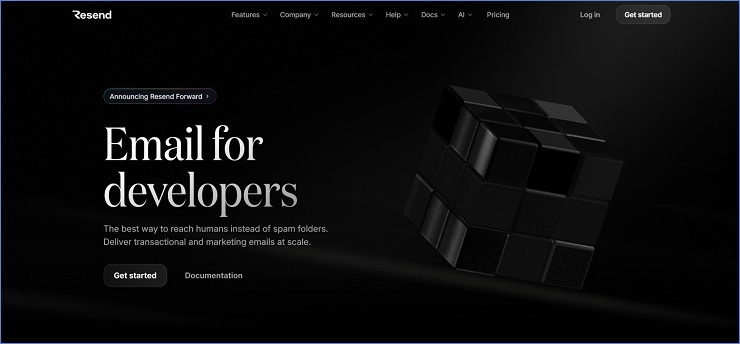
Resend is the Amazon SES alternative most likely to come up when a developer describes wanting “SES, but built in 2024.” It was built by a team frustrated with existing transactional email APIs, and the clearest evidence of that is React Email, an open-source library that lets you write email templates as React components instead of wrestling with table-based HTML, something neither SES nor most of its alternatives offer natively.
Resend is transactional only. There’s no campaign builder or list management bundled in, and Marketing Email is a separate product billed per contact rather than per email, so a team needing both transactional and marketing sending should budget for two line items.
Key Features of Resend
- React Email integration. Build templates as React components with live preview, a genuinely different development experience from the raw HTML strings SES expects in every API payload.
- Modern SDKs across every major language. Clean, well-documented client libraries replace the AWS SDK configuration SES setup typically requires.
- Batch sending. Send to multiple recipients with personalized content in a single API call, reducing the request overhead SES’s standard API pattern requires for the same task.
- Webhooks that work without SNS configuration. Delivery, bounce, and complaint events post directly to your endpoint, skipping the SNS topic and subscription setup SES requires for equivalent visibility.
- Inbound email routing. Receive and process incoming email programmatically, without the SES receiving rule sets and S3 bucket wiring the same feature demands on AWS.
- Native MCP server support. Like Mailtrap, Resend can be configured and used directly by AI coding tools, a capability SES has no path to without custom development.
- Pay-as-you-go overage billing. Continue sending past your plan limit automatically at $0.90 per 1,000 additional emails, rather than SES’s flat per-email rate that requires no plan tier at all.
- Dedicated IP warmup and monitoring. Available on the Scale plan for senders exceeding 3,000 emails a day, with Resend handling warmup and autoscaling rather than leaving it to manual scheduling the way SES does.
Why Resend Is a Better Amazon SES Alternative
Resend’s core pitch against Amazon SES is developer experience, full stop. Both platforms are API-first and built for teams that want to send email from code rather than a dashboard, but Resend wraps that philosophy in modern SDKs, React Email, and webhooks that work without any SNS configuration, none of which SES offers natively.
The tradeoff is scope. Resend doesn’t try to be a marketing platform the way Brevo or SendGrid do, which makes it one of the more direct like-for-like swaps among Amazon SES alternatives for teams that only need SES’s transactional sending replaced, not a full platform migration.
Best For
Developer teams, especially those building in React, who want an Amazon SES alternative focused purely on transactional sending with a modern API and no marketing platform bundled in, a common pattern among newer AWS SES alternatives built for this audience.
Resend Pricing
Resend’s Pro plan starts at $20/month for 50,000 emails, an exact match to this guide’s comparison volume, and scales to $35/month at 100,000 emails within the same Pro tier. The Scale plan starts at $90/month for 100,000 emails and runs up to $1,150/month at 2.5 million, adding dedicated IPs, Slack-based support, and 1,000 domains. The free plan includes 3,000 emails a month with a 100/day cap. Overage beyond your plan is billed automatically at $0.90 per 1,000 additional emails if enabled. Resend doesn’t currently offer annual billing discounts, and its Marketing Email product is billed separately, per contact rather than per email sent.
7. MailerSend: Amazon SES Alternative With Email and SMS in One API
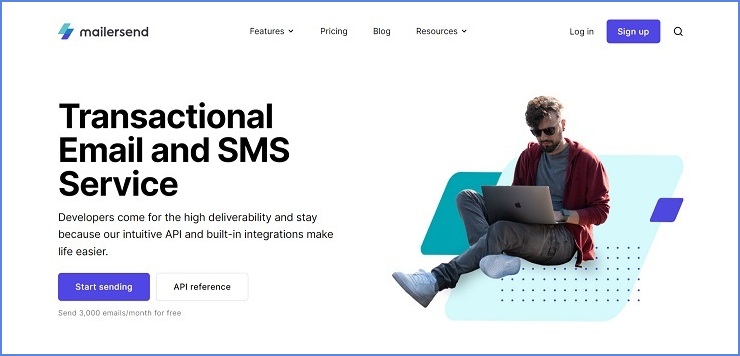
MailerSend, built by the team behind MailerLite, takes Amazon SES’s developer-first API approach and adds the dashboard, validation, and template tooling SES leaves out. It’s one of the more balanced Amazon SES alternatives on this list for teams that want to keep an API-driven workflow but stop building deliverability infrastructure from scratch.
MailerSend restructured its entry-level pricing on December 2, 2025, a change worth knowing about if you’re comparing it against older reviews. The free Hobby tier that previously offered 3,000 emails a month became a paid $7/month plan, and the new permanently free tier dropped to 500 emails a month with a 100/day cap.
Key Features of MailerSend
- Email and SMS from one API. Order confirmations and two-factor codes can go out as SMS through the same integration used for transactional email, a channel SES doesn’t touch at all.
- Built-in email verification. Validate addresses before sending without a separate tool, included across every paid plan.
- Drag-and-drop template builder. A visual editor with 90-plus content blocks replaces the raw HTML strings SES’s API expects for every send.
- Inbound email routing. Parse and process incoming replies, without the SES receiving rule sets and S3 storage configuration the same feature requires on AWS.
- 25-plus native integrations. Stripe, Zapier, and other ecommerce and automation tools connect directly, where SES typically needs custom Lambda functions to achieve the same connections.
- IP allowlisting. Restrict account access to specific IP ranges for added account security, a feature with no direct SES equivalent outside of broader AWS IAM policy work.
- Flexible Flex plan billing. Pure usage-based pricing with no monthly commitment after a free trial period, useful for teams with unpredictable or seasonal volume who don’t want to guess at a tier upfront.
- Dedicated IPs on Enterprise. Available for senders exceeding 100,000 emails a week, with MailerSend managing warmup rather than leaving it to manual scheduling.
Why MailerSend Is a Better Amazon SES Alternative
MailerSend’s advantage over Amazon SES is that it keeps the same API-first philosophy SES users are already comfortable with, while adding the dashboard, analytics, and validation that SES requires you to either build yourself or purchase as a separate tool. For a team that picked SES specifically because they wanted to control sending through code, MailerSend is one of the smoothest transitions among Amazon SES competitors precisely because it doesn’t ask you to change how you think about email.
The built-in SMS channel is a genuine differentiator against the rest of this list. Most of the other Amazon SES alternatives here are email-only, while MailerSend lets you trigger SMS notifications from the same API key.
Best For
Developer-led teams that want an Amazon SES alternative with the same API-driven workflow, plus built-in validation, templates, and optional SMS, without changing their integration pattern significantly.
MailerSend Pricing
MailerSend’s Starter plan starts at $35/month for 50,000 emails, an exact match to this guide’s comparison volume. The Professional plan starts at $110/month for the same 50,000-email entry point but adds unlimited domains, unlimited user seats, and features aimed at agencies managing multiple client domains. Below Starter, the Hobby plan runs $7/month for 5,000 emails, and the permanently free tier covers 500 emails a month with a 100/day cap. Overage beyond your plan’s quota is billed at a metered rate starting around $0.95 to $1.30 per 1,000 additional emails depending on plan size.
8. SMTP2GO: Among the Simplest AWS SES Alternatives for Predictable Pricing
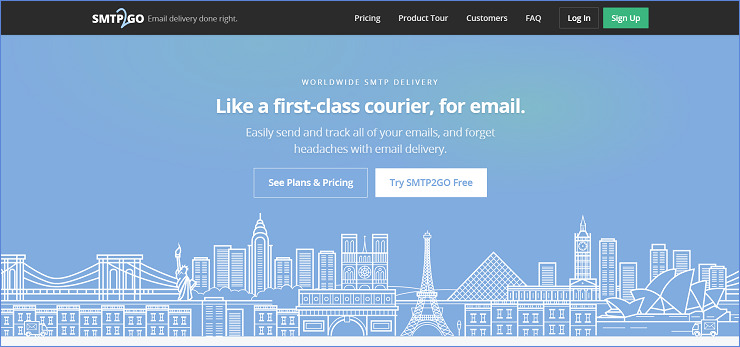
SMTP2GO has been running since 2006, longer than most of the other Amazon SES alternatives on this list, and its pitch hasn’t really changed in that time: reliable SMTP relay with a dashboard, without the complexity of bigger competitors. It doesn’t try to be a marketing platform or compete on features the way Brevo or SendGrid do. It does one thing, transactional and bulk SMTP relay, and keeps the pricing and setup simple while doing it.
That focus shows up in the gaps too. SMTP2GO has no contact database, no campaign builder, and no A/B testing, so teams that need marketing capabilities will be pairing it with a separate platform, the same tradeoff SES itself requires.
Key Features of SMTP2GO
- SMTP relay and REST API. Both protocols are supported from the entry plan, mirroring SES’s dual sending options without the AWS console configuration.
- DNS-based domain verification. SPF and DKIM pass automatically once you verify through standard DNS records, copy-paste simple compared to Route53-specific SES verification.
- Multi-region server infrastructure. Servers in the US, Europe, and Australia route automatically for delivery speed, useful for global sending without standing up separate regional AWS accounts.
- Email rendering preview across 40-plus clients. Test how an email displays before sending, paired with spam filter testing, a combination SES doesn’t offer at all.
- Sub-account management. Create isolated accounts for clients, departments, or projects under one main account, useful for agencies managing multiple sending identities without separate AWS IAM policies per client.
- Automatic bounce and complaint suppression. Addresses that bounce or complain are removed from future sends without manual configuration, where SES requires you to build this logic on top of SNS notifications yourself.
- ISO 27001 certification and MAAWG membership. Compliance and industry-standards credentials that simplify security review, the same kind of documentation gap SES leaves entirely to your own AWS configuration to satisfy.
- Email archiving add-on. Extend activity data retention from 30 days up to 2 years for compliance needs, billed per GB rather than requiring a custom S3 retention policy the way SES would.
Why SMTP2GO Is a Better Amazon SES Alternative
SMTP2GO’s advantage over Amazon SES is almost entirely about setup time and predictability. Domain verification runs through standard DNS records rather than Route53, dashboard reporting replaces the CloudWatch and SNS stack SES requires for the same visibility, and pricing is a flat tier plus a published overage rate rather than the multi-line-item billing SES produces once dedicated IPs, attachments, and the Virtual Deliverability Manager get added in.
It’s a narrower tool than SES in terms of raw capability, since it doesn’t try to handle marketing email, but for teams whose actual need is SMTP relay specifically, that narrowness is the point compared to fuller-featured Amazon SES competitors.
Best For
Teams using SES primarily for SMTP relay who want the same straightforward sending model with a real dashboard and predictable pricing, without taking on a full marketing platform they don’t need.
SMTP2GO Pricing
SMTP2GO’s Starter plan costs $15/month for 10,000 emails with $1.20 per 1,000 overage beyond that. At 50,000 emails a month, staying on Starter will cost $30/month total. The Professional plan at $75/month covers 100,000 emails outright and adds a dedicated IP, email testing tools, and inbound parsing, with overage dropping to $0.85 per 1,000. The free plan includes 1,000 emails a month with a 200/day cap, and Premier pricing is custom for senders above 3 million emails monthly.
9. SendPulse SMTP: Amazon SES Alternative With the Largest Free Transactional Tier
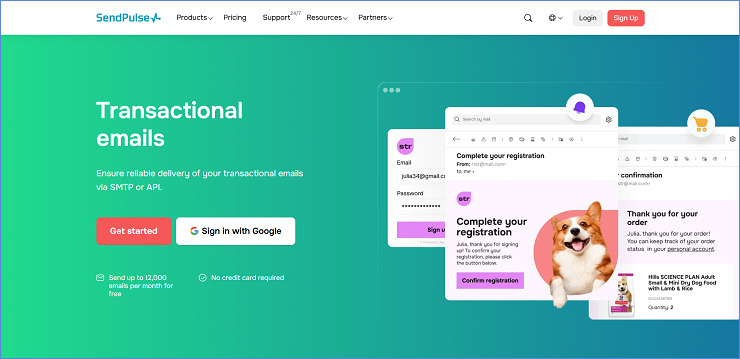
SendPulse SMTP stands out on this list for one specific reason: its free tier covers 12,000 transactional emails a month, well above what any of the other Amazon SES alternatives in this guide offer for free. That generosity comes from SendPulse’s broader business model, the SMTP product sits inside a much larger marketing platform that also includes chatbots, SMS, a CRM, and a website builder, and the free SMTP allowance functions partly as a funnel into that wider suite.
The free tier’s catch is a 50 messages-per-hour throughput cap, which is fine for steady transactional traffic but can bottleneck a sudden burst, like a marketing campaign that triggers thousands of transactional confirmations at once.
Key Features of SendPulse SMTP
- 12,000 free transactional emails a month. The most generous free transactional allowance of any Amazon SES alternative reviewed in this guide, useful for early-stage products not ready to commit to a paid plan.
- 130-plus pro-level HTML templates. Included on every plan, including the free tier, replacing the blank HTML payload SES expects for every send.
- Variable-based personalization. Insert customer name, order number, or payment date directly into transactional templates without custom templating logic on your end.
- Downloadable delivery reports. Open rates, click-through rates, inbox placement, delivery rates, and spam complaints are all exportable, where the same data on SES means building your own reporting layer on top of CloudWatch.
- Dedicated IP included on monthly SMTP plans. Sender reputation control without the separate per-IP fee Amazon SES charges for the same feature.
- AMP for Email support. Add interactive elements like forms and carousels directly inside the email body, a format SES doesn’t render or support in any documented way.
- Same-account access to the full SendPulse suite. Chatbots, SMS, and a CRM are available from the same login if a team’s needs grow past transactional email, without standing up a separate vendor relationship.
- 24/7 live chat support on all plans. Including the free tier, where SES support requires a separate paid AWS Support plan to get equivalent responsiveness.
Why SendPulse SMTP Is a Better Amazon SES Alternative
SendPulse SMTP’s clearest advantage over Amazon SES is the free tier itself: 12,000 emails a month with no credit card required goes well beyond what a team needs to validate a transactional sending integration before committing to anything paid, and it includes templates and reporting SES doesn’t offer at any price point on its own.
Beyond the free tier, the appeal is optionality. A team that starts with pure transactional SMTP and later wants chatbots, SMS, or marketing automation doesn’t need a new vendor relationship, it’s available in the same account.
Best For
Early-stage teams and startups that want to validate transactional email sending without committing budget upfront, with room to expand into SendPulse’s broader marketing suite later if needed.
SendPulse SMTP Pricing
SendPulse’s SMTP free plan covers 12,000 emails a month with a 50 messages-per-hour cap. Beyond that, pay-as-you-go credits start at $15 for a 10,000-email pack valid for 12 months, which would put 50,000 emails at roughly $75 if purchased in that format. A monthly Pro subscription is also available, priced around $52.40/month for 100,000 emails based on currently published rates, making the monthly plan the more predictable option once volume is steady rather than sporadic. If you could bear 50 emails/hour cap then the Basic plan costs $11.80/month for 50,000 emails.
10. Elastic Email: Cheapest Amazon SES Alternative With Built-In Marketing Tools
Elastic Email is the closest thing to a like-for-like price match for Amazon SES on this entire list. Its pay-as-you-go rate of $0.09 per 1,000 emails nearly matches SES’s own $0.10 per 1,000, while still including a dashboard, a template editor, and basic marketing tools that SES has no version of at any price.
That low price comes with a real tradeoff. Elastic Email’s affordability attracts high-volume senders who don’t always follow best practices, and several independent reviews report inconsistent deliverability on shared IP pools as a result, somewhat similar to the reputation risk SES itself carries on its own shared infrastructure before you’ve done any warmup work.

Key Features of Elastic Email
- Pay-as-you-go pricing at $0.09 per 1,000 emails. The closest direct price match to Amazon SES’s own rate of any tool in this guide, while still including a dashboard SES doesn’t have.
- Campaign Creator. Build A/B split, scheduled, and event-driven marketing campaigns directly in the platform, something SES has no path to without a separate marketing tool bolted on.
- Combined transactional and marketing API. Send both message types through the same Email API or SMTP relay, rather than maintaining two separate SES configuration sets for different use cases.
- Landing pages and signup forms. Build standalone pages to capture leads without a developer, a capability SES has no concept of.
- Checkouts and Paid Newsletters. Monetize an audience directly by selling digital products or running paid subscriptions, a feature set entirely outside what SES, a pure sending API, was ever built to do.
- Private IP purchase option. Add a dedicated IP starting around $28/month for senders who outgrow shared IP reputation concerns, priced separately rather than bundled at a flat add-on rate like Postmark’s.
- Auto-recharge for API credits. Pay-as-you-go credits top up automatically when running low, preventing the kind of mid-send interruption SES’s own billing model can also produce if a payment method lapses.
- Email list verification add-on. Clean your list before sending without a separate third-party verification tool, available as an add-on rather than built into the base plan.
Why Elastic Email Is a Better Amazon SES Alternative
Elastic Email’s pitch against Amazon SES is the rare case of competing almost directly on price while still adding the dashboard, templates, and basic marketing tools SES lacks entirely. For cost-sensitive teams that chose SES specifically because of its $0.10/1,000 rate, Elastic Email is the most natural price-comparable pick among these Amazon SES alternatives, since its pay-as-you-go rate sits just below SES’s own.
The honest caveat is that Elastic Email’s deliverability requires more active management than the premium options on this list. Teams moving off SES specifically because they were already struggling with shared-infrastructure reputation issues should weigh that tradeoff carefully before treating Elastic Email as a pure upgrade over other alternatives to Amazon SES in the same price range.
Best For
Cost-sensitive teams who chose Amazon SES primarily for its low per-email price and want something close to that same economics, while gaining a dashboard, templates, and basic marketing tools SES doesn’t include.
Elastic Email Pricing
Elastic Email’s free plan allows 100 emails a day, and the Starter plan starts at $19/month for 50,000 emails. The next plan, Pro costs $49/month for the same 50,000 monthly emails. And a dedicated private IP is available as an add-on starting around $40/month. There’s a separate pricing for Email Marketing plans that starts at $29/month for 2,500 contacts and 37,500 monthly emails.
How to Choose Among These Amazon SES Competitors
Picking the right Amazon SES alternative isn’t really a single decision, it’s four smaller ones that compound. Working through the same four layers used to evaluate the tools in this guide, in order, will get you to the right answer faster than starting from a feature checklist.
- Start with how much AWS-specific setup you actually want to remove. If your team is comfortable in the AWS console and the pain point is purely cost or feature gaps, a tool with a similar API-first philosophy (Mailgun, Resend, MailerSend) keeps the transition small. If the AWS complexity itself is the problem, prioritize tools with the fastest standard-DNS verification and no IAM dependency.
- Decide whether you need built-in marketing capability or pure transactional sending. Brevo, SendPulse SMTP, and Elastic Email combine both in one account. Postmark, Resend, and Mailgun are transactional-only by design and expect you to pair them with a separate marketing tool if you need one.
- Run your actual volume through the true cost comparison, not just the sticker price. The Quick Comparison Table earlier in this guide normalizes all 10 tools at 50,000 emails a month, but your own volume might land you in a different tier entirely, so rerun the math at your real number before committing.
- Weigh migration complexity against how urgently you need to move. A credential swap you can do in an afternoon is a very different project from a multi-week migration involving DNS reconfiguration and a full domain warmup sequence.
Layer 1: AWS Setup Removed by Amazon SES Alternatives
This table shows what each Amazon SES alternative removes from the standard SES setup process, and a realistic estimate of time to first authenticated send.
| Tool | IAM Role Required | Route53-Style Verification | SNS Webhook Wiring | Time to First Send |
|---|---|---|---|---|
| Mailtrap | No | No, standard DNS | No, native webhooks | Minutes |
| Brevo | No | No, standard DNS | No, native webhooks | Minutes |
| Postmark | No | No, standard DNS | No, native webhooks | Minutes |
| SendGrid | No | No, standard DNS | No, native webhooks | Minutes |
| Mailgun | No | No, standard DNS | No, native webhooks | Minutes |
| Resend | No | No, standard DNS | No, native webhooks | Minutes |
| MailerSend | No | No, standard DNS | No, native webhooks | Minutes |
| SMTP2GO | No | No, standard DNS | No, native webhooks | Minutes |
| SendPulse SMTP | No | No, standard DNS | No, native webhooks | Minutes |
| Elastic Email | No | No, standard DNS | No, native webhooks | Minutes |
Every one of these Amazon SES alternatives removes AWS-specific configuration entirely, which is the single biggest structural difference from staying on SES. Domain verification across all 10 happens through standard DNS TXT and CNAME records rather than Route53, and event tracking is delivered through each platform’s own webhook system rather than requiring SNS topic and subscription setup.
Layer 2: Built-In Capability Gap in Amazon SES Alternatives
This table shows which core capabilities are native to each platform versus something you’d still need to build or buy separately, since none of this exists in Amazon SES at all.
| Tool | Dashboard | Templates | Marketing Automation | Deliverability Monitoring |
|---|---|---|---|---|
| Mailtrap | Yes | Limited | Limited | Yes, per-provider |
| Brevo | Yes | Yes | Yes | Yes |
| Postmark | Yes | Yes | No | Yes |
| SendGrid | Yes | Yes | Yes, separate product | Yes |
| Mailgun | Yes | Yes | No | Yes |
| Resend | Yes | Via React Email | No | Limited |
| MailerSend | Yes | Yes | No | Yes |
| SMTP2GO | Yes | Limited | No | Yes |
| SendPulse SMTP | Yes | Yes | Yes, parent platform | Yes |
| Elastic Email | Yes | Yes | Yes | Limited |
Brevo, SendPulse SMTP, and Elastic Email are the only three Amazon SES alternatives in this guide with native marketing automation. SendGrid offers it as a separate, separately billed product. The rest are deliberately transactional-only, which is a feature for teams that don’t want marketing capability cluttering a transactional tool, and a gap for teams that do.
Layer 3: True Cost of Amazon SES Alternatives at Your Actual Volume
The Quick Comparison Table near the top of this guide normalizes pricing for all 10 Amazon SES alternatives at 50,000 emails a month. If your real volume is meaningfully higher or lower, the ranking can shift, since several tools (SendGrid, Mailgun, MailerSend, Resend) have published per-tool pricing that scales in large steps rather than smoothly, while others (SMTP2GO, Postmark, Elastic Email) bill overage per 1,000 emails on top of a base tier. Before committing, run your actual monthly volume against each provider’s live pricing page rather than relying on this guide’s 50,000-email benchmark alone.
Layer 4: Migration Reality for Amazon SES Alternatives
This table rates migration complexity for these Amazon SES alternatives as Low, Medium, or High based on what you’d need to rebuild and whether a domain warmup sequence is required.
| Tool | Migration Complexity | What You’d Rebuild | Warmup Needed |
|---|---|---|---|
| Mailgun | Low | Credential swap, minimal logic change | Often minimal if reputation transfers |
| Resend | Low | Credential swap, optional template rewrite for React Email | Yes, new sending domain |
| MailerSend | Low | Credential swap | Yes, new sending domain |
| SMTP2GO | Low | Credential swap | Yes, new sending domain |
| Postmark | Medium | Message stream setup, suppression list import | Yes, new sending domain |
| Mailtrap | Medium | Stream configuration for transactional/bulk separation | Yes, new sending domain |
| Elastic Email | Medium | Template rebuild if migrating from raw HTML | Yes, new sending domain |
| SendPulse SMTP | Medium | Template rebuild, throughput cap planning on free tier | Yes, new sending domain |
| Brevo | Medium to High | Automation rebuild if adopting marketing features | Yes, new sending domain |
| SendGrid | Medium to High | Automation rebuild if adopting Marketing Campaigns | Yes, new sending domain |
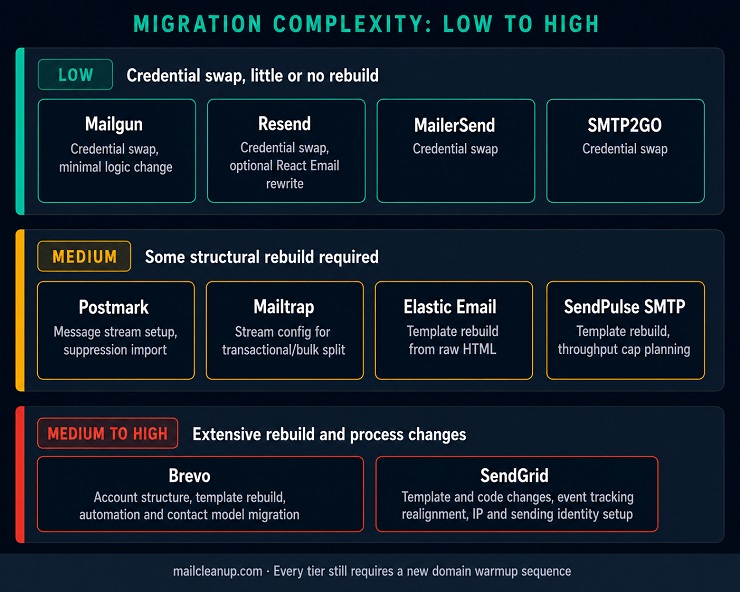
Every migration off Amazon SES requires a new domain warmup sequence somewhere, since sender reputation doesn’t transfer between providers even when the underlying domain stays the same. This applies whether you’re evaluating AWS-native alternatives to AWS SES or providers built completely outside the AWS ecosystem. Plan for a gradual ramp rather than cutting traffic over all at once, and keep SES running in parallel during the transition to avoid a deliverability gap.
When Staying with Amazon SES Beats Switching to an Amazon SES Alternative
Not every team should switch to one of these Amazon SES alternatives, and the honest answer depends on a few specific conditions rather than a blanket recommendation either way.
Staying on Amazon SES is usually still the right call when most of the following are true:
- Cost per email is your primary metric, and you’re sending at genuine scale. At millions of emails a month, SES’s $0.10/1,000 rate is difficult for any alternative on this list to match once volume gets large enough.
- Your team already has dedicated engineering resources for email infrastructure. If bounce handling, suppression logic, and a basic dashboard are already built and maintained, the case for switching weakens considerably.
- You’re already deep in the AWS ecosystem. IAM, Lambda, SNS, and CloudWatch are familiar tools your team uses elsewhere, so the SES-specific overhead is marginal rather than a new skill to acquire.
- You need a specific AWS region for data residency. SES’s regional availability ties directly to your existing AWS infrastructure in a way most alternatives can’t always match exactly.
Switching to an Amazon SES alternative makes more sense when the opposite is true: when engineer time spent maintaining SES’s surrounding infrastructure is the actual bottleneck, when a product or marketing team needs to own email as a growth channel without filing developer tickets for every campaign, or when the IAM, SNS, and CloudWatch overhead is genuinely slowing the team down rather than being background noise they barely notice.
Choosing the Right Amazon SES Alternative for Your Team
There isn’t one correct answer among these 10 Amazon SES alternatives, only the right fit for your specific combination of volume, AWS familiarity, and whether marketing capability matters to you. If you landed here while searching for alternatives to AWS SES rather than Amazon SES specifically, the same 10 tools apply, since AWS uses both names for the same underlying service across its own documentation. A developer-led team happy inside AWS and just tired of building dashboards from scratch will land somewhere different than a growing ecommerce brand that needs marketing automation in the same account as transactional sending.
If you’re still building out the rest of your sending infrastructure, a few related guides may help. For warming up a new sending domain or IP, see our guide on email warmup. For the authentication setup most of these alternatives still expect you to handle (SPF, DKIM, and DMARC), see our email authentication guide. If deliverability is the real reason you’re considering a switch, our guide to improving email deliverability and our breakdown of email sender reputation cover the fundamentals that apply no matter which provider you land on. And if something does go wrong mid-migration, our guide to diagnosing email delivery failure walks through the failure modes beyond a simple bounce.
A few of the tools reviewed in this guide have their own dedicated comparison posts worth reading if one of them is your front-runner: SparkPost alternatives, Elastic Email alternatives, SendPulse alternatives, EmailOctopus alternatives, and SMTP2GO alternatives each go deeper on a specific platform than this guide’s single-tool reviews do, including our SMTP relay roundup if SMTP relay specifically, rather than a full platform switch, is what you’re actually after.
FAQs About Amazon SES Alternatives
Is there a free Amazon SES alternative?
Yes. SendPulse SMTP offers the most generous free transactional tier in this guide at 12,000 emails a month, though capped at 50 messages per hour, hard to beat among AWS SES alternatives generally. Mailtrap (4,000/month), Resend (3,000/month), MailerSend (500/month), and SMTP2GO (1,000/month) also have permanent free tiers, all more generous in usable features than SES’s own $200 AWS credit for new accounts.
What is the best Amazon SES alternative for developers?
Mailtrap, Resend, and Mailgun are the strongest fits for developer-led teams. Mailtrap pairs a modern REST API and seven-language SDK coverage with deliverability analytics and native MCP support, so agent-driven workflows and human-triggered sends run through the same account. Resend offers modern SDKs, React Email template support, and native MCP integration for AI coding tools. Mailgun keeps SES’s API-first philosophy while adding built-in validation, inbound parsing, and a real dashboard, making it one of the more direct like-for-like replacements on this list.
Why do businesses look for Amazon SES alternatives?
Most teams leave Amazon SES because of engineering overhead, not price. SES requires building your own dashboard, bounce handling, and templates from scratch, plus configuring IAM roles, Route53 domain verification, and SNS webhooks. Teams without dedicated engineering resources for that work typically find one of the all-in-one Amazon SES competitors cheaper in total time, even at a higher per-email rate.
Are Amazon SES alternatives more expensive than Amazon SES itself?
Brevo is the strongest combined option, pairing transactional sending with a full marketing platform, including automation, segmentation, and a drag-and-drop editor, in one account. SendPulse SMTP and Elastic Email also support marketing campaigns alongside transactional sending, while SendGrid offers marketing as a separate, independently billed product.
Can I migrate to an Amazon SES alternative without hurting my deliverability?
Yes, if you migrate gradually rather than switching all traffic at once. Divert a small percentage of sending to the new provider first, monitor bounce and complaint rates closely, then increase volume in stages while running a proper domain warmup sequence on the new platform, since sender reputation never transfers automatically between providers, regardless of which alternatives to Amazon SES you’re evaluating.
Does Amazon SES offer a dashboard the way Amazon SES alternatives do?
Not a dedicated one. SES surfaces sending data through CloudWatch metrics and SNS notifications, which require manual configuration to view delivery, bounce, and complaint data in any organized way. Every Amazon SES alternative in this guide includes a native dashboard out of the box, with no separate AWS service configuration required to see the same information.
What is the best Amazon SES alternative for transactional email only?
Postmark is the strongest pick for transactional-only sending, built specifically around isolating transactional deliverability from any marketing traffic through dedicated message streams. SMTP2GO and Resend are also strong transactional-focused options, with SMTP2GO favoring simplicity and predictable pricing, and Resend favoring a modern developer experience.