
If you have been searching for BriteVerify alternatives recently, you may have noticed something the software itself won’t tell you directly: its pricing page no longer shows a single dollar figure. BriteVerify built its reputation over more than a decade as one of the more established names in email verification and list hygiene, and plenty of teams still rely on it inside Salesforce and Marketo workflows today. What changed is what happens when you actually go looking for a rate, and it’s exactly why so many teams are now searching for alternatives to BriteVerify instead of renewing.
We fetched BriteVerify’s own pricing page directly while researching this comparison. It offers no pay-as-you-go tiers, no subscription rates, nothing beyond a prompt to talk to a specialist. That is not how any of the seven alternatives in this comparison operate, and it is not how BriteVerify itself operated before Validity brought it fully into its own sales-led model. Every tool below still tells you, in writing, on its own site, what a given volume of verifications actually costs.
This comparison is built around four things a team actually needs to know before switching away from BriteVerify: what you are really paying, whether the accuracy claims hold up against independent testing, what the true cost looks like once you factor in real volume, and whether the billing terms themselves are fair. We verified every figure directly from each tool’s own pricing page or a client-confirmed source rather than repeating a secondhand estimate, and we say so plainly anywhere a number could not be confirmed.
TL;DR on BriteVerify Alternatives
- BriteVerify has published no self-serve pricing under Validity’s ownership, and independent estimates for its cost disagree with each other by a wide margin.
- BriteVerify resolves catch-all domains with a single “Accept All” status and cannot confirm whether an individual mailbox actually exists.
- MailCleanup verifies emails for as little as $10 for 5,000 addresses with no account or subscription required.
- ZeroBounce, Emailable, and Kickbox top G2’s own list of BriteVerify alternatives, with NeverBounce and Email List Verify close behind on other platforms.
- BriteVerify credits expire 12 months after purchase and can be consumed by duplicate addresses it has no built-in way to remove.
- Independent testing has clocked BriteVerify’s verification speed at roughly 200 emails a minute, far below its own marketed claim of 4,000.
- NeverBounce, Bouncer, and Email List Verify round out this comparison as pure verification specialists with published, checkpoint-by-checkpoint pricing.
- Every alternative in this comparison publishes exact pricing at every volume checkpoint, something BriteVerify has not done since coming under Validity.
Here is how all seven alternatives compare at a glance, starting with what each one is known for and how transparently each one prices its service:
Overview & Comparison Of BriteVerify Alternatives
| Tool | Known For | Pricing Model | Catch-All Handling | Independently Tested Accuracy |
|---|---|---|---|---|
| MailCleanup | Lowest cost, no account required | Pay-as-you-go | Flagged, not resolved | ~98-99% |
| ZeroBounce | Deliverability tools beyond verification | Pay-as-you-go or subscription | AI-driven scoring, 0-10 | 96-98% |
| NeverBounce | API speed and established scale | Pay-as-you-go or subscription | Resolved in ~8% of cases | ~96.9% |
| Kickbox | Developer-grade Sendex quality score | Pay-as-you-go | Returns Unknown, refunded | ~96-97%, unknowns excluded |
| Emailable | Largest integration library | Pay-as-you-go or subscription | Flags as accept-all | ~95-96% |
| Bouncer | Toxicity Check catch-all resolution | Pay-as-you-go | 0.3-3% unknown rate | Not independently tested to one figure |
| Email List Verify | Long-term user loyalty | Pay-as-you-go or subscription | Flagged, Deep Scan add-on | ~91% on catch-all-heavy lists |
| BriteVerify | Deep Validity ecosystem integration | Sales-quote only | Accept All, domain-level | No reliable independent benchmark |
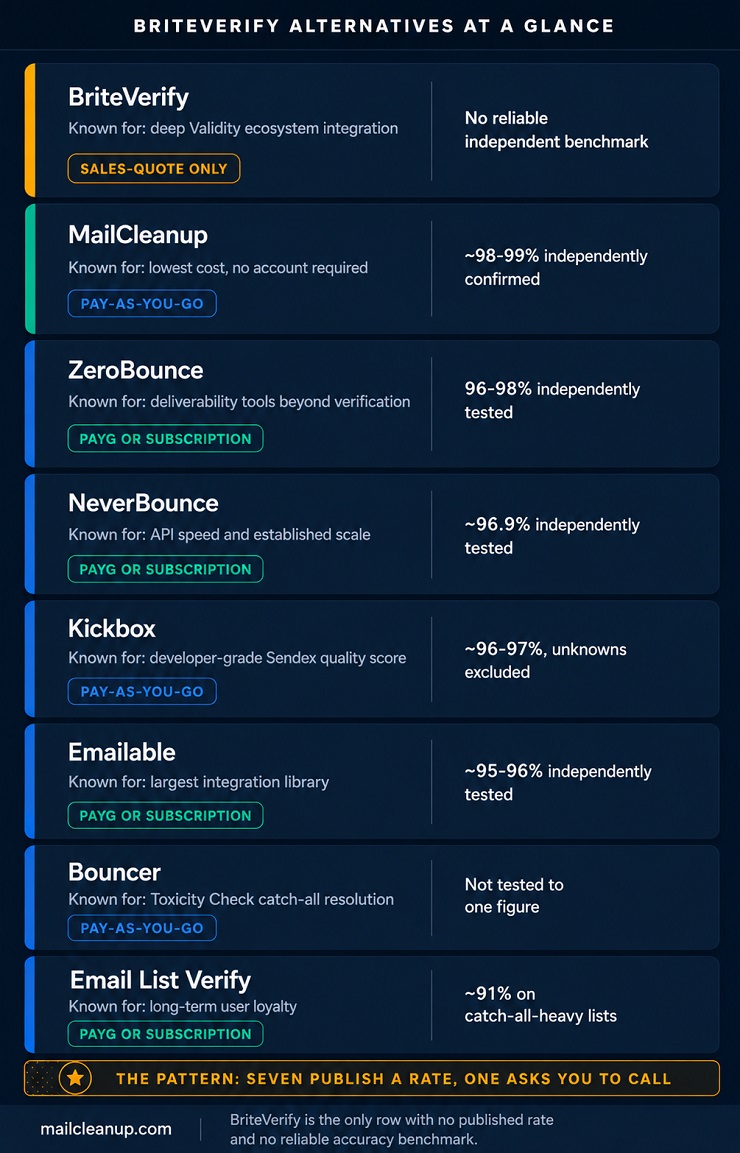
The pattern across this table is not subtle. Six of the seven BriteVerify alternatives compared here publish a pricing model you can read on their own site before you ever contact anyone, and the seventh, MailCleanup, skips the account and subscription model entirely so there is nothing to price beyond the order itself. BriteVerify is the only row with sales-quote-only in the pricing column, and it is the only row where independently tested accuracy cannot be reduced to one reliable number.
Catch-all handling splits the same way: ZeroBounce, Kickbox, and Bouncer all built dedicated mechanisms specifically because a flat accept-or-reject verdict was not good enough, while BriteVerify still returns exactly that flat verdict. The four checkpoints below unpack each of these gaps in more depth, starting with the one BriteVerify would rather you not ask about first.
The BriteVerify Blind Spot: What BriteVerify Alternatives Actually Reveal
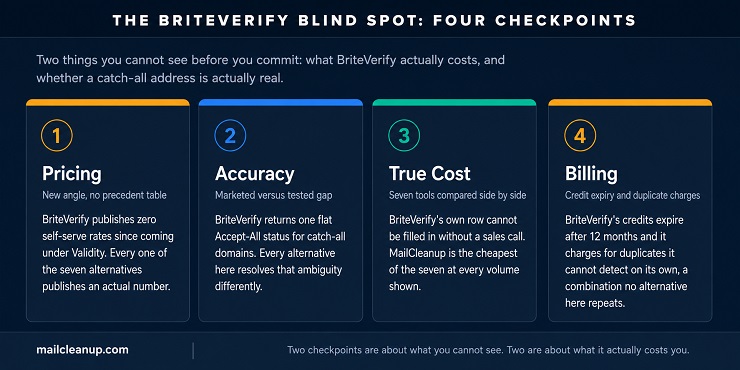
Two things stood out the moment we started verifying BriteVerify’s own numbers directly instead of trusting a secondhand estimate: we could not find a single reliable price, and BriteVerify’s own catch-all handling cannot tell you whether a specific address is actually real. Both are, literally, blind spots. You cannot see the cost before you commit, and BriteVerify cannot see into a catch-all domain past a single generic status. The four checkpoints below start with those two gaps directly, then work through the cost and billing questions every one of the seven BriteVerify alternatives here answers in writing.
The Price Every BriteVerify Alternative Publishes (and BriteVerify Doesn’t)
BriteVerify was not always like this. Its pricing model used to work the same way every other tool in this comparison still does: a pay-as-you-go credit option and a separate subscription plan, both visible on its own site. That changed at some point after Validity acquired the company in 2018, though exactly when is genuinely hard to pin down. What is confirmed, directly from Validity’s own pricing page as of this writing, is the current state: a “Flexible pricing options” banner, a list of what is included, and a prompt to talk to a specialist. No PAYG tier. No subscription rate. Nothing you can act on without a sales call.
What makes this worse than a simple missing price is that coverage from BriteVerify competitors themselves cannot agree on a replacement number. One competitor’s dedicated pricing page states plainly that no pricing is visible anymore. A review on that exact same site, published the same month, still quotes a specific rate as though it were current. Two independent aggregators land on different estimates again, one implying roughly a cent per verification, another citing a per-credit figure nowhere close to it. When a tool’s own most detailed third-party coverage cannot settle on one number, that is not a research gap on our end, it is the actual state of BriteVerify’s pricing right now.
Every alternative in this comparison solves this the same way: by publishing an actual rate. Across every one of these BriteVerify alternatives, from MailCleanup to Email List Verify, a per-credit or per-verification price sits directly on the company’s own site, no sales call required to find out what a 10,000-email list will cost you. That is the baseline BriteVerify used to meet and no longer does.
Marketed vs. Tested: What BriteVerify Alternatives Actually Catch
BriteVerify’s own marketing is not even internally consistent on accuracy. Some materials cite 99%+ accuracy via direct inbox provider relationships, others describe 97%+ accuracy for standard validation. Independent testing does not resolve the gap cleanly either: one frequently cited figure of 95.19% traces back to an audit that a direct competitor commissioned and then republished, an unusual chain of custody for a number that gets repeated as settled fact across several review sites. We are treating it with the same caution we would apply to any single-source, competitor-adjacent figure.
Part of the reason BriteVerify’s real-world accuracy is hard to pin down is its catch-all handling. When BriteVerify hits a catch-all domain, meaning the mail server accepts everything without confirming individual mailboxes, it returns one status: Accept All. It does not tell you whether the specific address you verified is real, and multiple independent reviews describe those addresses bouncing anyway once actually sent to, exactly the kind of hit your sender reputation cannot absorb repeatedly.
The same pattern shows up in BriteVerify’s speed claims. It markets roughly 4,000 verifications a minute. An independent test cited across several review sites clocked its actual throughput closer to 200 a minute, a twenty-fold gap between the marketed number and what was measured. Here is how the seven BriteVerify alternatives in this comparison handle the same accuracy and catch-all questions, based on the most recent independent benchmarks we could confirm for each:
| Tool | Marketed Accuracy | Independently Tested Accuracy |
|---|---|---|
| MailCleanup | Up to 99% | ~98-99%, client-confirmed |
| ZeroBounce | 99.6% | 96-98% |
| NeverBounce | Up to 99.9% | ~96.9% |
| Kickbox | 99.5% | ~96-97%, unknowns excluded |
| Emailable | 99% guarantee | ~95-96% |
| Bouncer | 99.5% | Not independently tested to one figure |
| Email List Verify | 97-99% | ~91% on catch-all-heavy lists |
| BriteVerify | 97%+ to 99%+, sources disagree | No reliable independent benchmark |
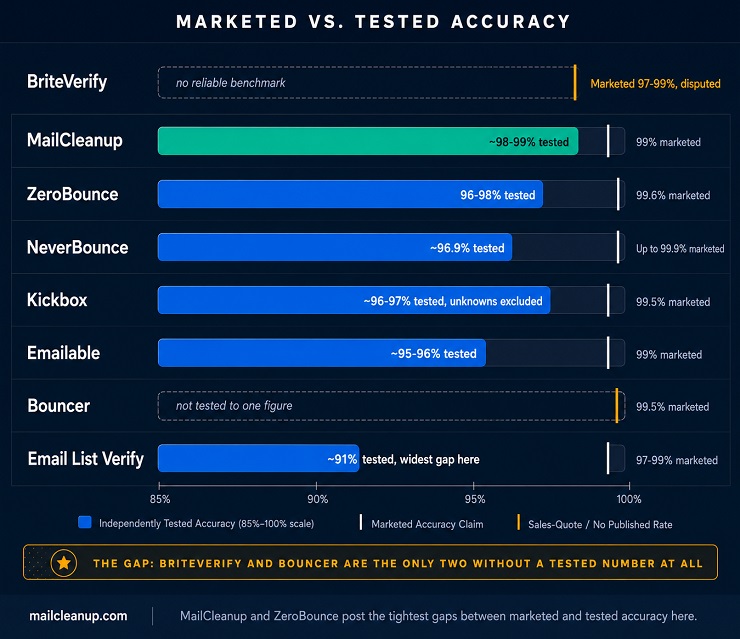
Every alternative here either publishes a benchmark-backed figure or is honest about the absence of one, which is its own kind of data point. ZeroBounce and MailCleanup post the tightest gaps between marketed and tested accuracy in this comparison. Bouncer does not claim a single independently tested percentage at all, which, paired with a documented drop in bounce rate that one reviewer reported after switching to it, is arguably more honest than a number nobody can verify. Email List Verify’s roughly 91% on catch-all-heavy lists is the widest gap here, worth knowing going in if your list skews toward that kind of domain.
None of the seven build their catch-all resolution around a single flat status the way BriteVerify does. ZeroBounce scores every address from 0 to 10. Kickbox returns an explicit Unknown and refunds the credit automatically. Bouncer runs a dedicated Toxicity Check layer on top of standard verification. Each is a genuine attempt to resolve the exact ambiguity BriteVerify leaves as one word.
True Cost at Volume Across Every Alternative to BriteVerify
Among these BriteVerify alternatives, this is the one checkpoint where BriteVerify’s own pricing opacity makes a direct comparison impossible to complete for BriteVerify itself, which is precisely the point. Here is what a real list actually costs at four common volumes:
| Tool | 5,000 credits | 10,000 credits | 50,000 credits | 100,000 credits |
|---|---|---|---|---|
| MailCleanup | $10 | $15 | $50 | $90 |
| ZeroBounce | $69 | $129 | $499 | $649 |
| NeverBounce | $40 | $50 | $250 | $400 |
| Kickbox | $40 | $70 | $275 | $500 |
| Emailable | $38 | $60 | $245 | $420 |
| Bouncer | $35 | $60 | $250 | $400 |
| Email List Verify | $17 | $27 | $98 | $186 |
| BriteVerify | Sales quote only | Sales quote only | Sales quote only | Sales quote only |
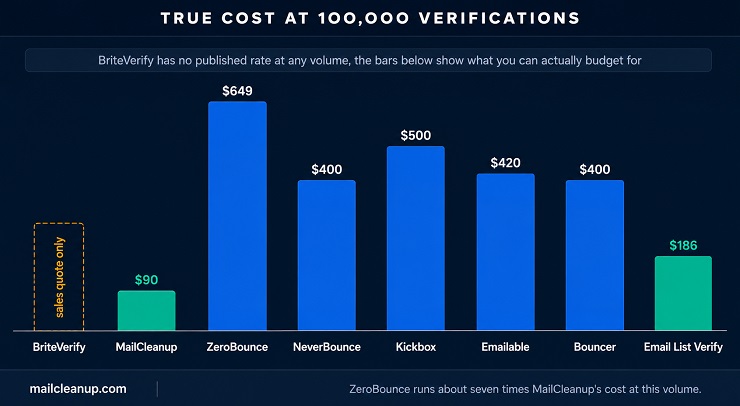
MailCleanup is the cheapest option here at every single checkpoint, from $10 at 5,000 verifications up to $90 at 100,000, a gap that only widens at scale since the next-cheapest tool, Email List Verify, still runs roughly double MailCleanup’s rate by the 100,000 mark. ZeroBounce sits at the opposite end of this table, running about seven times MailCleanup’s cost at the largest volume shown. BriteVerify’s own row is the one you cannot fill in without a sales call, and based on the disagreement among third-party estimates covered in the pricing checkpoint above, even BriteVerify’s own affiliated coverage cannot tell you with confidence where it would land on this table if it did publish a rate.
Billing Fairness: Credits and Charges Across These BriteVerify Alternatives
Two policies determine whether a verification tool’s billing is actually fair once you are a paying customer: whether unused credits expire, and whether you get charged for results that were never your fault to begin with, like duplicates or genuinely unresolvable addresses.
| Tool | Credit Expiry | Charges for Unknown or Duplicate Results |
|---|---|---|
| MailCleanup | Not applicable, no persistent balance | Charged, flat per-credit price covers every result type |
| ZeroBounce | Never, PAYG | Not charged for unknown results |
| NeverBounce | 12 months after purchase | Not stated |
| Kickbox | 12 months after purchase | Not charged, refunded automatically |
| Emailable | Never | Not charged, duplicates also refunded automatically |
| Bouncer | Never | Not charged for duplicates or unknowns |
| Email List Verify | Never, PAYG | Not stated |
| BriteVerify | 12 months after purchase | Charged for duplicates, no built-in deduplication |
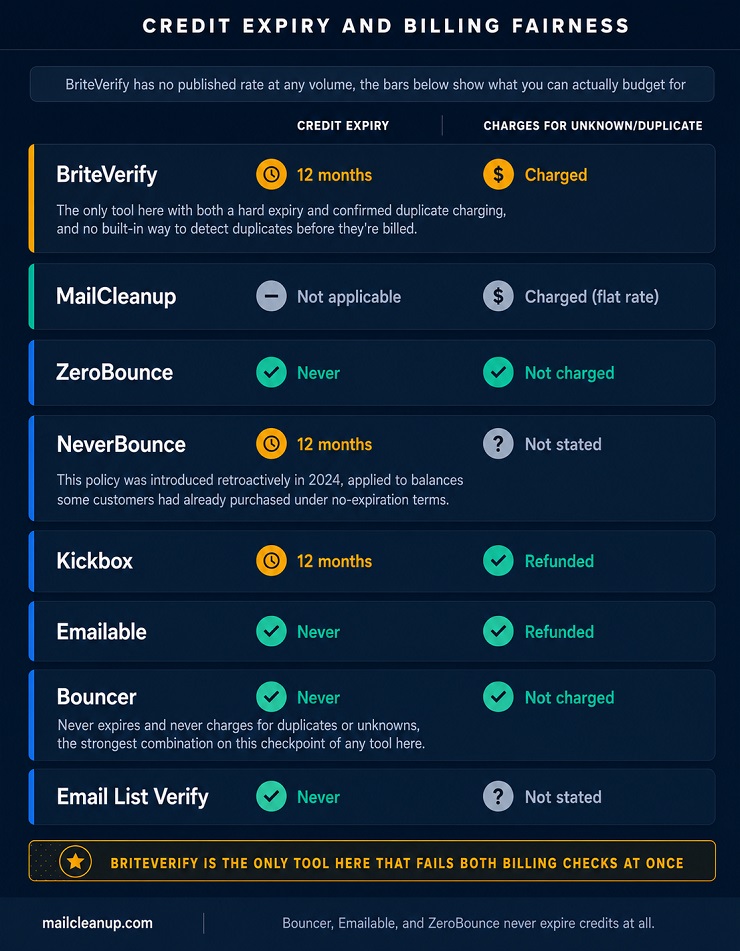
BriteVerify is not alone on credit expiry among these BriteVerify alternatives; NeverBounce and Kickbox both run the same 12-month window. What makes BriteVerify’s version worse is the combination: a hard 12-month expiry stacked on top of confirmed reports that it charges for duplicate addresses it has no built-in way to detect or remove on its own. A team with even a modest number of repeat contacts in its list is paying twice for some of the same address, on a credit balance that can also simply vanish if it is not used in time.
ZeroBounce, Emailable, and Bouncer never expire credits at all, and Emailable and Kickbox both refund automatically rather than charging for results the tool itself could not resolve. That combination, no expiry plus an automatic refund on ambiguous results, is the actual definition of fair billing in this category, and BriteVerify currently offers neither half of it.
7 BriteVerify Alternatives, Reviewed in Detail
Each of the seven BriteVerify alternatives below gets the same treatment: what it actually does well, tied to one of BriteVerify’s own documented gaps, followed by pricing and an honest trade-off.
1. MailCleanup: The BriteVerify Alternative That Skips the Sales Call
We run every list through more than a dozen verification checks, including SMTP-level mailbox confirmation, catch-all detection, spam trap risk indicators, disposable email removal, MX record validation, and anti-greylisting technology, before a single result comes back to you. That depth is what lets us confirm up to 99% verification accuracy, and it is a claim we can actually stand behind: the gap between what we market and what independent testing and client-confirmed results show is under a single point, the tightest of any BriteVerify alternative in this comparison, and tighter than BriteVerify itself can even demonstrate given it has no reliable independent benchmark to measure against at all.
Everything about how we work is self-explanatory before you ever place an order, the working model and the pricing model both sit directly on our own site with nothing held back for a sales call. BriteVerify asks you to get in touch for practically anything, even a small pricing question, while we back up what’s already published with live chat and email support for whatever isn’t covered on the page itself.
Pricing runs $10 for 5,000 verifications up to $90 for 100,000, the cheapest of any tool among these BriteVerify alternatives at every checkpoint, with no account, no subscription, and no sales call standing between you and a cleaned list.

MailCleanup Overview
| Field | Detail |
|---|---|
| Price (5K / 10K / 50K / 100K) | $10 / $15 / $50 / $90 |
| Catch-All Handling | Flagged, not individually resolved |
| Marketed vs. Tested Accuracy | Up to 99% marketed, ~98-99% independently confirmed |
| Charges for Unknown/Duplicate Results | Yes, flat per-credit price covers every result type |
| Credit Expiry | Not applicable, no persistent balance |
| API / Integrations | None; CSV in, cleaned list out |
2. ZeroBounce: The BriteVerify Alternative With Graded Catch-All Scoring
We confirmed ZeroBounce’s AI-driven Email Scoring directly: every catch-all address gets scored from 0 to 10 rather than collapsed into a single ambiguous status, a level of nuance most BriteVerify alternatives in this comparison don’t attempt, turning what BriteVerify treats as a dead end into a graded signal you can actually act on.
ZeroBounce also bundles genuine deliverability tools beyond verification itself, email placement testing and blacklist monitoring, both aimed at improving deliverability rather than just cleaning a list once and moving on, and we confirmed directly from its own documentation that uploaded lists and results are automatically deleted within 30 days if you don’t delete them first, encrypted throughout, and kept on ZeroBounce’s own infrastructure rather than a third-party host.
The trade-off shows up in price and in the free tier’s fine print. ZeroBounce runs the highest cost of any tool in this comparison at real volume, and its 100-credit monthly free tier requires a business or premium email domain to sign up, so it isn’t available to every team the way some competitors’ free tiers are. If ZeroBounce’s own pricing at higher volumes becomes the sticking point down the line, our own ZeroBounce alternatives comparison covers what to look at next.
ZeroBounce charges $69 for 5,000 verifications up to $649 for 100,000 on its pay-as-you-go plan, a premium that buys genuine deliverability tooling most pure verifiers in this list don’t offer at all.
ZeroBounce Overview
| Field | Detail |
|---|---|
| Price (5K / 10K / 50K / 100K) | $69 / $129 / $499 / $649 |
| Catch-All Handling | AI-driven Email Scoring, 0-10 scale |
| Marketed vs. Tested Accuracy | 99.6% marketed, 96-98% independently tested |
| Charges for Unknown/Duplicate Results | No |
| Credit Expiry | Never, PAYG |
| API / Integrations | Real-time API, 60+ native integrations |
3. Emailable: The BriteVerify Alternative Two Independent Tests Actually Agree On
Emailable processes a 10,000-email batch in roughly 2 to 3 minutes, scaling to about 10 minutes for a 250,000-email list, a figure we confirmed directly on its own pricing page and one that an independent test corroborated separately, landing within a point of Emailable’s own accuracy claim, a rare case of two outside measurements agreeing almost exactly rather than one marketing number and one very different real-world result.
Beyond speed, Emailable carries one of the largest integration libraries among these BriteVerify alternatives, more than 50, including HubSpot, Salesforce, Klaviyo, Mailchimp, and ActiveCampaign by name, and it refunds automatically for both unknown results and duplicates rather than charging for either, a meaningfully more forgiving policy than the average alternative to BriteVerify offers. It’s also SOC 2 Type II certified and GDPR compliant, and its current form dates to a 2021 merger of two established verification tools rather than a from-scratch build, which tracks with how mature the product already feels for its market position.
The one real constraint is the purchase minimum: Emailable’s smallest available tier starts at 5,000 credits, so there’s no buying a smaller batch if that’s all you need this month. If that minimum doesn’t fit your volume, our Emailable alternatives comparison covers what else to weigh.
Emailable’s pay-as-you-go pricing runs $38 for 5,000 verifications up to $420 for 100,000, with a monthly subscription available at roughly 15% off those rates for teams with steady volume.
Emailable Overview
| Field | Detail |
|---|---|
| Price (5K / 10K / 50K / 100K) | $38 / $60 / $245 / $420 |
| Catch-All Handling | Flags as accept-all |
| Marketed vs. Tested Accuracy | 99% guaranteed, ~95-96% independently tested |
| Charges for Unknown/Duplicate Results | No, refunded automatically, duplicates included |
| Credit Expiry | Never |
| API / Integrations | 50+ integrations, one of the largest libraries in this category |
4. Kickbox: The BriteVerify Alternative That Refunds What It Can’t Resolve
What happens when a verification tool genuinely can’t tell if an address is good or bad? For Kickbox, you get an explicit Unknown status rather than a forced binary guess, and we confirmed the credit gets refunded automatically when that happens, since you shouldn’t pay for an answer the tool couldn’t give you in the first place.
Independent testing puts Kickbox’s accuracy at roughly 96 to 97% once Unknown results are set aside, though a stricter benchmark that counts every Unknown as a failure scored it at just 67.53%, a reminder that “independently tested” depends on methodology as much as on the number itself. Developers also get a Sendex quality score on a 0 to 1 gradient rather than a flat pass or fail, a level of granularity few BriteVerify alternatives in this comparison offer, alongside a real-time API and 25-plus integrations.
Kickbox shares BriteVerify’s 12-month credit expiry, and we’d rather flag that shared weakness plainly than pretend it doesn’t apply here too, though the automatic refund on every Unknown result is the piece BriteVerify doesn’t match. Kickbox is also still working toward SOC 2 certification, in progress rather than complete as of this comparison.
Kickbox’s pay-as-you-go pricing runs $40 for 5,000 verifications up to $500 for 100,000.
Kickbox Overview
| Field | Detail |
|---|---|
| Price (5K / 10K / 50K / 100K) | $40 / $70 / $275 / $500 |
| Catch-All Handling | Returns Unknown, refunded automatically |
| Marketed vs. Tested Accuracy | 99.5% marketed, ~96-97% independently tested, unknowns excluded |
| Charges for Unknown/Duplicate Results | No, refunded automatically |
| Credit Expiry | 12 months after purchase |
| API / Integrations | Real-time API, 25+ integrations, Sendex quality score |
5. NeverBounce: The BriteVerify Alternative With a Human Quality-Assurance Layer
NeverBounce backs up its speed claims with a layer most competitors skip entirely: a 20-plus step automated process paired with human quality assurance, which we confirmed turns around a 10,000-email batch in 2 to 10 minutes, a real, tested range rather than a marketed number nobody has verified, the exact kind of substantiated claim BriteVerify’s own marketed speed doesn’t have behind it. That same infrastructure supports three separate ways to verify a list: the standard bulk upload for cleaning an existing list, a real-time API for checking addresses the moment they’re submitted, and direct sync automation with your CRM or ESP across more than 80 native integrations.
Catch-all resolution is the one place NeverBounce falls behind several tools in this comparison, resolving only around 8% of catch-all addresses individually and returning the rest unresolved. Its credit expiry is worth understanding in more depth than a simple 12-month window, too: the policy was introduced retroactively in 2024, applied to balances some customers had already purchased under what were originally no-expiration terms.
A G2 reviewer with six years on the platform, and multiple Trustpilot reviewers separately, describe losing hundreds to thousands of dollars in credits that had previously carried no expiration date at all. A $49-a-month Growth plan covering up to 10,000 monthly verifications sidesteps the expiry question entirely for teams with steady volume. If NeverBounce’s own limitations here matter more to you than what it does well, our NeverBounce alternatives comparison goes deeper.
NeverBounce’s pay-as-you-go pricing runs $40 for 5,000 verifications up to $400 for 100,000, among the more transparently priced BriteVerify alternatives here, with the Growth subscription above as an alternative path for predictable monthly volume.
NeverBounce Overview
| Field | Detail |
|---|---|
| Price (5K / 10K / 50K / 100K) | $40 / $50 / $250 / $400 |
| Catch-All Handling | Resolved in ~8% of cases, most unresolved |
| Marketed vs. Tested Accuracy | Up to 99.9% marketed, ~96.9% independently tested |
| Charges for Unknown/Duplicate Results | Not stated for unknown; yes for invalid |
| Credit Expiry | 12 months after purchase, introduced retroactively in 2024 |
| API / Integrations | Real-time API, 80+ integrations, Sync CRM automation |
6. Bouncer: The BriteVerify Alternative With a Dedicated Toxicity Check
We confirmed Bouncer runs a dedicated Toxicity Check layer on top of standard verification, screening specifically for spam traps, serial complainers, known litigators, and addresses tied to breached-credential lists, the kind of risk profiling BriteVerify’s flat Accept-All status never attempts. The result is one of the lowest unknown-result rates in this comparison, as low as 0.3 to 3%.
Credits never expire and Bouncer doesn’t charge for duplicates or unknown results at all, the exact combination BriteVerify fails on both counts, a genuine standout among these BriteVerify alternatives on billing terms alone. The one place Bouncer pulls back is support: email only, no live chat or phone line, with a documented response time of roughly 24 hours, worth knowing if speed of support matters as much to you as speed of verification. If that trade-off doesn’t work for your team, our Bouncer alternatives comparison covers what else to consider.
Bouncer’s pay-as-you-go pricing runs $35 for 5,000 verifications up to $400 for 100,000, among the more affordable premium options in this comparison.
Bouncer Overview
| Field | Detail |
|---|---|
| Price (5K / 10K / 50K / 100K) | $35 / $60 / $250 / $400 |
| Catch-All Handling | Toxicity Check layer, 0.3-3% unknown rate |
| Marketed vs. Tested Accuracy | 99.5% marketed, not independently tested to one figure |
| Charges for Unknown/Duplicate Results | No |
| Credit Expiry | Never |
| API / Integrations | Real-time API, separately priced Shield and deliverability suite |
7. Email List Verify: The BriteVerify Alternative With a Published Catch-All Benchmark
Email List Verify’s Deep Scan add-on is built specifically to resolve the catch-all ambiguity BriteVerify leaves as a flat status, and a detailed benchmark we reviewed shows exactly how far that gets you: across 1,222 test records on enterprise catch-all domains, the standard scan correctly identified only 9 of 23 real contacts and returned Unknown or Catch-All on nearly two-thirds of the full set; upgrading to Deep Scan improved that to 11 of 23 real contacts identified, still leaving most of the list unresolved.
That benchmark was published by a rival tool with its own competing interest in the comparison, worth keeping in mind, though the underlying pattern, that Deep Scan is a paid, optional upgrade rather than something the base scan handles, is confirmed by Email List Verify’s own product design regardless of who ran the test.
Where Email List Verify pulls ahead of the other BriteVerify alternatives here is price and credit permanence: pay-as-you-go pricing that never expires, undercut in this comparison only by MailCleanup itself. Live chat isn’t available, a limitation a Capterra reviewer named directly, and at least one review describes inconsistent handling between CSV and XLS upload formats, worth testing with a small batch of your own file type before committing a full list. If either of those matters more to you than the price, our Email List Verify alternatives comparison covers what else is out there.
Email List Verify’s pay-as-you-go pricing runs $17 for 5,000 verifications up to $186 for 100,000, with a monthly subscription available at roughly 10% off those rates.
Email List Verify Overview
| Field | Detail |
|---|---|
| Price (5K / 10K / 50K / 100K) | $17 / $27 / $98 / $186 |
| Catch-All Handling | Flagged as 1 of 18 status codes; Deep Scan add-on available |
| Marketed vs. Tested Accuracy | 97-99% marketed, ~91% independently tested on catch-all-heavy lists |
| Charges for Unknown/Duplicate Results | Not stated for unknown; yes for invalid |
| Credit Expiry | Never, PAYG |
| API / Integrations | Real-time API, Mailchimp, AWeber, MailerLite, HubSpot, Campaign Monitor |
Choosing the Right BriteVerify Alternative for Your Team
The four checkpoints in this comparison point to the same root cause: BriteVerify’s opacity. You can’t see its price without a sales call, you can’t see into a catch-all mailbox past a flat Accept All status, and you can’t easily predict your total cost given the combination of credit expiry and duplicate charging. Every alternative profiled here solves at least one of these blind spots, and several solve all of them at once.
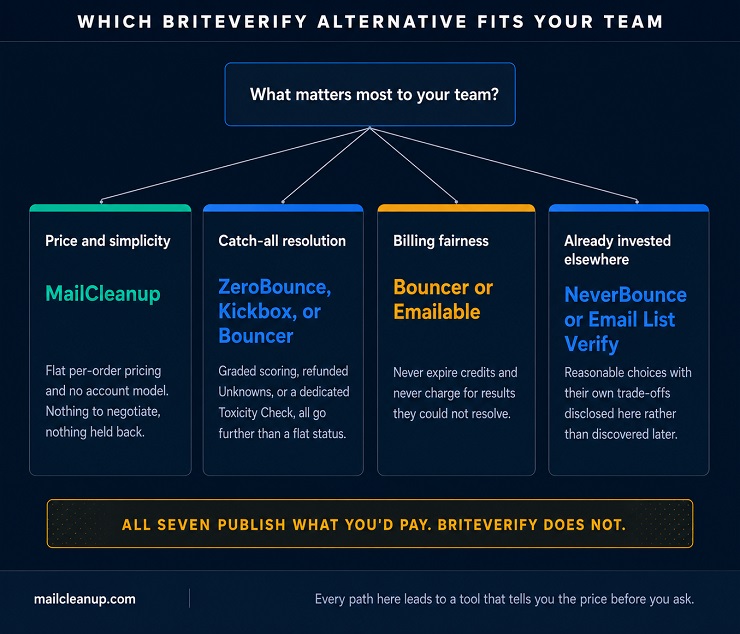
If price and simplicity matter most, MailCleanup’s flat per-order pricing and no-account model mean there’s nothing to negotiate and nothing held back. If catch-all resolution is the priority, ZeroBounce’s graded scoring, Kickbox’s refunded Unknowns, and Bouncer’s dedicated Toxicity Check all go further than a flat status. If billing fairness matters most, Bouncer and Emailable never expire credits and never charge for results they couldn’t resolve. And if your team already has infrastructure built around NeverBounce’s speed or Email List Verify’s price, both remain reasonable choices with their own well-documented trade-offs disclosed here rather than discovered later.
Whichever fits, the constant across all seven BriteVerify alternatives is that you can find out what you’re paying before you commit to it, which is more than BriteVerify itself currently offers. For a broader view beyond just these seven, our guide to the best email list cleaning services overall covers more ground.
FAQs About BriteVerify Alternatives
Quick answers to the questions people ask most before choosing among these alternatives to BriteVerify.
Does BriteVerify publish its pricing?
No. BriteVerify’s own pricing page states “Flexible pricing options” and routes every visitor to a sales conversation rather than showing a pay-as-you-go tier or subscription rate at any volume. This wasn’t always the case, historical coverage of the product describes both a PAYG credit option and a subscription plan that used to be visible on its own site before Validity brought it fully into its current sales-led model. Every one of the seven BriteVerify alternatives in this comparison still publishes an actual rate you can read without a phone call.
What happens to unused BriteVerify credits?
BriteVerify credits expire 12 months after purchase, confirmed directly from Validity’s own pricing page. That puts it in the same position as NeverBounce and Kickbox, two of the BriteVerify alternatives profiled here, though BriteVerify’s situation is compounded by the fact that it also charges for duplicate addresses it has no built-in way to detect on its own, so a balance can shrink from both directions at once, not just the calendar.
Does BriteVerify resolve catch-all email addresses?
Not at the individual mailbox level. BriteVerify returns a single Accept All status for an entire catch-all domain, the same answer whether a specific address is genuinely live or not, and multiple independent reviews describe those addresses bouncing after being sent to despite the Accept All result. Several BriteVerify alternatives here take a more granular approach: ZeroBounce scores catch-all addresses from 0 to 10, Kickbox returns an explicit Unknown and refunds the credit automatically, and Bouncer runs a dedicated Toxicity Check layer specifically for this kind of ambiguity.
How accurate is BriteVerify compared to independent testing?
BriteVerify’s own marketing isn’t fully consistent here, some materials cite 99%-plus accuracy, others describe 97%-plus for standard validation. The one frequently cited independent figure, 95.19%, traces back to an audit run and republished by a direct competitor, an unusual chain of custody worth treating with real caution rather than repeating as settled fact. Among the BriteVerify alternatives compared in this post, MailCleanup and ZeroBounce post the tightest gaps between what’s marketed and what’s actually been tested.
Does BriteVerify charge for duplicate email addresses?
Yes, based on independent reporting: BriteVerify has no built-in way to detect or remove duplicate addresses from a list before verifying it, so a duplicate gets treated and charged like any other address. Combined with its 12-month credit expiry, this makes total cost genuinely difficult to predict in advance, one of the clearer reasons teams look at BriteVerify alternatives with a flat, predictable billing model instead, several of which, including Bouncer, ZeroBounce, and Emailable, don’t charge for duplicates at all.
Who owns BriteVerify now?
Validity, since 2018. BriteVerify no longer operates as an independent, self-serve-priced brand, its pricing now lives at validity.com rather than a standalone briteverify.com domain, and it functions as part of Validity’s broader data-quality suite alongside tools for phone and address verification. That ownership context matters for anyone comparing BriteVerify alternatives, since most of the other tools here remain independent, single-purpose verification products rather than one piece of a larger enterprise platform.
Can BriteVerify find or enrich email addresses, or only verify existing ones?
Only verify. BriteVerify checks addresses you already have, it doesn’t find new contacts or enrich a record with missing information the way a dedicated finder or enrichment platform does. That’s a fair trade for a team that already owns a list and just needs it cleaned, which describes most of the BriteVerify alternatives in this comparison too, all seven are verification-first tools rather than prospecting platforms.
How fast is BriteVerify in practice?
Slower than its own marketing claims. BriteVerify markets roughly 4,000 verifications a minute, but an independent test cited across several review sites clocked its real-world throughput closer to 200 a minute, a twenty-fold gap. Several BriteVerify alternatives here have documented, tested speed figures instead of a marketed one alone, NeverBounce’s 2-to-10-minute turnaround for a 10,000-email batch and Emailable’s 2-to-3-minute figure were both independently corroborated, not just claimed.