
If you run an online store or are planning to start one, you probably feel pulled in a hundred directions: social media ads, paid campaigns, SEO, influencers, and more. But before you dive into all that, let me tell you why investing in the best email marketing software for ecommerce can be one of the smartest moves you make.
Email marketing remains one of the highest-ROI channels for ecommerce. On average, businesses get roughly $36 for every $1 spent — far more than many other marketing channels. And, because your emails reach people who have already interacted with you — customers, subscribers, or cart abandoners — your chances of converting them go up a lot.
In this post, we’ll walk you through a clear, structured approach. We’ll help you understand what really matters when choosing an email platform, and then we’ll share a curated list of the top 11 email marketing platforms for ecommerce (yes — from beginner-friendly to powerful, automation-heavy ones).
This guide is for you — whether you’ve just launched an online shop, you’re scaling up, or you manage multiple ecommerce clients as a marketer or agency. By the end, you’ll know what to look for, and be ready to pick the best email platform for ecommerce that fits your needs.
Quick Comparison: Top Email Marketing Software for Ecommerce at a Glance
Below is a side-by-side comparison table of the 11 best email marketing software for ecommerce. We’ve designed this table to help you quickly understand who each platform is best for, whether it offers a free plan or trial, how pricing starts, and what makes it stand out. This is especially useful if you want a fast shortlist before diving into detailed reviews.
| Software | Best For | Free Plan / Trial | Starting Price* | Key Strengths |
|---|---|---|---|---|
| Omnisend | Small to mid-sized ecommerce brands | Free plan available | From ~$16/month | Ecommerce-first automation, email + SMS + push |
| Moosend | Small to mid-sized ecommerce stores | 30-day free trial | From ~$9/month | Affordable pricing + unlimited sends, ecommerce automation, landing pages, segmentation |
| Klaviyo | Data-driven, scaling ecommerce brands | Free plan available | From ~$20/month | Deep segmentation, advanced personalization, SMS |
| Drip | Revenue-focused DTC brands | 14-day free trial | From ~$39/month | Lifecycle automation, revenue attribution |
| MailerLite | Startups and budget-conscious stores | Free plan available | From ~$10/month | Simple UI, core automations, affordability |
| ActiveCampaign | Growing stores & agencies | 14-day free trial | From ~$15/month | Advanced automation, CRM, behavior tracking |
| Sendlane | High-volume ecommerce senders | 60-day free trial | From ~$100/month | Send-based pricing, deliverability focus |
| Brevo | Cost-efficient, multi-channel users | Free plan available | From ~$9/month | Send-based pricing, email + SMS + WhatsApp |
| GetResponse | All-in-one marketing users | 14-day free trial | From ~$19/month | Email, automation, funnels, push notifications |
| Sender | Small to mid-sized online stores | Free plan available | From ~$10/month | Generous free plan, email + SMS |
| Mailchimp | General-purpose ecommerce marketing | Free plan available | From ~$8.50/month | Templates, integrations, broad feature set |
*Starting prices are approximate and based on entry-level plans for small lists. Pricing scales with contacts, sends, or feature upgrades depending on the platform.
Why Email Marketing is Critical for Ecommerce Success?
When you run an online store, email marketing isn’t just “another channel” — it’s a core sales and engagement engine. In ecommerce, email marketing means sending different kinds of emails: welcome messages when someone subscribes, cart-abandonment reminders when they leave items behind, product recommendations based on past purchases, re-engagement emails to bring back dormant customers, order confirmations and shipping updates, newsletters, discount or sale announcements, and more.
What Makes It So Valuable?
High ROI compared to many other channels
Email marketing continues to deliver one of the highest returns in ecommerce. On average, businesses get roughly US $36 return for every US $1 spent. That kind of return usually beats most paid ads or social campaigns — making email hard to ignore when you’re building or scaling a store.
Direct access to customers — you own the inbox
Unlike social media or ad platforms where algorithms decide who sees your message, email gives you direct access to your customer’s inbox. That means you control when and how you communicate. It also lets you build real, lasting relationships with your audience.
Automation, personalization & scalability
With a good ecommerce email platform, we can trigger emails automatically — like sending a welcome mail when someone signs up, or a cart-abandonment reminder if they left mid-checkout. We can segment customers based on behavior, past purchases or engagement, and send personalized emails (product recommendations, special offers, re-engagement nudges, etc.). This lets a small team manage marketing for thousands of customers without crushing workload.
Data & analytics to refine strategy over time
Email marketing tools give you clear metrics — open rates, click rates, conversion tracking, attribution. With that data, you can learn what works (or doesn’t), test subject lines, timing, frequency, content — and optimize your campaigns for better sales. Over time, that helps you build smarter, more profitable email flows.
In short: when you pick one of the best email marketing platforms for ecommerce, you get a tool that helps you sell smarter, grow customer loyalty, and scale — without pouring money into expensive ads.
What to Look For: Key Criteria When Choosing Email Marketing Software for Ecommerce
Before you pick any tool, we recommend you treat the choice like a decision — not a shortcut. The “best email marketing software for ecommerce” is the one that matches your store’s needs today and can grow as you scale. Here are the key criteria we always check when evaluating platforms.
- Ecommerce Platform Integration – Seamless sync with Shopify, WooCommerce, BigCommerce, etc. (products, customers, orders).
- Automation & Workflows – Must support abandoned cart flows, welcome series, post-purchase emails, and more.
- Segmentation & Personalization – Create dynamic and behavior-based customer segments for personalized messaging.
- Ease of Use – An intuitive UI, drag-and-drop builder, and ready-made templates for quick execution.
- Reporting & Analytics – Real-time email performance tracking: opens, clicks, sales attribution, and A/B testing.
- Scalability – Ability to expand as your business grows — more contacts, more automations, more insights.
- Pricing & Value – Fair pricing tiers with the features your ecommerce store actually needs.
- Omnichannel Capabilities – Optional add-ons like SMS, push notifications, and CRM integration to boost conversions.
These criteria help us decide which is the best email marketing platform for ecommerce depending on our goals — startup, mid-sized brand, or high-volume enterprise.
Top 11 Email Marketing Platforms for Ecommerce
Now that we know what truly matters when picking the best email marketing software for ecommerce, it’s time to look at the tools that actually deliver on these promises. But remember — there’s no single “perfect” solution for every store. Your ideal platform depends on where you are right now and where you’re planning to go.
1. Omnisend
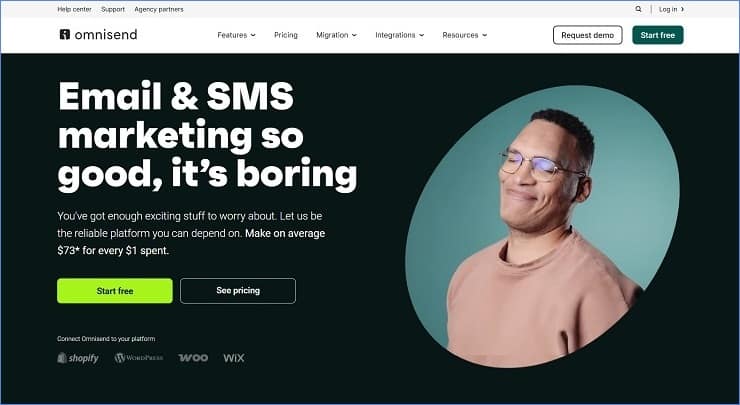
If you run an ecommerce store and are trying to pick the best email marketing platform for ecommerce, Omnisend often stands out — and for good reason. It’s built with online stores in mind, and it combines email, SMS, push-notification, and automation features in a unified, easy-to-use dashboard.
With Omnisend, you get powerful automation & workflow capabilities — pre-built flows like welcome series, cart-abandonment recovery, post-purchase follow-ups, shipping notifications, and more. You can also use its segmentation & personalization tools to send dynamic, behavior-based messages, personalized product recommendations, and targeted campaigns — which helps you drive higher conversions.
The drag-and-drop email builder and large library of ecommerce-focused templates make it quick and easy to design professional-looking emails without any coding. And, because Omnisend integrates smoothly with major ecommerce platforms like Shopify, WooCommerce, BigCommerce — your product catalog, customer data, and order history are always in sync.
For many small to medium-sized online stores, as well as growing brands, these features make Omnisend a top pick when choosing the best ecommerce email marketing software.
Ideal for: ecommerce entrepreneurs and DTC brands who want to automate their marketing, recover lost sales, personalize customer messaging, and scale — without juggling multiple tools or heavy technical work.
What we like about Omnisend
- Great automation & workflow builder
- Solid segmentation & personalization tools
- Easy drag-and-drop email builder
- Direct integration with popular store platforms
- Combines email, SMS & push notifications
- User-friendly even for non-tech founders
What we don’t like about Omnisend
- SMS costs extra beyond email plan
- Free plan has low monthly email limit
- Advanced automations have learning curve
- Some users find reporting less customizable
- Limited for CRM-heavy, B2B-focused workflows
- Scaling list size can increase cost significantly
Omnisend Pricing & Free Trial
Omnisend offers a Free plan that lets you try almost all features — including automations, segmentation, templates, and multi-channel messaging — with up to 250 contacts and 500 emails/month, no credit card required.
Once you grow, you can move to paid plans. The Standard plan starts at roughly $16/month, giving higher email volume and removing limits on push notifications. The Pro plan begins at around $59/month, unlocking unlimited emails, advanced reporting, bonus SMS credits, and priority support.
This pricing model — with a generous free option and scalable paid tiers — makes Omnisend a strong candidate among the best email marketing platforms for ecommerce, whether you’re just starting out or scaling up aggressively.
2. Moosend
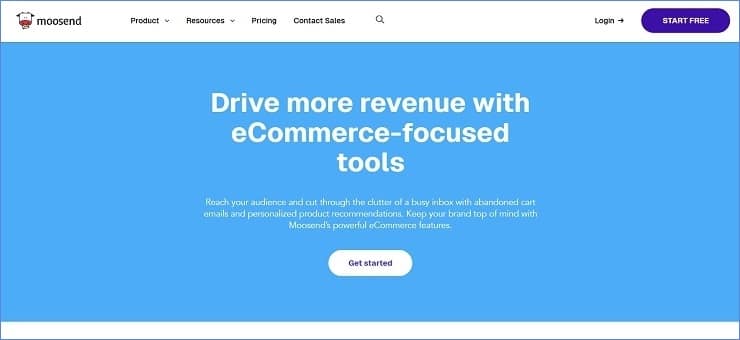
Moosend is a strong contender if you’re looking for the best email marketing software for ecommerce that balances ease of use with powerful automation. It’s built to help us turn subscriber activity into timely, relevant emails that actually drive sales.
With Moosend, you can create advanced marketing automation workflows for welcome emails, abandoned carts, product follow-ups, and re-engagement campaigns without touching code. The drag-and-drop email editor makes it easy for you and your team to design clean, conversion-focused emails fast. What really stands out is behavior-based segmentation, which lets us target shoppers based on browsing activity, purchase history, and engagement.
Moosend also supports AI-powered product recommendations, helping you send more personalized messages at scale. Add to that real-time analytics and A/B testing, and you get clear visibility into what’s working and where to optimize. Because of this balance of simplicity and depth, Moosend often earns its place among the best email marketing platforms for ecommerce, especially for brands that want strong automation without complexity.
Ideal for: Moosend works best if you’re running a small to mid-sized ecommerce store, a growing DTC brand, or an agency managing multiple ecommerce clients. If you want advanced automation, personalization, and solid reporting without a steep learning curve, this platform fits well as a best email marketing platform for ecommerce at this stage.
What we like about Moosend
- Clean and beginner-friendly interface
- Strong automation and workflow builder
- Behavior-based segmentation options
- AI product recommendations available
- Reliable ecommerce integrations
- Useful analytics and A/B testing
What we don’t like about Moosend
- Limited native SMS capabilities
- Fewer built-in CRM features
- Advanced designs need customization
- Fewer third-party integrations
- Reporting depth varies by plan
- No push notifications support
Moosend Pricing & Free Trial
Moosend offers a generous 30-day free trial, giving you full access to its core features without needing a credit card. This makes it easy for you to test whether it fits your ecommerce workflows before committing. After the trial, pricing starts with the Pro plan, which is contact-based and includes unlimited email sends. For smaller lists, pricing typically begins at around $9 per month, making it one of the more affordable options among the best email marketing software for ecommerce. As your subscriber list grows, the price scales gradually, while automation, segmentation, and analytics remain available.
For advanced needs, Moosend also provides Moosend+ and Enterprise plans with custom pricing. These tiers unlock transactional emails, advanced reporting, dedicated IPs, and priority support. There’s also a pay-as-you-go option if you prefer sending campaigns occasionally.
3. Klaviyo
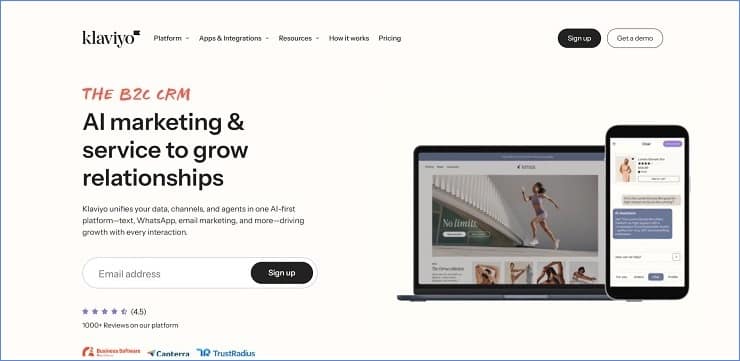
If you run an ecommerce store, Klaviyo can easily be one of the best email marketing platforms for ecommerce — and sometimes the safest long-term choice. At its core, Klaviyo is not just an email tool: it’s a full B2C CRM + marketing automation + customer data platform (CDP) built for online stores. From one unified dashboard, you can combine email and SMS, track all customer interactions, and use real-time data to power smart marketing.
What stands out for me are its deep data-driven personalization features. Klaviyo builds detailed customer profiles that record browsing history, purchase history, engagement — and then lets you segment based on dozens of criteria. This means you can send highly targeted emails: welcome series, cart-abandonment reminders, re-engagement nudges, or VIP offers — all tailored to each user’s journey. On top of that, its powerful automation & workflow engine (Flows) triggers messages based on behavior: like abandoned carts, post-purchase follow-ups, or birthday promos — without you lifting a finger.
Klaviyo also shines when it comes to omnichannel marketing: with email, SMS, mobile push and more, you can reach your customers however they prefer — from one place. Plus, its drag-and-drop builder and ready templates let you design professional emails quickly, even if you’re not tech-savvy. Because it integrates with major ecommerce platforms (Shopify, WooCommerce, BigCommerce, etc.), your store data (products, orders, customers) syncs automatically — which means less manual work and fewer errors.
All these features make Klaviyo a top pick when you want robust automation, advanced segmentation, and real-time personalization — especially if you’re serious about scaling.
Ideal for: online stores and DTC brands — from growing shops to established ecommerce businesses — who want to build long-term customer relationships, automate marketing across channels, and leverage data-driven campaigns without juggling multiple tools.
What we like about Klaviyo
- Deep customer data & profiling
- Strong segmentation & personalization
- Automation flows for emails & SMS
- Omnichannel (email, SMS, push) support
- Easy drag-and-drop email builder
- Smooth integration with ecommerce stores
What we don’t like about Klaviyo
- Free plan is very limited
- Costs rise sharply as contacts scale
- SMS credits and email volume cost extra
- Can be complex for absolute beginners
- Advanced analytics sometimes costly
- Requires good data hygiene for full benefit
Klaviyo Pricing & Free Trial
Klaviyo offers a Free plan that works for small or new stores: you get up to 250 active profiles, 500 email sends per month, and 150 SMS credits — enough to test platform capabilities and run simple campaigns. Once you grow, paid plans begin at $20/month for 251–500 contacts. As your list grows, pricing scales with the number of active profiles. There’s also an Email + SMS plan option that bundles both channels, which starts at around $35/month for small lists.
Because you only pay for “active profiles” (contacts you actually email), Klaviyo can be cost-effective for stores that keep their lists clean. For growing stores and serious marketers, this flexible pricing plus powerful features make Klaviyo one of the strongest contenders among the best ecommerce email marketing software.
4. Drip
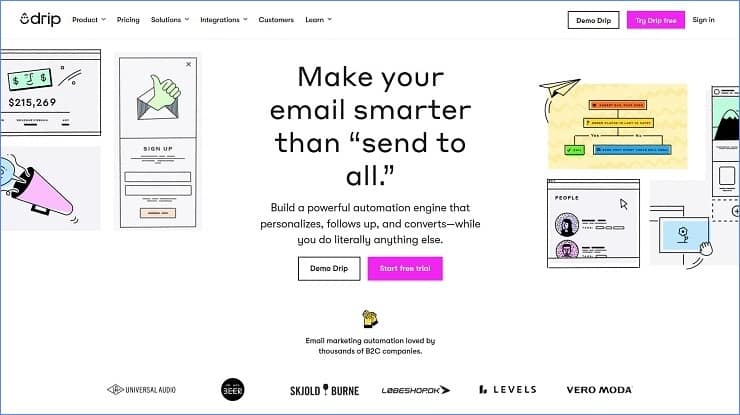
Drip is one of the best email marketing software for ecommerce brands that want a smarter, more intentional approach to customer communication. Instead of giving you generic email tools, Drip leans heavily into data-driven automation, making it easy for us to build journeys that mirror how real customers shop. Every action—whether someone views a product, abandons a checkout, or buys for the second time—can instantly trigger personalized emails designed to increase conversions.
One thing that stands out is Drip’s focus on deep ecommerce insights. We get revenue dashboards, workflow performance, segment analytics, and detailed attribution in one place. This helps us understand which campaigns actually make money. Its visual automation builder feels intuitive even when we’re creating advanced branching flows. And because Drip integrates natively with Shopify, WooCommerce, and BigCommerce, all customer and product data syncs automatically. We can then use dynamic product recommendations, behavior-based targeting, and pre-built ecommerce playbooks to move customers from first purchase to repeat purchase seamlessly.
Ideal for: ecommerce founders, DTC marketers, and growing brands that care about lifecycle marketing and want more depth than what traditional newsletters or basic email tools offer. It’s easily one of the best email marketing platforms for ecommerce if your goal is to grow revenue through personalization.
What we like about Drip
- Strong behavior-based automation engine
- Clean, visual workflow builder
- Real-time ecommerce segmentation
- Revenue dashboards with attribution
- Dynamic product recommendations built-in
- Templates tailored for ecommerce brands
What we don’t like about Drip
- Pricing grows with contact size
- Not a beginner-friendly platform
- No long-term free plan available
- SMS features add to overall cost
- Interface feels complex at first
- Limited design flexibility in templates
Drip Pricing & Free Trial
Drip offers a 14-day free trial, giving us full access to automations, segmentation, A/B testing, product feeds, and workflows. After the trial, pricing starts at $39/month for up to 2,500 contacts with unlimited email sends included. As your audience grows, the cost increases based on subscriber count. While Drip isn’t built for budget hunters, it’s designed for brands that want a performance-oriented tool. For stores that prioritize personalization, automation, and lifecycle revenue, Drip delivers strong value and holds its ground among the best ecommerce email marketing software available today.
5. MailerLite
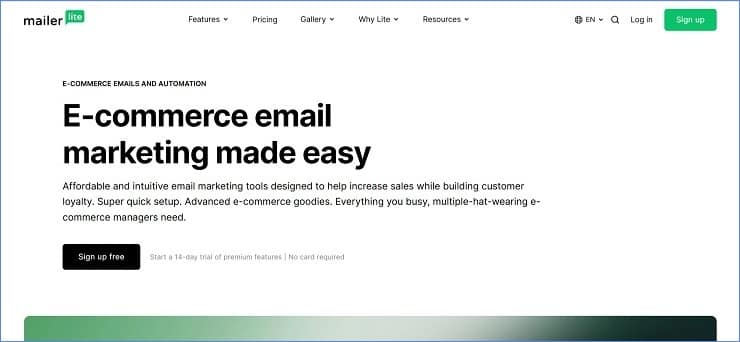
MailerLite often deserves a spot among the best email marketing software for ecommerce, especially if you want strong email marketing and automation without over-complicating things. It’s built to be easy yet powerful.
With MailerLite, you get a drag-and-drop email builder and ecommerce-ready templates that let you design clean, professional emails fast — no coding needed. You also get pre-built ecommerce automation workflows: welcome emails, abandoned-cart reminders, post-purchase follow-ups, and more — all triggered by real store events.
On top of that, MailerLite supports dynamic content, behavior-based segmentation, and personalization, so you can show different customers different product suggestions or messages depending on their history or interests. And because it integrates smoothly with common store platforms, your product catalog, orders, and customer data stay synced — which means your emails stay relevant. Its simplicity, combined with these core tools, makes MailerLite a strong candidate among the best email marketing platforms for ecommerce.
Ideal for: small to medium ecommerce stores, startups or indie brands — especially if you want a budget-friendly but capable email setup without juggling many tools.
What we like about MailerLite
- Easy drag-and-drop editor and templates
- Ready-made ecommerce automation flows
- Dynamic content and segmentation support
- Seamless ecommerce platform integration
- Good for small stores starting out
- Affordable plans even at low volume
What we don’t like about MailerLite
- Free plan limits contacts to 500
- Advanced automations limited on free tier
- Less powerful than heavy-duty CRM tools
- Might lack some features for large stores
- Deliverability reports somewhat basic
- Fewer advanced integrations than enterprise tools
MailerLite Pricing & Free Trial
MailerLite offers a free plan — up to 500 subscribers and 12,000 emails per month — which is great for small shops or when you’re just starting out. Their free plan gives you access to the drag-and-drop editor, basic automation, signup forms/pop-ups, landing pages and email sends.
If you grow beyond that, you can upgrade to a paid plan: the Growing Business tier starts around $10/month, offering unlimited email sends, more templates, dynamic emails, and extra features. The Advanced plan begins from about $20/month, adding advanced automation logic, custom HTML email editing, better support, and features useful for scaling stores. For a budget-conscious startup or small store, MailerLite offers an excellent value — letting you begin email marketing now and scale affordably as you grow.
6. ActiveCampaign
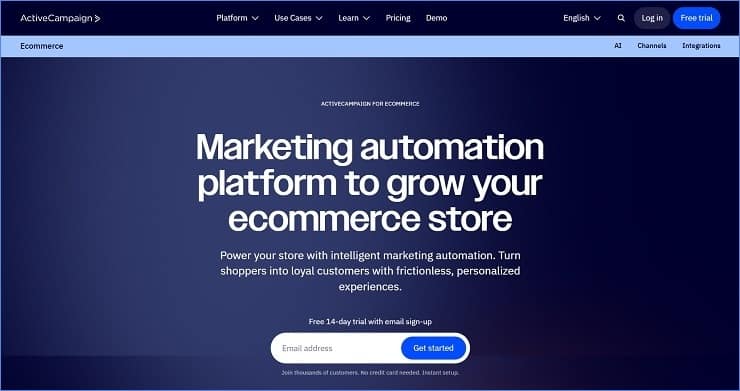
ActiveCampaign is a heavyweight contender when you’re hunting for the best email marketing platform for ecommerce. It gives us a full-fledged marketing automation + CRM + ecommerce email tool that grows with your store.
You get advanced automation and workflow capabilities — from abandoned-cart reminders to lifecycle flows, post-purchase sequences, and re-engagement campaigns — all triggered by real customer behaviour. Also powerful is its detailed segmentation & behavior-based targeting: you can group customers by purchase history, browsing habits or engagement levels, then send personalized promotional or follow-up emails.
For ecommerce shops, ActiveCampaign supports product-catalog integration and dynamic content insertion, meaning your emails can include real products relevant to the user. On top of that, it offers multi-channel support (email, SMS, site messages, CRM) and advanced automation tools that let you build complex customer journeys. If you want a full-stack solution — not just email blasts — this platform stands out among the best email marketing software for ecommerce.
Ideal for: growing ecommerce brands or agencies managing multiple stores who care about automation, customer data, and scalable marketing workflows.
What we like about ActiveCampaign
- Powerful automation + ecommerce workflow engine
- Detailed segmentation and behavior-based targeting
- Dynamic product-catalog integration in emails
- Multi-channel support (email, SMS, site messages)
- Scales well as your contact list grows
- Combines CRM with email marketing neatly
What we don’t like about ActiveCampaign
- More expensive than simple email tools
- Setup and learning curve for advanced features
- SMS, site-messages, extras raise cost
- Might be overkill for small/simple stores
- Cost increases significantly with large list size
- Some advanced features need manual tuning
ActiveCampaign Pricing & Free Trial
ActiveCampaign uses tiered pricing that scales with your number of contacts. For example, for 1,000 contacts, plans start as low as $15/month (Starter). With 2,500 contacts, Starter moves to $39/month. As your list grows to 5,000 contacts, pricing goes to about $79/month under Starter. Higher-tier plans (Plus, Pro, Enterprise) offer deeper automation, CRM tools, multi-channel messaging, and advanced reporting — but cost more depending on contact volume. There is a 14-day free trial available, so you can test the platform before committing. If you’re serious about scaling an ecommerce business with a robust, data-driven marketing stack, ActiveCampaign’s pricing — while not the cheapest — provides sound value for a full-featured solution.
7. Sendlane
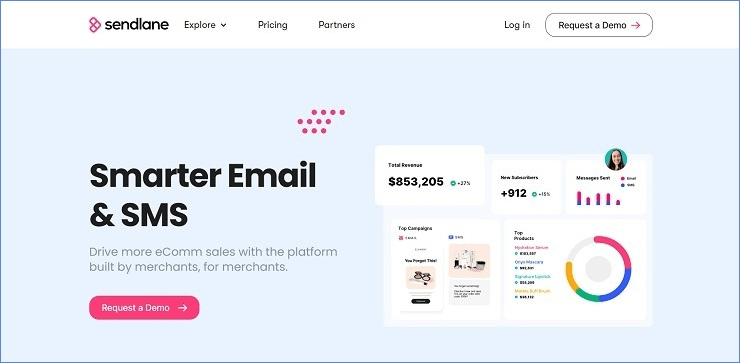
Sendlane is a powerful choice if you’re looking for the best email marketing software for ecommerce that delivers reliable performance and revenue-focused automation. It blends email + SMS + advanced automation + real-time tracking into one platform, making it easier for us to understand what actually drives sales. We also like its pre-built ecommerce workflows, including abandoned-cart, welcome, and post-purchase funnels that help you start fast and optimize quickly.
Another strong advantage is its behavior-based segmentation and dynamic content, which lets you target customers based on browsing behavior, purchase intent, and engagement patterns. This level of targeting makes Sendlane one of the best email marketing platforms for ecommerce if personalization is your priority.
Plus, Sendlane uses a send-volume pricing model with unlimited contacts, so you won’t be penalized as your list grows. And if inbox placement matters to you, their managed deliverability and premium IP add-ons help secure consistent inboxing — a huge win for revenue retention.
Ideal for: growing and enterprise-level ecommerce brands that send high volumes and rely heavily on automation and personalized campaigns. If you want a platform focused on deliverability, revenue tracking, and deep segmentation, it stands out as one of the best ecommerce email marketing software options.
What we like about Sendlane
- Strong ecommerce automation workflows
- Revenue tracking with real-time analytics
- Smart behavior-based segmentation tools
- Built-in email and SMS automation
- Managed deliverability and IP options
- Unlimited contacts under all plans
What we don’t like about Sendlane
- Pricing increases with send volume
- Trial limits full feature testing
- Not ideal for very small stores
- SMS credits billed separately
- Learning curve for advanced tools
- High tier needed for full support
Sendlane Pricing & Free Trial
Sendlane uses a send-based pricing model, meaning you get unlimited contacts and pay based on the number of emails you send each month. This structure works well for ecommerce brands that scale quickly or run frequent campaigns. The platform also offers a 60-day free trial where you can test up to 100 contacts and 500 emails, giving you enough room to explore automations, templates, analytics, and segmentation features.
Paid plans increase with send volume (starts at $100/month for 50,000 emails) and optional add-ons such as SMS credits, dedicated IPs, and advanced deliverability support. While Sendlane may feel pricey if you send heavily, it delivers strong value for ecommerce businesses that depend on personalization, automation, and consistent inbox placement — especially if you’re comparing options among the best email marketing platform for ecommerce.
8. Brevo
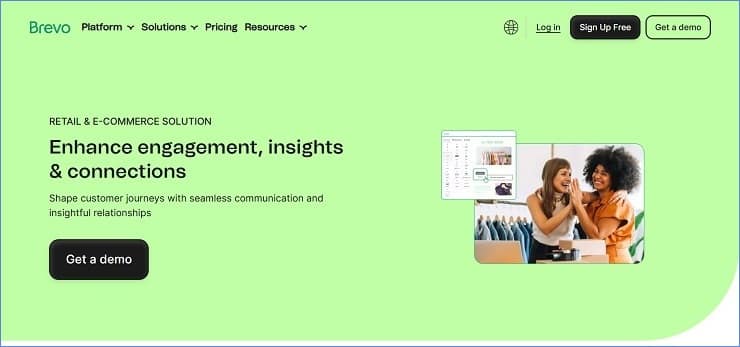
If you run an online store and want a flexible, budget-friendly tool, Brevo stands out as one of the best email marketing platforms for ecommerce. It blends email + SMS/WhatsApp + marketing automation + CRM tools into one platform — so you don’t need separate tools for different tasks. You get a drag-and-drop email builder and clean ecommerce-ready templates, which makes it easy to design stunning emails even if you’re not a designer.
What we like most is Brevo’s send-volume-based pricing model with unlimited contacts. That means you pay based on how many emails you send monthly — not how many contacts you have. This is a great match if you maintain a large subscriber list but don’t email every subscriber frequently.
Plus, Brevo offers marketing automation, behavior-based segmentation, dynamic content, and multi-channel campaigns (email, SMS, transactional messages, WhatsApp) — making it a strong contender among the best ecommerce email marketing software for stores that want flexibility without overspending.
Brevo suits small or medium ecommerce shops — especially those with large contact lists but moderate email frequency. It’s also a nice choice if you want a simple yet capable solution that grows with your business.
Ideal for: start-ups, growing stores, and businesses that prioritise cost-efficiency and multi-channel reach.
What we like about Brevo
- Send-volume model with unlimited contacts
- Easy drag-and-drop editor + ecommerce templates
- Email + SMS/WhatsApp + transactional messaging
- Automation, segmentation, dynamic content support
- Affordable for small/medium ecommerce stores
- Good fit for large lists with low send frequency
What we don’t like about Brevo
- Free plan has daily send limits
- Automation & A/B testing need paid plan
- Less advanced CRM compared to big tools
- Some advanced features only on high-tier plan
- Email frequency pricing can rise with volume
- Not ideal for heavy enterprise-level marketing
Brevo Pricing & Free Trial
Brevo offers a free plan (forever) where you can send up to 300 emails per day and store unlimited contacts — ideal to test features, build lists, or run occasional campaigns. Paid plans start at around $9/month under the Starter tier, which increases monthly email allowance and removes send-limits. The next tiers (Standard/Business) begin around $18/month or more, depending on the monthly email quota and extra features like automation, advanced analytics, and multichannel messaging. Because of its send-based pricing model, you pay for what you use — which often makes Brevo one of the most affordable choices among the best email platform for ecommerce, especially for growing or budget-conscious stores.
9. GetResponse
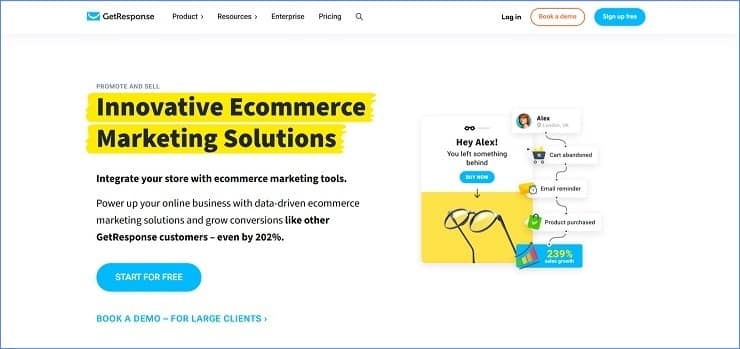
If you run an online store and want a full-stack tool, GetResponse can be a very solid pick for the best email marketing software for ecommerce. GetResponse gives you a complete set — email + SMS/ push notifications + automation + ecommerce integrations + landing pages — all from a single dashboard.
With GetResponse, you get one-click ecommerce integrations (Shopify, WooCommerce, BigCommerce, etc.), so your product catalog, customer data, and past orders sync automatically. That means you can trigger behavior-based automation like abandoned-cart reminders, post-purchase follow-ups, and promotional flows based on shopping behavior or order history.
It also offers advanced segmentation & personalization, letting you send tailored campaigns to different customer groups. You also get a drag-and-drop email + landing-page builder and ready templates — making it easy even if you aren’t a designer. For stores that want multi-touch engagement, GetResponse supports email + web push notifications + SMS + transactional emails + pop-ups + sales funnels — giving a true multi-channel marketing stack. Because of all that, GetResponse stands among the best email marketing platforms for ecommerce especially for stores that want to manage everything from one place.
Ideal for: small to mid-sized ecommerce stores, boutique shops, or growing brands looking for an all-in-one tool to manage emails, automation, sales funnels, and customer engagement — without juggling many separate tools.
What we like about GetResponse
- Full ecommerce-ready automation + integrations
- Email, SMS, push, pop-ups — all in one stack
- Behavior-based segmentation and personalization
- Easy drag-and-drop email & landing-page builder
- Unlimited monthly sends (all paid plans)
- Good multi-channel capabilities for growing stores
What we don’t like about GetResponse
- Free plan limited features and contacts
- Best ecommerce features only in higher tiers
- SMS & advanced tools cost extra
- May feel heavy for very small shops
- Some features need learning curve
- Reporting depth less than top-tier CRMs
GetResponse Pricing & Free Trial
GetResponse offers a 14-day free trial, so you can test core features without paying. Their paid plans start at $19/month (billed annually) for the “Starter/Email Marketing” tier — giving unlimited monthly sends, basic automation, email scheduling, landing pages, and list building tools. If you want full ecommerce marketing features — like abandoned-cart recovery, advanced automation, segmentation, web push notifications, sales funnels & transactional emails — you’ll likely move to the “Marketer” or higher plans priced around $59/month (for modest list sizes) when billed annually. Higher-volume or advanced needs (larger contact lists, SMS, advanced automation, product recommendations) will increase the cost accordingly.
This pricing plus broad feature set makes GetResponse a competitive and flexible option among the best ecommerce email marketing software — especially if you want to grow your store without needing separate tools for email, automation, landing pages or push-notifications.
10. Sender
When you want an email tool that’s both powerful and easy to use for your online store, Sender deserves attention among the best email marketing software for ecommerce. It’s built to help you turn visitors into buyers with drag-and-drop email builder, automation, segmentation, and ecommerce-style workflows all from a simple dashboard.
You can craft abandoned-cart campaigns, order confirmations, welcome sequences, and win-back flows, then automate them so they work while you sleep. What really stands out is Sender’s intuitive features for popup forms, landing pages, and signup experience, so you can capture more leads without extra tools.
You also get multi-channel automation with email and SMS, which makes it one of the best email marketing platforms for ecommerce if you care about reaching shoppers wherever they are. Best of all, Sender integrates with popular store platforms (like Shopify and WooCommerce), so your product data syncs cleanly and you can personalize messages based on actual purchase behavior.
Ideal for: small to mid-sized ecommerce shops and online brands who want a user-friendly but capable tool that grows with them.
What we like about Sender
- Simple email automations for ecommerce
- Strong drag-and-drop email builder
- Landing pages and popup forms included
- Behavior-based segmentation and targeting
- Email + SMS multi-channel messaging
- Easy onboarding for new users
What we don’t like about Sender
- Free plan shows Sender branding
- Some pricing tiers aren’t public
- SMS credits cost extra beyond base plan
- Advanced automation only in pro plan
- Enterprise needs contact for pricing
- Professional email limits grow with tier
Sender Pricing & Free Trial
Sender has a very generous Free Forever plan that gives you up to 2,500 subscribers and up to 15,000 emails per month — all without needing a credit card and good enough to start serious ecommerce email marketing.
For more advanced needs, the Standard plan (often starting around $10/month) unlocks no Sender branding, SMS messaging, unlimited templates, landing pages, and A/B testing — great for growing stores. The Professional plan (around $20/month) adds advanced automation, priority support, free SMS, and 10 role-based seats — useful if you run campaigns with a team. Bigger businesses can choose an Enterprise plan with unlimited emails, dedicated success manager, advanced permissions, and SLA support — pricing custom based on needs.
This pricing mix makes Sender one of the best email platform for ecommerce if you want affordable starts, multi-channel tools, and room to grow.
11. Mailchimp
Mailchimp is one of the most recognized names when it comes to the best email marketing software for ecommerce, especially if you want a tool that grows with your store and offers a rich set of features beyond just email.
At its core, Mailchimp gives us email automation, audience segmentation, CRM tools, and multi-channel messaging in one place. You can build automated ecommerce workflows like welcome series, cart abandonment triggers, order follow-ups, and lifecycle campaigns that speak directly to your shoppers’ behavior. What makes it easy to love is the drag-and-drop email builder with hundreds of templates, which helps you design professional campaigns fast. You also get advanced audience insights and analytics, so we can see what’s driving sales and where we can improve.
For many online stores, Mailchimp’s ecosystem — including landing pages, pop-ups, and ad tools — helps keep all your marketing under one roof instead of spreading across multiple platforms. Because of this breadth, it’s often regarded among the best email marketing platforms for ecommerce out there.
Ideal for: small to mid-sized ecommerce stores and growing brands that want an all-in-one marketing engine with solid automation and analytics, without stitching together too many tools.
What we like about Mailchimp
- Rich automation for ecommerce workflows
- Easy drag-and-drop email builder
- Advanced segmentation and personalization
- Includes landing pages and pop-ups
- Built-in CRM with audience insights
- Integrations with many ecommerce platforms
What we don’t like about Mailchimp
- Free plan is very limited now
- Pricing increases sharply with size
- Some features behind higher tiers
- Leads counted even if inactive
- SMS/MMS add-ons cost extra
- Can be confusing for first-timers
Mailchimp Pricing & Free Trial
Mailchimp’s pricing is tiered based on your store’s audience size and the features you need. It starts with a Free plan that lets you send basic emails to your first few hundred contacts (limited automation and send-limits apply). When you grow, the Essentials plan starts at about $8.50/month for basic templates, A/B testing, and 24/7 support. The Standard plan — at around $12.70/month — adds advanced automation, personalization tools, send-time optimization, and more detailed analytics. For larger ecommerce teams or high-growth brands, the Premium plan starts at $254.03/month and includes unlimited audiences, advanced segmentation and multivariate testing, priority support, and more custom options. Mailchimp also offers Pay-As-You-Go email credits and add-ons for SMS or transactional messaging if you want extra channels.
With this range of plans, Mailchimp can fit a wide variety of ecommerce businesses — from those just starting email automation to those scaling sophisticated, revenue-focused campaigns — which is why it continues to be one of the best ecommerce email marketing software choices available.
How to Evaluate & Pick: Matching Your Business Needs to the Right Software
Choosing the best email marketing software for your ecommerce store isn’t just about picking the one with the flashiest features — it’s about finding the tool that actually fits how you run your business. Think of this section as a friendly decision matrix. We’ll walk through the questions you should ask yourself so you can match your brand’s needs with the right platform.
Before jumping into the table, here’s the mindset we recommend: Start with what you need today, but choose software that won’t limit you tomorrow. Growth is the whole point of ecommerce. Your email system shouldn’t become the bottleneck.
Your Email Marketing Decision Matrix
Use the table below as a quick “self-checklist” to see where you fit and which type of tool you should be leaning toward.
| Evaluation Factor | What You Should Ask Yourself | If This Sounds Like You… | You’ll Match Best With… |
|---|---|---|---|
| Your Store Platform | “Where do I sell — Shopify, WooCommerce, Magento, or custom?” | You’re on Shopify or WooCommerce and want plug-and-play setups | Tools with native ecommerce integrations (Omnisend, Klaviyo, Mailchimp, Sendinblue/Brevo) |
| You sell on a custom-coded platform | Tools with flexible APIs and powerful automation (ActiveCampaign, Klaviyo, ConvertKit) | ||
| Your Store Size | “How big is my customer base right now?” | Just launched / under 500 customers | Beginner-friendly tools with free plans (MailerLite, Mailchimp Free, Sender, Brevo) |
| Medium-sized store (500–10,000 customers) | Tools with scalable automation + segmentation (Omnisend, Klaviyo, ActiveCampaign) | ||
| Large or rapidly growing store | Tools with advanced data insights and multi-channel workflows (Klaviyo, ActiveCampaign Premium, Mailchimp Premium) | ||
| Your Budget | “What can I realistically spend every month?” | Zero or minimal budget | Free or low-cost software (Sender, MailerLite, Brevo Free/Starter) |
| Small to medium budget | Platforms with balanced pricing + automation (Omnisend Standard, Mailchimp Essentials/Standard) | ||
| High or unlimited budget | Premium tools with deep analytics + SMS + predictive insights (Klaviyo, Mailchimp Premium, ActiveCampaign Professional) | ||
| Feature Priorities | “What features matter MOST to me?” | You just want to send simple newsletters | Sender, MailerLite, Brevo |
| You want abandoned cart + automation | Omnisend, Klaviyo, ActiveCampaign | ||
| You need SMS, push notifications, and omnichannel flows | Omnisend, Klaviyo | ||
| You want CRM + advanced segmentation | ActiveCampaign, Mailchimp Standard/Premium | ||
| Technical Comfort | “Do we prefer plug-and-play or more advanced customization?” | “We want it simple and clean.” | Brevo, MailerLite, Sender, Mailchimp Essentials |
| “We’re comfortable with learning advanced tools.” | Klaviyo, ActiveCampaign, Omnisend | ||
| Future Growth Plan | “Where do we want to be in 1–2 years?” | You plan to stay lean with simple marketing | Tools with strong basic automation (Sender, Brevo, MailerLite) |
| You plan to scale fast and want rich ecommerce insights | Klaviyo, Omnisend, ActiveCampaign |
Best Practices for Ecommerce Email Marketing (Once You Pick the Software)
Once you’ve chosen the best email marketing software for ecommerce, the real growth starts. The tool is only as effective as the strategy behind it — and that’s where a few simple best practices can completely transform your results. Think of these as the fundamentals every ecommerce brand (and agency) should follow to get consistent revenue from email.
Start with a clean, permission-based list
Your list is the backbone of every campaign you’ll ever send. If we send emails to people who never opted in, we’ll hurt our deliverability and damage our sender reputation.
So always:
- use double opt-in (if needed),
- avoid purchased lists, and
- clean out inactive contacts regularly (psstt… MailCleanup does it excellently)
This helps your emails land in the inbox, not spam — something every store owner wants when using the best email marketing platforms for ecommerce.
Segment your audience and personalize everything you can
Sending the same email to all customers is the fastest way to reduce engagement. Your software likely offers segmentation, which lets us separate customers by behavior, purchase history, or interests.
With the right tool, you can easily:
- target high-intent shoppers,
- reward loyal customers,
- give new visitors a gentle nudge, and
- bring back people who haven’t purchased in a while.
When we pair the best email marketing platform for ecommerce with smart personalization, we turn simple broadcasts into revenue-driving conversations.
Automate the essential flows that drive sales 24/7
Automation is where ecommerce email truly shines. Once it’s set up, it keeps converting even when we’re not working. At the very least, you should automate:
- Welcome Series — greet new subscribers, introduce your brand, and offer value.
- Cart Abandonment Flow — recover otherwise lost sales.
- Post-Purchase Follow-Up — increase retention and collect reviews.
- Re-Engagement Flow — win back inactive customers before they churn.
These flows are the foundation of any best ecommerce email marketing software and usually deliver the highest ROI.
Optimize your email content for clarity and conversions
We all know ecommerce customers browse on their phones, so your emails need to look great on every screen. Keep your designs clean, use short paragraphs, and make your call-to-action unmissable.
We also recommend:
- writing clear subject lines that create curiosity,
- using dynamic product recommendations if your platform supports it,
- adding relevant images without overloading the email, and
- testing different layouts from time to time.
Good content + the best email platform for ecommerce = higher clicks and more sales.
Track your performance and refine your strategy over time
Data is your superpower. Once emails go out, your software will show you what worked — and what needs improvement. Keep an eye on your:
- open rates,
- click-through rates,
- conversion rates, and
- revenue per email.
When you consistently measure and optimize, your entire email strategy becomes sharper and more profitable. That’s how you get long-term results from any best email marketing software for ecommerce.
Common Mistakes & Pitfalls to Avoid
Even when you choose the best email marketing software for ecommerce, results can suffer if a few critical mistakes creep in. We’ve seen many ecommerce brands struggle not because of the tool, but because of how it’s used. Below are the most common pitfalls you should actively avoid.
- Choosing software based only on price or free plans: We often see stores pick tools just because they’re cheap or free. That usually works short term. But as your list grows, limitations appear fast. The best email marketing platforms for ecommerce should support automation, segmentation, and scaling — not just save money today.
- Overlooking ecommerce platform integrations: If your email tool doesn’t integrate properly with Shopify, WooCommerce, or your custom setup, workflows break. Data syncing becomes manual. This defeats the purpose of using the best email marketing platform for ecommerce in the first place.
- Sending too many or irrelevant emails: When we email too often or without context, subscribers lose interest. Engagement drops. Unsubscribes increase. Inbox placement also suffers. Relevance always beats volume when using any best email platform for ecommerce.
- Not using segmentation and personalization: Generic email blasts rarely perform well. Ecommerce thrives on behavior-based messaging. If we’re not using segmentation, we’re wasting the power of even the best ecommerce email marketing software.
- Ignoring email deliverability basics: Many stores forget about authentication, sender reputation, and list hygiene. Without proper deliverability setup, emails won’t reach inboxes — no matter how good the content is.
- Failing to track and optimize performance: Sending campaigns without reviewing metrics is a missed opportunity. If we don’t analyze open rates, clicks, and conversions, we can’t improve. The best email marketing software for ecommerce gives us data — it’s up to us to act on it.
- Not planning for future growth: Starting simple is fine. Staying limited is not. We should always choose a platform that grows with your store, your team, and your marketing ambitions.
Avoid these mistakes, and you’ll unlock far more value from your email marketing efforts.
Conclusion & Final Recommendations
When it comes to choosing the best email marketing software for ecommerce, there is no single tool that works perfectly for everyone. The “right” platform depends on where your business is today, where you want to go, and how complex your marketing needs are. A new store may only need basic newsletters and a welcome flow. A growing brand may need advanced automation, segmentation, and SMS. Larger teams may look for CRM depth and multi-channel workflows. That’s why the best email marketing platforms for ecommerce are the ones that align with your current goals — not just popular names.
We strongly recommend testing before committing. Many tools in this list offer free plans or free trials. Use them. Explore the interface. Set up a cart abandonment flow. Check how well it integrates with your store. This hands-on approach helps you identify the best email marketing platform for ecommerce that actually fits your workflow.
Finally, start simple. Focus on core flows first. As your store grows, scale into advanced features with confidence using the best ecommerce email marketing software for your stage.
Here are a few blog posts that you would like –
- Best SMTP services to reach customer inboxes
- Best email verification services to keep your email lists clean
Quick FAQ: Honest Answers for Ecommerce Beginners
When we talk to new ecommerce founders, these are the questions that come up again and again. If you’re asking these too, you’re thinking in the right direction.
Do I really need email marketing if I already use social ads?
Yes. Social ads help you get attention, but email helps you build relationships. Ads stop the moment you stop paying. Email keeps working. Once someone joins your list, you can talk to them again without paying for every interaction.
Can I start with a free plan and still get results?
You can. A free plan is enough to learn the basics and set up a few important automations. The key is not the plan — it’s what you do with it. Even simple welcome emails and cart reminders can drive early sales.
What if my store platform is custom and not Shopify or WooCommerce?
That’s okay. Most email tools can still work with custom stores using APIs or manual data syncing. You may need a developer’s help at first, but it shouldn’t stop you from running email campaigns.
Is email marketing still effective in 2026?
Very much so. What changed is how it’s done. Generic blasts don’t work anymore. Timely, relevant, behavior-based emails still perform extremely well — often better than ads.
How many emails should I send?
There’s no fixed number. We usually suggest starting slow and listening to your audience. If engagement stays healthy, you’re on the right track. If unsubscribes spike, it’s time to adjust.
What’s the first email flow I should set up?
Start with a welcome series. It’s often the highest-performing flow for new stores. After that, move to cart abandonment and post-purchase follow-ups.
Do I need a big email list to make money?
Not at all. A small, engaged list often outperforms a large, inactive one. Focus on relevance, not size.