
EmailOctopus built its reputation on something genuinely useful: making email marketing affordable for the senders who need it most. Small businesses, bloggers, nonprofits, and independent creators chose it because it covered the essentials at a price that made sense. No bloated dashboards, no enterprise contracts, just clean list management, solid delivery, and transparent pricing that did not climb unpredictably as lists grew.
The problem is structural. EmailOctopus was designed to stay simple, and at a certain point, staying simple becomes a ceiling. There are no conditional automation workflows. There is no way to branch a journey based on what a subscriber did or did not open. There is no transactional email channel. When your sending needs outgrow what the platform was built to handle, it does not adapt with you. That is the moment most users start looking for EmailOctopus alternatives, and this post answers that question specifically.
We evaluated 11 platforms against the dimensions that actually matter to EmailOctopus users: automation depth, sending scope, cost at equal list size, and realistic migration effort. The tools are ordered by fit for the EmailOctopus user profile, starting with the closest like-for-like upgrade and moving toward platforms that serve a different stage of growth.
TL;DR on EmailOctopus Alternatives
- MailerLite is the strongest like-for-like EmailOctopus alternative on the market: same simplicity and price bracket, plus conditional automation, a landing page builder, and a website builder, with the trade-off of a sharply reduced free tier (250 subscribers as of June 2026, versus EmailOctopus’s 2,500).
- Sender is the only EmailOctopus alternative that genuinely matches EmailOctopus on free plan generosity: 2,500 subscribers and 15,000 emails per month at no cost, with automation features that EmailOctopus reserves for its paid tier.
- Brevo is the right choice if you have a large contact list but send infrequently: its volume-based pricing model charges per email sent rather than per contact stored, which can undercut EmailOctopus significantly for high-contact, low-frequency senders.
- Moosend competes directly with EmailOctopus on price and beats it on automation depth, with conditional workflows and website tracking triggers included, but carries no permanent free plan and acquisition uncertainty since Constant Contact purchased it in June 2025.
- Kit is purpose-built for the newsletter creator and blogger audience that EmailOctopus also targets, adding paid newsletter infrastructure and creator monetization tools that EmailOctopus does not offer at any plan tier.
- Mailchimp makes sense as an EmailOctopus alternative only when integration breadth genuinely outweighs cost; its free plan covers just 250 contacts and 500 emails per month, and paid plans run over twice the price of EmailOctopus at comparable list sizes.
- ActiveCampaign is where EmailOctopus users land when they need a CRM alongside email: lead scoring, pipeline management, and deep automation branching that no other tool on this list matches at this level of depth.
- Staying on EmailOctopus is still the right call if you are on the free plan with under 2,500 subscribers and your needs are genuinely newsletter-only; no EmailOctopus alternative in this list matches that free tier on subscriber count without giving something else up.
EmailOctopus Alternatives: Quick Comparison
| Tool | Best For | Free Plan | Paid From (1,000 contacts) | Automation | Sending Scope |
|---|---|---|---|---|---|
| MailerLite | Like-for-like upgrade | 250 subs, 2,500 emails/mo | ~$18/mo (Comfort) | Conditional | Marketing only |
| Brevo | Volume-based pricing + transactional | 9,000 emails/mo, unlimited contacts | $9/mo Starter (no automation); $18/mo Standard | Conditional on Standard | Marketing + Transactional + SMS |
| Moosend | Budget automation upgrade | 30-day trial only | ~$16/mo (Pro) | Conditional | Marketing only |
| GetResponse | All-in-one beyond email | 500 contacts, limited | $19/mo Starter (1 workflow); $59/mo Marketer | Conditional on Marketer | Marketing only |
| Sender | Best free plan by send volume | 2,500 subs, 15,000 emails/mo | $0 (free plan covers 1K contacts) | Conditional (free) | Marketing + Transactional |
| Kit | Newsletter creators and writers | 10,000 subs, 1 automation | $39/mo monthly; $33/mo annual (Creator) | Conditional | Marketing only |
| Mailchimp | Integration depth and ecosystem | 250 contacts, 500 emails/mo | ~$20/mo Essentials (no multi-step); ~$27/mo Standard | Multi-step on Standard | Marketing only |
| Omnisend | Ecommerce brands | 250 contacts, 500 emails/mo | ~$25/mo (Standard) | Conditional ecom flows | Marketing only; SMS on Pro |
| Constant Contact | Social-first small businesses | None (60-day trial) | ~$30/mo Lite; ~$45-50/mo Standard | Basic on Lite; Multi-step on Standard | Marketing only |
| ActiveCampaign | CRM and advanced automation | None (14-day trial) | $19/mo Starter (5-action limit); $59/mo Plus | CRM-level on Plus+ | Marketing only |
| SendPulse | Multichannel marketing | 500 subs, 15,000 emails/mo | ~$12/mo (Standard) | Conditional | Multichannel |
The EmailOctopus Switch Fit Stack: Four Dimensions Every EmailOctopus Alternative Should Be Judged On
Every EmailOctopus alternatives list in this SERP is a flat ranking. Tools are described one by one, features are listed, and the reader is left to compare them on whatever dimension they happen to prioritise. The problem with that approach is that EmailOctopus users switch for different reasons, and the tool that solves one switch trigger is often the wrong pick for another.
When evaluating EmailOctopus alternatives, four dimensions determine whether a switch actually improves your situation. Each maps to a specific limit of the EmailOctopus platform.
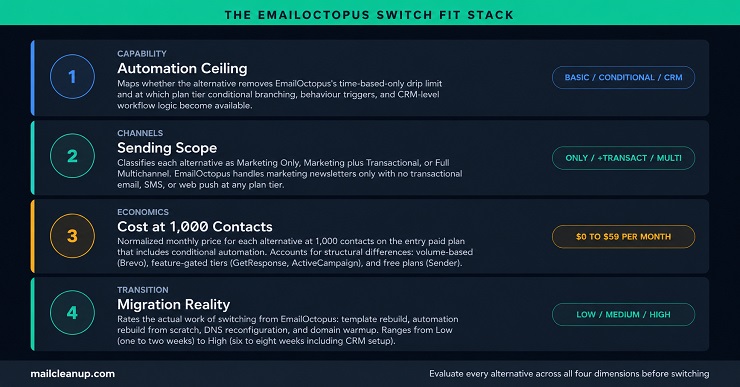
- Automation Ceiling: EmailOctopus supports time-based autoresponders and basic drip sequences. There are no conditional branches, no behaviour-based triggers beyond list subscription, no CRM-level workflow logic. This layer assesses each alternative on whether it removes that ceiling and, critically, at which pricing tier that capability becomes available. A tool that promises advanced automation only on its highest-tier plan is not a meaningful upgrade for the typical EmailOctopus user who is watching their budget.
- Sending Scope: EmailOctopus handles marketing newsletters only. It cannot send transactional emails (password resets, order confirmations, account notifications), and it has no SMS or web push channel. This layer classifies each alternative as Marketing Only, Marketing plus Transactional, or Full Multichannel. If transactional email is part of your requirement, you are evaluating a different product category, and the tool list needs to reflect that honestly.
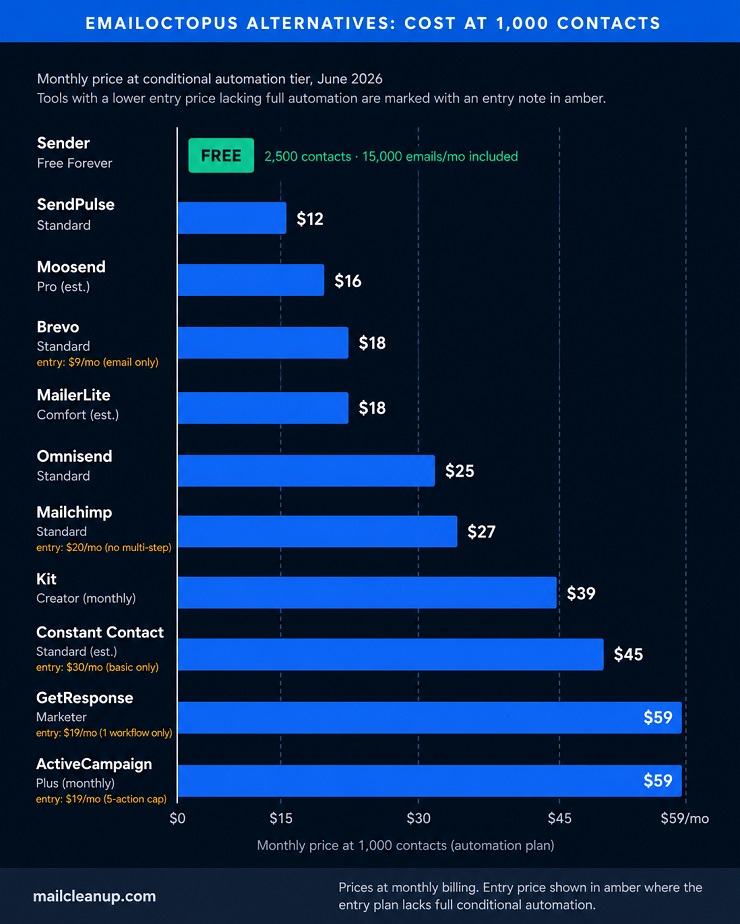
- Cost at 1,000 Contacts: EmailOctopus’s free plan at 2,500 subscribers is one of the most generous starting points in email marketing. Comparing alternatives purely on headline pricing misses the critical structural difference: some tools charge per email sent (Brevo), some charge per contact including unsubscribed ones (Mailchimp), and some charge per active contact only (Moosend, MailerLite). The normalized cost at 1,000 contacts in the How to Choose section makes this comparison honest. The range across the 11 tools reviewed here runs from free to over $50 per month for the same list size, depending entirely on the pricing model and plan tier.
- Migration Reality: EmailOctopus users are predominantly non-technical. Switching to any alternative means rebuilding email templates in a new editor, rebuilding automation sequences from scratch, reconfiguring DNS authentication records if the sending domain changes, and running a warmup period on new sending infrastructure. These are real costs that never appear on a pricing page. This layer rates each alternative as Low, Medium, or High migration complexity based on how much of this work the platform handles automatically versus how much falls to you. Our guide on email warmup covers the warmup requirements that apply whenever you move to a new sending infrastructure.
What EmailOctopus Is and Why Users Start Looking for an Alternative to EmailOctopus
EmailOctopus does one thing exceptionally well: it makes email marketing genuinely affordable. It routes through its own sending infrastructure (or through your own Amazon SES account on the Connect plan for even lower per-email costs) and passes the savings to the user. The drag-and-drop editor is fast and uncluttered. The free plan at 2,500 subscribers and 10,000 emails per month has no time limit and requires no credit card. It does not bill on unsubscribed contacts, which means list growth does not produce surprise charges the way it does on platforms like Mailchimp.
The platform’s limits are structural, not correctable by upgrading. EmailOctopus automation is time-based: send a welcome email, then a follow-up three days later, then another five days after that. You cannot send email B only to subscribers who clicked email A. You cannot trigger a sequence based on a page visit, a purchase event, or a custom field value. You cannot score leads or branch a journey by behaviour. These are not missing features on a product roadmap; they define the deliberate simplicity of what EmailOctopus chose to build.
Most users searching for EmailOctopus alternatives are hitting one of three specific walls:
- The automation ceiling: They need conditional branching, and EmailOctopus cannot provide it at any price tier.
- Channel scope limitations: They need transactional email alongside their campaigns, and EmailOctopus is a marketing-only tool.
- List growth cost pressure: At larger list sizes, subscriber-based pricing becomes less competitive against platforms that charge by email volume, and users start running the numbers on whether switching saves money.
Identifying which wall you are hitting tells you which part of the alternatives list to focus on. A blogger who needs conditional automation sits in a very different position from an ecommerce business that needs SMS flows, or a developer who needs transactional and marketing email from a single sending infrastructure. A well-maintained sender reputation is also worth protecting through any platform migration; our guide on email sender reputation covers how sending infrastructure changes affect inbox placement during and after a switch.
11 EmailOctopus Alternatives, Reviewed for Automation Depth, Sending Scope & Real Cost
Each of the 11 EmailOctopus alternatives below is assessed on the four Switch Fit Stack dimensions. They are ordered by fit for the typical EmailOctopus user profile, starting with the closest upgrade path. Pricing in each tool section reflects the most recently verified figures from each platform’s live pricing page. The full normalized comparison at 1,000 contacts, including all 11 tools side by side, is in the How to Choose section at the end of this post.
1. MailerLite: Best EmailOctopus Alternative for Like-for-Like Upgraders
MailerLite is the closest EmailOctopus alternative on the market for users who want to stay within the same price range and level of simplicity. It occupies the same corner of the market as EmailOctopus: affordable, clean, and built for small businesses, bloggers, and independent creators who want professional email campaigns without a steep learning curve.
The practical differences from EmailOctopus come down to three things. First, conditional automation: MailerLite supports workflow branching based on subscriber actions, opens, clicks, custom field values, and date-based triggers. Second, a landing page and website builder included on all paid plans, removing the need for a separate tool to build opt-in pages alongside your campaigns. Third, paid newsletter and digital product monetization on the Power plan, which EmailOctopus does not offer at any tier.
One change worth understanding before you switch: MailerLite substantially cut its free plan in June 2026, reducing it from 500 to 250 active subscribers and from 12,000 to 2,500 monthly emails. EmailOctopus’s free plan at 2,500 subscribers is now more than ten times more generous on subscriber count. MailerLite’s free tier is not a direct replacement for EmailOctopus’s; it is the right upgrade if you are already on a paid EmailOctopus plan and want conditional automation at a comparable monthly cost.

Key Features of MailerLite
- Conditional automation workflows with branching logic, multiple triggers, and A/B split steps within sequences
- Drag-and-drop email editor with a rich template library, including custom HTML editing on paid plans
- Landing page builder and website builder on all paid plans, no separate subscription required
- Subscriber segmentation by behaviour, custom fields, campaign activity, and date-based conditions
- Paid newsletter subscriptions and digital product sales on the Power plan
- AI writing assistant for subject lines and body copy on paid plans
Why MailerLite is a Better EmailOctopus Alternative
The automation capability gap is the core reason to switch. EmailOctopus sends a sequence of emails on a timer. MailerLite sends different emails to different subscribers based on what each one did with your previous message, when they joined, what their custom fields contain, or what they have purchased. For any list-based business running lead nurturing, onboarding sequences, or re-engagement flows, that distinction changes the quality of what you can build in a material way. The landing page builder and website builder extend that advantage by keeping your forms, pages, and campaigns in one place rather than spread across multiple tools.
Best For
Small businesses, bloggers, solopreneurs, and creators who have outgrown EmailOctopus’s basic automation but want to stay within a similar price bracket. Newsletter publishers looking to monetize with paid subscriptions and digital products without moving to a more expensive platform.
MailerLite Pricing
MailerLite updated its plan names and pricing on June 16, 2026. The Free plan covers 250 active subscribers and 2,500 emails per month. The Comfort plan starts at $12 per month (monthly billing) at the entry subscriber tier, with a monthly email allowance of ten times the subscriber count ceiling. The Power plan starts at $25 per month (monthly billing) with unlimited monthly emails, unlimited automations, unlimited landing pages and websites, and 24/7 live chat support. Annual billing saves approximately 10 percent. The exact Comfort and Power plan prices at 1,000 contacts are in the comparison table in the How to Choose section.
2. Brevo: Best EmailOctopus Alternative for Volume-Based Pricing & Transactional Email
Brevo (formerly Sendinblue) is structurally different from EmailOctopus in two ways that matter for a specific type of sender. First, it prices by email volume rather than subscriber count: you pay based on how many emails you send per month, not how many contacts you store. Second, it handles transactional email alongside marketing campaigns from the same account, which EmailOctopus does not offer at any tier.
The volume-based pricing model changes the cost calculation entirely for senders with large lists and low send frequency. If you have 10,000 subscribers but send one newsletter per month, Brevo charges you for 10,000 emails rather than for 10,000 contacts. At that ratio, Brevo often costs less than EmailOctopus’s subscriber-based tier for the same audience. If you send to your full list daily or run multiple campaigns per week, the model can run higher. There is also no penalty for inactive contacts: unsubscribed addresses stored in your account do not add to your bill unless you email them.
The transactional email capability is the second structural advantage. Password resets, order confirmations, account notifications, and triggered system emails can all go through the same Brevo account as your marketing campaigns, with a unified contact history showing both types of communication per subscriber. A built-in CRM, SMS marketing, and web push notifications are also available, making Brevo the closest to a full communication platform among the budget-tier EmailOctopus alternatives in this list.
Key Features of Brevo
- Volume-based pricing: charge is per email sent, not per contact stored
- Transactional email via API and SMTP relay, included on paid plans
- Marketing automation with conditional workflows and multi-step branching (Standard plan and above)
- SMS marketing and web push notification channels
- Built-in CRM for contact management, deal tracking, and communication history
- Shared and dedicated IP options with sender reputation monitoring
- Drag-and-drop email and landing page editor
Why Brevo is a Better EmailOctopus Alternative
EmailOctopus is marketing-only. Brevo adds transactional email, SMS, and a CRM to the same account. For any business sending both campaign newsletters and system notifications, consolidating those into one platform means a single view of each contact’s full communication history and one less sending infrastructure to authenticate and maintain. The volume-based model is also a direct cost advantage for EmailOctopus users with large, infrequently-emailed lists who are paying subscriber-based fees for contacts they rarely reach. The conditional automation on the Standard plan closes the workflow logic gap that EmailOctopus cannot address. See our email authentication guide for a walkthrough of the SPF, DKIM, and DMARC configuration that applies when adding a new sending domain through Brevo.
Best For
Businesses that send both marketing campaigns and transactional system emails and want a single platform for both. High-contact, low-frequency senders seeking to reduce subscriber-based fees. Teams that need SMS or multichannel capability without adding a separate platform subscription.
Brevo Pricing
Brevo offers a permanent free plan with unlimited contact storage and up to 300 emails per day (approximately 9,000 per month), with Brevo branding on outgoing emails. Paid plans are structured by monthly email volume rather than contact count. The Starter plan begins at $9 per month for 5,000 emails per month (monthly billing) and does not include marketing automation. The Standard plan begins at $18 per month for 5,000 emails per month and adds unlimited automation, landing pages, A/B testing, and advanced reporting.
Brevo logo removal on the Starter plan is a paid add-on at $10.80 per month; it is included on Standard and above. At four campaigns per month to 1,000 contacts (4,000 emails), the Starter plan at $9 per month covers the volume. Standard at $18 per month is required for automation. Annual billing saves 10 percent.
3. Moosend: Best EmailOctopus Alternative for Budget-Conscious Automation Upgraders
Moosend is the EmailOctopus alternative to consider when you need conditional automation at a price comparable to EmailOctopus, without moving to a more expensive tier. It targets the same cost-sensitive buyer as EmailOctopus but delivers a meaningfully more capable automation builder at a comparable price point.
Where EmailOctopus gives you time-based drip sequences, Moosend gives you conditional workflows: if-then branching based on subscriber behaviour, website tracking triggers that fire automations when a contact visits a specific page, and product recommendation blocks that pull data from your store. For a small business that has hit the EmailOctopus automation ceiling and cannot justify jumping to an enterprise-priced tool, Moosend is a direct like-for-like comparison that usually wins on feature depth per dollar.
One material fact to disclose before committing: Moosend was acquired by Constant Contact in June 2025, having previously been owned by Sitecore since 2021. As of mid-2026, Moosend operates as a standalone product with its own pricing, features, and support structure, and no pricing changes or feature discontinuations have been announced. The honest assessment is that the day-to-day product works and is actively serving customers; the longer-term roadmap under Constant Contact is genuinely unknown. For a multi-year commitment, that uncertainty is a real factor. For a short-to-medium-term decision, it should not block the evaluation.
No permanent free plan: Moosend has no permanent free tier, which is the sharpest contrast with EmailOctopus. The 30-day free trial covers all core features with no credit card required, but a paid subscription is required to continue after the trial ends. If EmailOctopus’s free plan at 2,500 subscribers is a core part of your current setup, this structural difference matters.

Key Features of Moosend
- Conditional automation workflows with if-then branching, 32 available triggers, and behaviour-based paths
- Website tracking to trigger automations based on page visits and on-site behaviour
- Product recommendation blocks populated from ecommerce store data
- Unlimited email sends on all paid plans, with no monthly volume cap
- Drag-and-drop email editor with 80-plus responsive templates
- Landing page builder included on all paid plans
- A/B testing for subject lines, content, and sender name
Why Moosend is a Better EmailOctopus Alternative
The automation depth is the primary case for switching. EmailOctopus sends emails on a schedule. Moosend sends emails based on what a subscriber does: if they click a specific link, if they visit a page on your site, if they abandon a cart, if they have not opened in 60 days. That is a qualitatively different capability, not a marginal upgrade. The unlimited send volume on all paid plans is also an advantage over platforms that cap monthly emails at a multiplier of subscriber count: with Moosend, running a re-engagement campaign to your full list does not push you into a higher tier mid-month.
Understanding how behaviour-triggered campaigns differ from broadcast campaigns in terms of deliverability risk is worth reviewing before building conditional sequences, since triggered sends carry different complaint-rate dynamics than broadcast newsletters.
Best For
Budget-conscious marketers who need conditional automation and behaviour-triggered workflows but cannot justify the pricing of enterprise platforms. Ecommerce operators with a small-to-medium list who need product recommendation emails and cart abandonment flows. Small businesses that have outgrown EmailOctopus’s automation but are not yet ready for a full CRM-level platform.
Moosend Pricing
Moosend offers a 30-day free trial with no credit card required, covering all core features and unlimited sends to up to 1,000 contacts during the trial period. The Pro plan starts at $9 per month (monthly billing) for 500 contacts, with unlimited email sends, automation workflows, landing pages, and form builders included. Pricing scales by subscriber count with no email send cap; at 1,000 contacts the Pro plan costs approximately $16 per month. The Pro plan at 1,000 contacts and the comparison against EmailOctopus’s equivalent tier are in the normalized table in the How to Choose section. A Moosend+ plan with transactional email, dedicated IP, and custom enterprise features is available on request.
4. GetResponse: Best EmailOctopus Alternative for All-in-One Marketing Beyond Email
GetResponse sits a step above EmailOctopus in scope and price, offering a platform that combines email marketing, landing pages, marketing automation, website builder, and webinar hosting in a single account. If you are a content creator, coach, or course builder looking to consolidate multiple tools into one, or if you are a small business that needs webinar infrastructure alongside email campaigns, GetResponse covers ground that EmailOctopus and most other alternatives on this list do not touch.
The important caveat is that GetResponse’s pricing tiers are misleadingly structured for automation users. The Starter plan at $19 per month for 1,000 contacts includes unlimited email sends and autoresponders, but only one automation workflow. If you need genuine marketing automation with conditional branches, multiple workflows running simultaneously, and behaviour triggers, you need the Marketer plan at $59 per month for 1,000 contacts. That price jump from Starter to Marketer is significant, and it is the first thing to check before treating GetResponse as a budget-tier EmailOctopus alternative. It is not one.
Where GetResponse genuinely earns its Marketer plan price is in the breadth of what you get alongside email: unlimited automation workflows, advanced segmentation, ecommerce integrations, and webinar hosting for up to 100 attendees included at the Marketer tier without an add-on fee. The Creator plan at $69 per month adds paid newsletter infrastructure and course creation tools with up to 500 enrolled students. For a creator monetizing an audience through multiple revenue streams, the all-in-one pricing across those capabilities often compares favourably to assembling the same stack from separate tools.

Key Features of GetResponse
- Unlimited email sends on all paid plans, no monthly volume caps
- Marketing automation with conditional branching and behaviour triggers on Marketer and above
- Webinar hosting for up to 100 attendees on Marketer, up to 500 on Creator
- Landing page and website builder on all paid plans
- Paid newsletter and online course infrastructure on the Creator plan
- Ecommerce integrations for abandoned cart, product recommendation, and post-purchase flows
- Built-in contact scoring and tagging on Marketer and above
Why GetResponse is a Better EmailOctopus Alternative
EmailOctopus is email only. GetResponse is email plus webinars, landing pages, courses, and a website builder from a single account. For a creator or educator building an audience, the combination of email automation, paid newsletter delivery, course hosting, and webinar infrastructure without separate Teachable or Zoom subscriptions can reduce total tool cost even at GetResponse’s Marketer-tier pricing. The automation builder on the Marketer plan closes the conditional workflow gap EmailOctopus cannot address, and the ecommerce flows on the same plan handle abandoned cart and post-purchase sequences that EmailOctopus has no equivalent for.
For background on how switching email infrastructure affects inbox placement, our guide on improving email deliverability covers the key steps to protect your sender reputation during and after a migration.
Best For
Content creators, coaches, and course builders who want email, webinars, landing pages, and paid content infrastructure from a single platform. Growing SMBs that need marketing automation with ecommerce integrations. Businesses for whom the Marketer plan’s all-in-one feature set justifies a higher per-month cost than budget-tier EmailOctopus alternatives.
GetResponse Pricing
GetResponse offers a free plan for up to 500 contacts with basic email marketing features and a 14-day premium trial of paid features, requiring no credit card. The Starter plan is $19 per month for 1,000 contacts (monthly billing) with unlimited emails, autoresponders, landing pages, and one automation workflow. The Marketer plan is $59 per month for 1,000 contacts (monthly billing) with unlimited automation workflows, webinar hosting up to 100 attendees, advanced ecommerce tools, and five user seats. The Creator plan is $69 per month for 1,000 contacts (monthly billing) and adds course creation, paid newsletters, and webinars up to 500 attendees. Annual billing reduces all prices by 18 percent.
5. Sender: Best Free EmailOctopus Alternative by Send Volume
Sender is the EmailOctopus alternative most directly aimed at the same cost-sensitive, simplicity-first audience that EmailOctopus built its reputation on, with one decisive difference in the free tier: where EmailOctopus offers 2,500 subscribers and 10,000 emails per month at no cost, Sender offers 2,500 subscribers and 15,000 emails per month for free, and includes automation workflows, segmentation, and landing pages on the free plan without feature-gating them to a paid tier. If you are currently using EmailOctopus’s free plan and need to send more campaigns per month without paying, Sender is the only EmailOctopus alternative in this list that competes on both subscriber count and send volume simultaneously.
The more substantive difference from EmailOctopus is in what is included at zero cost. EmailOctopus reserves automation workflows for paid subscribers. Sender makes them available on the free plan alongside segmentation, transactional email, and triggered sequences. A welcome series, re-engagement campaign, and purchase notification flow can all be built and run at no cost, which is not possible with EmailOctopus until you move to a paid plan. Transactional email, an area where EmailOctopus has no capability at any plan tier, is supported on all Sender plans including free.
The paid plans remain budget-first. Sender Standard starts at $7 per month and scales by contact count with a monthly email allowance of approximately 12 times your subscriber total. Sender Professional, from $14 per month, increases the monthly send multiplier to 24 times the contact count, which matters for teams running multiple campaigns per week or sequences with high step counts. Every paid tier includes all features without upselling, which means no tiered automation limits, no feature unlocks by plan, and no surprise paywalls.
Key Features of Sender
- Free Forever plan with 2,500 contacts, 15,000 emails per month, automation and segmentation included, no credit card required
- Conditional automation workflows available on all plans including free, with visual workflow builder
- Transactional email supported on all plans including the free tier
- Email and SMS from a single platform (SMS on paid plans)
- Landing page and popup builder on all plans
- Segmentation by behaviour, purchase history, and custom fields
Why Sender is a Better EmailOctopus Alternative
EmailOctopus’s free plan is generous on subscriber count but limited on what those subscribers can receive: basic campaign emails only, no automation workflows, no transactional capability. Sender’s free plan matches EmailOctopus on subscriber count, beats it on monthly send volume, and adds automation workflows and transactional email at no additional cost. For a solo creator or small business currently on EmailOctopus’s free plan who needs to run a welcome sequence or send a product notification alongside their newsletter, Sender removes the constraint without introducing a monthly bill.
The addition of transactional email puts it in a different category from EmailOctopus for any sender who needs both types in one platform. Maintaining good email list hygiene between platforms also protects your deliverability during any transition, since active list verification reduces bounce risk on a new sending infrastructure.
Best For
Solo creators, bloggers, and small businesses currently on EmailOctopus’s free plan who need more monthly sends or automation without upgrading to a paid plan. Budget-sensitive SMBs that need transactional email alongside marketing campaigns without committing to a higher-cost platform. Teams that want all features available from day one without navigating plan tiers.
Sender Pricing
The Free Forever plan covers 2,500 contacts and 15,000 emails per month with automation, segmentation, landing pages, and 24/7 support, no credit card required. The Standard plan starts at $7 per month (monthly billing) at the entry contact tier, with a monthly email allowance of approximately 12 times the contact count. The Professional plan starts at $14 per month (monthly billing) with a 24x send multiplier and priority support. All features are included across all tiers with no feature gates between Standard and Professional. Enterprise pricing is available on request for high-volume accounts.
6. Kit: Best EmailOctopus Alternative for Newsletter Creators & Writers
Kit (which rebranded from ConvertKit in October 2024) is built for the same audience EmailOctopus serves well, bloggers, newsletter writers, podcasters, and independent creators, but with a depth of creator-specific tooling that EmailOctopus has no equivalent for. Where EmailOctopus gives you campaigns and drip sequences, Kit gives you paid newsletter subscriptions, digital product sales, a built-in commerce layer with a 0.6 percent transaction fee, a creator referral network, and visual automation workflows with 28 pre-built templates spanning welcome, launch, nurture, and re-engagement flows. For a creator whose email list is also a revenue channel, the product scope is categorically different.
The free Newsletter plan is one of the most generous in the email marketing space by subscriber count: up to 10,000 subscribers with unlimited email sends, unlimited landing pages, and unlimited forms at no cost. That is four times EmailOctopus’s free subscriber ceiling. The catch is equally notable: the free plan carries Kit branding on every email, every landing page, and every form, limits you to a single automation and a single sequence, and offers no third-party integrations. For a creator just building their list, those constraints are manageable. For anyone running an actual marketing stack, they require the Creator plan almost immediately.
The Creator plan saw a significant price increase in September 2025: the monthly starting price for 1,000 subscribers moved from $15 to $39 per month (monthly billing) or $33 per month (annual billing). That increase makes Kit one of the more expensive options in the budget-tier EmailOctopus alternatives space once you move to a paid plan. Whether the jump is justified depends entirely on whether you use the creator monetization tools. A newsletter publisher selling a paid newsletter subscription, a course creator selling digital products, and a blogger earning through Kit’s Creator Network recommendations are all cases where the consolidated pricing can outperform the cost of separate tools for email, checkout, and distribution.

Key Features of Kit
- Free Newsletter plan for up to 10,000 subscribers with unlimited emails, landing pages, and forms (one automation, Kit branding on all assets)
- Visual automation builder with 28 pre-built workflow templates covering welcome, launch, nurture, and re-engagement sequences
- Paid newsletter subscriptions: charge subscribers for newsletter access on a monthly, quarterly, or annual basis
- Digital product sales with a 0.6 percent transaction fee, no separate checkout platform required
- Creator Network for cross-newsletter subscriber recommendations (Pro plan includes SparkLoop referral programme worth $99 per month)
- Tag-based single-list model: no duplicate contact billing across multiple lists or segments
- 100-plus third-party integrations on Creator plan, covering Shopify, Teachable, Thinkific, Stripe, and WordPress
Why Kit is a Better EmailOctopus Alternative
EmailOctopus is a tool for sending emails to a list. Kit is a platform for building an audience, monetizing it directly, and automating the communication around that monetization. The distance between those two descriptions is where Kit’s case for EmailOctopus users sits. If your newsletter is your business, or is becoming one, Kit consolidates the tools you would otherwise need: email platform, checkout for digital products, paid newsletter paywall, subscriber referral programme, and creator analytics.
The visual automation builder adds conditional workflow logic that EmailOctopus cannot match, and the tag-based subscriber model avoids the duplicate-contact billing that inflates costs on platforms like Mailchimp. For any EmailOctopus user whose list is also a direct revenue channel, Kit makes a compelling case for the transition.
Best For
Newsletter writers, bloggers, podcasters, and independent creators building and monetizing an audience. Course sellers and digital product creators who want a single platform for email, checkout, and subscriber management. Creators who will use Kit’s automations, integrations, and monetization tools frequently enough to justify the premium over budget-tier EmailOctopus alternatives.
Kit Pricing
The free Newsletter plan covers up to 10,000 subscribers with unlimited email sends, unlimited landing pages, one automation, and one sequence. Kit branding appears on all emails and landing pages on the free plan; removing it requires upgrading to Creator. The Creator plan is $39 per month (monthly billing) or $33 per month (annual billing) for up to 1,000 subscribers, with unlimited automations, unlimited sequences, 100-plus integrations, A/B testing for subject lines, and branding removed. The Pro plan is $79 per month (monthly billing) or $66 per month (annual billing) for 1,000 subscribers and adds subscriber engagement scoring, the SparkLoop newsletter referral system, advanced deliverability reporting, and collaborative editing.
Prices scale with subscriber count: Creator at 5,000 subscribers is $89 per month on monthly billing; at 10,000 subscribers, approximately $100 per month. Annual billing saves approximately 16 percent. A 14-day free trial is available for paid plans, and Kit offers a 30-day money-back guarantee.
7. Mailchimp: Best EmailOctopus Alternative for Integration Depth and Ecosystem
Mailchimp is the most recognised name in email marketing globally, and it is one of the EmailOctopus alternatives where the case for switching is narrower than its brand recognition suggests. At comparable list sizes, Mailchimp is consistently more expensive than EmailOctopus, it counts unsubscribed contacts toward your billing limit (requiring manual archiving to control costs), and it reduced its free plan in January 2026 to 250 contacts and 500 emails per month. For a small business or creator currently on EmailOctopus’s free plan at 2,500 subscribers, Mailchimp is not a like-for-like upgrade and in most cases represents a cost increase for comparable functionality.
Where Mailchimp justifies its position in a list of EmailOctopus alternatives is in integration depth. With over 300 native integrations covering CRMs, ecommerce platforms (Shopify, WooCommerce, BigCommerce), social media ad platforms (Facebook, Instagram), payment processors, and design tools (Canva), Mailchimp’s ecosystem is the widest of any tool reviewed here. If your business is already embedded in a tool stack that integrates natively with Mailchimp, and moving to a different email platform would break or complicate those connections, the ecosystem value may outweigh the cost premium.
One billing behaviour worth understanding before committing: Mailchimp counts all contacts toward your plan limit, including those who have unsubscribed. A list of 1,000 active subscribers and 500 historical unsubscribes counts as 1,500 contacts in Mailchimp’s billing, and the overages are charged automatically. EmailOctopus does not count unsubscribed contacts. This difference can push a Mailchimp bill meaningfully above its advertised price for any list with normal churn over time.

Key Features of Mailchimp
- Over 300 native integrations: the widest ecosystem among all EmailOctopus alternatives reviewed here
- Multi-step automation with branching logic and up to 200 journey points on Standard and above
- Predictive segmentation and behavioural targeting on Standard
- AI-powered email copy and subject line generation (Intuit Assist) on Standard
- A/B testing for subject lines, content, and send times on Essentials and above
- Ecommerce integrations for abandoned cart recovery, product recommendations, and revenue attribution
- Retargeting ad integration for Facebook and Instagram on Standard
Why Mailchimp is a Better EmailOctopus Alternative
EmailOctopus integrates with fewer than 50 third-party tools directly. Mailchimp integrates with over 300. For any business running a tech stack where CRM data, ecommerce order data, Facebook ad audiences, and Canva-designed assets need to sync with email without a middleware layer, Mailchimp’s ecosystem eliminates a category of work that EmailOctopus simply cannot address.
The Standard plan’s multi-step automation with conditional branching also closes the workflow logic gap that EmailOctopus cannot address, with predictive segmentation adding a layer of targeting depth beyond any other budget-tier tool in this list. If integration breadth is the specific reason you are looking for EmailOctopus alternatives, Mailchimp is the answer. If it is not, other tools reviewed here offer comparable or superior automation at a lower price.
Best For
Businesses with existing tool stacks that integrate natively with Mailchimp and where breaking those connections would add operational complexity. Teams that need retargeting ad synchronisation with Facebook and Instagram from their email platform. Mid-sized businesses willing to pay a premium for the widest possible integration ecosystem.
Mailchimp Pricing
The free plan covers 250 contacts and 500 emails per month as of January 2026, with no automation, no email scheduling, and Mailchimp branding on all emails. The Essentials plan starts at $13 per month for 500 contacts (monthly billing), with a monthly send limit of 10 times the contact count, A/B testing, and 24/7 chat support, but no multi-step automation.
At 1,000 contacts, Essentials costs approximately $20 per month. The Standard plan starts at $20 per month for 500 contacts, unlocking multi-step automation with branching, predictive segmentation, and dynamic content. At 1,000 contacts, Standard costs approximately $27 per month. The Premium plan starts at $350 per month for 10,000 contacts and adds priority support and unlimited audiences. Mailchimp bills for all contacts, including unsubscribed ones; contacts must be manually archived to stop billing for them.
8. Omnisend: Best EmailOctopus Alternative for Ecommerce Brands
Omnisend is built specifically for ecommerce operators, and that specificity makes it a poor general-purpose EmailOctopus alternative for bloggers or service businesses, and an excellent one for anyone running a Shopify, WooCommerce, or BigCommerce store. Where EmailOctopus gives you a blank canvas for email campaigns, Omnisend gives you pre-built ecommerce automation workflows out of the box: abandoned cart recovery, browse abandonment, post-purchase follow-ups, win-back sequences, and product review request flows, all templated and ready to activate with a store integration.
The gap from EmailOctopus here is not just feature depth but category fit. EmailOctopus does not have native Shopify or WooCommerce integration, abandoned cart triggers, or product-block emails that pull live store inventory. For an ecommerce brand trying to run lifecycle email from EmailOctopus, every one of those capabilities requires manual workarounds or third-party tools. Omnisend builds them into the core product and connects to your store in minutes.
One material change from May 2026 affects this tool’s positioning: Omnisend removed SMS access from its Free and Standard plans for new subscribers on May 4, 2026. SMS is now exclusively on the Pro plan for new accounts. Existing accounts on Standard before that date retain legacy SMS access. For a new ecommerce store evaluating Omnisend as an EmailOctopus alternative specifically because of email-plus-SMS campaigns, the entry price for that use case is now the Pro plan at $59 per month for 2,500 contacts, not the Standard plan at $16 per month.

Key Features of Omnisend
- Pre-built ecommerce automation workflows: abandoned cart, browse abandonment, post-purchase, win-back, product review request
- Native Shopify, WooCommerce, and BigCommerce integrations with real-time purchase event triggers
- Web push notifications included on all plans (including free), no additional subscription required
- Product-block emails that pull live inventory, pricing, and imagery directly from your store
- Segmentation based on purchase history, browsing behaviour, lifetime value, and order count
- All features (automations, A/B testing, segmentation) available on the free plan within its sending limits
- SMS marketing on Pro plan for new subscribers (as of May 4, 2026); Standard plan SMS no longer available to new accounts
Why Omnisend is a Better EmailOctopus Alternative
EmailOctopus has no native ecommerce integrations, no abandoned cart trigger, and no product-block capability at any plan tier. Omnisend is built around those exact capabilities. For a Shopify store that chose EmailOctopus because it was the most affordable option available, Omnisend closes the ecommerce automation gap for a starting price of $16 per month on Standard, or approximately $25 per month at 1,000 contacts. That is a meaningful upgrade in capability for a modest increase in cost, particularly when the alternative is patching EmailOctopus with Zapier automations and manually managed product emails. The pre-built workflow templates mean a store can have abandoned cart recovery and post-purchase sequences running within a day of integrating, rather than building from scratch.
Best For
Shopify, WooCommerce, and BigCommerce store owners who need lifecycle email automation (abandoned cart, post-purchase, win-back) built around actual ecommerce events rather than generic drip sequences. Small ecommerce brands currently on EmailOctopus who have hit the ceiling on what they can build with a general-purpose email platform. Stores with established email lists that want pre-built revenue-driving flows without configuring integrations from scratch.
Omnisend Pricing
The Free plan covers 250 contacts per month and 500 emails per month, with all features including automations, A/B testing, and segmentation available within those limits, no credit card required. Omnisend branding is present on free plan emails. The Standard plan starts at $16 per month for 500 contacts (monthly billing), scaling to approximately $25 per month for 1,000 contacts, $65 per month for 5,000 contacts, and $132 per month for 10,000 contacts. The Standard plan email send limit is 12 times the contact count per month.
As of May 4, 2026, SMS is not available on the Standard plan for new subscribers; it is exclusive to the Pro plan. The Pro plan starts at $59 per month for 2,500 contacts, includes unlimited email sends, SMS marketing at volume-based rates (from $0.007 per SMS for US sends), advanced AI reporting, and dynamic content personalisation. Annual billing reduces costs by approximately 30 percent.
9. Constant Contact: Best EmailOctopus Alternative for Social-First Small Businesses
Constant Contact is the EmailOctopus alternative for small businesses that need human support, event management, and social media integration alongside email, and are willing to pay a premium for those extras over the budget-first positioning that EmailOctopus occupies. Where EmailOctopus competes on being the cheapest tool that does the job, Constant Contact competes on being a reliable, full-featured platform with a 97 percent claimed deliverability rate, phone support on Standard and above, and a 30-year track record with SMBs. The positioning is fundamentally different, and the price reflects it.
The most important thing to understand about Constant Contact pricing before signing up is how steeply it scales. The Lite plan starts at $12 per month for 500 contacts, a figure that looks competitive next to EmailOctopus. At 1,000 contacts, the Lite plan climbs to approximately $30 per month. At 5,000 contacts on the Standard plan, the bill reaches $110 per month. That scaling curve is one of the steepest in the category, and it catches many users by surprise when a modestly growing list produces a significant mid-year bill increase. EmailOctopus scales much more gradually. For any business where list growth is a real and near-term expectation, building that trajectory into the comparison before committing matters.
What justifies Constant Contact at its price point relative to other EmailOctopus alternatives are the features it includes that most email marketing platforms do not: built-in event registration and management, surveys and polls inside campaigns, native Facebook and Instagram posting, and phone support on Standard plans. For a small business that runs events, manages in-person registrations alongside email campaigns, and values the option to call someone when something breaks, those additions are genuinely useful.

Key Features of Constant Contact
- Built-in event registration, RSVP tracking, and event promotion via email and social
- Social media posting to Facebook, Instagram, and LinkedIn from within the email platform
- Surveys and polls embedded in campaigns for audience research
- Phone support on Standard and above (rare at this price range; most EmailOctopus alternatives offer email or chat only)
- A/B testing for subject lines on Standard and above
- Three pre-built automation workflows on Standard; multi-step custom automations on Premium
- 97 percent claimed deliverability rate with dedicated deliverability monitoring
Why Constant Contact is a Better EmailOctopus Alternative
EmailOctopus has no event management, no social media posting integration, and no phone support at any plan tier. For a small business that runs workshops, classes, or community events and wants email, event registration, and social promotion from one tool, Constant Contact consolidates what would otherwise require three separate subscriptions. The phone support is a genuine differentiator at this price range: most tools in the budget tier of EmailOctopus alternatives offer only email or chat, and response times on entry plans can be slow.
If your business values the ability to speak to a person during a time-sensitive campaign issue, Constant Contact is one of the few platforms in this list that provides it. See our guide on SMTP services and servers for context on how shared IP infrastructure compares to dedicated alternatives when switching from EmailOctopus’s Amazon SES environment.
Best For
Small businesses that run events, classes, or workshops and want email marketing, event registration, and social media posting from one platform. Nonprofits taking advantage of Constant Contact’s 30 percent annual discount for eligible organizations. SMBs that place high value on phone support and a 30-year platform track record over feature depth or lowest possible cost.
Constant Contact Pricing
No permanent free plan. A 60-day free trial is available with no credit card required. The Lite plan starts at $12 per month for 500 contacts (monthly billing) and scales to approximately $30 per month at 1,000 contacts; it includes a single welcome automation, a 1-user limit, and basic email templates. The Standard plan starts at $35 per month for 500 contacts and approximately $45 to $50 per month at 1,000 contacts, adding A/B testing, three pre-built automation workflows, behavioural segmentation, and up to three user seats.
The Premium plan starts at $80 per month for 500 contacts and adds unlimited users, dynamic content, custom automation paths, and 500 SMS messages per month. Annual billing saves 15 percent. Nonprofits qualify for up to 30 percent off with annual prepayment.
10. ActiveCampaign: Best EmailOctopus Alternative for CRM & Advanced Automation
ActiveCampaign is where EmailOctopus users land when they have outgrown every other tool in this list. It is not a like-for-like upgrade from EmailOctopus, and it should not be evaluated as one. It is a different category of software: a full marketing automation platform with an integrated sales CRM, lead scoring, pipeline management, predictive sending, and an automation builder that competes with enterprise platforms at a fraction of enterprise prices. For a small business or agency that needs CRM-level behaviour tracking, multi-condition workflow logic, and a single platform connecting email sequences to a sales pipeline, ActiveCampaign is the EmailOctopus alternative that closes that gap completely.
The Starter plan entry price of $19 per month (monthly billing) or $15 per month (annual billing) at 1,000 contacts is one of the more misleading figures in email marketing pricing. Starter limits each automation to five actions total, which means a simple welcome email, a 3-day follow-up, and a conditional branch already exhausts the plan’s automation capacity.
For anyone looking at ActiveCampaign because they want real marketing automation, Starter is not the plan to use. The Plus plan at $59 per month (monthly billing) or $49 per month (annual billing) at 1,000 contacts removes all automation action limits, adds the full CRM with lead scoring, landing pages, and AI-powered content tools. That is the realistic entry point for the capability set ActiveCampaign is known for. Budget for Plus from the start.
One structural note applies to fast-growing lists: the Starter plan is capped at 10,000 contacts. Beyond that ceiling, Plus or above is required regardless of feature needs. For a business currently at 2,000 contacts and growing steadily, factoring in the Plus upgrade in year two is more honest budgeting than starting on Starter and hitting the ceiling mid-strategy.
Key Features of ActiveCampaign
- Unlimited automation actions and unlimited workflows on Plus and above; 850-plus third-party integrations
- CRM with contact and deal management, lead scoring, and pipeline views on Plus and above
- Predictive sending on Pro: AI calculates the optimal send time per individual contact based on historical open behaviour
- Conditional content blocks: show different email content to different segments within one campaign
- Site and event tracking: trigger automations based on website visits, page-specific actions, and custom events
- Contact and deal scoring: assign and update scores automatically based on behaviour to qualify leads
- A/B testing for email content and subject lines on Plus and above; split automations on Pro
Why ActiveCampaign is a Better EmailOctopus Alternative
EmailOctopus has no CRM, no lead scoring, no behavioural triggers beyond list subscription, and no automation depth beyond time-based drip sequences. ActiveCampaign on the Plus plan delivers all of those capabilities in a single account. For a business that has grown to the point where email marketing and sales pipeline management are running in separate tools with manual handoffs between them, ActiveCampaign removes that friction.
The automation builder on Plus is categorically more powerful than any other tool in this list: conditional branches, goal steps, contact scoring updates, CRM deal creation, and tag management can all happen within a single workflow without external integrations. Switching to ActiveCampaign from EmailOctopus is a High complexity migration requiring DNS reconfiguration, full automation rebuilds, and CRM setup. Our Elastic Email alternatives and SparkPost alternatives guides assess similar high-investment platform migration decisions in depth for additional context.
Best For
Growing SMBs and agencies where email marketing and sales pipeline management need to live in a single platform. B2B businesses running lead nurturing sequences that need to trigger CRM actions based on subscriber behaviour. Teams that have genuinely outgrown conditional automation in every other tool on this list and need CRM-level workflow logic without an enterprise price tag.
ActiveCampaign Pricing
No free plan. A 14-day free trial with up to 100 contacts is available without a credit card. The Starter plan is $19 per month (monthly billing) or $15 per month (annual billing) for 1,000 contacts, with a hard limit of five automation actions per workflow and a contact ceiling of 10,000 total. The Plus plan is $59 per month (monthly billing) or $49 per month (annual billing) for 1,000 contacts, with unlimited automation actions, the full CRM, lead scoring, landing pages, and AI-powered content generation. The Pro plan is $99 per month (monthly billing) or $79 per month (annual billing) for 1,000 contacts and adds predictive sending, conditional content, attribution tracking, and three user seats.
Annual billing saves approximately 20 percent. Additional user seats cost $12 per month each. CRM enhanced pipelines are a paid add-on at $68 per month.
11. SendPulse: Best EmailOctopus Alternative for Multichannel Marketing
SendPulse sits at a different position in the EmailOctopus alternatives landscape from every other tool reviewed here: it is the only platform in this list that combines email, SMS, web push, and chatbot marketing across Telegram, WhatsApp, Instagram, and Facebook from a single account. For an EmailOctopus user whose audience is engaged across multiple channels and who wants to run sequences that combine email with messaging app outreach, SendPulse is the natural destination. No other alternative in this post replicates that channel stack natively. Our full review of SendPulse alternatives covers the platform’s capabilities in depth if you want to evaluate its position against dedicated multichannel tools.
The email marketing core competes directly with EmailOctopus on price at the entry level. The free plan at 500 subscribers and 15,000 emails per month is more limited than EmailOctopus on subscriber count (2,500 versus 500) but equal on send volume. The Standard paid plan scales from approximately $9.60 per month at 500 subscribers to approximately $12 per month at 1,000 subscribers following the March 2, 2026 price increase. That pricing sits close to EmailOctopus’s own Pro plan at equivalent list sizes, which means the cost case for switching is not about saving money but about gaining channels and automation depth.
The automation builder on paid plans includes conditional workflows, meaning SendPulse closes the same automation gap that drives most users away from EmailOctopus, while adding multichannel capability that EmailOctopus cannot match.
The platform’s complexity is also higher than EmailOctopus’s. The dashboard manages email, SMS, chatbots, push, and CRM in one interface, and users who only need email marketing sometimes find the breadth of the platform more navigation overhead than they want. EmailOctopus’s single-screen simplicity is genuinely hard to beat for senders who know they will never use the extra channels. If that describes your use case, SendPulse is the wrong EmailOctopus alternative. If you are actively running or planning to run Telegram or WhatsApp alongside email, it is the only tool in this list that makes it native.
Key Features of SendPulse
- Email, SMS, web push, and chatbot automation for Telegram, WhatsApp, Instagram, and Facebook from one account
- Visual automation flow builder with conditional branching across channels: trigger an SMS if email is not opened, for example
- Free plan at 500 subscribers and 15,000 emails per month (email channel only)
- 140-plus email templates, drag-and-drop editor with AMP email support
- Course builder and website builder included for creators who want a broader digital platform
- SMTP relay service for transactional emails available as a separate subscription
- Enterprise plan requires a minimum of 2,500 contacts
Why SendPulse is a Better EmailOctopus Alternative
EmailOctopus is email-only. SendPulse adds SMS, web push, and native chatbot flows across the major messaging platforms. For any EmailOctopus user whose audience is active on Telegram, WhatsApp, or Instagram and who currently manages those channels with separate tools, consolidating into SendPulse eliminates subscription overhead and enables cross-channel automation flows that are not possible with a single-channel email platform. The conditional automation also closes the workflow logic gap that EmailOctopus cannot address. The caveat is platform complexity: if you need only email, simpler tools in this list serve that need at comparable or lower cost. If you need the full multichannel stack, SendPulse is the only EmailOctopus alternative here that provides it natively.
Best For
Businesses and creators with active audiences on Telegram, WhatsApp, or Instagram who want email and messaging app campaigns from a single automation platform. International senders targeting markets where messaging apps outperform email for direct communication. EmailOctopus users who specifically need multichannel automation without assembling multiple separate tools.
SendPulse Pricing
The Free plan covers 500 subscribers and 15,000 emails per month, with a 140-plus template library, a drag-and-drop editor, and basic automation available. The Standard plan starts at approximately $9.60 per month at 500 subscribers (monthly billing), scaling to approximately $12 per month at 1,000 subscribers, following the March 2, 2026 pricing update. The Pro plan adds dynamic segmentation, re-engagement email campaigns, and email verification credits, starting from approximately $11.52 per month at 500 subscribers.
The Enterprise plan requires a minimum of 2,500 contacts and includes unlimited automated flows, unlimited sender addresses, and additional account users. SMS, web push, and chatbot channels are priced separately from the email plans. Annual and biannual billing discounts of up to 50 percent are available.
When Switching to an EmailOctopus Alternative Is Not the Right Move
Every alternatives post in this SERP tells you to switch. This section does not. There are specific, real scenarios where EmailOctopus is still the correct platform, and where the EmailOctopus alternatives in this post would be a cost or complexity upgrade that produces no measurable benefit.
1. You are on the free plan under 2,500 subscribers and your needs are genuinely newsletter-only.
EmailOctopus’s free tier at 2,500 subscribers and 10,000 emails per month has no time limit and requires no credit card. No EmailOctopus alternative in this list matches that free tier on subscriber count without giving up something meaningful: Sender matches on subscribers but is a slightly different interface; MailerLite has cut its free tier to 250 subscribers; Mailchimp’s free plan covers 250 contacts with 500 monthly sends.
If you send a regular newsletter to under 2,500 subscribers and you have no automation requirements beyond a welcome email, you are in the exact use case EmailOctopus was built for, and switching adds cost without adding proportional value.
2. You are using EmailOctopus Connect with your own Amazon SES account.
The Connect mode, which routes sending through a user-supplied Amazon SES account, gives technically-comfortable senders some of the lowest per-email costs in the market and full control over their own sending reputation and warmup. No EmailOctopus alternative in this post replicates that infrastructure model. If your team is already managing Amazon SES, has warmed domains, and values infrastructure cost control over platform features, switching to a hosted platform removes control you currently have rather than adding capability.
Our guide on email delivery failure is worth reviewing before making any infrastructure changes, since the failure modes that appear during a platform migration are predictable and addressable with the right preparation.
3. You have already invested in conditional automation through Zapier or Make integrations.
EmailOctopus integrates with Zapier and Make, and some users have built conditional logic externally rather than inside the email platform. If those integrations are working and the business is not actively seeking new automation capabilities, the switching cost (rebuilding integrations, re-authenticating connected tools, re-warming the sending domain) may outweigh the benefit of native conditional automation on another platform. The calculus changes as those external automations multiply in complexity and cost.
4. You are a nonprofit on EmailOctopus’s 20 percent lifetime discount.
EmailOctopus applies a 20 percent lifetime discount for nonprofit organizations. Several alternatives offer nonprofit discounts, but not as a lifetime commitment: Constant Contact’s 30 percent nonprofit discount requires annual prepayment, and MailerLite’s discount requires application. If your organization has already locked in EmailOctopus’s lifetime rate, compare the total annual cost against alternatives before switching.
How to Choose the Right EmailOctopus Alternative for Your Use Case
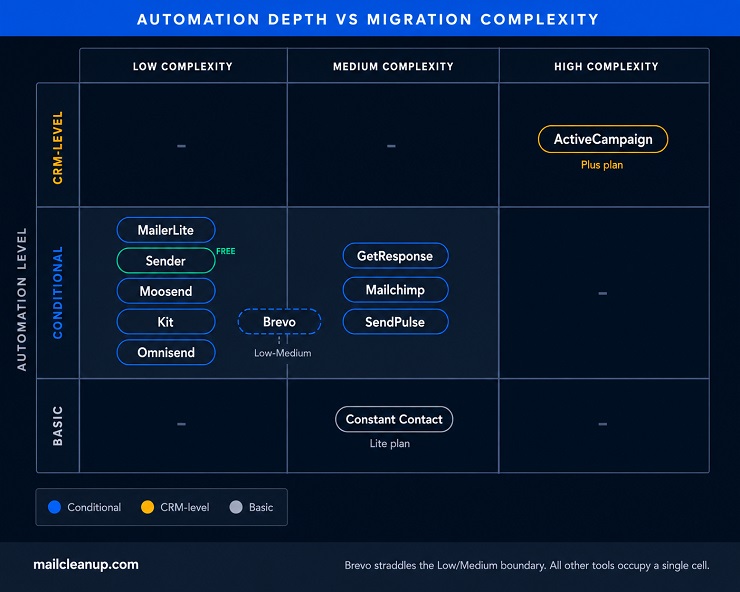
The table below compares all 11 EmailOctopus alternatives across the four Switch Fit Stack dimensions. Automation Level uses three ratings: Basic (time-based drip only), Conditional (if-then branching and behaviour triggers), and CRM-level (lead scoring, pipeline integration, attribution). Sending Scope uses three ratings: Marketing Only, Marketing plus Transactional, and Multichannel. Cost at 1,000 Contacts reflects the entry paid plan at that subscriber tier on monthly billing. Migration Complexity reflects how much rebuild work switching from EmailOctopus requires.
| Tool | Automation Level | Sending Scope | Cost at 1,000 Contacts | Migration Complexity |
|---|---|---|---|---|
| MailerLite | Conditional | Marketing Only | ~$18/mo (Comfort) | Low |
| Brevo | Conditional (Standard) | Marketing + Transactional + SMS | $9/mo Starter (no automation); $18/mo Standard | Low-Medium |
| Moosend | Conditional | Marketing Only | ~$16/mo (Pro) | Low |
| GetResponse | Conditional (Marketer) | Marketing Only | $19/mo Starter (1 workflow); $59/mo Marketer | Medium |
| Sender | Conditional | Marketing + Transactional | $0 (Free Forever covers 1K contacts) | Low |
| Kit | Conditional | Marketing Only | $39/mo monthly; $33/mo annual (Creator) | Low |
| Mailchimp | Multi-step (Standard) | Marketing Only | ~$20/mo Essentials; ~$27/mo Standard | Medium |
| Omnisend | Conditional (ecom flows) | Marketing + SMS on Pro | ~$25/mo (Standard) | Low |
| Constant Contact | Basic (Lite); Multi-step (Standard) | Marketing Only | ~$30/mo Lite; ~$45-50/mo Standard | Medium |
| ActiveCampaign | CRM-level (Plus+) | Marketing Only | $19/mo Starter (5-action limit); $59/mo Plus | High |
| SendPulse | Conditional | Multichannel | ~$12/mo (Standard) | Medium |
- Automation ceiling is the driver: MailerLite (lowest cost entry point with conditional branching), Moosend (behaviour triggers at a comparable price to EmailOctopus), or ActiveCampaign Plus (deepest workflow logic, including CRM integration). Choose based on how complex your sequences need to become.
- Sending scope is the driver: Brevo (marketing plus transactional from one account, volume-based pricing), Sender (transactional included on the free plan), or SendPulse (full multichannel including Telegram, WhatsApp, and Instagram chatbots natively).
- Cost at list size is the driver: Sender (free for up to 2,500 contacts, automation included), SendPulse (~$12/month at 1,000 subscribers, post-March 2026 pricing), or Moosend (~$16/month at 1,000 contacts). If cost alone drives the decision, EmailOctopus’s own Pro plan may still be the cheapest option at small list sizes.
- Migration simplicity is the driver: MailerLite, Sender, or Omnisend (Low complexity, one to two weeks including DNS warmup) over GetResponse or Mailchimp (Medium, two to four weeks) over ActiveCampaign (High, six to eight weeks including CRM configuration and domain warmup). Running email verification on your list before migrating reduces bounce risk on the new infrastructure.
FAQs on EmailOctopus Alternatives
What is the best EmailOctopus alternative for small businesses?
MailerLite is the strongest pick for most small businesses: same simplicity and price range as EmailOctopus but with conditional automation workflows, a landing page builder, and a website builder. Moosend is the closest alternative in price with better automation depth. For users on EmailOctopus’s free plan, Sender matches EmailOctopus on subscriber count at no cost and adds automation that EmailOctopus reserves for paid tiers.
Which EmailOctopus alternatives offer a free plan comparable to EmailOctopus’s free tier?
Sender is the only EmailOctopus alternative that matches EmailOctopus on subscriber count: both cover 2,500 contacts, but Sender provides 15,000 monthly emails versus EmailOctopus’s 10,000 and includes conditional automation on the free plan. Kit covers 10,000 subscribers free but limits users to one automation and applies Kit branding to every email, form, and landing page.
Can any EmailOctopus alternatives send transactional emails alongside marketing campaigns?
Yes. Brevo, Sender, and ActiveCampaign all support transactional email alongside marketing campaigns. Brevo is the most common switch for this use case: transactional sending is included on its Starter plan from $9 per month, with no separation between campaign and system emails. ActiveCampaign routes transactional email through a Postmark integration, billed separately from the main subscription.
Is MailerLite a good alternative to EmailOctopus for automation?
Yes, on a paid plan. MailerLite’s Comfort plan adds conditional branching, multiple triggers, and A/B split steps that EmailOctopus cannot match at any tier. MailerLite reduced its free plan to 250 active subscribers in June 2026, so it is not a free-tier replacement for EmailOctopus’s 2,500-subscriber free plan. It suits users on a paid plan who want conditional automation at a comparable cost.
How difficult is migration when switching to an EmailOctopus alternative?
Migration complexity varies. MailerLite, Sender, and Omnisend are Low complexity: direct list import and guided DNS setup. GetResponse and Mailchimp are Medium: editor differences require template rebuilds. ActiveCampaign is High: automation architecture must be rebuilt from scratch alongside CRM configuration. Plan 4 to 6 weeks for domain warmup on any new sending infrastructure regardless of which EmailOctopus alternative you choose.
What features do EmailOctopus alternatives offer that EmailOctopus does not support?
The three most common gaps are conditional automation (EmailOctopus supports only time-based drip sequences), transactional email capability, and multichannel sending beyond email. Landing pages are included on MailerLite, Moosend, GetResponse, and Kit at comparable price points. Ecommerce integrations for abandoned cart recovery and post-purchase flows, which Omnisend provides natively, are not available on EmailOctopus at any plan tier.
Which EmailOctopus alternative works best for simple newsletter sending?
Sender is the closest equivalent for pure newsletter sending: the same 2,500-subscriber free tier, 15,000 monthly emails versus EmailOctopus’s 10,000, and a comparable drag-and-drop editor. MailerLite is the upgrade path for users wanting a more polished paid-plan interface. Both are simpler to operate than Mailchimp and considerably cheaper than Kit for users who only need broadcast newsletters.
Which EmailOctopus alternative is best for ecommerce brands?
Omnisend is the clearest EmailOctopus alternative for ecommerce, offering pre-built abandoned cart, browse abandonment, and post-purchase automations connected natively to Shopify, WooCommerce, and BigCommerce. The Standard plan costs approximately $25 per month at 1,000 contacts. SMS is now exclusive to the Pro plan for new Omnisend accounts as of May 2026, making the entry price for combined email and SMS campaigns $59 per month.