
Soft bounce vs hard bounce is one of the most overlooked topics in email marketing. Yet, it plays a huge role in email deliverability. Many marketers focus on opens and clicks. They rarely check bounce reports. As a result, inbox placement drops slowly without any clear warning.
Email bounces may look harmless at first. However, when they add up, they can damage your sender reputation. Internet service providers track how often your emails fail to reach real inboxes. If bounce rates stay high, your emails are more likely to land in spam—or not get delivered at all.
This is why understanding different bounce types matters.
In this guide, we’ll explain what bounce emails are and why they happen. We’ll also break down the key differences between soft bounce vs hard bounce with clear examples. Finally, we’ll share simple ways to reduce email bounces and protect your deliverability.
Let’s start with the basics.
What Are Bounce Emails?
Bounce emails are emails that do not reach the recipient’s inbox. Instead of being delivered, they are sent back by the receiving mail server. This usually happens when there is a problem with the email address or the destination server.
In simple terms, if you send an email and it cannot be delivered, that email is called a bounce email.
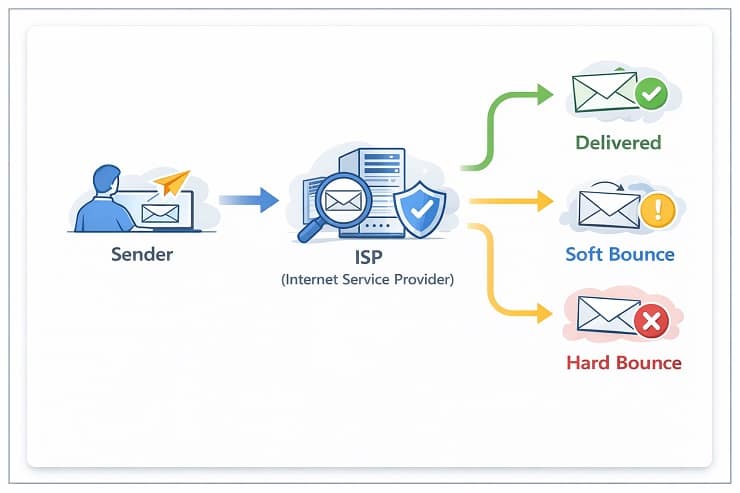
From a technical point of view, an email “bounces” when the receiving email server rejects it. When this happens, the server sends an error message back to the sender. This message explains why the email failed. These messages are often called bounce notifications or bounce reports.
Internet service providers (ISPs) and email servers track these failures closely. They use bounce data to judge the quality of your email list. If too many emails bounce, ISPs may see you as a risky sender. As a result, your email deliverability can suffer.
It’s also important to understand the difference between sent, delivered, and bounced emails. A sent email only means it left your system. A delivered email means it reached the recipient’s mail server. A bounced email means delivery failed completely.
This is why bounce tracking matters when measuring your email bounce rate.
Why Do Emails Bounce Back?
Emails bounce back for many reasons. Some are simple. Others are more technical. Let’s look at the most common ones.
Invalid email addresses are the top cause. This happens when an address does not exist or was typed incorrectly. Sending emails to such addresses almost always leads to a bounce.
Server rejections are another reason. Sometimes, the receiving server refuses your email due to poor sender reputation or strict security rules.
Temporary delivery issues can also cause bounces. For example, the recipient’s mailbox may be full, or their server may be temporarily unavailable.
Finally, spam filtering and policy blocks play a big role. If your email looks suspicious or breaks ISP rules, it may be rejected before it ever reaches the inbox.
Understanding why emails are bouncing back helps you fix problems early and keep your campaigns healthy.
Types of Email Bounces Explained
When it comes to email marketing, not all bounces mean the same thing. This is why understanding the types of email bounces is important. Each bounce sends a different signal to inbox providers. And each one needs a different response from you.
At a high level, email bounces are grouped based on whether the delivery failure is temporary or permanent. Some emails fail only for a short time. Others fail because the address itself is no longer valid. Treating both in the same way can hurt your email deliverability.
This is where many marketers go wrong.
If you ignore bounce types, you may keep sending emails to bad addresses. Over time, this increases your email bounce rate. It also tells ISPs that your list hygiene is poor. As a result, even valid emails may start landing in spam.
On the other hand, when you understand bounce categorization, you can take the right action. You can retry some emails. You can remove others immediately. Most importantly, you protect your sender reputation.
To do this properly, we need to look at the two main bounce categories. These are soft bounces and hard bounces. In the next sections, we’ll compare soft bounce vs hard bounce in detail and explain how each one affects your campaigns.
What Is a Soft Bounce?
A soft bounce in email marketing happens when your email reaches the recipient’s server but cannot be delivered at that moment. The key thing to remember is this: soft bounces are usually temporary.
In most cases, the email address is valid. The problem is with timing or server conditions. Because of this, email servers may try to deliver the message again later.
Soft bounces are common, especially in large campaigns. However, they should still be monitored. If ignored, they can slowly affect your email deliverability.
Here are some common soft bounce scenarios:
- Mailbox full: The recipient’s inbox has no space left. The server rejects new messages until space is cleared.
- Server downtime: The receiving mail server may be offline or under maintenance for a short time.
- Message size too large: If your email or attachment exceeds size limits, the server may reject it.
- Temporary ISP throttling: Internet service providers sometimes slow down or limit incoming emails to control traffic.
In all these cases, the email may go through once the issue is resolved.
Example: Let’s say you send a campaign to 10,000 subscribers. Some emails bounce because a few inboxes are full or the recipient’s mail server is temporarily down. These emails usually get delivered when the server recovers or the inbox clears. This is a typical soft bounce in email marketing.
Should You Worry About Soft Bounces?
In many situations, soft bounces are harmless. If they happen once or twice, there is usually nothing to worry about. Email service providers often retry delivery automatically.
However, repeated soft bounces can become a problem. If the same address keeps bouncing again and again, ISPs may start seeing it as risky. Over time, repeated failures can hurt your sender reputation and increase your overall bounce rate.
This is how ESPs interpret repeated soft bounces. A few temporary failures are normal. But ongoing soft bounces suggest poor list hygiene or delivery issues. When this happens, your emails may face stricter filtering.
This is why it’s important to track soft bounces closely and take action when they don’t resolve on their own.
What Is a Hard Bounce?
A hard bounce in email marketing happens when your email cannot be delivered at all. Unlike soft bounces, hard bounces are permanent failures. This means the email address will never be able to receive your message.
In most cases, hard bounces occur because the destination itself is invalid. No amount of retrying will fix the problem. Because of this, email servers immediately reject the message and send it back.
Common causes of hard bounces include:
- Invalid or non-existent email addresses: The address does not exist, was typed incorrectly, or was never created.
- Deleted mailboxes: The email account once existed but has been removed by the user or the provider.
- Domain does not exist: The domain name after the “@” is invalid or no longer active.
- Blocked sender reputation: If your sender reputation is poor, some servers may block your emails completely.
Hard bounces are a strong signal that your email list contains bad data.
Example: Imagine sending an email to an address like [email protected], but the mailbox no longer exists. The receiving server rejects the message immediately and reports a permanent failure. This is a hard bounce in email marketing and the address should not be contacted again.
Why Hard Bounces Are Dangerous for Deliverability?
Hard bounces have a direct impact on your sender reputation. When ISPs see emails sent to invalid addresses, they assume poor list hygiene. As a result, your trust score drops.
Email service providers closely monitor hard bounce rates. If your hard bounce rate crosses an acceptable bounce rate threshold, ESPs may take action. This can include warning notices, sending limits, or even pausing your account.
In severe cases, high hard bounce rates can lead to blacklisting. Once this happens, even valid emails struggle to reach inboxes. Recovering from this damage takes time and effort.
This is why removing hard bounce emails from your list is not optional. It is a critical part of email deliverability best practices.
Soft Bounce vs Hard Bounce
Understanding soft bounce vs hard bounce makes it much easier to manage email bounces the right way. While both mean your email was not delivered, the reason and impact are very different. This is why you should never treat them the same.
Let’s break it down side by side.
| Factor | Soft Bounce | Hard Bounce |
|---|---|---|
| Definition | A temporary delivery failure | A permanent delivery failure |
| Temporary or Permanent | Temporary issue | Permanent issue |
| Typical Causes | Mailbox full, server downtime, message too large, ISP throttling | Invalid email addresses, deleted mailboxes, non-existent domains, blocked sender |
| Retry Behavior | Email servers may retry delivery | No retries; delivery fails immediately |
| Impact on Sender Reputation | Low impact if occasional | High impact, damages sender reputation |
| Recommended Action | Monitor and retry for a short time | Remove hard bounce emails from your list immediately |
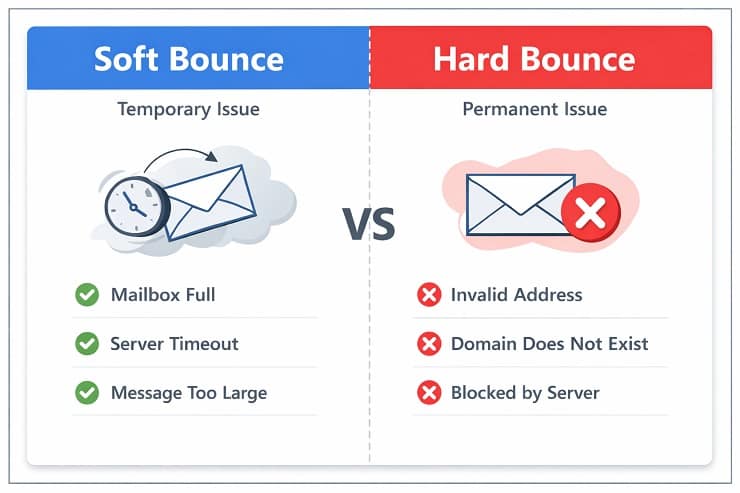
As you can see, the difference between soft and hard bounce in email marketing is clear. Soft bounces usually happen because of temporary conditions. Hard bounces happen because the address itself is bad.
For you as a sender, this difference matters a lot. Soft bounces give you some room to wait and observe. Hard bounces require quick action. If you keep sending emails to hard bounce addresses, your email bounce rate increases fast. Over time, this hurts email deliverability.
This is why smart email bounce management starts with identifying bounce types correctly. Once you do that, you can protect your sender reputation and keep your campaigns healthy.
What Is an Acceptable Email Bounce Rate?
An acceptable email bounce rate is the percentage of emails that fail to reach the inbox without harming your email deliverability. To manage bounce rates correctly, you must understand soft bounce vs hard bounce, because each type has a different risk level.
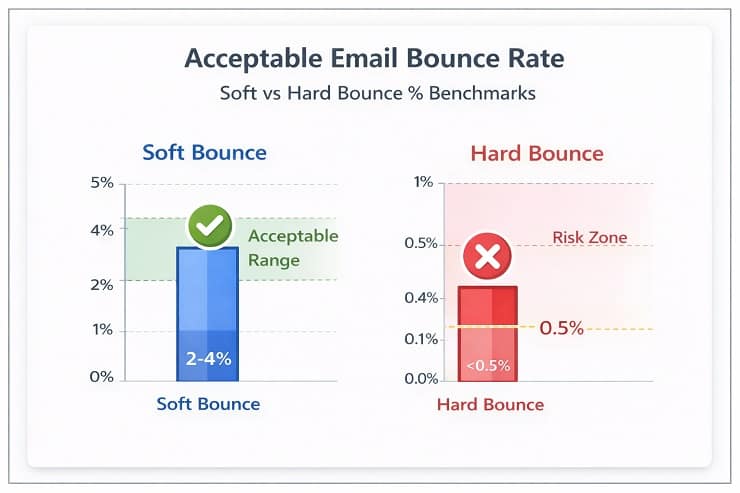
In general, a total email bounce rate below 2% is considered safe. This tells inbox providers that your list is healthy. A bounce rate between 2% and 5% is a warning sign. Anything higher than this crosses the bounce rate threshold and can damage your sender reputation.
When we break this down further, the numbers become clearer.
A soft bounce rate of up to 1%–2% is usually acceptable. Soft bounces often happen due to temporary issues like a full mailbox or a short server outage. When they occur occasionally, they are considered normal and low risk.
A hard bounce rate, however, should stay below 0.5%. Hard bounces usually come from invalid email addresses or non-existent domains. Even a small increase in hard bounces can quickly hurt deliverability and signal poor list hygiene.
Example: If you send 5,000 emails and 150 bounce, your email bounce rate is 3%. If most of these are soft bounces, the issue may be temporary. However, if 40–50 of those are hard bounces, it signals poor list hygiene and can quickly affect your sender reputation.
If your bounce rates remain high over time, it often means your email list is outdated or unmanaged. This is a clear sign that stronger email bounce management and list cleaning practices are needed.
By monitoring both soft and hard bounce rates separately, you can stay within safe limits and protect your campaigns before problems grow.
How Email Bounces Affect Email Deliverability?
Email bounces have a direct impact on email deliverability. Every time an email fails, inbox providers take note. Over time, a high bounce rate makes it harder for your emails to reach the inbox, even when you send to valid contacts.
There is a clear relationship between bounce rate and inbox placement. When too many emails bounce, ISPs assume something is wrong with your sending practices. As a result, your emails may start landing in spam or get blocked completely. This is why understanding soft bounce vs hard bounce is important for long-term deliverability.
Inbox providers evaluate senders based on trust. One of the biggest trust signals is sender reputation. Bounce behavior plays a major role here. Clean lists and low bounce rates help build trust. Poor list hygiene does the opposite.
Several systems work together to judge your emails:
- Sender score: This is a reputation score based on your sending history. High bounce rates can lower your sender score and reduce inbox placement.
- Spam filters: Spam filters look for risky patterns. Frequent bounces, especially from invalid email addresses, increase the chances of filtering.
- SMTP error codes: When emails fail, servers return SMTP error codes. ISPs analyze these errors to understand why emails are bouncing back and whether the failures are temporary or permanent
(SMTP error codes reveal why emails fail and choosing reliable SMTP services can help prevent some delivery issues.) - ESP feedback loops: Email service providers track bounce data and share it with ISPs. Repeated issues can trigger sending limits or warnings from your ESP.
Together, these signals decide where your emails land. By keeping bounce rates low and maintaining good list hygiene, you improve deliverability and protect your sender reputation.
Email Bounce Management Best Practices
Good email bounce management helps you protect your sender reputation and improve email deliverability over time. The goal is simple. Reduce unnecessary bounces and take action before they turn into bigger problems. When you manage bounces properly, inbox providers trust you more.
Let’s look at how you can do that in practice.
How to Reduce Email Bounces?
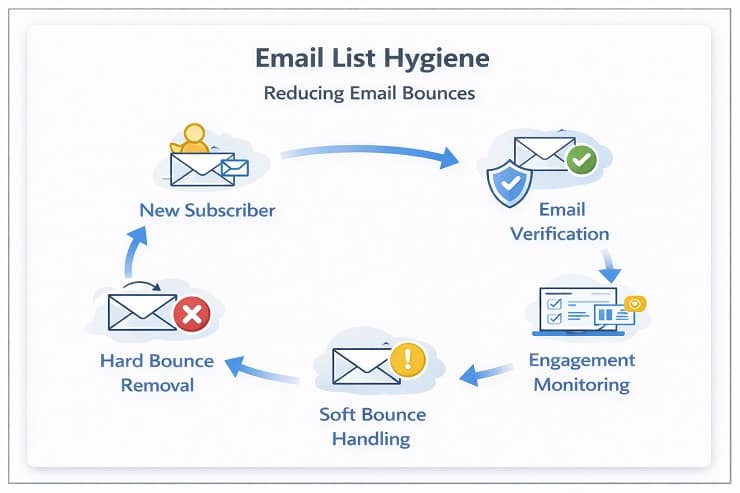
If you want to know how to reduce email bounces, the first step is prevention. Fixing problems early is always easier than repairing deliverability later.
First, avoid purchased or scraped email lists. These lists often contain invalid email addresses. Sending to them almost guarantees hard bounces and poor list hygiene.
Next, use double opt-in whenever possible. This confirms that the email address exists and that the user wants to hear from you. As a result, your list stays cleaner from the start.
You should also monitor bounce reports after every campaign. Bounce data tells you why emails are failing and whether the issue is temporary or permanent. Ignoring these reports can quietly damage your sender reputation.
Finally, segment inactive users. If someone hasn’t engaged with your emails for a long time, they are more likely to bounce later. Reducing sends to inactive contacts helps keep bounce rates under control.
Maintaining strong list hygiene is one of the most effective ways to reduce bounce rates and improve engagement.
How to Fix a High Email Bounce Rate?
Sometimes, bounce rates rise even when you follow best practices. When this happens, you need to act fast. Knowing how to fix a high email bounce rate can prevent long-term deliverability damage.
Start by identifying hard bounces versus soft bounces. This helps you understand which failures are temporary and which ones are permanent. The difference between soft bounce vs hard bounce matters here, because each requires a different response.
Next, remove repeat offenders from your list. Email addresses that bounce again and again are a clear risk. Keeping them only increases future bounce rates.
If you notice a sudden bounce spike, pause your campaigns. Sending more emails during a problem can make things worse. Take time to investigate before resuming.
Lastly, audit your acquisition sources. Check where your email addresses come from. Poor signup sources often lead to invalid addresses and higher bounce rates.
By applying these steps consistently, you improve list hygiene and keep your email campaigns healthy.
How Email Verification Helps Prevent Bounces
Email bounces do not always happen because of bad intent. In most cases, they happen quietly over time. That’s why email verification to reduce bounces plays such an important role in long-term list health.
Let’s break this down in a simple way.
How Invalid Emails Enter Your List
Invalid email addresses can enter your list from many places. For example, users may make typing mistakes during signup. Some people use temporary or disposable emails. Others abandon inboxes they no longer use.
Over time, these addresses turn into hard bounces. Even a good list can slowly degrade if it is not checked regularly. This is why relying only on signups is not enough.
Why Manual Cleanup Isn’t Scalable
You might think manual cleanup can solve the problem. However, it does not scale well. Checking thousands of email addresses one by one is slow and error-prone.
More importantly, manual checks cannot detect deeper issues. You cannot easily identify spam traps, inactive mailboxes, or risky domains. As your list grows, this approach becomes unrealistic and unsafe for email deliverability.
Role of Real-Time and Bulk Email Verification
This is where email verification tools become useful. Real-time verification checks email addresses at the point of entry. It helps block invalid or fake addresses before they enter your list.
Bulk email verification works on existing lists. It scans your contacts and flags invalid email addresses, inactive inboxes, and high-risk entries. As a result, you can clean your list without guessing.
Together, these methods support better list hygiene and reduce future bounce-related issues.
Benefits of Email Verification
Using email verification brings several long-term benefits.
First, it leads to fewer hard bounces. Invalid and non-existent addresses are removed before campaigns are sent.
Second, it helps protect your sender reputation. Internet service providers trust senders who consistently send to valid recipients.
Third, it improves overall email deliverability. More emails reach the inbox instead of getting blocked or filtered.
Finally, it supports cleaner list hygiene. Your list stays fresh, accurate, and engagement-ready.
A Simple Way to Stay Bounce-Free
If you regularly send emails, verification should be part of your workflow. Tools like MailCleanup are designed to help you identify risky addresses and maintain a healthy email list without adding extra effort.
We see email verification as a preventive step, not a quick fix. When you clean your list proactively, you avoid bounce problems before they hurt your campaigns.
In the long run, this small habit makes a big difference.
Should You Remove Hard Bounce Emails Immediately?
Yes, in most cases, you should remove hard bounce emails from your list immediately. This is one of the safest email deliverability best practices, and most email service providers expect you to do this.
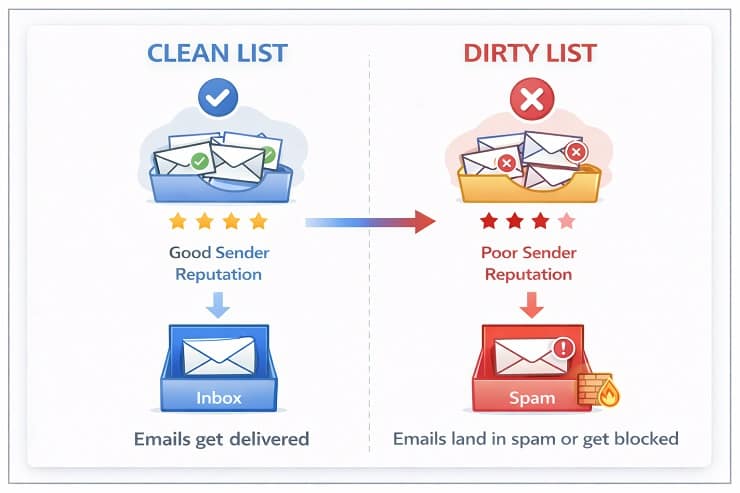
Let’s break it down in a simple way.
Best practices for handling hard bounces
Hard bounces usually mean the email address does not exist. It could be due to invalid email addresses, closed accounts, or typing errors. Because of this, there is no real recovery path.
So, the best approach is clear.
As soon as a hard bounce is recorded, we should suppress that address. We should not try to email it again. This protects your sender reputation and keeps your list hygiene clean.
When we compare soft bounce vs hard bounce, this is the biggest difference. Soft bounces may recover. Hard bounces almost never do.
What ESPs expect from you?
Email service providers closely track how you handle bounces. They expect you to:
- Automatically stop sending to hard bounce addresses
- Keep your bounce rate below the accepted bounce rate threshold
- Maintain clean acquisition and list management practices
If you ignore hard bounces, ESPs may flag your account. Over time, this can limit sending or even lead to account suspension.
Risks of re-sending to hard bounce addresses
Re-sending to hard bounce emails sends a bad signal to ISPs. It tells them you are not managing your list properly.
This can lead to:
- Lower inbox placement
- More emails landing in spam filters
- Damage to your sender score
- Poor email deliverability overall
In short, repeatedly mailing hard bounces makes it harder for your valid emails to reach real people.
Automation tips for bounce suppression
Manual cleanup is risky and slow. Instead, we should rely on automation.
Here’s what works best:
- Enable automatic bounce suppression in your ESP
- Tag or block hard bounces after the first failure
- Use email verification to reduce bounces before sending
- Review SMTP error codes to confirm bounce types
By automating this process, we reduce human error and protect our sending reputation at scale.
In simple terms, removing hard bounce emails right away is not optional. It is a core part of responsible email bounce management. When you do this consistently, your campaigns stay healthier, cleaner, and far more effective.
Final Checklist to Keep Bounce Rates Low
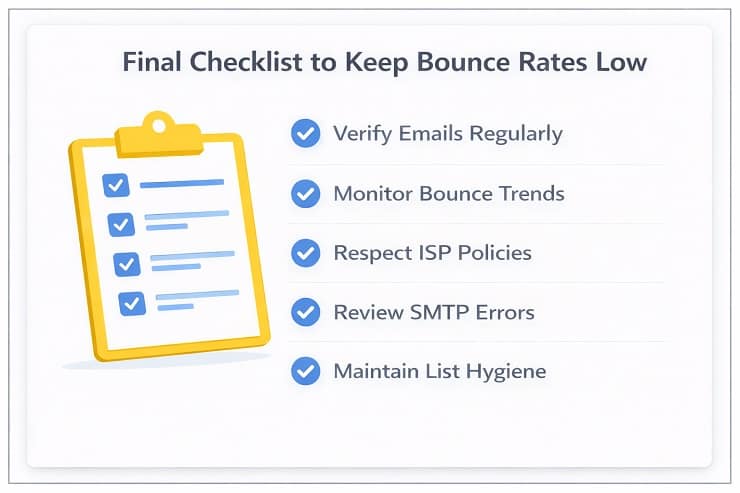
- Verify emails before sending: Always verify your list to catch invalid email addresses early. This simple step supports email bounce management and helps prevent issues related to soft bounce vs hard bounce behavior.
- Monitor bounce trends regularly: Track your bounce data after every campaign. Understanding the email bounce rate meaning helps you stay within the acceptable email bounce rate and spot problems before deliverability drops.
- Respect ISP and ESP policies: ISPs closely watch how you send emails. Ignoring their rules can trigger spam filters, ISP throttling, and long-term damage to your sender reputation.
- Maintain strong list hygiene: Clean your list often by removing inactive users and suppressing repeat offenders. Good list hygiene is one of the most effective email deliverability best practices.
- Review SMTP error codes frequently: Bounce reports and SMTP error codes explain why emails are bouncing back. Reviewing them helps you fix delivery issues like mailbox full errors or blocked servers faster.
FAQs on Soft Bounce vs Hard Bounce
What are bounce emails?
Bounce emails are messages that fail to reach the recipient’s inbox. This usually happens due to invalid email addresses, server issues, or strict ISP rules. Understanding what bounce emails are helps you protect your email deliverability early.
What is the difference between soft bounce and hard bounce?
The main difference between soft bounce vs hard bounce is permanence. A soft bounce is usually temporary, like a mailbox full or server downtime. A hard bounce is permanent and happens when an email address does not exist or the domain is invalid.
Why are my emails bouncing back even with a good ESP?
Even the best email service providers cannot fix poor list quality. Emails are bouncing back when lists contain outdated contacts, typos, or inactive domains. Spam filters and sender reputation also play a big role here.
What is a good or acceptable email bounce rate?
An acceptable email bounce rate is usually below 2%. A hard bounce rate above 0.5% is risky, while higher soft bounce rates may signal temporary issues or weak list hygiene.
Should I remove hard bounce emails from my list?
Yes, you should remove hard bounce emails from your list immediately. Re-sending to these addresses hurts your sender reputation and can lead to ESP warnings or account suspension.
How can I reduce email bounces long term?
To reduce email bounces, focus on strong email bounce management. Use email verification to reduce bounces, monitor SMTP error codes, respect ISP policies, and maintain clean list hygiene over time.
Conclusion: Manage Email Bounces Before They Hurt Deliverability
Email bounces may look like a small technical issue. However, over time, they quietly damage your email deliverability and sender reputation. That is why understanding bounce behavior early matters.
Once you know the difference between soft bounce vs hard bounce, managing them becomes much easier. Soft bounces often fix themselves. Hard bounces do not. Ignoring this difference leads to poor inbox placement and higher risk from ISPs.
The good news is that most bounce-related issues are preventable. Clean lists, strong list hygiene, and regular monitoring can keep your bounce rate within a safe range. These are simple habits, but they make a big difference.
If you want a scalable way to reduce email bounces, email verification plays a key role. It helps remove invalid email addresses before they harm your sender score. Over time, this leads to better inbox placement and more reliable campaign performance.
At the end of the day, email success is not about sending more emails. It is about sending smarter emails to real, reachable people. When you manage bounces correctly, everything else in your email strategy starts to work better.